The Last Male Northern White Rhino Is Gone. Now What?
Nobody was looking at Sudan the way you’d look at the last of something. He was just there, in the red dust of Ol Pejeta, getting older. And then on March 19, 2018, he wasn’t there anymore — and the math suddenly became very simple and very terrible.
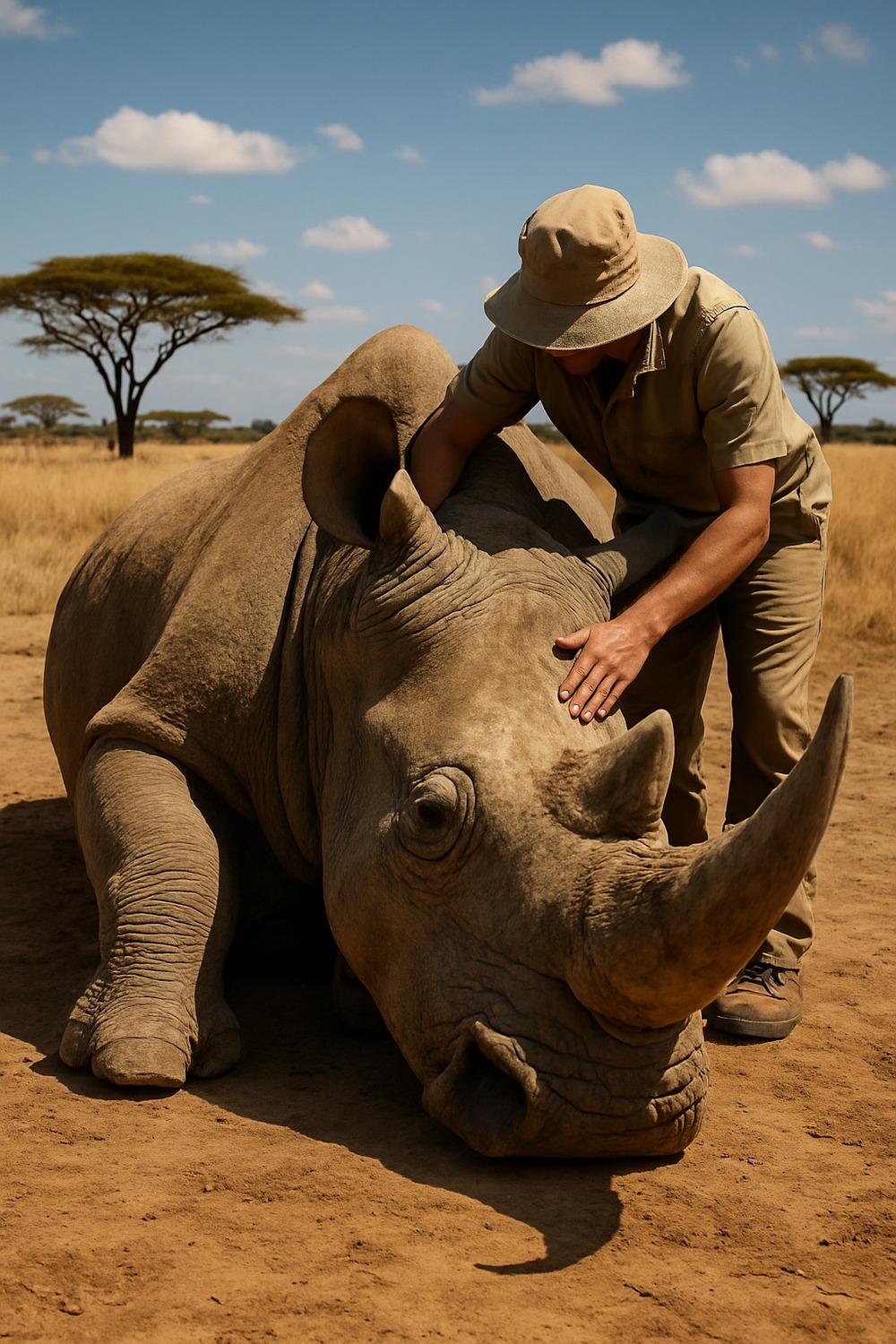
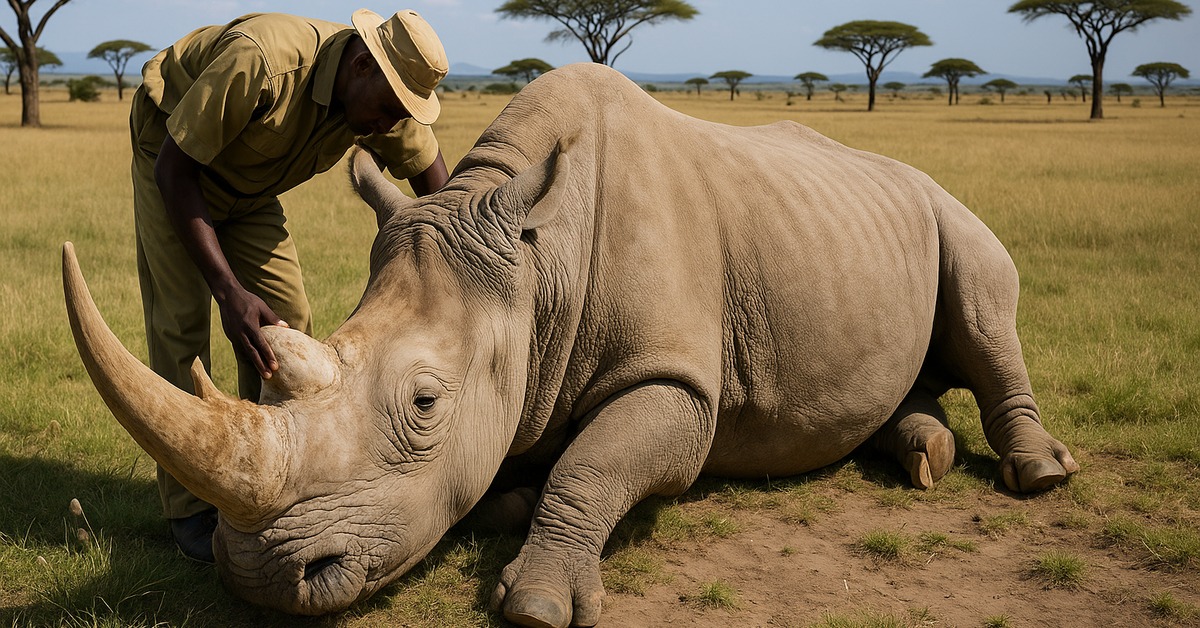
He was 45 years old. A northern white rhino named Sudan, and the rangers who’d guarded him with rifles for years knelt in the dirt beside him as he went. These were men who’d spent years sleeping near him, tracking his movements, watching for poachers. They stroked his rough gray skin while he died. And just like that, a subspecies lost its last male, and something that had survived on this planet for millions of years started its final chapter.
Northern White Rhino Extinction: How We Got Here
The thing that gets me about this story is the speed. The northern white rhino’s collapse didn’t unfold over centuries like some slow geological tragedy — it happened in a single human lifetime. In the 1960s, several thousand still roamed central Africa. By 1980, poaching and habitat destruction had cut that number to a few hundred. By 2015, only three remained alive. Researchers tracking the subspecies documented one of the most dramatic population crashes in recorded history.
How does a creature that survived ice ages get erased in fifty years?
The answer is horn. Rhino horn sells for more than gold in parts of Asia, prized for traditional medicine despite being made of the exact same keratin as your fingernails. Poachers came first, then fences, then farms, then roads. The northern white rhino’s world shrank from vast savanna corridors to nothing. Not gradually. Fast.
Two Survivors Now Guard an Entire Species
Today, two northern white rhinos exist on Earth. Najin, age 35, and her daughter Fatu, age 23. Both female. Both living inside a protected enclosure at Ol Pejeta, with armed rangers rotating watch every hour of every day. They’re not just endangered animals at this point — they’re living archives of something the rest of the world already lost. Scientists and conservationists from around the globe have made their survival the focal point of one of the most ambitious rescue operations in the history of modern science.
There’s footage of Fatu grazing in the late afternoon. She looks completely calm. Ordinary, almost. Just a rhino eating grass. But she’s half the entire living population of her subspecies, and she has no idea.
Science Racing Against a Biological Clock
Here’s where the story gets genuinely strange. Sudan, despite being gone, isn’t entirely out of the picture — because before he died, researchers collected and preserved his sperm. A consortium of scientists from Kenya, Germany, Italy, and the Czech Republic, led by reproductive biologist Thomas Hildebrandt of the Leibniz Institute for Zoo and Wildlife Research, are working to create northern white rhino embryos in the lab. The plan: fertilize eggs harvested from Najin and Fatu with Sudan’s frozen sperm, then implant those embryos into southern white rhino surrogates. It’s never been done before with this subspecies. And the northern white rhino extinction clock doesn’t pause while they figure it out.
There have already been successes worth paying attention to. In 2019, scientists announced they’d created the first northern white rhino embryos in a laboratory — two of them, now sitting frozen in liquid nitrogen. More embryos followed after that. The lab portion works. Getting a surrogate southern white rhino to carry one to term? That’s the wall nobody’s broken through yet.
That last fact kept me reading for another hour.
What Millions of Years of Survival Looks Like Up Close
Rhinos have been on this planet for roughly 50 million years. They outlasted the sabertooth cat. They walked through ice ages and watched entire ecosystems rise and collapse around them. The northern white rhino specifically adapted to the lush savannas and woodlands of central Africa — modern-day Uganda, South Sudan, the Democratic Republic of Congo — grazing in herds that shook the ground when they moved.
Then, within a few decades of sustained human pressure, the herds were gone.
The last known wild population in the DRC was wiped out sometime around 2008. There were no dramatic announcements. No global vigil. It just stopped. The silence where a herd used to be is one of those facts that’s hard to sit with once you’ve read it.
The Frozen Zoo: A Backup Plan for the Planet
Sudan’s death wasn’t the end of his genetic line, because scientists had already been preparing for it. Cryopreserved cells, sperm, and tissue samples from multiple northern white rhinos are stored at facilities including the San Diego Zoo Wildlife Alliance’s Frozen Zoo — a repository holding genetic material from more than 10,000 individual animals across 1,000 species. Researchers like Jeanne Loring of Scripps Research have been exploring whether these preserved cells could be used to create stem cells, and eventually viable eggs and sperm, opening a path that doesn’t depend solely on what Najin and Fatu can provide.
It’s a backup plan for a backup plan.
And the fact that we need one says something pretty loud about where we are. If the embryo-implantation route fails, if Najin and Fatu can’t provide enough viable eggs, the frozen zoo becomes the last door. Science is holding it open with both hands right now.
By the Numbers
- In 1960, an estimated 2,000+ northern white rhinos lived across central Africa — by 2018, that number had reached zero males (WWF, 2018).
- Rhino horn on the black market: up to $60,000 per kilogram. More valuable by weight than cocaine or gold (Save the Rhino International, 2021).
- The San Diego Zoo’s Frozen Zoo holds cryopreserved genetic material from over 10,000 individual animals, making it one of the largest collections of its kind on Earth. The scale of it is hard to visualize until you start reading about what’s actually stored there.
- ~15,000 southern white rhinos in the wild — the closest relatives and potential surrogates. A genuine conservation recovery story, which makes the northern white rhino’s collapse even harder to absorb by comparison.
Field Notes
- In 2017, Sudan was listed on Tinder with the bio “the most eligible bachelor in the world.” People signed up just to swipe right on a rhino. It raised real money and real awareness for northern white rhino conservation efforts — turns out absurdity gets clicks when the cause is real.
- Fatu cannot naturally carry a pregnancy due to degenerative changes in her uterus.
- Which means even if the embryo science works perfectly, she can’t be her own surrogate. Every single step of this rescue requires technology that didn’t exist a decade ago.
- Rhino horn is keratin — same protein as human fingernails and hair. Multiple independent scientific studies have confirmed it has no medicinal properties. Demand continues anyway, driving one of the most destructive black markets in wildlife history.
What We Lose When a Species Disappears Forever
The northern white rhino extinction isn’t just a line item in a conservation report. These animals shaped the ecosystems they lived in — grazing patterns that maintained grassland structure, dung that fertilized soils, behavior that influenced dozens of other species around them. When a megafauna species disappears, it doesn’t just leave a gap in a list somewhere. It leaves a gap in how the world actually functions. Those gaps compound over time in ways that are genuinely hard to predict until the moment you realize they’re irreversible.
Sudan’s death made headlines for maybe two days. Then the news cycle moved on, as it does.
But Najin and Fatu are still out there, breathing Kenyan dust, under armed guard, carrying the entire weight of their lineage. And somewhere in a lab, embryos are frozen in liquid nitrogen, waiting for a surrogate, waiting for the technology to catch up with the urgency. The story isn’t over yet. It’s just in a very strange, very fragile middle.
The question the northern white rhino story leaves you with is one most of us would rather not sit with too long: what else is slipping away right now, while we’re looking somewhere else? Species don’t usually vanish with fanfare. They go quietly, one by one, until someone does the math and realizes the number has hit zero. Sudan mattered. Najin and Fatu matter. And the science racing to pull this back from the edge might matter more than most people realize. More stories like this one live at this-amazing-world.com — and some of them are even stranger than this.