The Helmet That Kept Knights Alive — And Nearly Killed Them
It is 1346. You are somewhere outside Calais, inside eleven months of siege, and the only thing between your face and a lance tip is an elongated iron snout — angled just enough to send the blow somewhere else. That angle is the whole story.
The hounskull bascinet helmet weighed 2.2 kilograms and sat directly on a human skull mid-battle. Medieval Europe produced a lot of brutal engineering, but few pieces of armor compress so much calculated desperation into a single shape. A helmet built to look like a dog’s muzzle, worn by knights who could barely see, hear, or breathe inside their own protection, designed by men who understood that survival is a geometry problem. It deserves more than a museum placard.
The Hounskull Bascinet Helmet’s Strange, Brilliant Shape
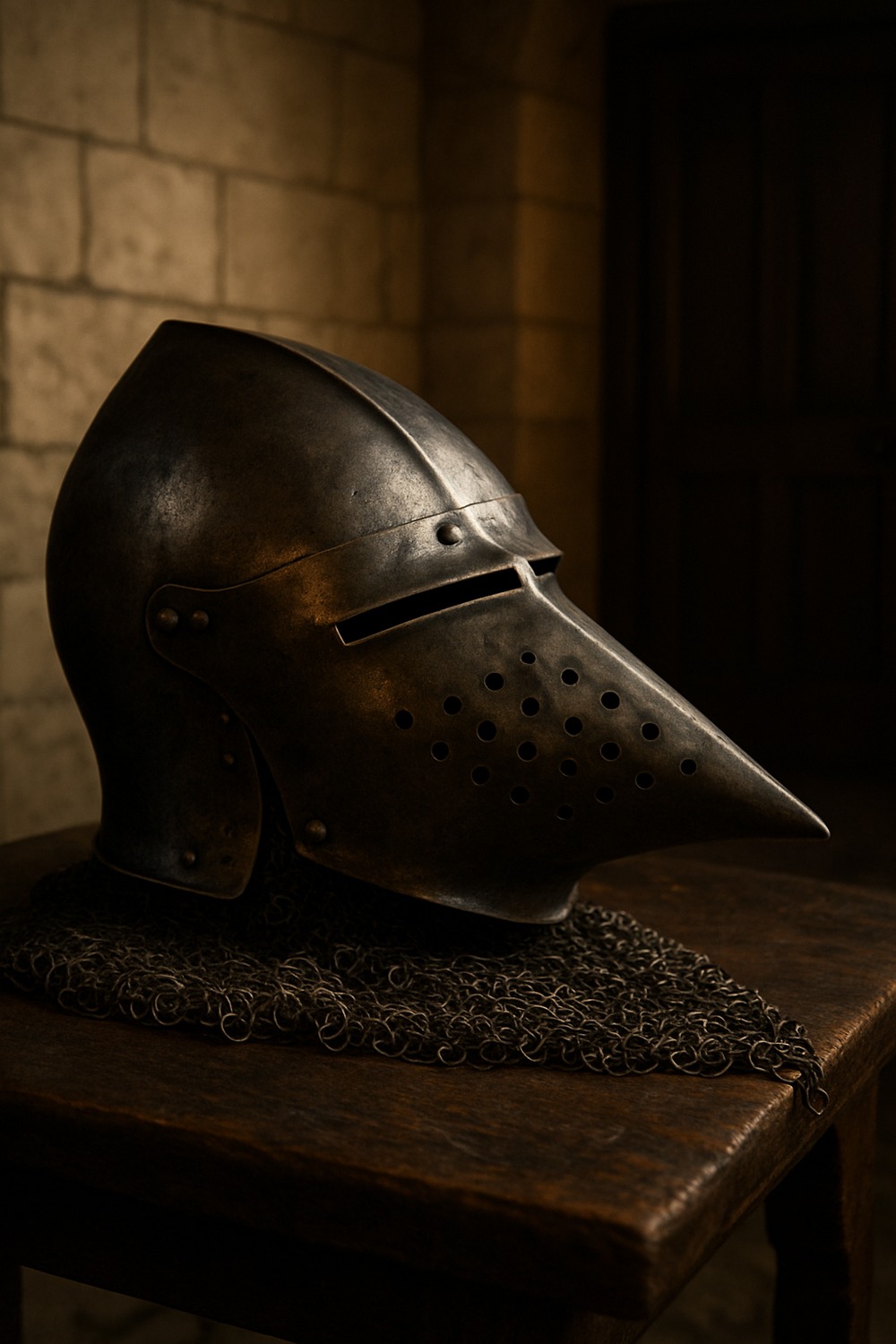
The visor’s pointed snout wasn’t aesthetic. It was applied physics with a body count attached.
As documented across medieval arms scholarship, the angled surface was designed to deflect lance tips and sword strikes away from the wearer’s face rather than absorbing impact head-on. A flat surface stops a blow. An angled one redirects it. That difference, measured in degrees of steel, separated a fractured skull from a near miss. Knights weren’t just wearing armor — they were wearing mathematics. Every degree of that snout was a calculated answer to the question: what happens when something very fast hits something very hard? The answer, hammered into the steel itself, was: it goes somewhere else.
Which sounds obvious, until you try to forge that shape by hand over an open fire in the 14th century.
Those Tiny Holes Weren’t Decorative — They Saved Lives
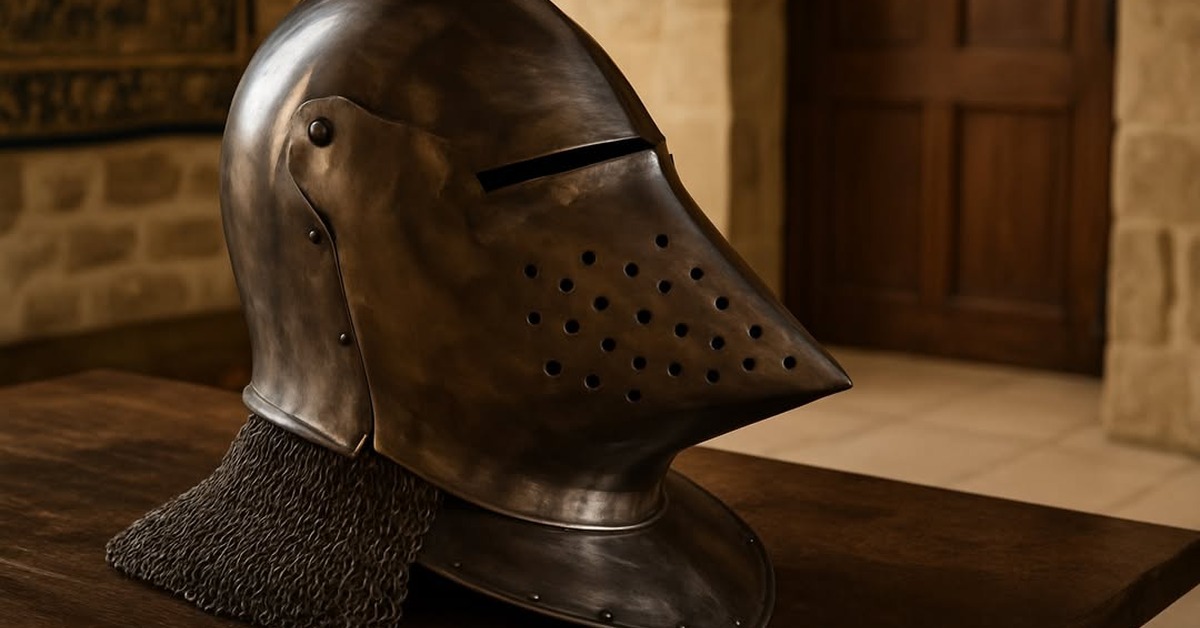
Run your finger along the visor of a replica hounskull bascinet and you’ll feel rows of small punched perforations lining the snout. A replica displayed at Tryon Palace in North Carolina gives modern visitors a tactile sense of what medieval knights actually carried into battle — and those holes are one of the first things people notice.
At the Siege of Calais in 1346–47, knights wore full armor through months of summer campaigning. Without ventilation, heat exhaustion ended careers — and lives — before any enemy got close. The perforations weren’t an afterthought. They were the helmet admitting something important: you could engineer perfect deflection geometry and still lose a man to suffocation. The human body inside the armor was fragile in ways that had nothing to do with swords.
Survival is always more complicated than it looks.
Vision Reduced to a Thumb’s Width of War
Here’s where it gets genuinely unsettling. The visor slit — the narrow horizontal gap through which a knight saw the entire world during combat — was roughly the width of a human thumb. That’s it. Peripheral vision: gone. Depth perception: badly compromised. Hearing: muffled through layers of steel. Smell: whatever recycled air had been sitting inside the helmet since the last time those perforations caught a breeze.
Medieval knights trained for years to fight inside this sensory deprivation. They learned to read a battlefield through a strip of chaos, trusted their horses and peripheral instincts when their eyes literally couldn’t cover the angles. That’s not bravery in the abstract.
That’s bravery as a practiced, technical skill. There’s a difference.
What It Felt Like to Actually Wear One
2.2 kilograms doesn’t sound like much — until it’s balanced on your skull for hours. Scholars who study medieval military history note that total armor weight could reach 15 to 25 kilograms, with the helmet contributing constant pressure on the cervical spine. The hounskull bascinet’s weight distribution was actually considered relatively well-engineered for its era, the load sitting closer to the skull’s center of gravity than earlier designs allowed.
Well-engineered doesn’t mean comfortable.
Visitors who’ve handled the Tryon Palace piece describe a shift in understanding — an almost physical empathy for the men who strapped these things on and walked toward other men with swords. It stops being history. It becomes weight in your hands, and then something harder to name.
The Siege of Calais Changed How Knights Thought About Armor
Eleven months. English forces under Edward III blockaded Calais from September 1346 to August 1347 — knights in full armor, including bascinets like the hounskull, enduring seasons of weather, disease, and grinding attrition. The ventilation problem became impossible to ignore at that scale, across that duration. It stopped being an edge case and started being a pattern.
What followed wasn’t a rejection of the hounskull design. It was refinement. Armourers studied what worked, what failed, what got men killed in ways the enemy didn’t intend. Perforations got more precise. Visor mechanisms improved. The lesson of Calais wasn’t that armor was the problem. It was that armor had to evolve as fast as the threats it faced — including the threat of the armor itself.
And that’s exactly what happened.
The Engineering Was More Advanced Than It Looks
Forging a hounskull bascinet visor wasn’t a matter of hammering iron into a point and calling it finished. The snout shape required armourers to work steel into compound curves without modern machinery — heating, hammering, shaping, cooling, reheating, repeating. Researchers studying surviving examples from European museum collections have identified subtle regional variations in construction technique, suggesting different armourer schools developed distinct approaches to the same engineering problem.
Each helmet is, in a sense, a fingerprint of its maker.
The rivets holding visor to skull cap had to be strong enough to survive combat impact but loose enough that the visor could still swing up — essential for eating, drinking, catching breath during breaks in fighting. Get that balance wrong and a knight was either vulnerable or dangerously inconvenienced. At the wrong moment, both could be fatal. That last detail kept me reading about this for another hour — the idea that the mechanism letting you eat your dinner was the same one that could get you killed.
By the Numbers
- The Siege of Calais lasted 340 days (1346–47) — one of the longest sieges of the Hundred Years’ War, long enough that ventilation failures in armor shifted from inconvenience to documented tactical concern.
- Total plate armor: 15–25 kg. The hounskull bascinet alone was roughly 8–15% of that.
- The visor slit on surviving examples measures as narrow as 10–15mm in height — less than the width of a standard pencil. That gap was the knight’s entire forward view in battle.
- A skilled armourer could spend 40–100 hours on a single high-quality bascinet. One helmet. Possibly one of the most labor-intensive objects a medieval person could own.
Field Notes
- The name “hounskull” — also written “houndskull” — derives from the German Hundsgugel, meaning “dog’s hood.” Medieval observers apparently took one look at the snout-shaped visor and named it immediately, which suggests the resemblance was pretty hard to miss.
- Crude repairs, mid-campaign.
- Some surviving bascinets show evidence of field repair work — crude patches, re-riveted sections — suggesting these helmets were fixed on campaign rather than discarded, which makes sense when you consider that a single bascinet could represent months of a soldier’s income.
- The angled deflection principle built into the hounskull visor isn’t just history. It’s now standard in motorcycle helmets, hard hats, and modern protective headgear design worldwide — the same physics, better materials.
Why This Helmet Still Has Something to Teach Us
The hounskull bascinet helmet is a 700-year-old answer to a question that hasn’t gone away: how do you keep a human being alive in an environment built to kill them? Medieval armourers didn’t have materials science or biomechanical engineering as disciplines. They had fire, hammers, failure, and the feedback loop of men returning from battles with injuries that told them exactly what needed fixing. They iterated. They refined. They built better — not because they had better tools, but because they paid close attention to what the failures were telling them.
That process — observe, fail, adjust, repeat — is the same one behind every piece of protective technology we have now. Motorcycle helmets. Surgical masks. Space suits. The hounskull bascinet is early evidence that human beings have always refused to accept that dangerous environments get the final word.
Pick up a replica. Feel the weight settle onto your skull. Try to see the room through that narrow visor slit. The men who wore these into battle stop being distant historical figures and become something more specific: engineers working in iron, problem-solvers in steel, people who looked at a genuinely terrible situation and asked what angle gives us a chance. That impulse hasn’t changed at all. We’ve just got better materials.
The hounskull bascinet survived centuries because the problem it solved was real and the solution was honest. No excess. No flourish. Just physics, applied by hand, in the heat of a forge, by someone who understood that lives depended on getting the angle right — and who had probably seen what happened when someone got it wrong. That story matters because the instinct behind it is still running. If this kind of history keeps you up at night, there’s more waiting at this-amazing-world.com. The next one is stranger.