The Last Two: Earth’s Final Northern White Rhinos
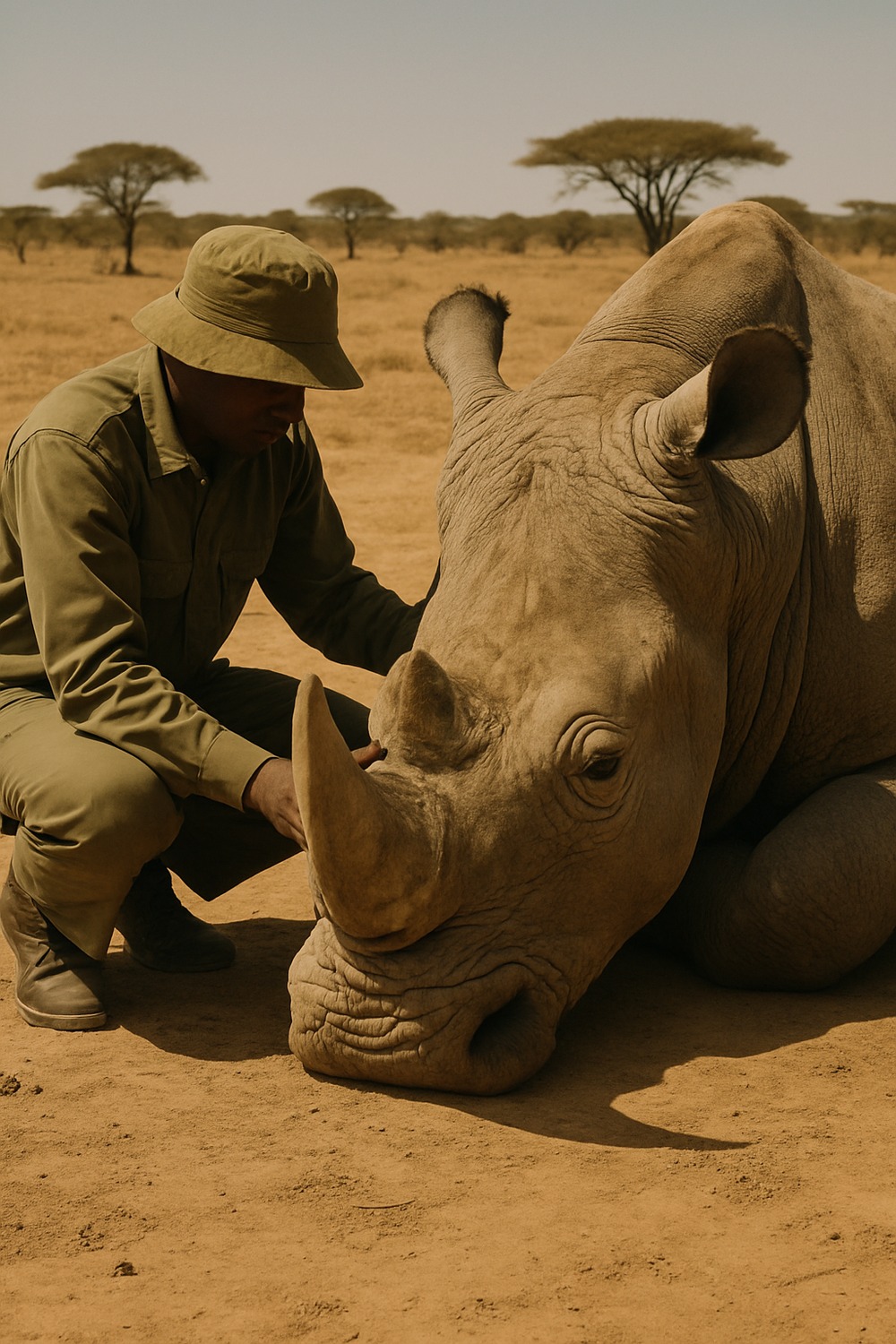
March 19, 2018. A 45-year-old rhino named Sudan lies down in the grass at Ol Pejeta Conservancy in Kenya — and doesn’t get back up. Two females are left. Armed guards now watch them sleep.
Sudan was arthritic. He was tired. The rangers who’d spent years keeping him alive recognized what it meant when he went down. He was the last male northern white rhino on Earth, and when he died, a species didn’t technically go extinct — it just lost every natural path back. What came after is one of the strangest scientific rescue operations anyone has attempted, and as of right now, it still isn’t finished.
How northern white rhino extinction became unstoppable
They once roamed across Uganda, Chad, Sudan, the Central African Republic, and the Democratic Republic of Congo. Tens of thousands of them, at their peak. By 1984, poaching had hammered that number down to around 15. Researchers tracking the subspecies watched it happen in real time — rhino horn was fetching more per kilogram than gold on the black market, and the political instability across the region made meaningful protection nearly impossible.
By 2015, there were three animals left from a lineage that had been on this planet for millions of years.
That’s not a decline. That’s a collapse. Poachers weren’t just killing rhinos — they were erasing an evolutionary chapter that survived the Ice Age, outlasted the woolly mammoth, and persisted through the fall of entire civilizations. Humans managed to undo all of that in fewer than 50 years. For a horn made of keratin. The same material as a fingernail.
Two Animals Left, Guarded Around the Clock
Najin is in her thirties. Her daughter Fatu is in her twenties. They live at Ol Pejeta Conservancy — a 90,000-acre wildlife sanctuary in central Kenya — and they are almost certainly the most closely watched animals on Earth right now. Rangers carry AK-47s and rotate shifts. Cameras, tripwires, around-the-clock presence. The annual cost of protecting them runs into the millions, and everyone involved understands what losing either one actually means. If you want to read more stories that live at this edge, this-amazing-world.com covers the cases most people never hear about.
Here’s the part that really stops you cold: neither female can give birth naturally. Fatu can’t carry a pregnancy at all. Najin’s hind legs are too weak to bear the weight. The species hasn’t just been reduced to two animals — it’s lost the biological capacity to save itself through any normal means. The only option left is a laboratory in Italy and a team of scientists who refuse to declare it over.
The Lab Is the Last Habitat for This Species
The BioRescue consortium — researchers from Kenya, Germany, Italy, and the Czech Republic — has spent years harvesting eggs from Najin and Fatu and fertilizing them with Sudan’s preserved sperm. As of early 2024, they’ve created multiple viable northern white rhino embryos, which are sitting frozen in Cremona, Italy, waiting. The plan is to implant them into southern white rhino surrogates, using closely related animals as living incubators for a subspecies those surrogates have never shared territory with. It has never been successfully completed in rhinos. The entire northern white rhino extinction timeline now hinges on whether it can be.
The margins involved are brutal. Every egg retrieval requires anesthesia — genuinely risky for animals Najin and Fatu’s age. Every fertilization attempt has a limited window. Every embryo transfer into a surrogate could simply fail, with no clear explanation and no easy retry. And even a successful birth doesn’t save anything on its own — you’d need dozens of calves across multiple generations before the math starts to look survivable.
The team keeps going anyway.
They Survived Everything Except Us
Northern white rhinos walked alongside sabertooth cats. They made it through the Pleistocene ice ages — glacial periods that buried entire continents and rewrote the map of the world. They survived catastrophic eruptions, centuries of drought, the rise and fall of civilizations they had no awareness of. They were here before agriculture. Before cities. Before anyone thought to write anything down.
And we knew what was happening. Conservationists were raising alarms in the 1970s. The population crash was visible and documented. Protections were implemented, then ignored, then reinstated at a point when it no longer mattered in the wild.
That last detail kept me reading about this for another hour. Not the extinction itself — the part where the warnings existed and the response came anyway, just slightly too late.
Sudan Became a Symbol — And That Changed Something
Turns out, putting a name on an animal changes how people respond to it. In 2017, Sudan was listed on Tinder — a fundraising campaign that went globally viral and raised over $9 million for BioRescue in a single month. Strange, funny, and somehow genuinely sad: a 45-year-old arthritic rhino with a dating profile that read “I’m one of a kind.” The campaign worked not because anyone found it scientifically convincing, but because it made one specific animal feel real to people who’d never encountered the subspecies before. When Sudan died the following year, major newspapers around the world ran actual obituaries.
That public grief, however brief, is part of what funds the science. BioRescue doesn’t run on goodwill. It runs on research grants and donations, many of which spiked sharply after Sudan died. Grief, it turns out, can function as a conservation tool. The open question is whether it sustains long enough to matter.
By the Numbers
- Around 2,000+ northern white rhinos lived across central Africa in 1960. By 2015: 3. (WWF, 2023)
- Rhino horn sells for up to $65,000 per kilogram on the black market — more by weight than gold, cocaine, or platinum
- At least 30 northern white rhino embryos created in the BioRescue lab by early 2024, which makes it the largest frozen genetic library assembled for any critically endangered megafauna
- Southern white rhinos, the closest living relatives, currently number around 20,000 — a direct demonstration of what protection and political will can do when applied before the cliff edge
Field Notes
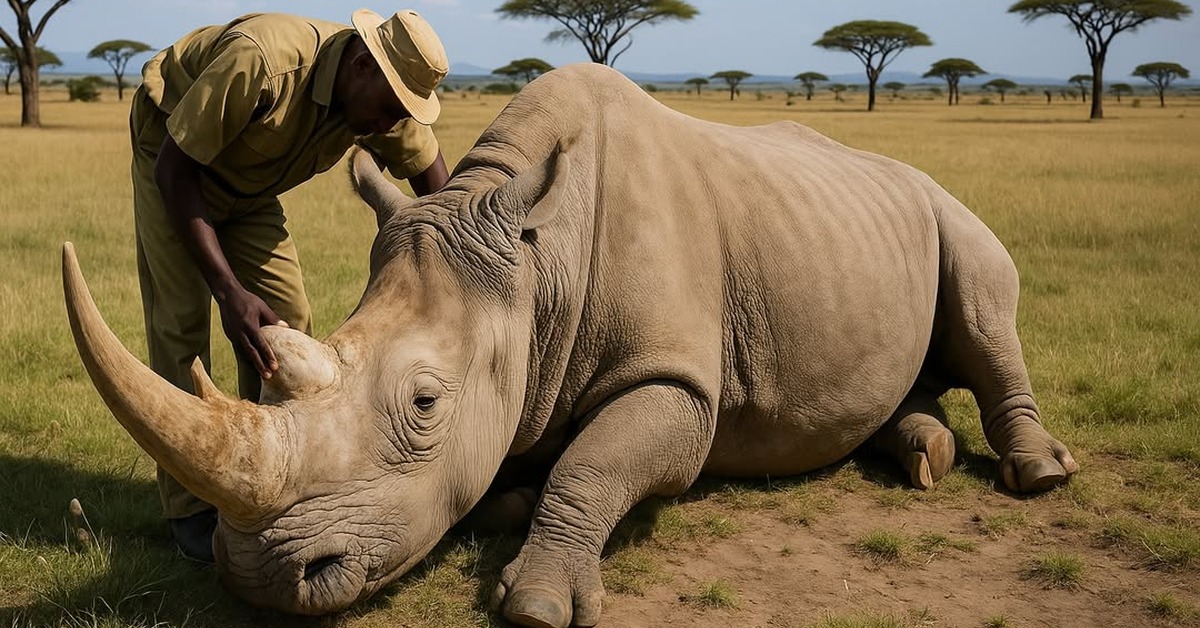
- Fatu and Najin recognize their keepers by voice — they respond differently to familiar rangers than to strangers, and the Ol Pejeta team uses this to minimize stress during veterinary procedures.
- Technically a subspecies, not a separate species. But northern whites have diverged from southern whites significantly enough that scientists treat them as functionally distinct — unique behavioral and physiological traits that crossbreeding simply can’t replicate.
- The first successful embryo transfer in a white rhino surrogate was completed in 2023. Southern white embryo into a southern white surrogate — a proof-of-concept step, essentially — before attempting it with the northern white embryos.
What We Lose When a Species Goes Silent
The northern white rhino extinction isn’t only a conservation failure. It’s a data loss — millions of years of immune responses, behavioral knowledge, and ecological relationships, all of it permanently inaccessible the moment the last animal dies. Rhinos are ecosystem engineers. Their grazing patterns shape grassland structure, creating habitat conditions for smaller animals that depend on those spaces. Their disappearance doesn’t stay local. It ripples outward for decades in ways that are genuinely hard to model in advance.
We don’t fully understand what we’re dismantling until the dismantling is done. By then the question isn’t what could have been done differently. It’s what else is currently disappearing without anyone paying attention yet.
Najin and Fatu are alive right now. There are people with rifles making sure of that. There are scientists in Cremona working through every remaining option. The outcome isn’t written. But the window is narrow, and every year without a surrogate calf makes the arithmetic harder to argue with.
Two animals. Forty-five years of accumulated loss. A team that won’t let the story close without a fight. Whether the science works or not, what’s happening at Ol Pejeta sits at an edge we’ve never actually stood at before — a species kept from extinction by frozen embryos, preserved sperm, and the stubbornness of researchers who understand exactly what the silence would mean. It shouldn’t have come to this. But it did. There’s more at this-amazing-world.com — and the next one is stranger than this.