Australia’s Wrap-Around Spider: The Master of Bark Disguise
Most camouflage is a costume. The wrap-around spider — Dolophones conifera, tucked into the eucalyptus forests of eastern Australia — skips the costume entirely and rewrites the physics of being seen. It doesn’t change color. It doesn’t hide under debris. It presses its concave abdomen against a tree trunk and becomes, by every visual measure that matters to a hungry bird, an unremarkable patch of bark. Dawn light falls across it and finds nothing to catch on.
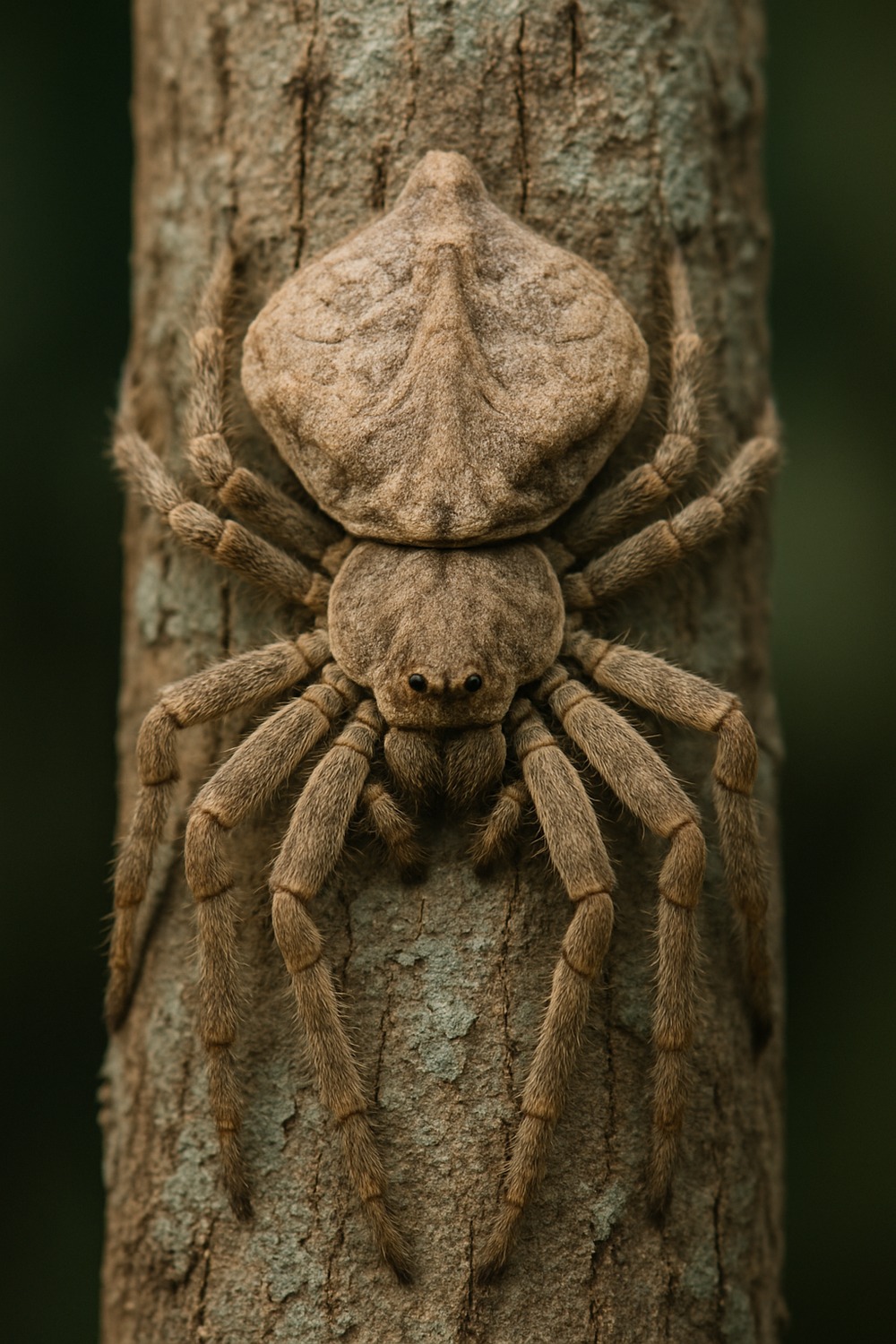
A Body Built for Disappearing
Here’s the thing about the wrap-around spider’s camouflage — it’s not really about color. Color is part of it, sure. The dorsal surface runs a complex mosaic of browns, grays, and ochres that mirrors lichen-speckled eucalyptus bark with accuracy that feels almost unfair. But the real trick is structural. Unlike most spiders, whose abdomens bulge outward in that familiar rounded shape, Dolophones conifera has a concave underside — a scooped, dish-like surface (researchers actually call this a “flattened profile morphology”) that lets it physically conform to the curve of a branch or trunk. When it presses down and draws those legs flat along its flanks, there are no protruding limbs catching morning light. No edges to cast shadows. The spider doesn’t just match the bark. It merges with it.
And that shadow thing matters more than it sounds. Birds hunting by sight don’t just look for color — they look for the telltale shadow that a three-dimensional object throws against a flat surface. It’s how avian visual processing works: shape, contrast, depth. The wrap-around spider’s flattened profile eliminates that shadow almost entirely.
What you get isn’t camouflage as costume. It’s camouflage as physics — a manipulation of the way light falls and fails. Evolution spent millions of years sculpting this animal into something that looks less like a living creature and more like a feature of the landscape. Which, honestly, is a little unsettling when you think about it too long.
The Nighttime Hunter
When darkness arrives, something changes. The motionless disc of bark-colored legs suddenly unfurls. Dolophones conifera belongs to Araneidae — the orb-weavers — and it builds delicate, wheel-shaped webs to intercept moths and flies drawn toward the night. It feeds fast, wraps prey in silk with practiced efficiency, then consumes it. Its eight eyes aren’t exceptional by arachnid standards, but they’re well-adapted to low-light conditions, helping it read vibrations across the web’s silk geometry. By the time the eastern sky starts to pale, the web is often already gone — the spider has eaten it, recycling the proteins in the silk, and has resumed its flattened position against the bark. Ready to be invisible again.
What I find genuinely strange about this dual existence is the precision it requires. The spider’s shift between states — daytime ghost, nighttime predator — isn’t random. It’s regulated by circadian rhythms and light cues, and biologists have observed that even on overcast days, the spider holds its concealment posture until actual darkness arrives. This suggests a calibrated sensitivity to ambient light that goes beyond simple reflex. There’s something almost disciplined about it. Every moment spent exposed is, in the brutal arithmetic of evolutionary biology, a moment where the math could tip fatally toward the predator. Turns out this spider has internalized that calculation with a rigor most organisms never manage.
The Unanswered Question
Why this specific solution? Other tree-dwelling spiders flatten themselves against bark without developing a dramatically concave abdomen. Some use posture alone, others use silk retreats, others pile debris on their backs. The wrap-around spider’s approach is anatomically expensive — a significantly modified body plan that required real evolutionary investment across countless generations.
Was it the specific predator community in Australian eucalyptus forests? The particular curvature and texture of the trees themselves? Some combination of ecological pressures unique to this corner of the Southern Hemisphere? Researchers have proposed hypotheses, but the fossil record for small soft-bodied spiders is notoriously poor (fossilized spider abdomens barely exist, which makes paleontologists visibly miserable), and definitive answers remain out of reach. The question just sits there, open, which is either frustrating or fascinating depending on your temperament.
A body plan this specialized, arrived at this precisely — that’s not accident. That’s a very long argument with a very specific environment.
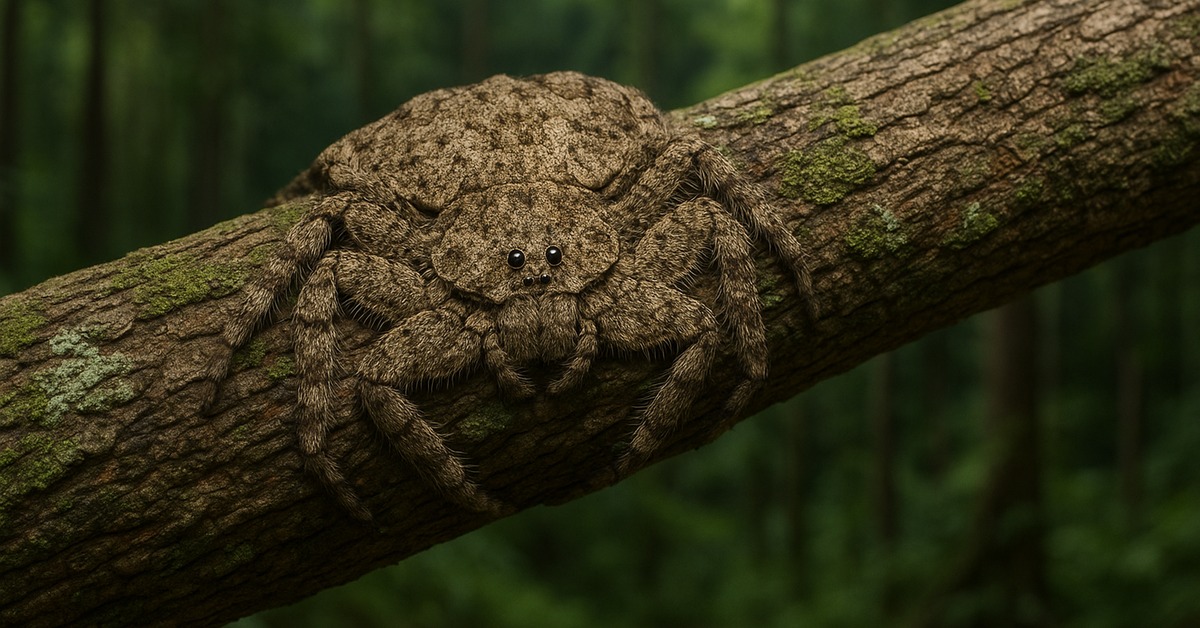
Lessons Written in Silk and Shadow
Engineers working in biomimicry — the field of lifting design solutions from biology — have flagged the wrap-around spider’s camouflage system as a legitimate model for tactical concealment technology. The problem military researchers keep running into is exactly what the spider has already solved: a three-dimensional object pressed against a flat surface still throws a shadow, and that shadow gives it away. A material that could dynamically conform to its background and suppress that shadow profile, the way Dolophones conifera‘s body does against bark, would be a genuine advance.
Researchers in materials science and adaptive optics have started exploring flexible, texture-mimicking surfaces partly inspired by organisms like this one. Translating biological elegance into something manufacturable is still a formidable problem, but the spider’s design keeps coming up as a reference point. Every time it does, I think about how long this solution has been sitting in the Australian bush, working perfectly, while human engineers are only now catching up to the question it answered.
How It Unfolded
- 1793 — First formal arachnological records from eastern Australia begin appearing in European natural history literature, though Dolophones species remain largely unnamed for decades.
- 1869 — Tamerlan Thorell describes early Dolophones specimens, establishing the genus within Araneidae and noting the unusual abdominal morphology.
- Late 20th century — Field researchers in Queensland and New South Wales begin documenting the spider’s daytime bark-flattening behavior in systematic wildlife surveys, linking posture directly to predator avoidance.
- 2010s–present — Biomimicry and materials science communities reference Dolophones conifera‘s flattened profile morphology in published research on adaptive camouflage surfaces and shadow-suppression technology.
By the Numbers
- ~18–22 mm — typical body length of an adult female Dolophones conifera
- 0 mm — effective shadow depth cast when fully flattened against bark (below avian detection threshold)
- Millions of years — estimated evolutionary timeline for the concave abdomen morphology to reach its current form
- 1 night — typical lifespan of a single orb web before the spider consumes and recycles it
- 8 — number of eyes, configured for low-light sensitivity rather than acute daylight resolution
Field Notes
- Dolophones conifera is one of approximately 17 recognized species within the Dolophones genus, all native to the Australasian region.
- Web construction typically begins within the first hour after full darkness — the spider appears to use ambient light thresholds rather than an internal clock alone.
- The concave underside functions as more than camouflage: it may also reduce the spider’s silhouette against the sky when viewed from below by ground predators.
- Silk recycling — eating the web before dawn — is common in orb-weavers, but the wrap-around spider’s behavior is among the most consistently documented examples of this in Australian species.
- Learn more about orb-weaver biology at the Araneidae Wikipedia page, or explore related Australian arachnids on this site’s Australian wildlife section.
FAQ
- Where does the wrap-around spider live? Eastern Australia, primarily in eucalyptus woodland and forest from Queensland down through New South Wales. It strongly favors rough-barked tree species whose texture closely matches its own dorsal patterning.
- Is it dangerous to humans? No. Dolophones conifera is non-aggressive and its venom presents no meaningful threat to people. It would rather stay invisible than interact with anything large.
- How does it build its web if it spends all day motionless? Construction happens at night, fast. The spider emerges at darkness, engineers the web, hunts through the night hours, then dismantles and eats the structure before dawn returns.
- Can I find one if I go looking? In theory, yes — if you’re in the right habitat. In practice, the camouflage is good enough that most people walk past dozens without registering them. Searching at night with a headlamp, before the web comes down, is the most reliable method.
- What does it eat? Moths and small flying insects that blunder into the web are the primary prey. Like most orb-weavers, it wraps catches quickly and feeds at intervals through the night.
Editor’s Take — Alex Morgan
What keeps pulling me back to this spider isn’t the camouflage itself — it’s the economy of it. No moving parts, no metabolic cost at rest, no complex behavior required. Just a body shape that makes light behave differently. I’ve read enough biomimicry literature to know that human engineers dream about this kind of solution: passive, structural, zero-maintenance. And there it is, pressed against a tree in Queensland, doing it every single morning. The spider doesn’t know it’s extraordinary. That might be the most extraordinary thing about it.
What stays with me, after a week spent reading about this animal, is how thoroughly it dismantles certain assumptions. We tend to associate sophisticated strategy with large brains, complex social structures, some evidence of learning. Here is a creature with a nervous system small enough to fit on a pinhead, running a daily camouflage routine so precise it consistently defeats the sharpest avian eyesight in one of the world’s most biologically competitive environments. No conscious planning. No learning curve. Just the accumulated problem-solving of evolution encoded into anatomy and behavior, pressed flat against a eucalyptus trunk in the Australian dawn, waiting for the world to look somewhere else.