


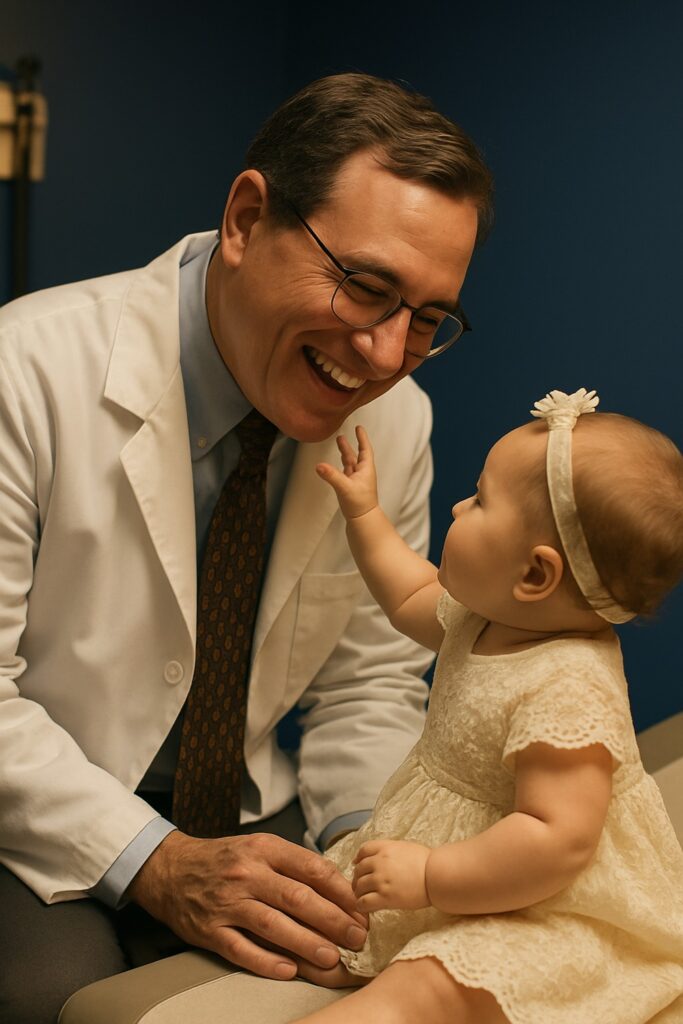
The scan was supposed to be routine. It was 16 weeks in, and what the doctors found instead was a tumor already competing with a heart the size of a walnut.
Her name is Lynlee Hope. Born in Lewisville, Texas — technically twice. The first time, she weighed 1 pound 3 ounces and her heart faltered on the table. The second time, she arrived healthy, crying, and pink. What happened between those two moments is the kind of thing that makes you question where exactly the boundary sits between medicine and something harder to name.
The Fetal Surgery Tumor That Threatened Everything
At 16 weeks pregnant, Margaret Hawkins Boemer went in for what should have been an unremarkable scan. Instead, doctors at Texas Children’s Fetal Center found a sacrococcygeal teratoma — a tumor growing at the base of her unborn daughter’s spine. Dr. Darrell Cass, one of the lead surgeons on the case, explained that the tumor was pulling blood from the baby’s body faster than her tiny heart could compensate. Think of it like a second passenger demanding more than the engine can supply. Without surgery, cardiac failure wasn’t a possibility. It was a trajectory.
Margaret was also grieving. This pregnancy had started as twins. She’d already lost one baby. And now the surviving daughter had a tumor growing at her base, roughly the size of Margaret’s own fist. The decision waiting for her was one medicine can describe but can’t soften.
How Doctors Operate on a Baby Not Yet Born
Fetal surgery isn’t science fiction — but it’s close enough to feel that way. Texas Children’s Fetal Center is one of a very small number of institutions in the world equipped for procedures this complex, with coordinated teams spanning fetal cardiology, maternal-fetal medicine, and neonatal surgery. You can read about other moments where humans have pushed past what seemed survivable at this-amazing-world.com, but this one has a particular quality to it.
At 23 weeks gestation, the team moved. Surgeons partially delivered Lynlee from the womb — just her lower body — while keeping her attached to the placenta, which remained her only life support. The exposure lasted minutes. Each second outside the uterus compounded risk. They removed the bulk of the tumor, intervened when her heart began to fail, and then returned her — carefully, precisely — to the womb to keep developing.
That last part is the part I kept turning over for another hour after I first read it. They put her back.
What Happened When Her Heart Nearly Stopped
Mid-surgery, Lynlee’s heart began to fail.
A pediatric cardiologist stepped in immediately, working on a patient weighing just over a pound — roughly comparable to a small apple, if that analogy helps, though it probably doesn’t. They stabilized her. Then the surgical team closed the uterus, and the two of them — mother and daughter — were left to do what the situation required: keep going.
Margaret spent the following 12 weeks on strict bed rest. Twelve weeks of monitoring, waiting, and trusting that the procedure had done what it was supposed to do. Week by week, Lynlee grew.
Then came the moment the whole team had been holding their breath for.

The Second Birthday Nobody Forgets
At nearly full term, Lynlee was delivered by C-section. Her family came to call it her second birthday. She weighed 5 pounds 5 ounces. Breathing. Crying. A week later, surgeons removed the remaining tumor tissue in a follow-up procedure. And then, for the first time since that 16-week scan changed everything, Margaret Boemer took her daughter home.
Worth pausing on what that second birth actually represented. Lynlee’s life wasn’t saved in a NICU. It wasn’t saved at birth. It was saved inside the womb, during a surgery most hospitals in the world don’t perform. The first birth was intervention. The second was completion.
Sacrococcygeal teratomas like Lynlee’s are classified as dangerous not primarily because they’re malignant — the majority found before birth are benign — but because of what they do to circulation. The tumor constructs its own vascular network and diverts blood away from the organs that need it most. It steals, essentially, and keeps stealing as it grows. A fetal heart can only compensate for so long before the math stops working in its favor.
By the Numbers
- Sacrococcygeal teratoma occurs in roughly 1 in 30,000 to 70,000 live births — making Lynlee’s case rare even within the category of rare pediatric diagnoses.
- Girls are affected three to four times more often than boys. Researchers still don’t have a clean explanation for why.
- 23 weeks gestation — near the absolute floor of fetal viability, which most guidelines set somewhere between 22 and 24 weeks.
- Texas Children’s Fetal Center has performed over 1,000 fetal interventions since its founding, which places it among the most experienced programs of its kind in the Western Hemisphere — and that experience is precisely what makes cases like Lynlee’s possible rather than theoretical.

Field Notes
- Some documented sacrococcygeal teratomas exceed the size of the infant’s head by delivery.
- The procedure performed on Lynlee — open fetal surgery — is categorically different from minimally invasive fetal interventions. It requires opening the uterus itself, which carries a significant risk of preterm labor. The mother’s recovery is as physically demanding as the baby’s, a fact that tends to get underreported in the coverage of these cases.
- Post-removal monitoring is non-negotiable.
- In rare cases, a tumor that’s benign at birth can develop malignant characteristics later in childhood — which means Lynlee’s story, as extraordinary as it already is, still has chapters being written.
Why Lynlee’s Story Changes What’s Possible
The broader significance of this fetal surgery tumor case isn’t confined to one family’s outcome. It’s a proof of concept with clinical implications. It establishes — not in theory but in an actual documented case — that a surgical team can operate on a fetus at 23 weeks, stabilize a failing heart mid-procedure, return the baby to the uterus, and have that baby survive to term. Each time that succeeds, the playbook expands for every family that comes after.
And those families exist. Roughly 1 in every 30,000 to 70,000 pregnancies will produce a diagnosis like this one. Those parents will sit in an exam room and hear terminology they have no framework for. They’ll be handed statistics, options, timelines. What happened at Texas Children’s means that for some of them, the list of options now includes something that, not long ago, wasn’t on the list at all.
Lynlee Hope is home. She has two birthdays. She has a mother who spent 12 weeks largely motionless so her daughter could grow. She has a surgical team who worked on a heart smaller than a fingertip and held steady when it faltered. Medicine doesn’t always look like a cure — sometimes it looks like this: a fetus returned to the womb at 23 weeks, one pound three ounces, given another chance to finish what she started. For more stories that sit at the edges of what medicine can do, there’s more at this-amazing-world.com.


