


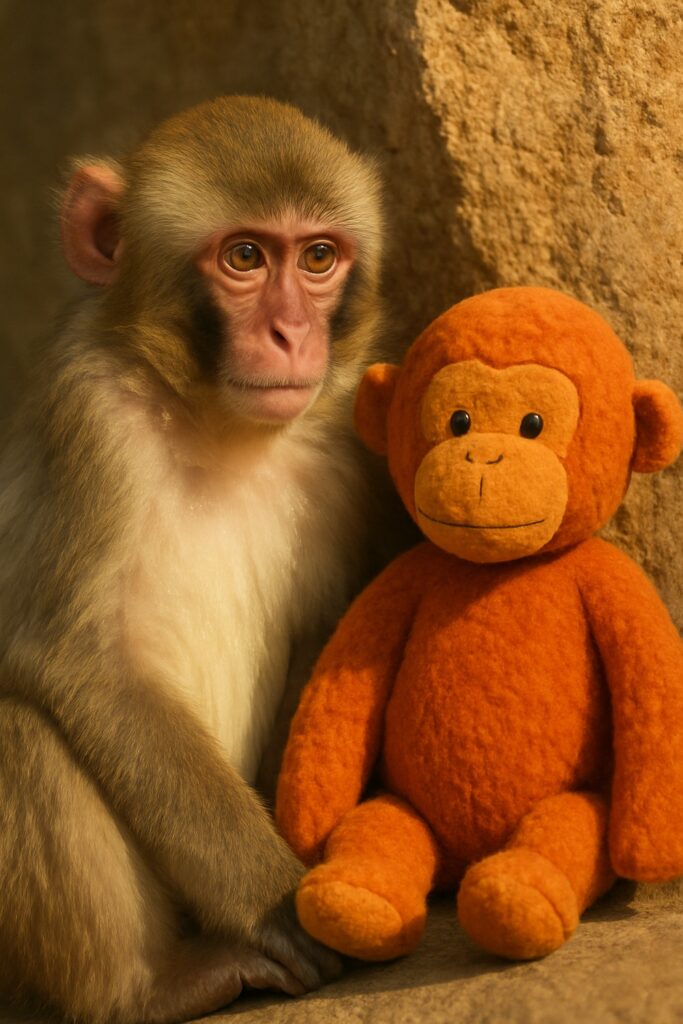
Nobody photographed Punch because they thought it would matter. He was six days old, curled inside a green basket, pressed against a plush orangutan nearly as big as he was — and it just looked like a cute picture.
It turned out to be the beginning of something researchers don’t get to document very often. Punch is a macaque, small and bright-eyed, born into a social world that makes office politics look gentle. And from day six of his life, he had one constant: a stuffed orangutan that wasn’t his mother, wasn’t his species, and wasn’t alive. He didn’t care about any of that. He held on anyway.
Why This Baby Monkey Stuffed Toy Changed Everything
Attachment behavior in young primates has been studied for decades — most famously by psychologist Harry Harlow, whose experiments in the 1950s showed that infant monkeys deprived of their mothers would cling desperately to soft surrogate objects, even when choosing between softness and food. So what Punch is doing isn’t random or especially surprising in isolation. It’s a deeply wired survival response. What makes his case different is the duration, and what it’s meant for his actual daily life inside a real, complicated social group.
Because comfort isn’t just for emergencies. It’s a baseline. When the world feels unpredictable — and monkey society is nothing if not unpredictable — having one constant thing can make everything else navigable. Punch found that constant on day six.
Growing Up Monkey Is Harder Than It Looks
Primate social structures are complex, political, and sometimes brutal. Young macaques have to learn the rules fast: who to groom, who to avoid, where they rank, how to read a signal that could mean the difference between acceptance and a bite. For a baby navigating all of that from scratch, stress levels can spike hard and fast. Researchers who’ve studied animal social behavior note that early comfort objects can act almost like a stress-regulation tool — keeping young animals calm enough to actually learn social skills, rather than freeze up completely when something goes wrong.
Think about what that actually means for Punch. The stuffed orangutan wasn’t just something soft to drag around. It was helping him function. Every time things got overwhelming — a bigger monkey got too close, a new face appeared, an interaction went sideways — he had something to hold. Literally.
That last detail kept me reading about this for another hour.
What Science Says About Baby Monkey Comfort Behavior
Primates separated early from their mothers show a strikingly consistent pattern. They seek out something warm, soft, and yielding. In Harlow’s original research, infant rhesus monkeys chose a cloth “mother” over a wire one that provided milk, spending up to 18 hours a day clinging to the soft surrogate. The baby monkey stuffed toy phenomenon isn’t unique to Punch, but his case is unusual because there’s photographic continuity — the same toy, the same animal, months apart. It’s a visual timeline of attachment that researchers rarely get handed to them this cleanly.
And there’s one detail that keeps nagging at me. The toy Punch latched onto is an orangutan. A different species entirely. He didn’t reach for something that looked like him. He just reached for something safe.
Which is maybe the whole point.
The Moment That Makes This Story Hit Differently
Punch wasn’t just a lonely monkey with a toy. He was actively trying to integrate into his troop — testing relationships, getting things wrong, learning the ropes through trial and a lot of error. And through all of it, the stuffed orangutan came with him. Other monkeys in his group noticed. Some were curious. Some couldn’t have cared less. But Punch never dropped it to seem more normal, never left it behind when he was trying to impress somebody bigger.
He didn’t abandon his comfort object to fit in. He brought it with him into the social world he was trying to build.
That kind of loyalty to your own needs, under that kind of social pressure? That’s not nothing.

Here’s the Thing About First Bonds Running Deep
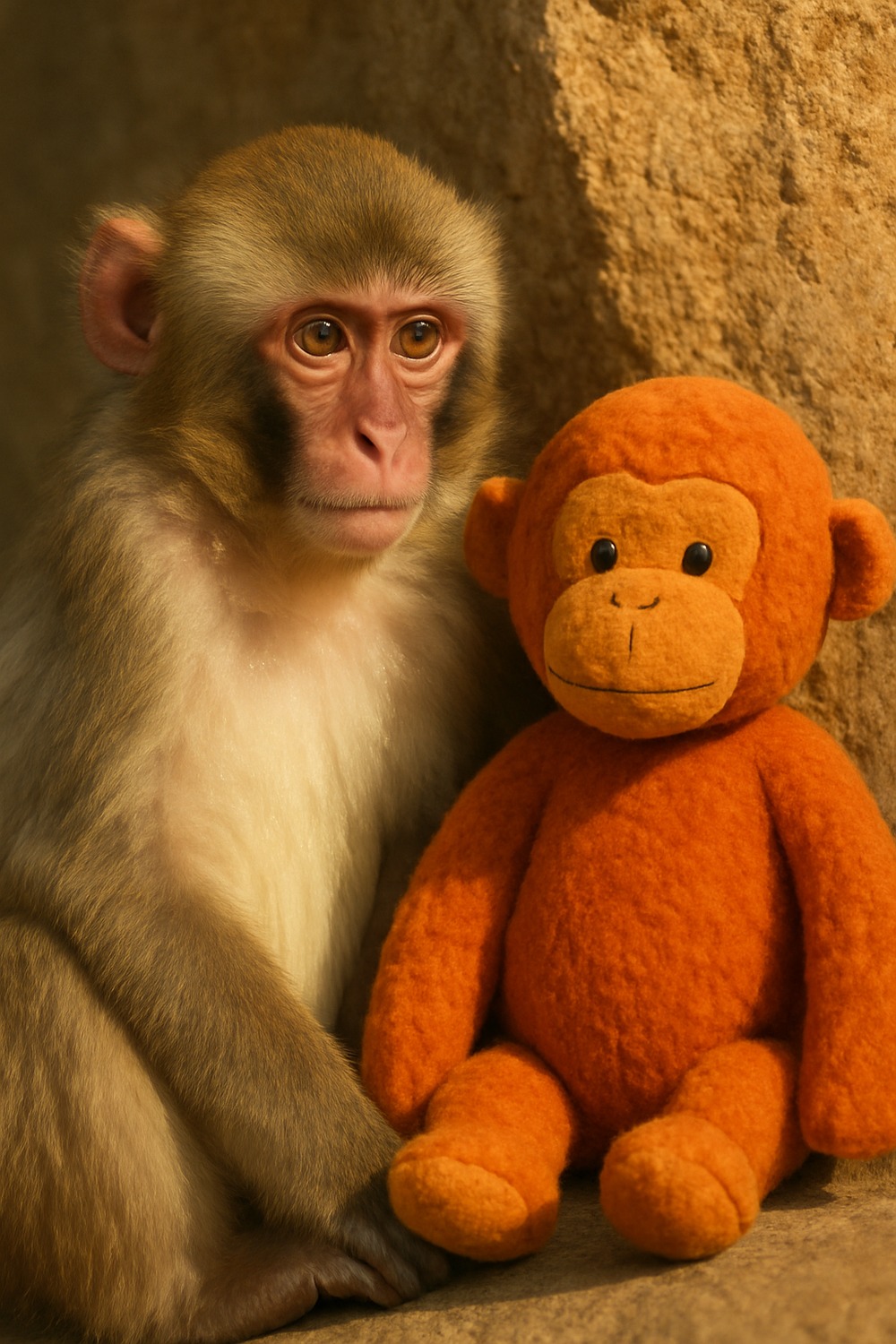
The science of early attachment isn’t just a primate story. It’s a mammal story, and in a lot of ways, a human one. Psychologists studying childhood object attachment — what researchers call “transitional objects” — have found that the bonds formed in the first weeks of life set a template for how an individual manages stress, uncertainty, and connection for years afterward. That plush orangutan became Punch’s transitional object in the truest sense of the phrase. A bridge between helplessness and confidence. Between isolation and something that feels like belonging.
Turns out it didn’t matter that the orangutan wasn’t alive, wasn’t his mother, wasn’t even the right species. What mattered was that it was there. Consistently. Without any social demands attached. And for a young primate learning the exhausting complexity of group life, that kind of unconditional presence is genuinely irreplaceable.
The open question — the one researchers haven’t answered yet — is whether Punch’s deep attachment to this toy changes how he eventually bonds with actual members of his troop. Does having a reliable comfort object make social integration easier? Or does it give him a kind of safety exit that delays full investment in real relationships?
Nobody knows yet. But they’re watching.
By the Numbers
- In Harlow’s 1958 studies, infant rhesus macaques spent up to 18 hours per day clinging to soft cloth surrogates — compared to just 1-2 hours with wire surrogates that actually provided food.
- Around 60% of human infants develop attachment to a specific comfort object between 6 and 12 months of age.
- Macaque troops can range from 10 to over 200 individuals — Punch isn’t navigating a small group. He’s navigating a whole political system, from birth.
- Cortisol levels in isolated infant monkeys can spike to 3-4 times normal within 30 minutes of caregiver separation. Soft surrogates measurably reduce that spike — not eliminate it, but reduce it enough to matter.

Field Notes
- Young macaques start reading social hierarchy signals within their first few weeks — which adults to approach, which to avoid entirely.
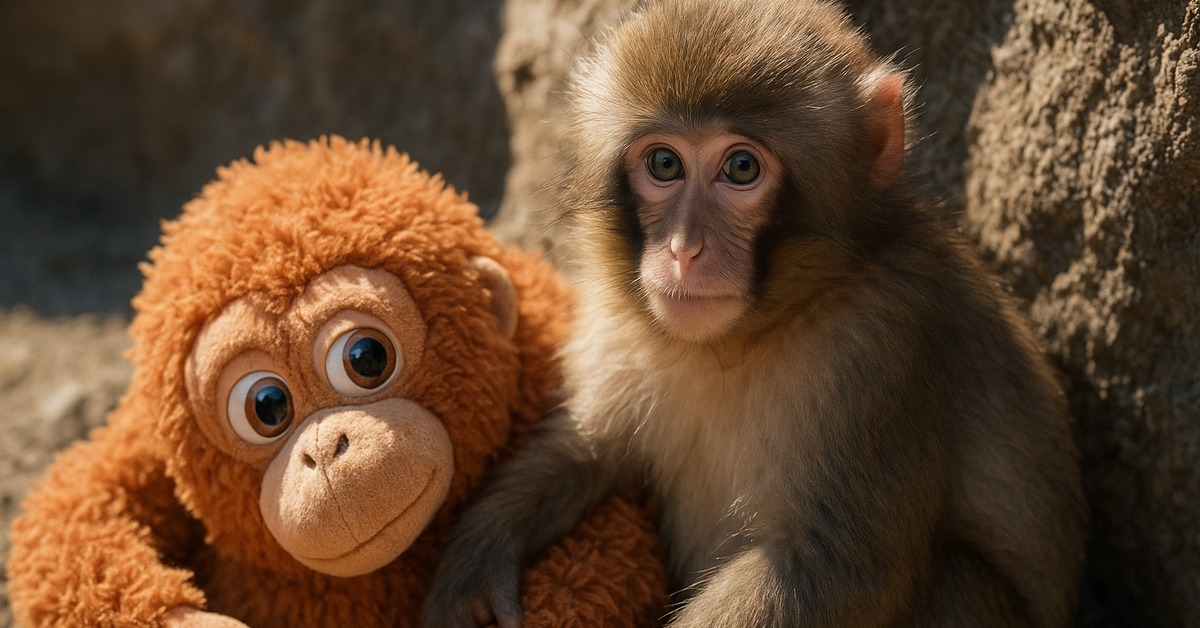
- Most people assume comfort objects are a human thing. Zoo primatologists have documented dozens of cases where captive-born macaques, baboons, and chimpanzees spontaneously adopted soft objects as surrogates when maternal contact was limited. It’s not rare. It’s just rarely photographed well enough to follow over time.
- Punch’s attachment didn’t fade as he grew more capable. It deepened as social pressures increased.
Why One Small Monkey’s Story Matters to All of Us
Punch is still young. Still figuring out his troop, still building friendships, still carrying that worn plush orangutan through the complicated daily business of being a social animal. What his story gives us is a rare, documented window into something researchers usually only theorize about — the way early comfort shapes long-term resilience. The baby monkey stuffed toy isn’t a cute detail on the side of a bigger story. It is the story. It’s evidence that first bonds leave real marks, and that what we reach for in our most vulnerable moments tells the truth about what we actually need.
Think about the objects you still have from childhood. The worn blanket folded in a drawer. The stuffed animal you kept when you got rid of everything else. There’s a reason those things survive all the moves and purges and grown-up rationalizations. They were there when the world was new and overwhelming.
That means something. Even for a macaque who doesn’t know that’s what it means.
Punch is building real friendships now — slowly, cautiously, on his own terms. But he’s doing it with his plush orangutan still in hand. And honestly, that might be exactly right. Comfort isn’t weakness. It’s infrastructure. It’s how you stay regulated enough to show up for everything else. There’s more at this-amazing-world.com — and the next one is even stranger.


