



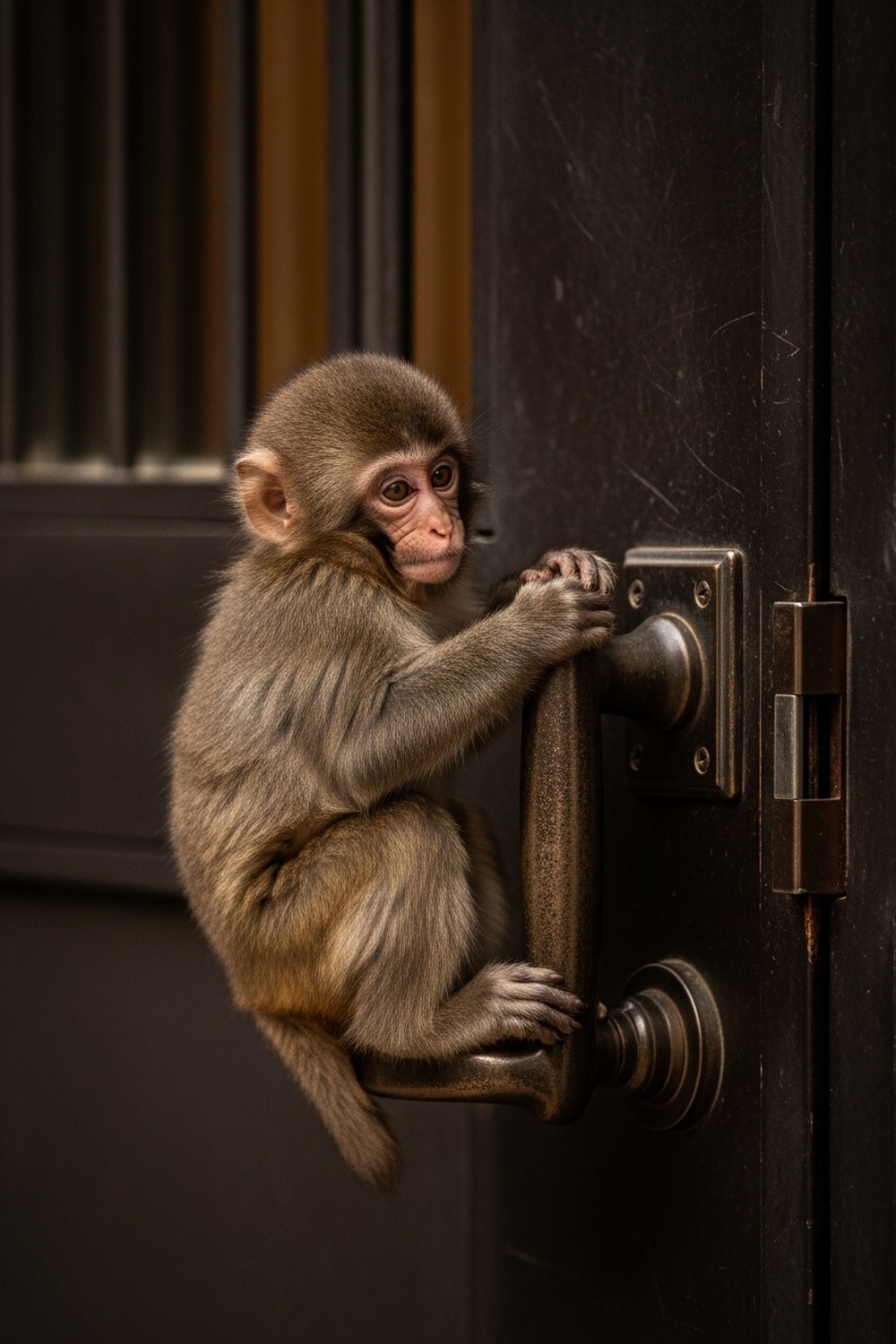
Nobody was watching the door. That’s how a juvenile Japanese macaque at Ichikawa Zoo got both hands around a doorknob and nearly solved the problem nobody thought he’d find.
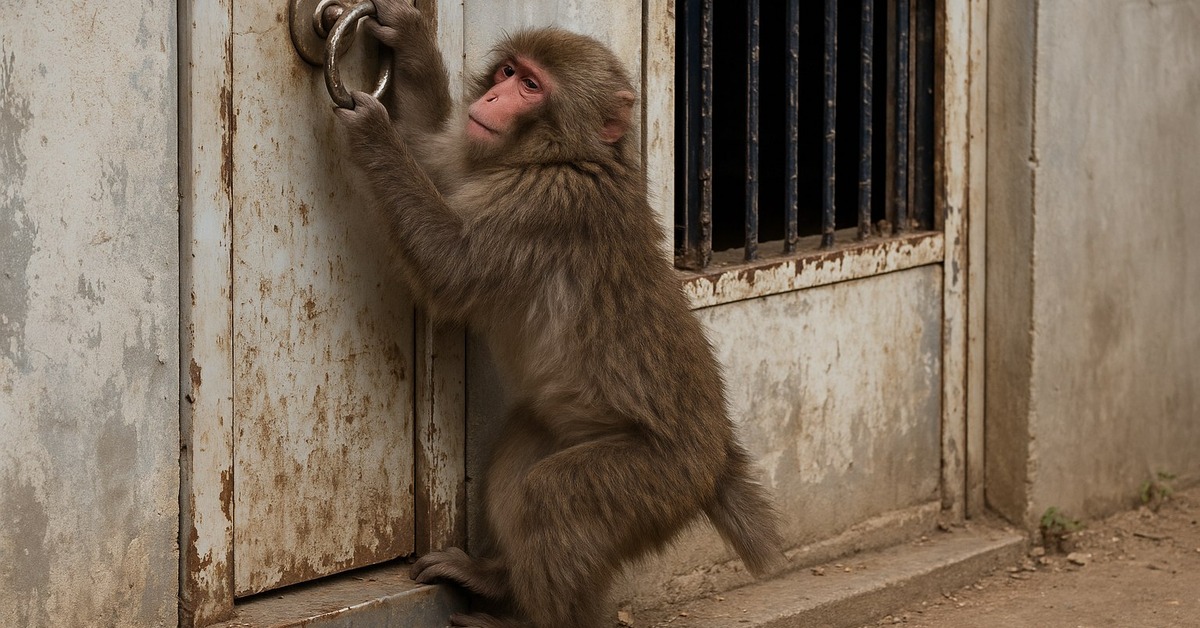
Staff at Ichikawa Zoological and Botanical Garden in Chiba, Japan, photographed what visitors had already stopped to stare at: a young Japanese macaque, alone, pressing his full body weight against a door in what was — let’s be clear about this — a deliberate, sustained attempt to get through it. The photos spread fast. But the full story behind them is something else entirely.
The Baby Monkey Escape That Wasn’t Just Restless
Japanese macaques — Macaca fuscata — are among the most cognitively complex primates in Asia. Primatologist Kinji Imanishi, who pioneered field studies on macaque social behavior in the 1950s, documented early on that these animals build detailed mental maps of their environments — doors, barriers, escape routes, the whole architecture of a place. So when this little guy found a knob, he didn’t paw at it uncertainly. He wrapped both hands around it and turned.
Short bursts of focused effort. Rest. Try again. That’s not restlessness — that’s a toddler working a puzzle box. Except this puzzle box led outside.
Which raises the obvious question: what was he actually trying to reach?
How Rejection Shapes a Young Macaque’s Mind
He was rejected by his mother at birth. It’s more common than most people realize, and considerably more damaging than it sounds. Zookeepers at Ichikawa stepped in immediately — round-the-clock feedings, constant tactile contact, and a plush surrogate they called the “Mama Doll.” Something soft and consistent he could cling to. For a species that spends its first year physically attached to its mother, that substitute isn’t a comfort item. It’s closer to a lifeline.
Hand-raised primates develop a strange familiarity with human spaces. Door handles. Cabinet latches. Zippers. They watch, and they remember. This particular macaque didn’t just stumble onto that door. He’d been watching people use it. You can read about other extraordinary animal bonds at this-amazing-world.com.
Why a Baby Monkey Escape Attempt Tells Us Something Bigger
Here’s the thing: the baby monkey escape attempt isn’t just a cute zoo story. Baby Japanese macaques in their first year show measurable cortisol spikes — the stress hormone — even during brief separations from a maternal figure. Without that bond, the stress doesn’t spike and recover. It becomes chronic. And chronic stress in infant primates actually rewires the developing brain, making it hypervigilant, impulsive, and in some documented cases, more driven to seek novel environments. To find a way out.
He wasn’t bored.
He was looking for something. And that distinction is everything.

The Mama Doll: A Simple Fix With a Complicated Legacy
Surrogate objects in primate care: they work, and they don’t. Harry Harlow’s experiments in the 1950s showed that infant rhesus monkeys would choose a soft cloth “mother” over a wire one that provided food — comfort contact matters as much as calories to a developing primate nervous system. Ichikawa’s Mama Doll follows the same logic. It gives the macaque something to cling to, something warm-adjacent, something his nervous system can register as safe. Short-term stress markers do come down.
But cloth can’t groom him. Can’t correct him. Can’t carry him on a moving, breathing body. Turns out that missing feedback — the actual social texture of a mother — is exactly what will make reintegration into Monkey Mountain’s hierarchy so difficult later. The older males there don’t factor in difficult starts.
That last fact kept me reading for another hour.
By the Numbers
- Japanese macaques have been studied continuously since 1948 — the longest-running primate field study in the world, a dataset that fundamentally shaped what we understand about social learning in non-human primates.
- First month of life: roughly 90% spent in direct physical contact with their mother.
- Even a 30-minute separation measurably elevates cortisol levels in infant macaques, according to behavioral endocrinology research from the early 2000s.
- Ichikawa Zoological and Botanical Garden has maintained a free-roaming macaque population — “Monkey Mountain” — for decades, housing at times over 100 individuals whose social dynamics have been documented by Japanese wildlife researchers.
- Harlow’s 1958 cloth-versus-wire surrogate experiments: infants spent up to 18 hours a day clinging to the soft surrogate. Less than one hour with the wire one that actually provided milk. That ratio permanently changed how zoologists approach infant primate care.

Field Notes
- Japanese macaques are the northernmost non-human primates on Earth — they survive Nagano winters that drop below -15°C. Their famous hot spring bathing wasn’t instinct. It was learned by a single young female in 1963 and spread through the group purely by observation.
- Faster learners when young.
- Rejected infant macaques who are successfully hand-raised and later reintegrated into semi-wild groups often develop unusual social strategies — attaching to non-maternal adult females, forming alliances across age lines that wouldn’t normally exist — as if building from scratch the template they never received.
- The doorknob incident isn’t unique: macaques at multiple facilities across Japan have been documented operating sliding doors, latching mechanisms, and faucets.
What This Story Actually Says About Wild Minds
The baby monkey escape attempt at Ichikawa Zoo lands differently depending on how much context you carry into it. On the surface: funny, a little heartbreaking, undeniably shareable. Underneath: a specific story about what happens when a highly social animal loses the one relationship its entire neurology was constructed around.
He wasn’t malfunctioning at that door. He was responding to his environment with complete logic. That’s not a zoo problem — it’s a biology problem, one wildlife researchers and zoo staff are still genuinely working to solve.
And when the photos show him slumped against the door, whole attempt abandoned, it doesn’t read as failure. It reads as a very particular kind of exhaustion. The kind that comes from trying hard for something that stayed just out of reach.
He ended up back with his Mama Doll. Which is both a small comfort and a genuinely complicated one. But those two images — hands on a doorknob, then slumped against the wood — say more about animal cognition and attachment than a lot of what gets published on the subject. Some things don’t need a caption. If this kind of story stays with you, there’s more at this-amazing-world.com — and the next one is even stranger.


