


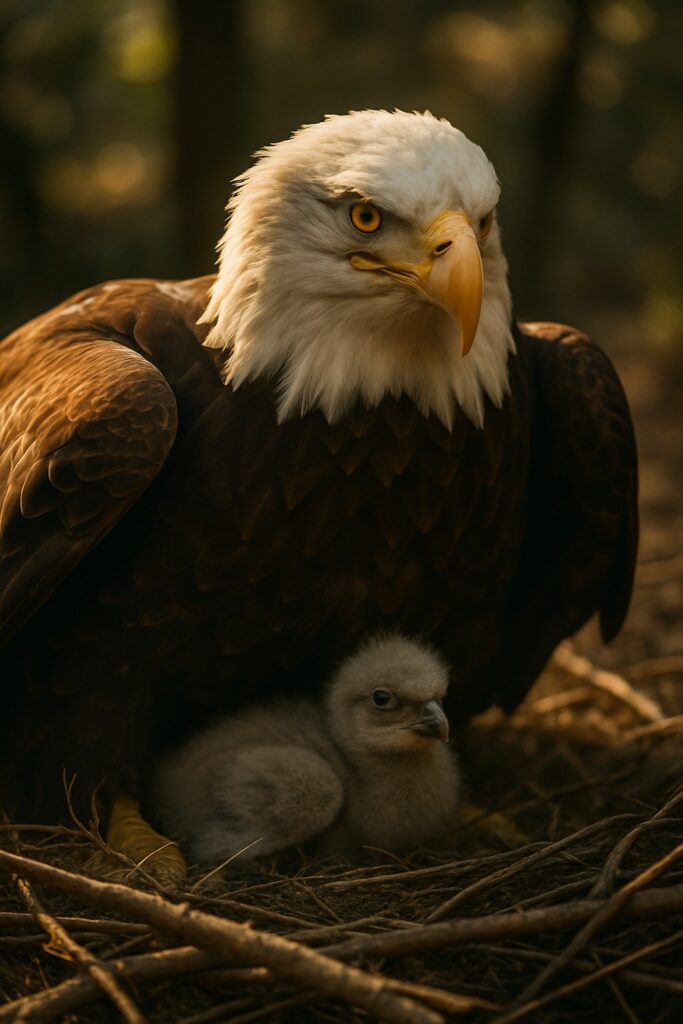
Here’s the thing about instinct: it doesn’t wait for permission. Murphy, a flightless bald eagle at a Missouri wildlife sanctuary, spent the better part of two years brooding a cold river rock — treating it with the vigilance and tenderness of a bird who genuinely believed he had something to protect. When a bald eagle adopts an orphaned eaglet, the story usually begins with a chick. Murphy’s began with a stone. That distinction tells you everything about what drove what happened next.
Murphy lives at the World Bird Sanctuary in Valley Park, Missouri, where he’s been a resident since a wing injury permanently grounded him years ago. Staff watched him build a ground nest, settle into it with obvious purpose, and guard a river rock with the vigilance of a bird who still believed he had something to protect. When an orphaned eaglet arrived in spring 2023, the question wasn’t whether Murphy could care for it. The question was whether the eaglet would survive long enough for anyone to try.

How a Grounded Eagle Never Stopped Being a Father
Bald eagles — Haliaeetus leucocephalus — are one of North America’s most studied raptors, and their parenting behaviour is among the most documented in avian biology. According to the Cornell Lab of Ornithology, bald eagles are monogamous, often bonding for life, and both parents share incubation and chick-rearing duties with unusual consistency for large raptors. In the wild, bald eagle pairs return to the same nest year after year, adding material until the structure can weigh over a ton. The drive to tend a nest isn’t a learned preference — it’s a biological imperative, encoded deeply and expressed whether or not conditions are ideal.
Murphy had no mate, no egg, no territory overhead. None of that stopped him. He built the nest anyway, using the materials available to him on sanctuary grounds. And when there was nothing to incubate, he found a rock.
That detail is harder to dismiss than it sounds. Displacement behaviour in birds — redirected instincts applied to inappropriate objects — has been observed in captive raptors before, but rarely with the persistence Murphy demonstrated. This wasn’t a one-afternoon experiment. Staff at the World Bird Sanctuary noted that Murphy tended his stone consistently, adjusting his position over it, sheltering it during cold weather, and reacting defensively when other birds came close. The rock wasn’t a mistake. To Murphy, it was an object worth protecting. That distinction matters enormously for what came next.
Sanctuary staff didn’t intervene immediately. They watched, letting the behaviour run its course — because disrupting it would have told them nothing. What they observed was a bird in full parental mode, waiting. He just didn’t know what he was waiting for.
The Orphaned Eaglet and a Decision That Couldn’t Be Undone
Why does this matter? Because every wildlife rehabilitator who’s ever hand-raised a raptor knows the cost of getting the early weeks wrong.
Spring 2023 brought the World Bird Sanctuary an orphaned eaglet — too young to survive without intensive care and, ideally, the kind of species-specific parenting that human staff simply can’t replicate. Hand-raised raptors frequently imprint on humans, which sounds charming until you realise it means they can’t be released. A bird that treats people as flock members doesn’t survive in the wild. Finding a surrogate parent — even an unconventional one — is almost always preferable. There’s a parallel here to how other animals express attachment through unexpected bonds; if you’ve ever read about why a baby monkey clings to a surrogate for years, you already understand how deep the wiring for attachment runs, even when the object of that attachment defies all logic.
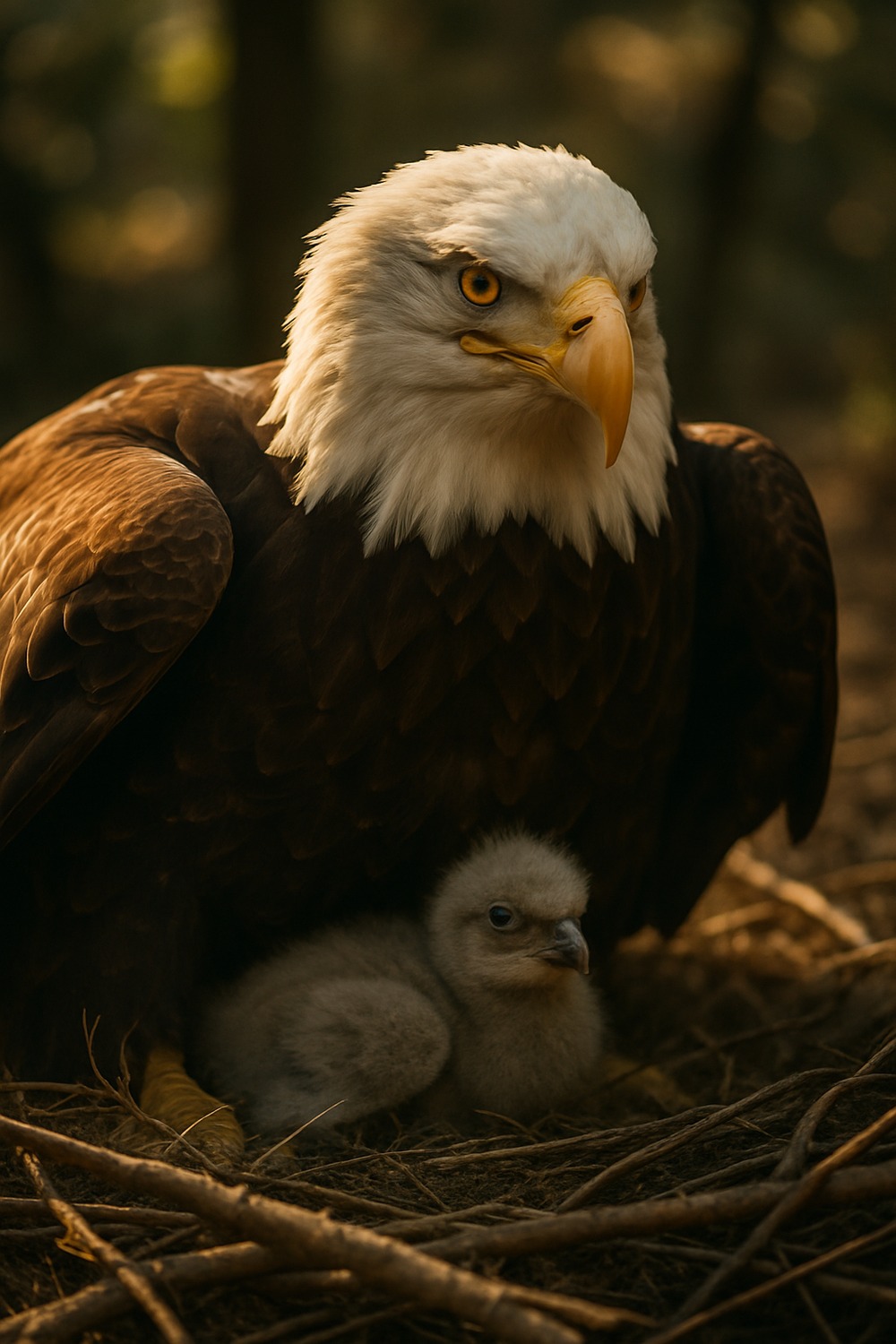
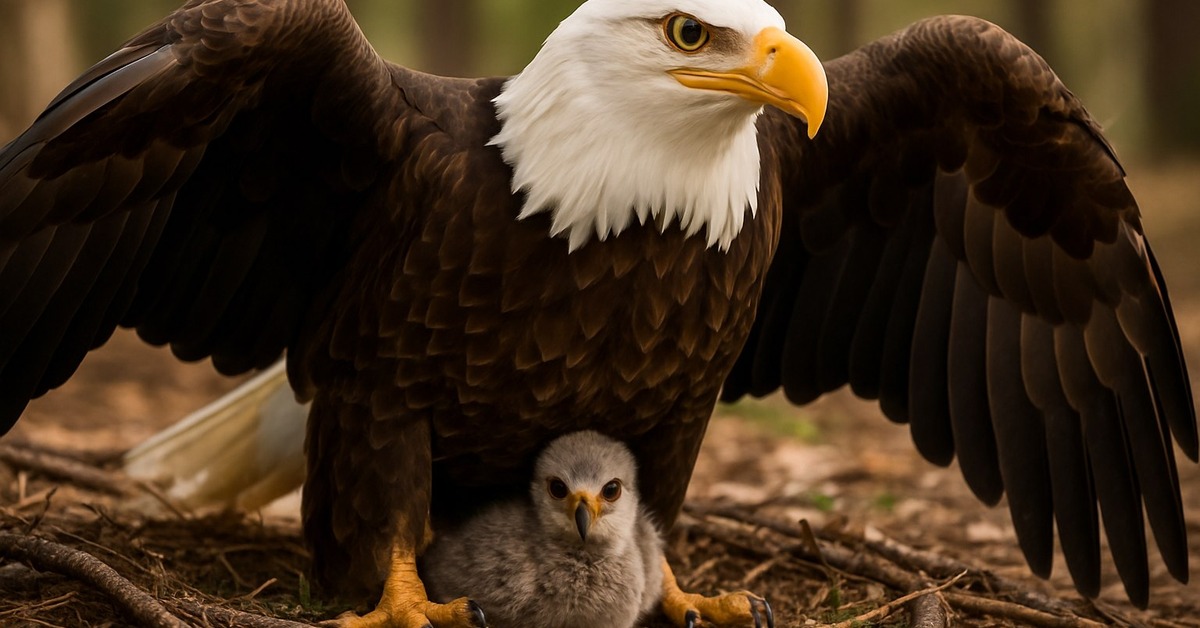
Placing the eaglet with Murphy wasn’t a casual call. Staff had to weigh real risks: Murphy is six pounds of apex predator with talons designed to crush, and an eaglet in its first weeks is essentially helpless. What tipped the balance was Murphy’s behaviour — not aggression, but something that looked, with uncomfortable precision, like readiness. When they removed the rock and placed the chick in its spot, Murphy looked down for a moment that staff described as almost evaluative. Then he leaned in and opened his wings. He covered the eaglet completely. Beak down, wings spread, the same posture he’d held over the rock — except this time, something underneath him moved. And Murphy didn’t flinch.
What Science Says About Animal Adoption and Parental Drive
Murphy’s story is extraordinary, but it isn’t without scientific context. Cross-individual adoption — where an adult animal takes on the care of an unrelated juvenile — has been documented across dozens of species, from orcas to meerkats to, increasingly, birds of prey. A 2021 review published in National Geographic explored the mechanisms behind animal adoption, noting that in many cases the adopting individual had experienced reproductive loss or — as in Murphy’s case — reproductive deprivation: the thwarted biological drive to parent, with nowhere to go.
When a bald eagle adopts an orphaned eaglet, the species’ high-investment parenting model is a central factor. These aren’t birds that raise dozens of offspring and move on. A bald eagle pair might successfully fledge one or two chicks per season, with every chick representing months of sustained, focused effort. That investment architecture doesn’t switch off in a bird who can no longer breed in the wild. It redirects. Researchers studying raptor cognition at institutions like the Peregrine Fund have noted that in birds with strong pair-bond and parenting instincts, the presence of a juvenile in the nest triggers hormonal and behavioural responses that can override normal caution almost immediately (researchers actually call this priming, and it’s measurable in hormone assays taken within hours of exposure).
What’s counterintuitive isn’t that it happened — it’s that it required so little encouragement. Some surrogate pairings in wildlife rehabilitation require careful habituation, gradual introduction, weeks of monitoring before physical contact is permitted. Murphy required none of that. The transition from rock to chick happened in a single afternoon.
Murphy had been practising for this, apparently, for years — just with the wrong prop.
Murphy’s Adoption Changes What the Sanctuary Does Next
And the implications landed fast. Before spring 2023, surrogate parenting for eaglets at many sanctuaries relied heavily on puppet feeding — a human uses a glove shaped like an eagle head to deliver food without exposing the chick to human faces. The technique works, but it’s labour-intensive, imperfect, and emotionally draining for staff who know they’re providing a pale imitation of actual eagle parenting. Murphy’s case made the argument for something better. Watching a bird reduced to brooding rocks still perform every beat of eagle parenthood the moment a real chick arrived — that’s not a heartwarming anecdote. That’s a protocol waiting to be written.
By summer 2023, the eaglet was growing at a normal rate, responding to Murphy’s vocalisations, and displaying the alert, socially calibrated behaviour that wildlife rehabilitators look for as indicators of successful development. A bald eagle adopted by another bald eagle — even a flightless one — learns things a puppet simply can’t teach: the posture of a threatened eagle, the specific vocalisations that mean “stay close” versus “something is wrong,” the rhythm of being covered at night and uncovered in morning light. These aren’t decorative experiences. They’re the behavioural vocabulary a wild eagle needs to survive.
Every bird rehabilitated under the Bald Eagle Protection Act of 1940 carries legal weight as well as ecological significance — getting the rearing right isn’t optional. Sanctuary staff began documenting the pairing systematically, recognising that Murphy’s case could become a model. They weren’t just watching a heartwarming story unfold. They were watching a protocol emerge in real time.

How It Unfolded
- 2003 (approx.): Murphy arrives at the World Bird Sanctuary in Valley Park, Missouri, after a severe wing injury renders him permanently flightless and non-releasable.
- 2021–2022: Staff observe Murphy constructing a ground nest and beginning to brood a river rock consistently, exhibiting sustained incubation behaviour over multiple seasons.
- Spring 2023: An orphaned eaglet is received by the sanctuary; staff make the decision to place the chick in Murphy’s nest, replacing the rock.
- Summer 2023: The eaglet reaches fledgling developmental milestones on schedule, with Murphy’s surrogate parenting credited as a primary factor in the bird’s healthy progress.
By the Numbers
- 6 lbs (2.7 kg): Murphy’s approximate weight — typical for a male bald eagle, which are smaller than females in this sexually dimorphic species.
- 20–30 years: the typical wild lifespan of a bald eagle, with captive individuals sometimes exceeding 40 years under sanctuary care.
- 1,000+ lbs (450 kg): the recorded weight of the largest documented wild bald eagle nest, built up over decades of annual additions by a returning pair.
- 417: the number of bald eagles in Missouri counted during the 2022 mid-winter survey by the Missouri Department of Conservation, up from near-zero breeding pairs in the 1970s.
- 1940: the year the Bald Eagle Protection Act was enacted in the United States, marking the beginning of federal legal protection for the species.
Field Notes
- Murphy isn’t the only non-releasable raptor to exhibit surrogate parenting behaviour — a male red-tailed hawk at a California wildlife centre was documented brooding a clutch of eggs for a temporarily incapacitated female in 2019, successfully hatching two chicks.
- Bald eagles don’t use body heat alone to incubate — they have a specialised brood patch, a featherless area of skin on the belly dense with blood vessels, which transfers heat directly to eggs. Murphy’s brood patch was almost certainly active when he brooded the rock.
- Turns out the case for surrogate eagle rearing over puppet-feeding is now backed by release-success data: birds raised by conspecific surrogates show measurably higher post-release survival rates in multi-year tracking studies by the Peregrine Fund.
- Researchers still can’t fully explain why Murphy’s transition from rock to chick was instantaneous rather than gradual — whether the chick’s warmth, vocalisation, or movement was the key trigger remains an open question that may require controlled study to answer.
Frequently Asked Questions
Q: How does a bald eagle adopts an orphaned eaglet situation usually work in wildlife rehabilitation?
Wildlife rehabilitators first attempt to return orphaned eaglets to their biological nest if it’s accessible and the parents are still present. When that’s impossible, surrogate pairing with a compatible non-releasable eagle is the preferred option — it requires careful assessment of the surrogate’s temperament and parenting history. Murphy’s case was unusual because his sustained brooding behaviour made him an obvious candidate. Staff had effectively watched him audition for the role for two years.
Q: Can a flightless eagle really teach an eaglet what it needs to know to survive?
Partially — and that’s an honest answer. Murphy can teach vocalisation, threat posture, social cues, and the emotional regulation that comes from consistent parental presence, all of which are critical in early development. What he can’t teach is flight behaviour, hunting technique, or aerial territorial navigation. That gap is addressed through graduated flight training and soft-release programmes where the eaglet can develop those skills in a managed environment before full independence.
Q: Is it common for bald eagles to exhibit parenting instincts without a mate or eggs?
More common than most people expect. Displaced parental behaviour — redirected nesting, brooding, or territorial guarding in the absence of a mate or offspring — has been documented in multiple raptor species in captivity or rehabilitation settings. It’s not a malfunction. Bald eagles invest so much in each offspring that the drive to parent doesn’t simply pause when circumstances are wrong. It looks for an outlet. Murphy found one in a piece of river stone and held it for two winters.
Editor’s Take — Alex Morgan
What stays with me about Murphy isn’t the adoption — it’s the rock. A six-pound eagle, grounded for life, building a nest on the dirt and incubating a piece of river stone for two winters. That’s not delusion. That’s biological fidelity so strong it will find a target even when there isn’t one. We tend to talk about animal instinct as something mechanical, automatic, almost beneath notice. Murphy’s rock makes that argument impossible to sustain. The drive was real. It was just waiting for something real to hold.
Murphy’s story is, on its surface, about one eagle and one chick in a Missouri sanctuary. But the rock is what lingers. Because the rock means that the capacity to protect, to shelter, to father — it was never contingent on whether the conditions were right. It was there the whole time, expressed on whatever was available. And when something genuinely worth sheltering finally arrived, Murphy didn’t hesitate for a single second. Which raises a question worth sitting with: how many other forms of love are quietly doing the same thing, right now, waiting for the right moment to unfold their wings?


