


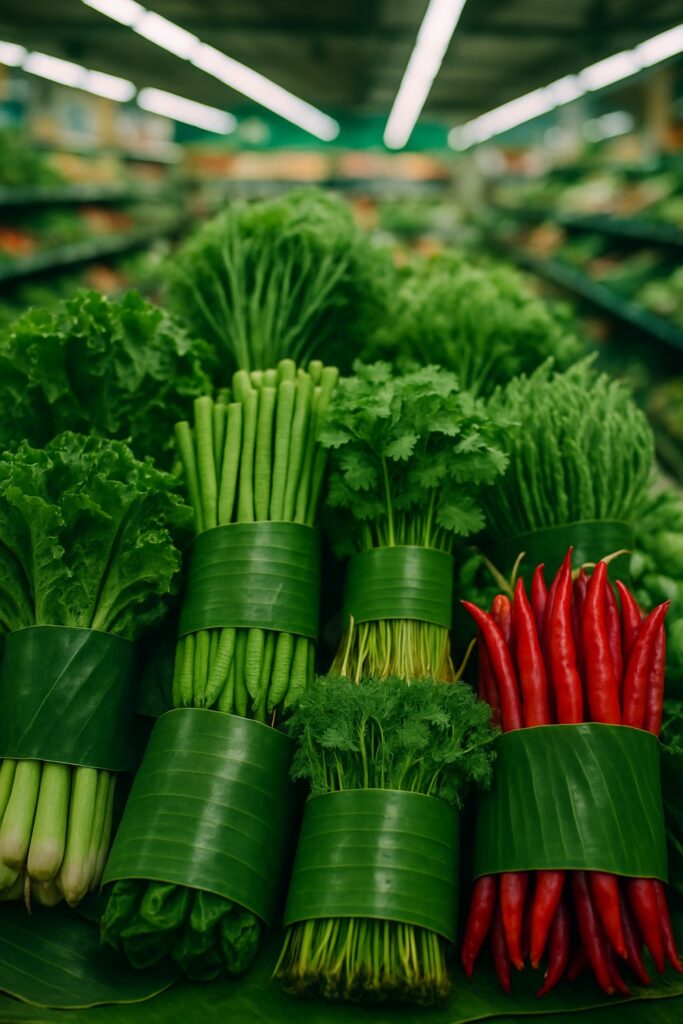
The photo didn’t go viral because it was beautiful. It went viral because people recognized something — something old, and slightly embarrassing, like running into a friend you treated badly.
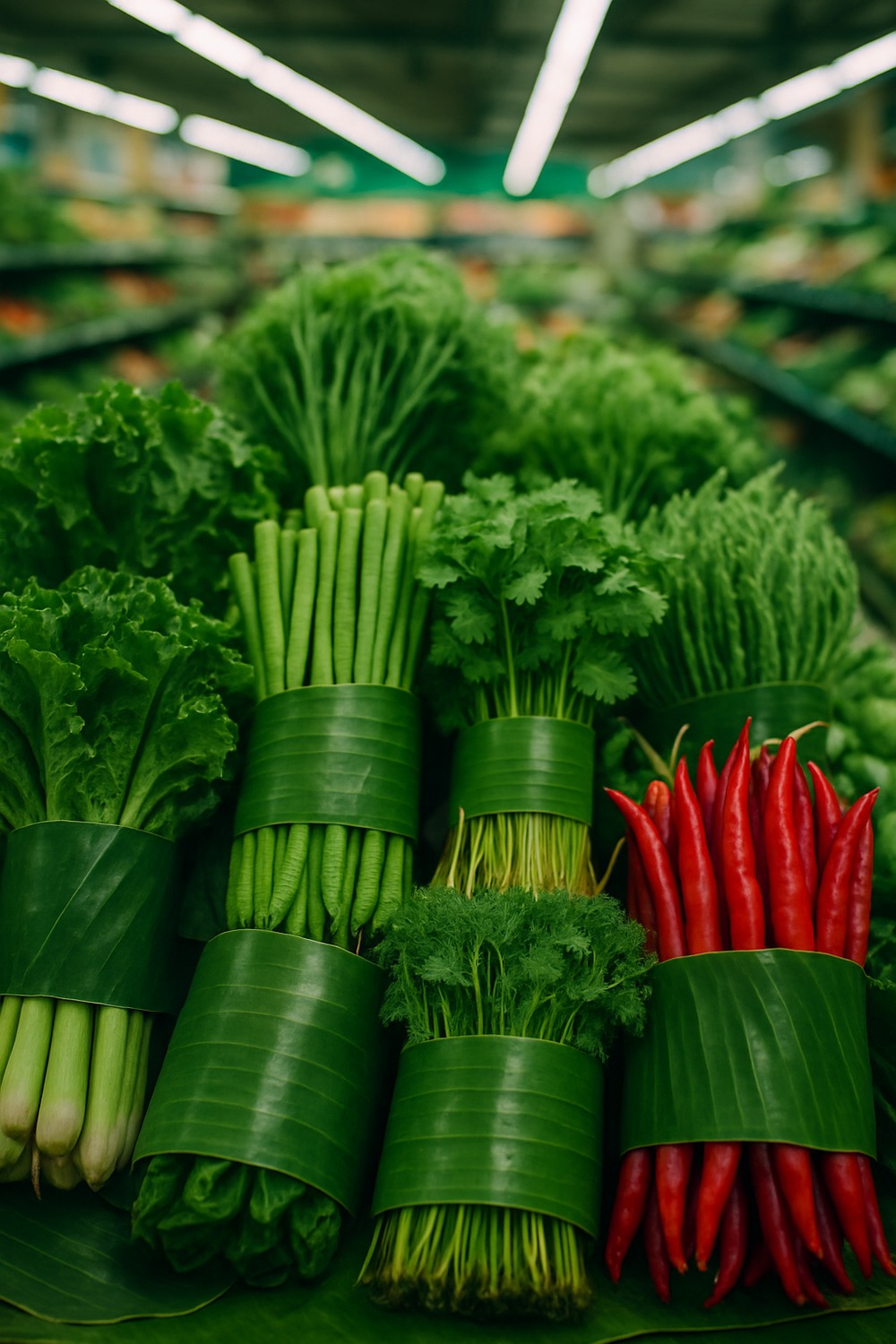
Peppers. Green beans. Leafy greens. All bundled in thick, waxy banana leaves, sitting under fluorescent lights in a Chiang Mai supermarket with barcodes and loyalty card scanners. The internet reacted like it had discovered something new. But across Southeast Asia, grandmothers watched the whole thing unfold from their kitchens and felt approximately nothing. This was never a trend. It was just how food traveled before plastic showed up and convinced everyone it was the future.
Banana Leaf Packaging’s Ancient Role in Thai Markets
It is sometime in the sixteenth century. A market vendor in what will eventually be called Thailand wraps peppers in a large, dark green leaf, folds the edges under, and hands it across a wooden stall. The buyer doesn’t think about this. Why would they? It’s just how things are wrapped.
Researcher Dr. Suraphol Sudara, who spent years studying traditional Thai foodways at Chulalongkorn University, documented how banana leaf wrapping shows up in Thai cultural records going back centuries — not just in markets, but woven into ceremonies, offerings, rituals. The leaf wasn’t packaging in the modern sense. It was infrastructure. It was everywhere, doing everything, until the 1970s and 80s when plastic arrived and the whole country apparently decided, collectively and almost overnight, that cheap petroleum film was progress.
The rivers and streets eventually made the counterargument.
Why Supermarkets Are Making the Switch Now
What made the Chiang Mai photos land so hard wasn’t the leaves themselves. It was the setting. Specialty eco-markets using banana leaves? Sure. Rural morning stalls? Expected. But a mainstream grocery chain — refrigerated aisles, barcode scanners, the works — that’s a different signal entirely. When the mainstream moves, people notice. That contrast is doing something that a hundred sustainability campaigns couldn’t quite manage: it’s showing people that going back doesn’t mean going backwards.
For more on how traditional practices like this are quietly reshaping food culture across Asia, this-amazing-world.com has been following these shifts for a while now.
Meanwhile, the supply side of this equation is almost aggressively simple. A single mature banana plant drops thirty to forty large, usable leaves every month. No factory involved. No fossil fuels, no processing, no logistics chain to untangle. Just a plant doing what tropical plants do — growing constantly, abundantly, and with startling generosity.
What a Banana Tree Can Actually Produce
Banana trees don’t take seasons off. In tropical climates they produce leaves year-round, which means banana leaf packaging isn’t a romantic idea with a supply problem — it’s a genuinely renewable material with a consistent yield. That last fact kept me reading for another hour, because the numbers don’t behave the way you’d expect from something this low-tech.
The leaves are naturally waxy. Slightly antibacterial. In humid climates where fresh produce can go soft within a day, that waxy surface layer isn’t decorative — it’s doing real work, slowing moisture loss, reducing direct contamination. People across India, Thailand, the Philippines, and Vietnam figured this out generations before anyone had a lab to confirm it. They discovered practical chemistry the old-fashioned way, which is to say: by eating the results and noticing what lasted longer.
When the leaf has done its job, it composts in two to four weeks. Returns nitrogen and potassium to the soil. Feeds the next cycle of growth. The whole loop is so clean it almost sounds like it was designed by someone who really thought it through.
Nobody designed it. It just grew.

The Problem Plastic Created — and Can’t Undo
Thailand generates around 2 million tonnes of plastic waste per year. That figure comes from the Thai government’s own Pollution Control Department, which is worth noting — it’s not an outside accusation, it’s an internal accounting. Of those 2 million tonnes, roughly 0.5 million get properly recycled. The rest goes somewhere. A significant portion ends up in waterways that drain into the ocean, which is how Thailand ended up ranked among the world’s top contributors to marine plastic pollution.
The infrastructure to manage plastic waste responsibly never kept pace with how fast plastic took over. Markets, street stalls, roadside vendors, supermarkets — all of them switched within a few decades. The leaf knowledge didn’t disappear exactly. It just got crowded out, treated as old-fashioned, associated with poverty rather than wisdom.
Switching back isn’t as simple as handing someone a banana leaf. But something in that Chiang Mai photo suggests the cultural permission to try has quietly shifted.
By the Numbers
- Thailand: 2 million tonnes of plastic waste per year, 0.5 million recycled (Thai Pollution Control Department, 2021)
- One banana plant yields 30–40 large leaves per month in tropical conditions — continuously, year-round, no processing required.
- Plastic takes up to 450 years to break down in a landfill. A banana leaf is gone in 2–4 weeks under natural conditions, leaving behind nitrogen and potassium instead of microplastics.
- Maharashtra, India, banned single-use plastic in 2018. In Mumbai and Pune markets, banana leaf bundle sales reportedly tripled within months. Not gradually. Within months.

Field Notes
- Banana leaves contain polyphenols — natural antioxidants that can transfer to food during wrapping, slightly extending freshness beyond what bare storage offers. People figured this out empirically, centuries before the word polyphenol existed.
- Haran in Japanese bento culture: a specific leaf variety used as a divider, valued for antibacterial properties long before refrigeration. Never fully abandoned, even as plastic took over.
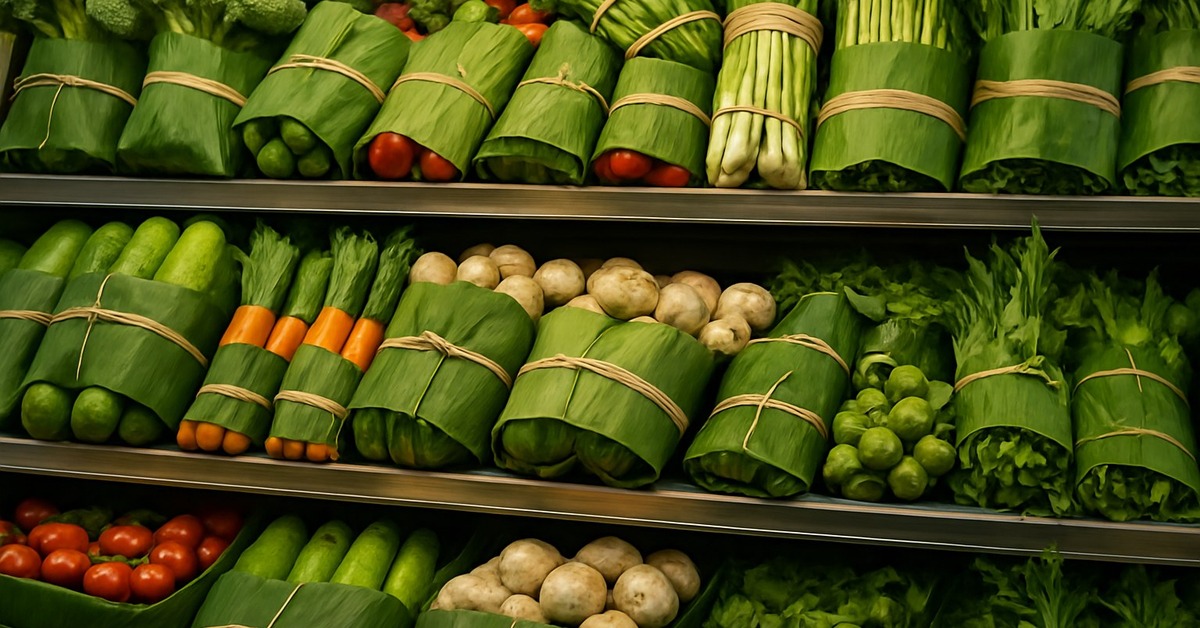
- The Chiang Mai photos weren’t staged or curated for an eco-campaign. Regular supermarket. Regular produce aisle. Which is precisely why they traveled the way they did.
- No new supply chain needed. No patents. No factory investment. A farmer already growing bananas already has the packaging. The barrier isn’t capital — it’s cultural momentum, and that’s exactly what a viral photo can shift.
Why This Moment Feels Different From Other Eco Trends
Most sustainability campaigns have an ask. Bring your own bag. Decline the straw. Choose the bruised apple over the perfect one. Each of those asks something from the consumer, requires a decision, creates a small friction. Banana leaf packaging asks the customer nothing. The leaf wraps the pepper. The pepper goes in the basket. The entire weight of the change sits with the supplier, not the shopper. That’s a structurally different model from most of what gets branded as a green solution, and it matters more than it sounds.
What’s actually happening across Thailand, India, the Philippines, parts of Vietnam — it’s not innovation. It’s rediscovery wearing innovation’s clothes.
The technology is zero. The material is already being grown. The knowledge of how to use it never fully left — it was just waiting at the edge of things while plastic had its few decades of dominance. There’s no patent to license, no new factory to finance, no supply chain to build from scratch. For rural and semi-urban markets especially, scalability isn’t a future promise. It’s immediate. It was always immediate.
Banana leaf packaging won’t absorb the global plastic crisis. Liquids, long-haul refrigerated transport, hermetically sealed goods — real limitations, genuinely. But for fresh produce in tropical climates, which is where an enormous portion of unnecessary single-use plastic actually concentrates? The leaf has a centuries-long track record. The only thing that interrupted it was a few decades of petroleum film that turned out to be a much bigger problem than it looked.
The question was never whether it works.
The question is whether a photograph taken under fluorescent lights in a northern Thai supermarket becomes a footnote in the plastic crisis story, or the sentence where something finally started to turn.
The oldest answer in the room was always the banana leaf, sitting quietly at the edge of everything, slightly waxy, faintly green, doing exactly what it always did. It didn’t need a rebrand. It didn’t need a campaign. It needed one photograph and forty million people who were, somewhere underneath all the scrolling, already tired of plastic. The world circles back to things that worked — usually after trying everything else first, usually at significant cost, usually while insisting the old way was too simple to take seriously. More of these stories live at this-amazing-world.com. The next one is stranger than this one.


