


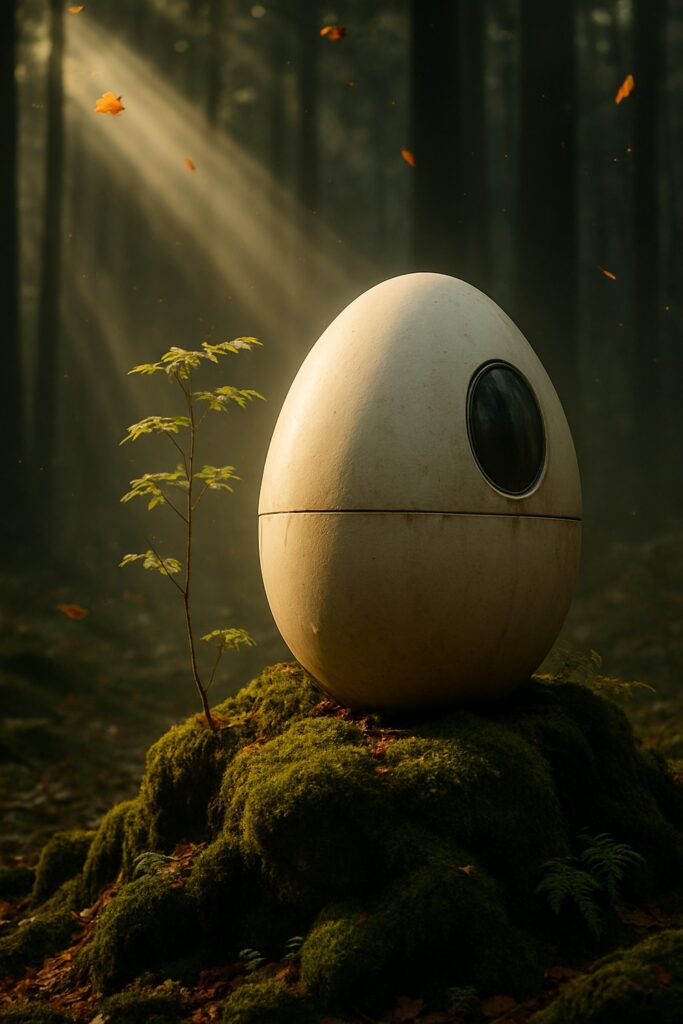
Here’s the thing about biodegradable burial pods: they don’t ask permission to make sense. Death feeds life — always has — and yet we’ve spent centuries pouring concrete over that fact. The pods that Bios Urn began shipping from Barcelona in 1998 didn’t invent a new idea. They recovered a very old one and gave it a germination capsule.
In the hills outside Barcelona, a grove of young oaks stands where a gravel car park once sat. Each tree grows from a biodegradable capsule containing a person’s cremated remains. No headstones. No marble. Just canopy and birdsong and soil that remembers. The question no one thought to ask until recently: why did we ever choose stone over seed?

What Biodegradable Burial Pods Actually Are
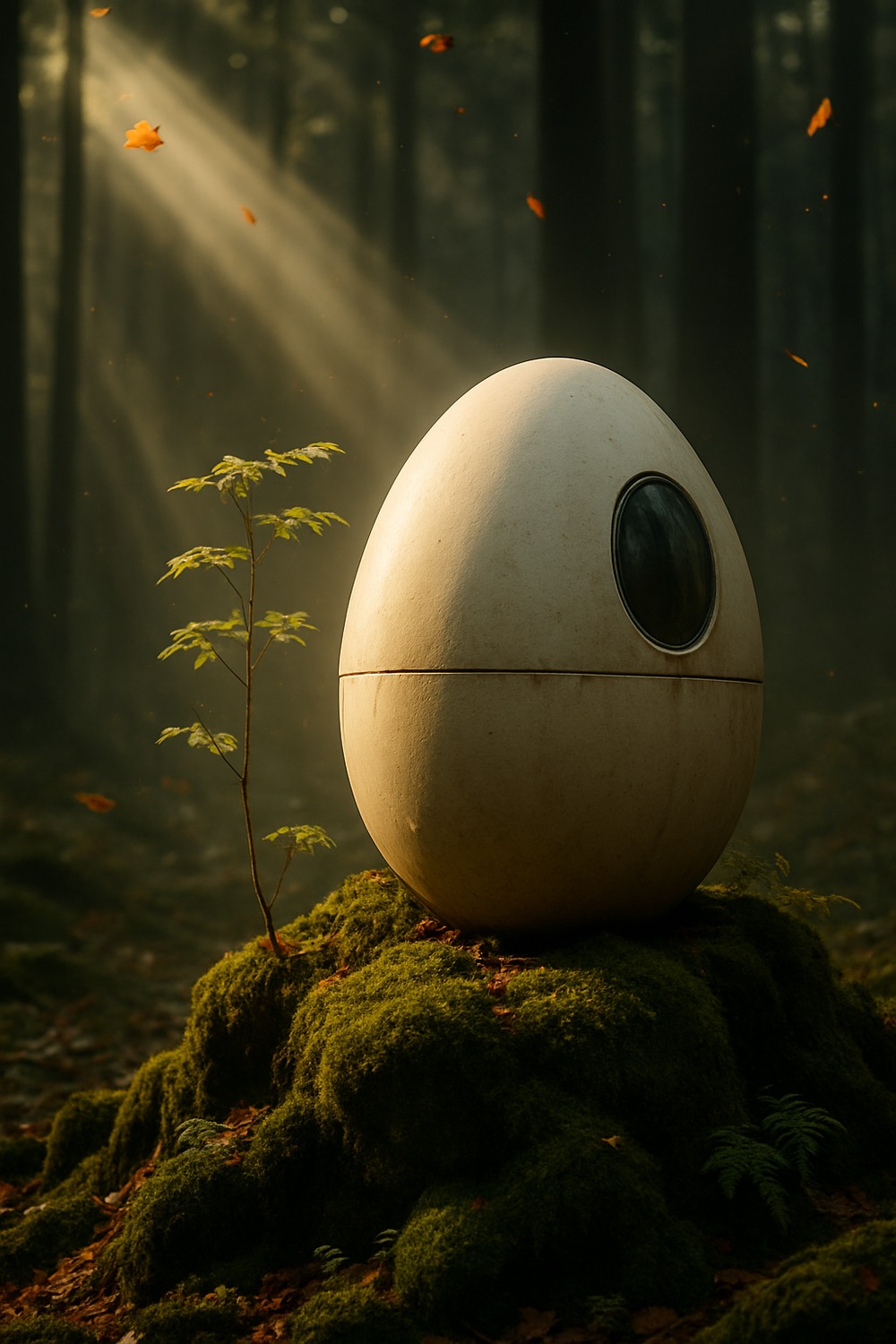
The concept sounds almost too elegant to be real. A biodegradable burial pod — sometimes called an organic burial pod or eco-urn — is a container made from fully compostable materials, typically coconut shell, compressed peat, and cellulose. The pod holds cremated ashes, or in some designs, an unembalmed body in fetal position, and it’s planted directly into the ground with a seed or sapling secured above it. As the pod breaks down over weeks and months, nutrients from the remains migrate upward into the growing root system. Bios Urn, founded in 1998 and relaunched with enormous public attention in 2013, pioneered the modern version of this idea and has since shipped more than 160,000 units to customers in over 65 countries. Their design — a two-part urn with a germination capsule on top — has become the most recognised format in the field.
The natural burial movement that underpins this approach has roots going back centuries, but the technology to scale it industrially is genuinely new. What makes these pods different from simply scattering ashes under a tree? The chemistry matters here. Cremated remains — called cremains — are high in calcium phosphate and potassium, but also contain elevated sodium levels that can actually inhibit seed germination if applied directly. The biodegradable burial pod solves this by buffering the ash with peat moss and activated charcoal (researchers actually call this a pH regulation layer), which neutralise acidity and regulate the slow release of minerals into the surrounding soil. It’s a designed system, not just a poetic gesture. Decomposition runs roughly three to five years for full integration, depending on soil moisture and microbial activity.
Picture it from the tree’s perspective. A root tip encounters a mineral-rich pocket. It doesn’t know — can’t know — what it’s found. But it grows toward it anyway. That indifference is, somehow, the most honest memorial imaginable.
The Forest Economy of Grief and Growth
The funeral industry has never been gentle on the planet, and the numbers are startling once you see them laid out. In the United States alone, traditional burial practices consume more than 30 million board feet of hardwood casket lumber, 90,000 tons of steel, 1.6 million tons of reinforced concrete for burial vaults, and roughly 800,000 gallons of embalming fluid — largely formaldehyde — every single year, according to data compiled by the Green Burial Council. Cremation, long considered the greener alternative, still releases approximately 400 kilograms of carbon dioxide per body incinerated. Biodegradable burial pods, by contrast, generate no embalming chemicals, no mined materials, and no carbon from industrial manufacturing. They do something no other burial method achieves: they convert a body’s remaining chemistry into a net ecological positive.
In places where reforestation is urgent — and those places are multiplying — that shift in the ledger matters. Nature has always recycled everything. It’s humans who briefly, expensively, interrupted that loop. For more on nature’s quietly extraordinary recycling systems, consider how a palm tree in Borneo fruits entirely underground, building its entire reproductive cycle below the surface where soil chemistry governs everything.
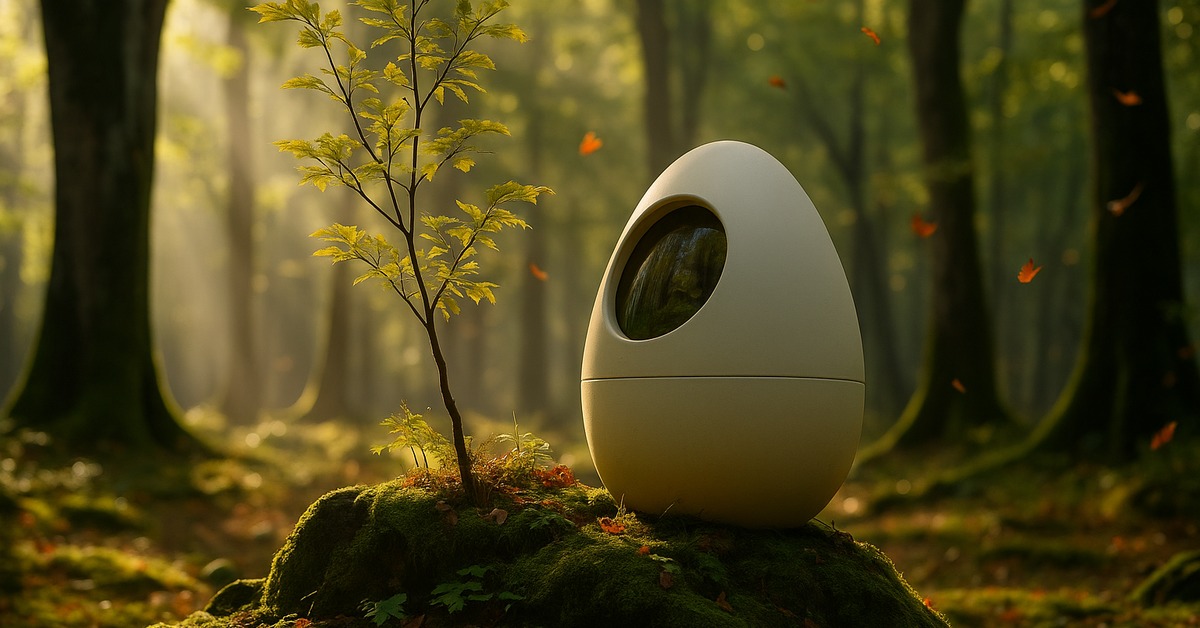
Why does this matter beyond the headline statistics? Because the economics of grief are shifting right alongside the ecology. In the UK, the average traditional funeral cost crossed £4,000 in 2022, according to SunLife’s annual Cost of Dying report. A Bios Urn retails for around €145. Even when you add the cost of a plot in a designated memorial forest — which organisations like Capsula Mundi in Italy have begun establishing — the total typically falls well below conventional burial. Capsula Mundi, founded by designers Anna Citelli and Raoul Bretzel, has designed both urn-sized pods and a larger egg-shaped pod intended for whole-body burial without embalming, a concept that has received significant media coverage since 2015 even though full-body organic pod burial remains legally complex in most jurisdictions.
Families describe the experience differently than they expect. The grief doesn’t diminish. But it moves. Instead of a fixed stone to visit, there’s a living thing that changes with the seasons, that grows visibly, that shelters other creatures. One father in Spain described watching a pair of warblers nest in his daughter’s oak in its third year. He called it “the first surprise she ever gave me twice.”
The Science Behind Living Memorials
Can a tree actually grow better because of human remains? Forest ecologists take that question seriously. Research published through institutions including the University of Sydney’s School of Life and Environmental Sciences has examined how nitrogen and phosphorus from decomposing organic matter — including human remains — influence fungal networks and soil microbiome diversity beneath memorial trees. Mycorrhizal fungi, which form symbiotic networks connecting tree root systems across forest floors, respond vigorously to localised nutrient enrichment. The findings are consistently encouraging: a single biodegradable burial pod creates what researchers describe as a “nutrient pulse” — a concentrated zone of mineral availability that can accelerate early root development by measurable margins. According to a 2021 feature in National Geographic, the green burial movement is one of the fastest-growing segments of the death-care industry globally, with North American market estimates suggesting compound annual growth above 11 percent through 2030.
At this rate of adoption, the question is no longer whether green burial can scale — it’s whether the legal frameworks will catch up before the demand outruns them.
What surprises most people is how little of the actual biological material survives cremation. Cremains contain almost no organic carbon — the fire consumes it. What remains is mostly inorganic mineral ash. This means biodegradable burial pods using cremains aren’t releasing nitrogen the way a composted body would. Their primary contribution is mineral, not organic. Whole-body green burial, where permitted, delivers a richer biological legacy to the soil. Several US states, including Washington, Colorado, and California, have now legalised human composting — a process called natural organic reduction — which produces a cubic yard of finished compost per body. Some families have used this material in conjunction with memorial tree plantings, creating what is arguably the most complete nutrient return of any burial method.
The mycorrhizal network beneath a memorial forest doesn’t distinguish between a tree planted yesterday and one planted a century ago. It connects them all. That biological democracy — ancient root meeting young root, no hierarchy, no monument — might be the most radical thing about this movement.
How Biodegradable Burial Pods Are Reshaping Memorial Spaces
Traditional cemeteries cover an estimated 1 million acres in the United States alone, according to the Green Burial Council’s 2022 landscape survey. Much of that land is ecologically sterile — mown grass, chemically treated, impermeable beneath concrete vaults. Organisations like the Conservation Burial Alliance, established formally in 2016, work to certify burial sites that actively support habitat restoration. These aren’t just fields with trees; they’re designed ecosystems, with species selection guided by local biodiversity goals. Prairie restorations in the Midwest, longleaf pine corridors in the Southeast, oak woodland regeneration in California — each project maps burial sites to reforestation priorities. A body doesn’t go into neutral ground. It goes into a recovery zone.
The biodegradable burial pod becomes, in this framework, a delivery mechanism for both emotional closure and ecological repair — and the evidence from early sites is hard to argue with. Named sites like Ramsey Creek Preserve in South Carolina — opened in 1998 as the first conservation burial ground in the US — have demonstrated that families accept, and often prefer, the wilder aesthetic of a living memorial landscape over manicured rows of stone. The transformation of even a fraction of that sterile acreage into managed woodland would represent a conservation intervention of genuine scale. We kept building stone cities for the dead while the living world lost forest. That seemed normal, once.
The legal terrain is complicated and uneven. In the United Kingdom, the Natural Death Centre has catalogued more than 270 woodland burial sites as of 2023, making it one of the most developed markets for green burial anywhere. Germany has permitted forest burial since 2001 in designated Friedwald (peace forest) sites, with over 60,000 people now interred across dozens of certified forest locations. The United States lags behind on whole-body pod burial due to state-by-state variance in burial law, but biodegradable urns for cremated remains face almost no regulatory barriers. The gap between what’s legally possible with ashes versus full body burial is still wide in most of the world.
Architects and landscape designers are already responding. Several firms have proposed converting decommissioned urban cemeteries — of which there are thousands globally — into memorial forest parks, using biodegradable burial pods as the mechanism for phased ecological transition. The graves remain. The trees grow over them. The city gains a forest.
What Comes Next: Forests of Memory at Scale
Five percent. That’s all it would take to make a measurable dent. If just five percent of annual deaths in the United States — approximately 150,000 people per year — chose a tree-based memorial burial, planted in designated reforestation zones, that single behavioural shift would generate more than 1.5 million new trees per decade. Scaled globally, where roughly 60 million people die each year, the numbers become genuinely significant in reforestation terms. The Trillion Trees initiative — a collaboration between the World Wildlife Fund, Wildlife Conservation Society, and BirdLife International launched in 2019 — estimates that restoring 350 million hectares of degraded forest by 2030 is biologically achievable. Memorial forests won’t carry that effort alone, but they represent one of the few reforestation pathways that comes with its own emotional demand signal built in. People don’t need to be convinced that trees matter. They need to be shown that choosing a tree is possible.
And technology is moving alongside the cultural shift. Several startups are now developing biodegradable burial pods embedded with seed mixes calibrated to local soil types, with QR codes that link to a growing digital memorial — photographs, voice recordings, written remembrances — accessible by touching a tag embedded in the bark of the sapling. The physical and digital memorial merge. A living tree becomes an archive. It’s a development that some grief counsellors have welcomed cautiously, noting that the ability to revisit a loved one’s voice beneath their tree adds a sensory dimension to memorial visits that traditional headstones never offered.
Stand in a mature conservation burial ground on an October afternoon. The oaks are turning. Wind moves through the canopy in long slow pulses. Somewhere below the leaf litter, a root tip is finding a mineral seam. You can’t tell whose tree is whose. You weren’t meant to.

How It Unfolded
- 1998 — Bios Urn is founded in Barcelona, Spain, establishing the first commercially available biodegradable burial pod designed specifically for cremated remains.
- 1998 — Ramsey Creek Preserve in South Carolina opens as the first conservation burial ground in the United States, pioneering the concept of burial as habitat restoration.
- 2013 — Bios Urn relaunches with a redesigned two-part pod and a global online campaign that generates over 20 million social media impressions in its first month, pulling green burial into mainstream awareness.
- 2015 — Italian designers Anna Citelli and Raoul Bretzel reveal the Capsula Mundi whole-body egg pod prototype, igniting international debate about the future of burial law and cemetery design.
- 2019 — Washington State becomes the first US state to legalise natural organic reduction (human composting), opening a new frontier for body-based soil amendment and memorial tree planting.
- 2023 — The UK’s Natural Death Centre logs over 270 certified woodland burial sites, making Britain the most developed woodland burial market in the world.
By the Numbers
- 800,000 gallons of embalming fluid — primarily formaldehyde — are used in US traditional burials annually (Green Burial Council, 2022).
- 160,000+ Bios Urn pods shipped to customers across 65+ countries between 1998 and 2023.
- 400 kg of CO₂ released per standard cremation — compared to effectively zero direct emissions from a biodegradable pod burial.
- 60,000+ people interred across Germany’s certified Friedwald forest burial sites since the programme launched in 2001.
- 11% compound annual growth rate projected for the North American green burial market through 2030 (Green Burial Council industry data).
Field Notes
- In 2019, a team at Jae Rhim Lee’s Coeio company in the US completed trials of a “infinity burial suit” — a garment threaded with mushroom spores designed to accelerate decomposition and neutralise toxins in the body before nutrients enter the soil. The suit, which has been tested in controlled burial plots in California, represents a parallel track to pod-based burial using fungal biology rather than capsule design.
- Cremated remains are almost entirely inorganic — around 95 percent calcium phosphate mineral — which means a pod using only ashes contributes mineral nutrition rather than the richer organic chemistry of a composted whole body. Many families don’t know this distinction exists.
- Neolithic burial sites in the Levant contain the oldest recorded instances of deliberate “seed burial” — placing plant material with human remains to encourage growth at the gravesite — suggesting the instinct to merge death and germination is at least 10,000 years old.
- Researchers still can’t fully answer whether memorial trees planted over cremains live longer, shorter, or equivalently compared to trees in unmodified soil over multi-decade timescales. Long-term botanical data from conservation burial sites is only now beginning to accumulate, and no peer-reviewed 30-year study yet exists.
Frequently Asked Questions
Q: How does a biodegradable burial pod actually work with cremated ashes?
A biodegradable burial pod typically consists of two chambers: a lower section holding the cremated remains mixed with peat moss and activated charcoal, and an upper germination capsule containing the seed or young sapling. The charcoal buffers the high pH and sodium content of cremains, which would otherwise inhibit germination. Over roughly three to five years, the capsule breaks down completely, releasing minerals into the surrounding root zone. No plastics, no metals, no residue.
Q: Is it legal to plant a memorial tree using a burial pod?
For cremated remains, biodegradable burial pods face very few legal barriers in most countries — placing ashes in an urn and interring it in approved land is broadly permitted. Whole-body pod burial is more complex, because most jurisdictions require burial in a licensed cemetery or approved natural burial ground. In the UK, over 270 certified woodland burial sites now accept whole-body natural burial. In the US, regulations vary by state, and only a handful have legalised full-body alternatives like natural organic reduction. Always verify local law before purchasing land or selecting a site.
Q: Do trees really grow better from biodegradable burial pods, or is that just marketing?
Turns out the honest answer depends heavily on burial type. Pods containing cremated remains offer mineral supplementation — mainly calcium and phosphorus — that can support early root development, but they don’t provide the rich organic nitrogen that a composted whole body would deliver. Studies on natural organic reduction have shown measurable improvements in soil microbial diversity and nutrient availability. For ashes-only pods, the ecological benefit is real but modest — the more significant gain is what the tree replaces: a concrete vault, a hardwood casket, and decades of mown sterile cemetery turf.
Editor’s Take — Alex Morgan
What stays with me isn’t the biology — it’s the accounting. Every year, the US buries enough hardwood to build a small city, and soaks it in formaldehyde, and seals it in concrete, and calls it respect. The biodegradable burial pod doesn’t just offer a gentler option; it exposes how strange our current default always was. We spent centuries building permanent monuments to impermanence. The tree gets that backwards — and in doing so, gets it exactly right.
The shift from stone to seed is still young, still legally uneven, still finding its footing in cultures that have built rituals around permanence for millennia. But the instinct behind it — the feeling that a living thing honours the dead better than a carved one — seems to need very little explaining once people encounter it. Somewhere in Spain right now, an oak is adding another ring to its heartwood. It doesn’t know what it’s growing from. Maybe that’s the point. What would it mean to measure a life not in the weight of its monument, but in the height of its canopy?


