


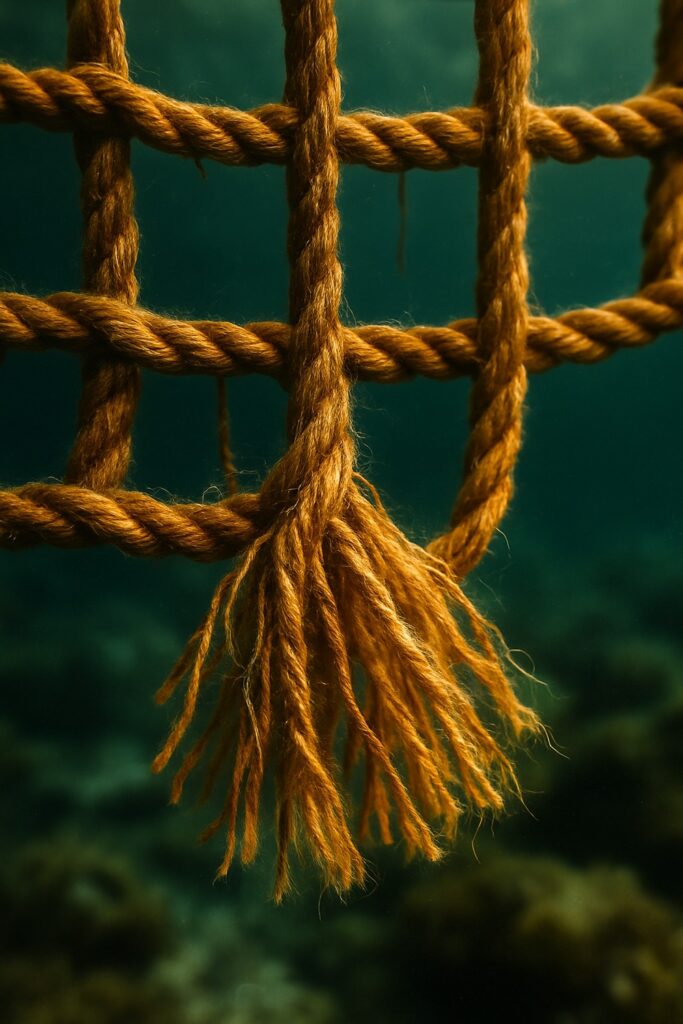
Biodegradable fishing nets built to dissolve represent one of those solutions so counterintuitive you almost dismiss it before you understand it. The material has to be strong enough to haul a catch through rough seas — and then, left alone in the dark, quietly fall apart. An estimated 640,000 tonnes of fishing gear gets lost or abandoned in the world’s oceans every single year, most of it nylon or polyethylene engineered to outlast everyone alive today. What’s being built now is designed to expire instead.

The Ghost Gear Crisis Haunting Our Oceans
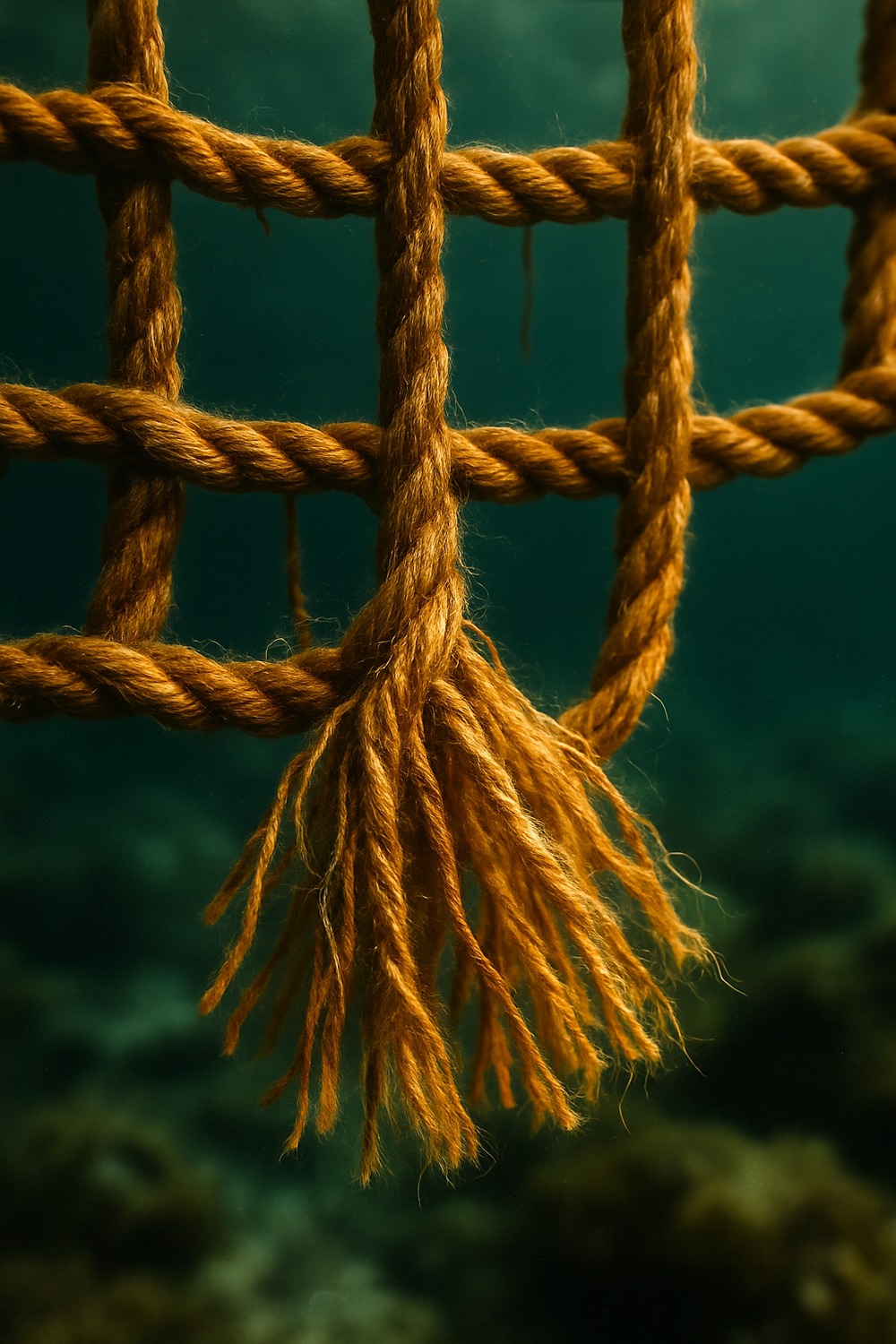
Ghost gear isn’t a fringe problem. The Global Ghost Gear Initiative puts lost and abandoned fishing equipment at roughly ten percent of all ocean plastic pollution — which, when you stop to think about it, is a staggering share for a single category of debris. Unlike a plastic bottle floating near shore, a lost net is actively lethal. It keeps doing the one thing it was designed to do.
Marine animals entangle themselves seeking shelter or prey, then drown or starve slowly, out of sight and out of reach. Sea turtles are particularly vulnerable — already endangered across multiple species, they can’t back out of mesh the way a fish sometimes can. Dolphins, monk seals, seabirds that dive near the surface. The list goes on (researchers who work on this full-time describe a kind of cumulative horror to the data). And the economics make it worse: ghost nets damage coral reefs, destroy fishing habitats, and cost the global industry billions annually through gear replacement and reduced catches.
Traditional nets are built from synthetic polymers chosen specifically because they don’t break down. Nylon resists saltwater corrosion, holds tensile strength under enormous load, survives years of mechanical stress. These are the exact qualities that make it catastrophic when lost. A nylon net abandoned in cold, deep water can persist structurally for 600 years. Polyethylene fares about the same.
So the fishing industry has been living with an uncomfortable paradox for decades: the properties that make nets commercially viable are the same ones that guarantee their destructive longevity on the ocean floor. Breaking that paradox meant rethinking the chemistry from scratch — not weakening the material, but programming it.
Engineering a Net That Knows When to Let Go
What nobody expected was how elegant the solution would turn out to be. The breakthrough at the heart of biodegradable fishing nets is a new class of specially engineered polymers — materials built with something like a molecular clock inside their structure. Under active use, with regular air exposure during hauling and drying, degradation is negligible. But these polymer chains contain chemical linkages that are vulnerable to specific biological agents naturally present in seawater: enzymes produced by marine microorganisms and bacteria that colonize submerged surfaces. Left continuously submerged, the ocean’s microbial community starts methodically dismantling the polymer structure, link by molecular link. And they perform with the same tensile strength as conventional nylon while doing it — resisting the brutal forces of hauling heavy catches through rough seas.
The result is a net that holds together reliably through its working life but begins meaningfully breaking down after roughly three years of continuous immersion. That three-year threshold isn’t arbitrary (and this matters more than it sounds). It comes from fisheries data and environmental modeling. Most nets are actively used for one to two seasons before being retired, damaged, or replaced, so three years gives a meaningful safety margin beyond expected operational life while ensuring abandoned gear doesn’t become permanent.
Polymer scientists involved in early trials report the degradation is gradual and controlled — the net weakens progressively, reducing its capacity to trap large animals before it ultimately fragments and gets consumed by microbial communities. Unlike conventional plastic, which breaks into toxic microplastics, these polymers are engineered to break down into compounds that integrate harmlessly into natural marine biogeochemical cycles.
That last detail is the one that tends to get buried under the engineering story — and it probably shouldn’t be.
What This Means for Fishermen and Marine Life
Why does this matter to the people actually hauling nets? Because sustainability that tanks your livelihood isn’t a solution anyone will adopt.
For fishing communities in coastal Southeast Asia, West Africa, and Latin America — where small-scale fisheries dominate and gear loss is a daily operational reality — the promise of biodegradable nets carries serious practical weight. Fishermen lose nets constantly. Storms, underwater structures, simple misfortune. The financial burden is real, but so is the psychological weight of knowing each lost net becomes a permanent ghost killing the resource base they depend on. Biodegradable nets don’t eliminate loss. They just reduce its consequences dramatically.
Field trials run in collaboration with fishing cooperatives in the Philippines and Norway found that working fishermen reported comparable catch performance between biodegradable prototypes and conventional nylon nets — which is the critical validation. Early adopters noted little difference in handling characteristics, knot strength, or mesh stability during normal operations (the industry term for this is “functional equivalence,” and it’s basically the make-or-break metric for any new gear material). But the trials also revealed something the researchers hadn’t fully anticipated: fishermen who understood what the nets were designed to do became more invested in tracking where they deployed them, which turns out to have its own conservation value.
Here’s the thing — behavioral change that nobody planned for is often the most durable kind.

Uncharted Waters: The Challenges Ahead
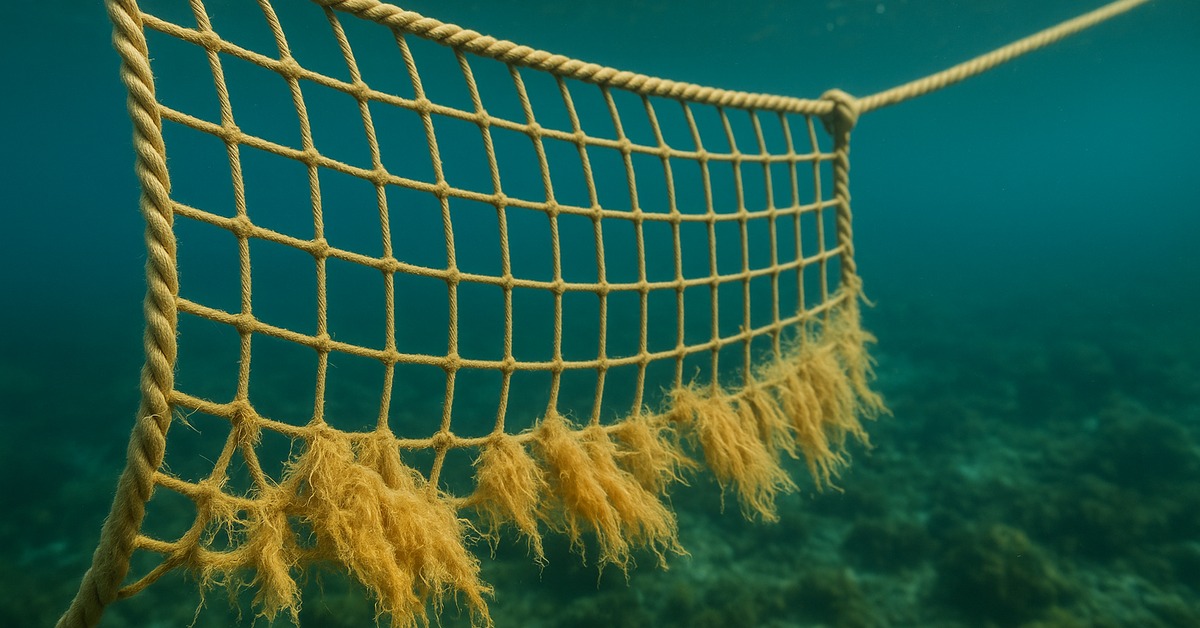
The optimism here is real. So is the uncertainty. Ocean environments aren’t uniform, and the enzyme communities and microbial populations that drive polymer degradation vary dramatically between the warm, bacteria-rich shallows of tropical seas and the cold, sparse depths of the Arctic. A net engineered to degrade predictably off the coast of Indonesia may behave completely differently beneath the Bering Sea.
Researchers are candid that comprehensive environmental testing across diverse marine ecosystems is still in early stages. There are open questions about degradation byproducts, too — whether all the breakdown compounds are as benign as laboratory models predict when they’re introduced into complex, living reef or kelp forest ecosystems. A technology that solves ghost fishing while quietly acidifying a reef system would be a trade no one should accept.
But the regulatory gap might be the biggest near-term obstacle. Frameworks for certifying biodegradable marine gear are nascent at best, with no internationally recognized standards yet established for testing or labeling claims. Which means manufacturers can say almost anything on a product label right now, and nobody has the authority to verify it. That’s a problem the technology itself can’t solve — and the people most exposed to bad labeling are the fishing communities least equipped to audit the claims they’re being sold.
How It Unfolded
- Early 2000s — Ghost gear first quantified as a significant share of ocean plastic pollution; the Global Ghost Gear Initiative begins coordinating international tracking efforts.
- 2010s — Materials scientists begin developing enzyme-sensitive polymer architectures as an alternative to conventional nylon and polyethylene fishing gear.
- 2019 — Field trials with fishing cooperatives in the Philippines and Norway demonstrate functional equivalence between biodegradable prototypes and standard commercial nets.
- 2026 — Biodegradable fishing nets enter broader market testing; international certification frameworks still under development, with no recognized global standard yet established.
By the Numbers
- 640,000 tonnes — fishing gear lost or abandoned in the world’s oceans every year
- 10% — share of total ocean plastic pollution attributed to ghost gear, per the Global Ghost Gear Initiative
- 600 years — estimated structural persistence of a nylon net abandoned in cold, deep water
- 3 years — targeted continuous-immersion threshold at which biodegradable nets begin meaningful degradation
- 1–2 seasons — typical active working life of a commercial fishing net before retirement or replacement
Field Notes
- Degradation rate in biodegradable nets is triggered by continuous submersion — regular air exposure during hauling and drying keeps breakdown negligible during active use
- Microbial enzyme communities responsible for degradation vary significantly between tropical shallows and Arctic deep water, meaning performance data from one region may not transfer directly to another
- Fishermen in Philippine and Norwegian field trials reported no meaningful difference in catch rates, knot strength, or mesh handling compared to standard nylon gear
- Unlike conventional plastics, which fragment into persistent microplastics, the target breakdown products of these engineered polymers are designed to integrate into natural marine biogeochemical cycles
- No internationally recognized certification standard currently exists for biodegradable marine fishing gear — labeling claims remain largely unverified
Frequently Asked Questions
- How do biodegradable fishing nets work? They’re built from engineered polymers containing chemical linkages that enzyme communities in seawater can break down. During normal use — when nets are regularly hauled, dried, and re-deployed — degradation is minimal. After roughly three years of continuous submersion, the material weakens progressively until microbial communities consume it entirely.
- Will they break down while fishermen are using them? No. The degradation mechanism requires sustained, uninterrupted immersion. Regular air exposure during hauling and drying inhibits the process, so working nets stay functionally stable throughout their normal operational life.
- Are the breakdown products safe for marine ecosystems? Laboratory models indicate yes — the polymers are designed to produce compounds that integrate into natural marine biogeochemical cycles rather than fragmenting into microplastics. Field verification across diverse real-world ecosystems is ongoing, and some questions about specific breakdown compounds in complex reef and kelp environments remain open.
- Do they actually catch as much fish as regular nets? Field trials in the Philippines and Norway suggest comparable performance. Fishermen reported similar catch rates, mesh stability, and knot strength. Independent large-scale validation across more fishing regions is still needed.
- Why aren’t they already in widespread use? Cost, scaling, and certification are the main bottlenecks. No internationally recognized standard exists for testing or verifying biodegradability claims in marine gear, which makes it difficult for buyers to evaluate products — and for manufacturers with genuinely better materials to distinguish themselves from those making marketing claims that haven’t been independently verified.
- Where can I learn more about ghost gear? The Global Ghost Gear Initiative maintains ongoing documentation of the problem’s scale and tracks interventions globally. For the materials science background, academic literature on biodegradable polymers is a reasonable starting point. For applied context, ocean plastic solutions coverage on this site tracks emerging developments across the field.
Editor’s Take — Alex Morgan
What stays with me about this story isn’t the chemistry — it’s the fishermen in those Philippines trials who started paying closer attention to where they dropped their gear once they understood what it was built to do. Nobody designed that outcome. It wasn’t in any research protocol. A material that changes behavior just by existing is doing something a policy memo never could. The certification gap is real and it will slow things down. But the instinct that drove this technology — that you can program accountability into an object — feels like something worth holding onto.
The fishing net has existed in essentially the same conceptual form for millennia — a tool of extraordinary simplicity pressed into service by human hunger and ingenuity. That it can now be redesigned at the molecular level to carry an expiration date, to participate in the ocean’s own biological rhythms rather than outlast them by centuries, is something I didn’t fully appreciate until I started digging into the materials science behind it. Scaling production to meet global demand, building certification standards that actually mean something, getting the information to fishing communities worldwide — that’ll take years of coordinated work. The ghost gear crisis won’t be resolved overnight. But the technology exists. The chemistry works. Somewhere beneath the surface, the ocean is already waiting.


