



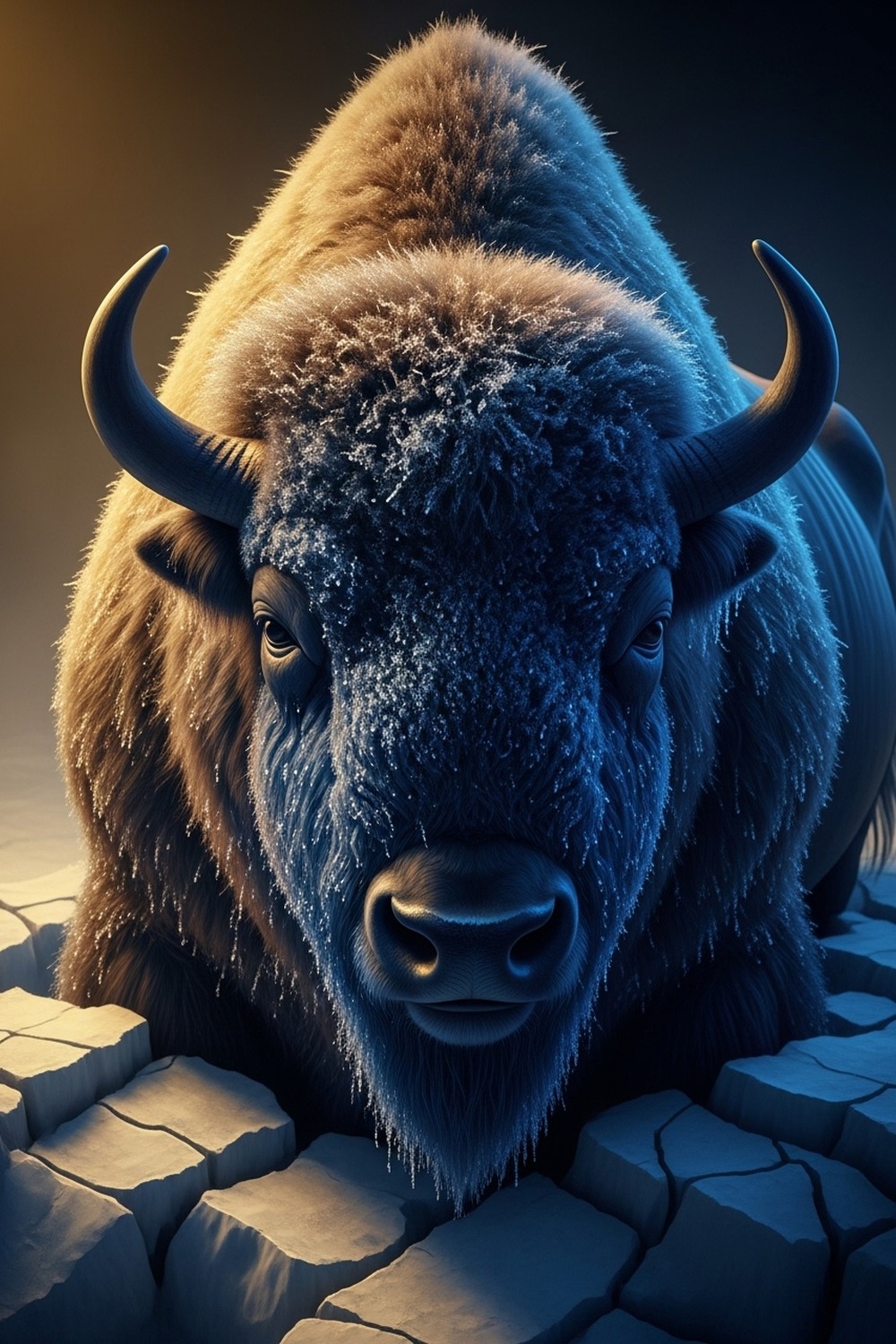
Blue Babe frozen bison Alaska — the name sounds almost whimsical until you understand what it actually describes: a 35,000-year-old bison carcass, not fossilized, not skeletal, but skinned in deep mineral blue and pulled from Alaskan permafrost with its muscles still fibrous and its digestive contents still readable. The preservation shouldn’t have been possible. And yet.
Gold miners using hydraulic equipment near Fairbanks in the summer of 1979 changed what scientists understood about Ice Age preservation. The bison hadn’t turned to stone. He had been frozen mid-decay, suspended by permafrost — and the first researchers to examine him found not just a body, but a story. A hunt. A kill. A world.

The Discovery That Stopped a Mining Crew Cold
Hydraulic mining — blasting permafrost with pressurized water to reach gold-bearing gravel beneath — near Fairbanks in Alaska’s Yukon-Tanana Uplands is not the kind of work that prepares you for the Pleistocene. When the frozen earth gave way in late July 1979, it revealed a nearly complete bison carcass, partially exposed, stained a vivid blue-violet. The color came from vivianite, an iron phosphate mineral that forms when iron compounds in the soil react with decomposing organic tissue under anaerobic, oxygen-deprived conditions (researchers actually call this a diagenetic transformation — and this matters more than it sounds, because it means the chemistry preserved the tissue even as it altered its appearance). It’s the same compound that sometimes stains ancient bones blue in waterlogged archaeological sites. In this case, it had saturated the bison’s hide, giving him a color no living animal has ever worn.
R. Dale Guthrie, a paleontologist at the University of Alaska Fairbanks, led the subsequent scientific investigation and would go on to write the definitive account of the specimen. The miners contacted the university almost immediately. Guthrie’s team moved fast — permafrost specimens degrade rapidly once exposed to air and warmth. They transported the carcass to a refrigerated facility and began the meticulous process of thawing, documenting, and sampling.
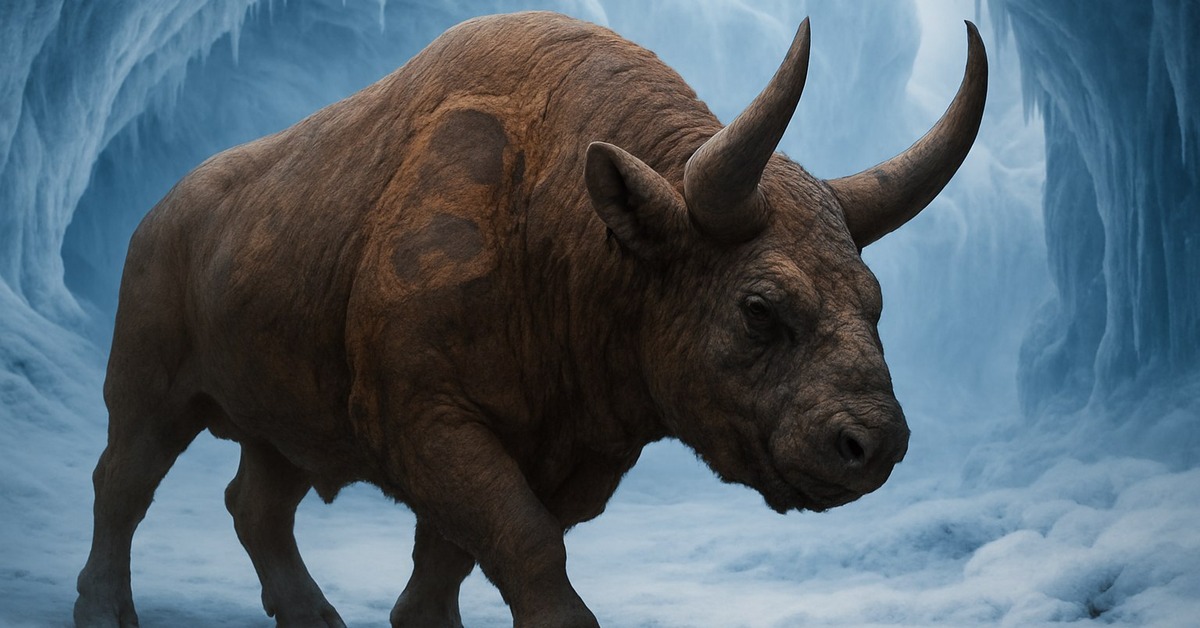
What they found exceeded every expectation. Skin largely intact. Muscles retaining their fibrous structure. Digestive contents survived. Nose leather still present. This wasn’t a fossil in any conventional sense — it was closer to a mummy, preserved with astonishing fidelity.
They named him Blue Babe, after the great blue ox of Paul Bunyan’s folklore. The name was irreverent, affectionate, and oddly perfect. Here was a giant of the Pleistocene, stained the color of legend. The name stuck.
The Mammoth Steppe and the World He Roamed
Blue Babe wasn’t just a bison. He was a window into a vanished ecosystem — one of the most productive cold-weather grasslands the Earth has ever sustained. The Mammoth Steppe, as paleontologists call it, stretched from Western Europe across Siberia and into Alaska and the Yukon during the Pleistocene epoch. Rich, grassy, densely populated with large herbivores: woolly mammoths, woolly rhinoceroses, horses, reindeer, musk oxen, and the steppe bison, Bison priscus. The predators who hunted them were equally impressive — cave hyenas, dire wolves, and the cave lion, Panthera leo spelaea, one of the largest felids that ever lived.
To understand what Blue Babe tells us about this ecosystem, it helps to think about how life has always organized itself around resources, predators, and terrain — a dynamic as old as complex animal behavior itself, visible even in the trilobites that gathered and moved in groups across ancient environments 500 million years ago, as explored in this look at how trilobites gathered 500 million years ago.
Blue Babe belonged to Bison priscus, a species larger and more robust than modern American bison. Radiocarbon dating, conducted in the 1980s, placed his death at approximately 36,000 years ago — a figure later revised using more refined techniques. More recent AMS radiocarbon analysis, including work referenced in Guthrie’s 1990 monograph Frozen Fauna of the Mammoth Steppe, settled on an age closer to 31,000 to 36,000 years before present. Some accounts cite figures up to 47,000 years based on earlier dating methods. The uncertainty itself is scientifically meaningful — it reflects how difficult it is to pin down exact dates for organic material at the outer edge of radiocarbon’s reliable range.
The Mammoth Steppe is gone. Its precise ecology — why it was so productive, why it collapsed — is still debated. Blue Babe doesn’t resolve that debate. But he makes it vivid in a way no bone assemblage ever could.
Claw Marks, Bite Marks, and a Cave Lion Attack
Why does the wound evidence matter so much? Because what Guthrie’s team identified on Blue Babe’s neck, back, and hindquarters wasn’t ambiguous — it was a forensic record of a specific predation event, stamped into preserved tissue and readable across 30 millennia.
Bite marks and claw punctures on the bison’s body matched, through careful comparison with known predator jaw measurements, the bite pattern of Panthera leo spelaea, the Pleistocene cave lion. Estimated to be roughly 10 to 25 percent larger than a modern African lion based on skeletal remains recovered across Eurasia, the cave lion was a formidable predator. According to research compiled by the Smithsonian Institution’s National Museum of Natural History, Pleistocene megafaunal predator-prey interactions remain one of the most actively studied areas in Ice Age paleontology, precisely because physical evidence of actual kills is so rarely preserved.
Turns out the Blue Babe frozen bison specimen offered something almost unprecedented: a direct, physical record of a predation event from tens of thousands of years ago. Guthrie believed there may have been more than one lion involved. The wound patterns suggest a coordinated assault from behind and above — but the kill wasn’t completed cleanly. Something interrupted it. The leading hypothesis is that temperatures dropped sharply, the bison died from his injuries in freezing conditions, and the carcass was rapidly buried by windblown sediment before scavengers could reach it.
A fragment of cave lion claw was actually recovered from the bison’s skin during examination — physical evidence of the attacker, embedded in the victim, preserved across 30,000-plus years. The predator left a calling card, and the permafrost kept it.
A specimen that preserves not just anatomy but a datable, species-specific violent encounter is, to be direct about it, the kind of evidence that should permanently recalibrate how cautiously we speak about inferring behavior from the fossil record.

Blue Babe Frozen Bison Alaska: What He Tells Science Now
Blue Babe’s value to science didn’t end with Guthrie’s original study. In 1984, Guthrie and colleagues consumed a small portion of Blue Babe’s neck meat, slow-cooked in a stew, as part of an informal celebration marking the completion of the specimen’s preparation. Guthrie reported that the meat was “not unpleasant” but had a strong, slightly mineral aftertaste — consistent with what one might expect from vivianite-saturated tissue. It was an unusual act, but it confirmed something important: cellular-level tissue had survived, and the bison was, in a very real sense, still a biological object rather than a mineralized artifact.
Advances in ancient DNA analysis have since opened new possibilities. The University of Copenhagen’s Centre for GeoGenetics, which has led much of the world’s Pleistocene genomics work since the early 2000s, has demonstrated that permafrost-preserved specimens can yield high-quality DNA even after tens of thousands of years. Bison priscus specimens have contributed to understanding how modern American bison and European wisent diverged from their common ancestor. Blue Babe himself hasn’t been the subject of published genomic analysis as of the most recent literature — but specimens of comparable age and preservation have yielded usable sequence data, meaning his genetic material may still hold recoverable information.
And he now resides at the University of Alaska Museum of the North in Fairbanks, reconstructed and on permanent display, where visitors stand a few feet from a body that walked the same Alaskan ground they drove to reach. That compression of temporal distance into physical closeness is something no textbook replicates.
How It Unfolded
- ~31,000–36,000 years ago: A steppe bison is attacked, likely by cave lions, and dies on the Alaskan tundra, rapidly frozen and buried in permafrost near present-day Fairbanks.
- July 1979: Gold miners using hydraulic equipment near Fairbanks expose the nearly complete carcass; the University of Alaska Fairbanks is notified within days.
- 1984: R. Dale Guthrie and his team complete scientific preparation of the specimen; informal consumption of tissue confirms extraordinary soft-tissue preservation.
- 1990: Guthrie publishes Frozen Fauna of the Mammoth Steppe, the comprehensive scientific account of Blue Babe and the ecosystem he inhabited.
By the Numbers
- ~31,000–36,000 years: Estimated age of the Blue Babe specimen based on AMS radiocarbon dating (Guthrie, 1990)
- 10–25%: Estimated size advantage of Panthera leo spelaea (cave lion) over a modern adult male African lion, based on comparative skeletal analysis
- ~90%: Approximate proportion of large Ice Age megafauna species that went extinct in North America between 13,000 and 10,000 years ago
- 1 fragment: Number of cave lion claw tips physically recovered from Blue Babe’s preserved hide — direct forensic evidence of the attack
- 1: Blue Babe is the most complete frozen steppe bison specimen ever recovered from North American permafrost
Field Notes
- Vivianite coloration isn’t unique to this specimen — the same iron phosphate compound has been found staining bones in Neolithic burial sites across Europe — but it has rarely been observed coloring preserved soft tissue at this scale. The blue hue was immediately visible to the miners in 1979 and hadn’t faded when Guthrie’s team examined the carcass.
- Blue Babe’s digestive contents were analyzed and found to include grass and sedge species consistent with Mammoth Steppe vegetation — meaning we know, with reasonable certainty, what he ate in the final days before his death.
- Cave lions in Pleistocene Alaska are attested not just through Blue Babe’s wounds but through direct fossil remains; at least four cave lion specimens have been recovered from Alaskan permafrost contexts, suggesting a resident population rather than occasional migrants.
- Researchers still can’t determine with certainty whether the lion attack directly killed Blue Babe or whether he survived the initial assault and succumbed to injuries or hypothermia shortly after — the preserved wound evidence is consistent with both scenarios, and no cause of death can be definitively ruled in or out.
Frequently Asked Questions
Q: What exactly is the Blue Babe frozen bison Alaska specimen, and where is it now?
Blue Babe is a naturally mummified steppe bison (Bison priscus) recovered from permafrost near Fairbanks, Alaska in 1979. Approximately 31,000 to 36,000 years old, he is one of the best-preserved large mammal specimens from the Pleistocene epoch ever found — skin, muscle tissue, and digestive contents all survived intact. He’s currently on permanent display at the University of Alaska Museum of the North in Fairbanks, where visitors can see the reconstructed specimen in person.
Q: Why is Blue Babe blue? What caused the color?
The blue color comes from vivianite, a hydrated iron phosphate mineral that forms when iron compounds in soil react with phosphorus released by decomposing organic tissue in low-oxygen, waterlogged conditions. As the bison’s body began to decompose before freezing, this chemical reaction saturated his hide with vivianite crystals, producing the deep blue-violet staining. It’s the same mineral that occasionally colors ancient human bones found in waterlogged archaeological sites, though it’s rare to see it preserved across soft tissue at this scale.
Q: Did cave lions really kill Blue Babe, and how do we know?
The evidence is strong but not absolute. Paleontologist R. Dale Guthrie identified bite marks and claw punctures on Blue Babe’s neck and hindquarters whose dimensions and spacing match the jaw anatomy of Panthera leo spelaea, the Pleistocene cave lion. A fragment of cave lion claw was also recovered directly from the preserved hide. What remains unconfirmed is whether the attack was the direct cause of death, or whether Blue Babe survived temporarily before dying from wounds or exposure. The predation event is well-evidenced; the precise cause of death is still uncertain.
Editor’s Take — Dr. James Carter
What strikes me most about Blue Babe isn’t the preservation — it’s the claw tip. One fragment of a cave lion’s nail, still embedded in a bison’s skin after 35,000 years. We spend a lot of time in paleontology inferring behavior from bones and sediment layers. Blue Babe skips all that inference. He’s a snapshot of a specific afternoon, a specific predator, a specific chase. That kind of resolution is almost unbearably rare. It should change how we talk about what the fossil record actually can and can’t tell us.
Blue Babe sits in a museum in Fairbanks, a few hundred kilometers from where he died. The permafrost that preserved him is warming — faster than at any point in the last 10,000 years. As it thaws, more bodies will emerge: mammoths, horses, lions, bison, organisms that haven’t seen open air since the Ice Age. Some will be as complete as Blue Babe. Some will carry information we don’t yet have the tools to read. What the frozen ground is about to give back to science is unknown. The question is whether we’re ready for it.


