The Deadliest Thing in the Ocean Fits in Your Palm
Blue-ringed octopus venom has no antidote — and that’s not a gap in medical knowledge anyone is close to filling. A creature the size of a golf ball, sitting in a tide pool that looks like nothing, carrying enough tetrodotoxin to kill 26 adults. The bite is nearly painless. By the time most people understand what happened, the window for anything useful has already closed.
Somewhere off the Australian coast, a soft-bodied animal the size of your fist is tucked between two rocks in a shallow pool. No spines. No claws. Nothing that reads as threatening. It looks, honestly, like something decorative — the kind of thing a tourist might scoop up for a photo. That impulse has nearly killed people.
Blue-Ringed Octopus Venom: Nature’s Most Lethal Surprise
The blue-ringed octopus carries tetrodotoxin — the same neurotoxin found in pufferfish — but concentrated enough to kill 26 adult humans from a single bite. According to research documented on Wikipedia, tetrodotoxin works by blocking sodium channels in nerve cells, which basically shuts off the body’s ability to breathe. What makes this particularly unsettling is that the bite is nearly painless. A lot of victims don’t realize anything happened until they can’t move their fingers.
Here’s the thing: the octopus doesn’t even produce the toxin itself. It’s manufactured by symbiotic bacteria living inside the animal’s salivary glands — the octopus is essentially hosting a tiny biological weapons lab. And those bacteria aren’t paying rent.
When the Blue Rings Flash, Run
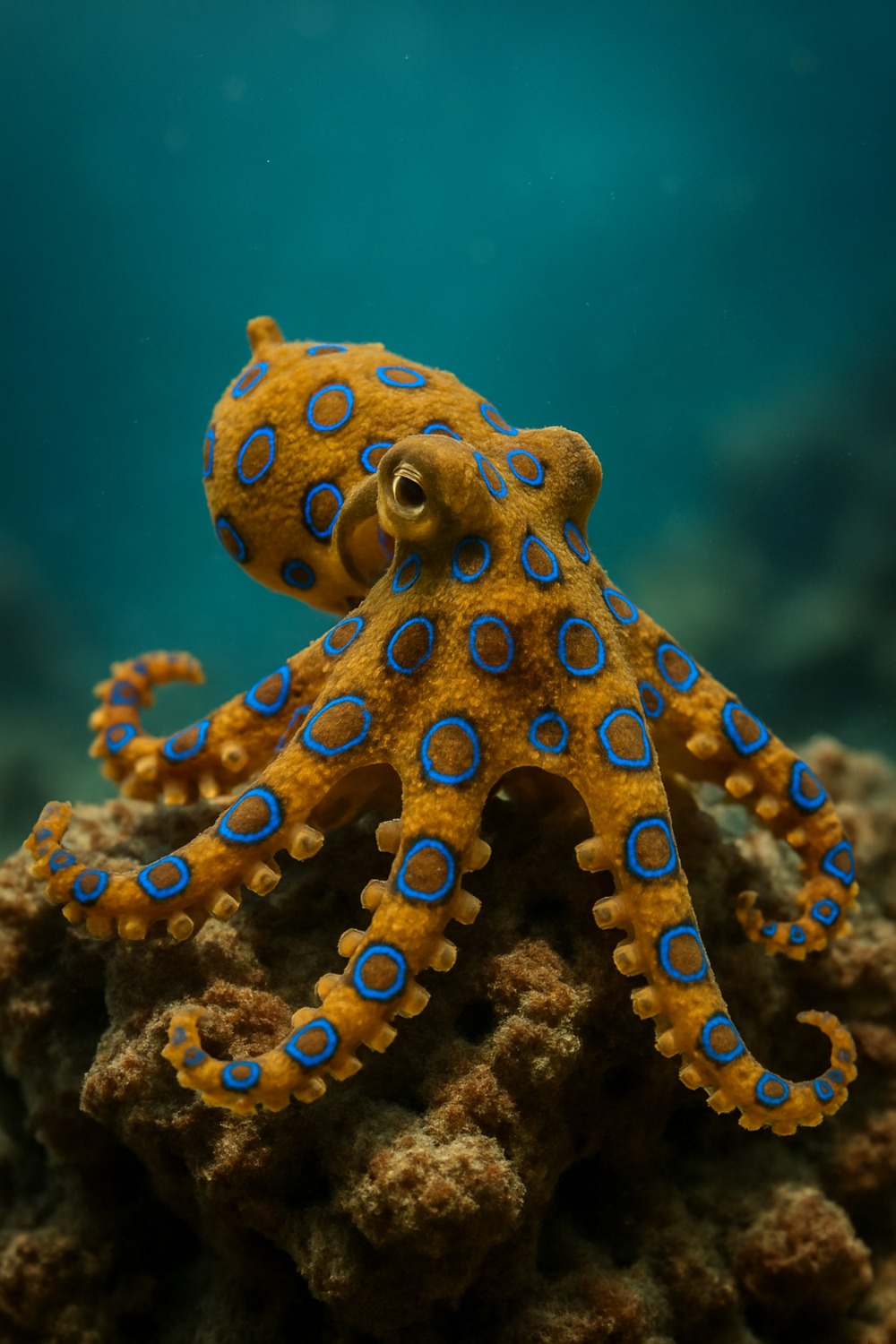
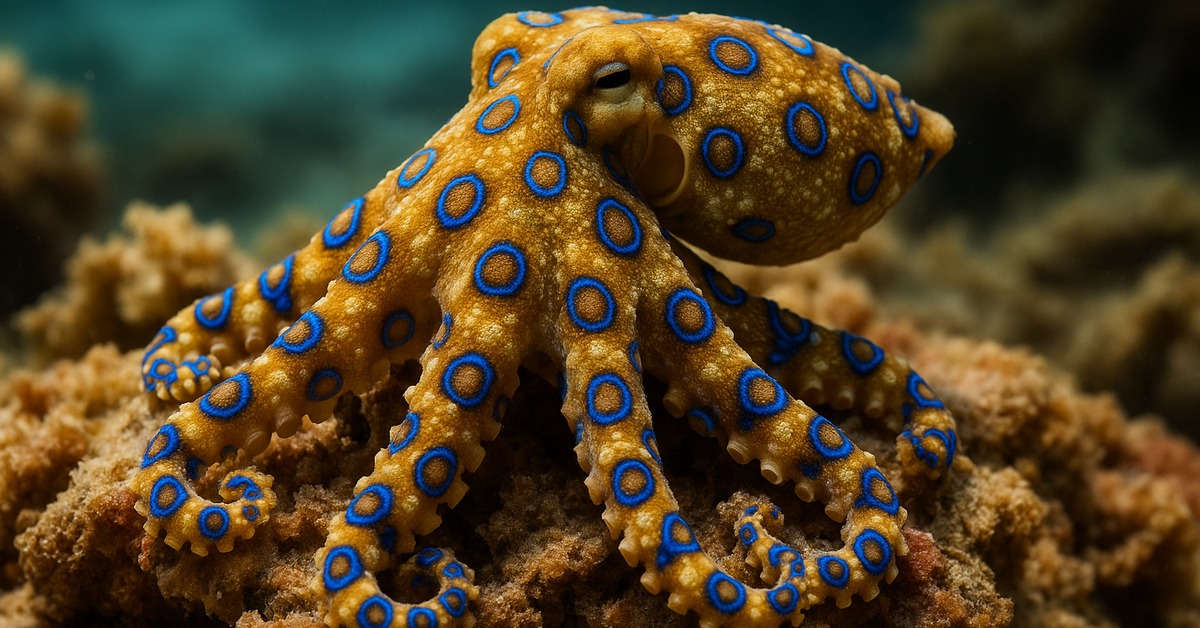
Those 50 to 60 iridescent rings scattered across its body start pulsing when it feels cornered — neon blue, rapid-fire, almost strobing. It’s one of the most visually dramatic warning signals in the animal kingdom. Most of the time, though, this animal is invisible. Its skin shifts constantly — sand, coral, rock — and it barely registers as a living thing until you’re already too close. If you want to understand how ocean creatures evolved to survive without size or speed, this-amazing-world.com goes deep into exactly that.
The rings aren’t aggression. They’re fear — which matters, because a frightened blue-ringed octopus is a dangerous one. The beauty is the warning. Most people just don’t know how to read it.
No Antidote, No Mercy, No Second Chance
There is no antidote. Not a weak one, not a partial one — none at all. Despite decades of research, scientists have never developed a specific treatment for blue-ringed octopus venom. If someone gets bitten, the only option is immediate artificial respiration: manually keeping the person breathing, sometimes for hours, until the toxin clears their system. The victim can be fully conscious through all of it — completely paralyzed, aware of everything around them, unable to communicate. That last detail isn’t speculation. It’s in the case reports.
Why does this matter? Because the gap between “I’m fine” and “this is a medical emergency” is brutally short — sometimes minutes — and the bite itself looks like nothing more than a small scratch.
Victims have described feeling completely normal, then losing control of their limbs before they could reach for a phone. The bite is tiny, almost invisible, frequently mistaken for an insect sting.
There’s no second warning.
This Small Animal Lives Everywhere You’d Swim
Blue-ringed octopuses live throughout the Indo-Pacific — Australia, Japan, the Philippines, parts of the Indian Ocean — in shallow coastal waters, tide pools, coral reefs, sandy flats, rocky shores. Exactly the places where swimmers, snorkelers, and tourists spend their afternoons. They hide in shells, inside old bottles, tucked into debris. People have picked up what looked like a pretty shell only to find it already occupied.
They’re not hunting anyone. They’re small, expertly camouflaged, and perpetually surrounded by accidental threats — which is precisely what humans are, from the octopus’s perspective. And that combination, small plus invisible plus lethal, is what makes them so genuinely dangerous.
Scientists Still Don’t Fully Understand How It Works
Researchers don’t have the full picture yet — and that’s not false modesty. Scientists still can’t fully explain how blue-ringed octopuses regulate tetrodotoxin production: how they avoid poisoning themselves, how they control venom delivery, or exactly how that bacteria-host relationship evolved in the first place. Cephalopod researcher Dr. Roy Caldwell at UC Berkeley has studied these animals extensively, and even within his field there’s ongoing disagreement about how many distinct species actually exist. Most sources confirm at least three. The real count is probably higher.
A field where the species count is still contested is a field that hasn’t finished surprising people. And then there’s the pharmaceutical angle. Tetrodotoxin, in extremely controlled doses (researchers actually call this “sub-lethal therapeutic dosing”), is being studied as a potential painkiller — specifically for chronic pain and opioid withdrawal. One of the deadliest compounds in the ocean is being quietly researched as a way to save lives in hospitals. Biology really does have a sense of irony.
How It Unfolded
- 1955 — Hapalochlaena maculosa formally described; early toxicology notes flagged unusual potency but the mechanism remained unknown
- 1964 — Tetrodotoxin isolated and identified as the active neurotoxin; linked to the blue-ringed octopus through case studies in Australian hospitals
- 1988 — Symbiotic bacteria confirmed as the source of tetrodotoxin production, shifting understanding of how marine animals acquire chemical defenses
- 2010s–present — Tetrodotoxin enters clinical trials as a candidate treatment for chronic pain and opioid withdrawal; species count still under active revision
By the Numbers
- Tetrodotoxin is approximately 1,200 times more toxic than cyanide by weight — a lethal dose for an adult is estimated at just 1–2 micrograms per kilogram of body weight (National Institutes of Health toxicology data)
- One octopus, enough venom to potentially kill 26 adults
- Body length when fully extended: 5–8 inches (12–20 cm), making it one of the smallest venomous marine animals relative to its lethal potential
- At least 3 confirmed species exist — Hapalochlaena lunulata, H. maculosa, H. fasciata — though researchers suspect up to 10 additional undescribed species may be scattered across the Indo-Pacific, still unclassified
Field Notes
- The blue rings only appear when the octopus is alarmed. A calm one looks completely ordinary — no rings visible at all.
- Unlike most venomous animals, there’s no stinger or fang involved. The blue-ringed octopus bites with a beak-like structure similar to a parrot’s bill, and the puncture is so small it frequently gets mistaken for a scratch or insect bite — which is part of what makes delayed treatment so common.
- Tetrodotoxin has turned up in other marine animals too — pufferfish, certain starfish, some flatworms. The toxin-producing bacteria appear to be far more widespread in ocean ecosystems than anyone expected, and that’s still being studied.
Why the Smallest Predator Matters Most
Size was never the strategy. The blue-ringed octopus developed chemistry instead — a defensive system so effective that nothing in its environment has found a reliable way around it. Blue-ringed octopus venom is, in a real sense, the product of millions of years of biological problem-solving compressed into an animal smaller than your fist. An animal that never needed to be fast, or large, or visible.
The practical lesson is blunt: shallow water isn’t automatically safe water. The most dangerous things in the ocean rarely look dangerous. If you’re snorkeling in the Indo-Pacific and something small, soft, and strangely beautiful starts flashing neon blue at you — back away. Immediately. Every time.
Editor’s Take — Alex Morgan
What stays with me isn’t the venom potency or the absence of an antidote — it’s the consciousness detail. Fully aware, completely paralyzed, unable to signal anyone. That’s buried in case reports most people will never read. The blue-ringed octopus doesn’t get the cultural fear it deserves because it’s small and it doesn’t chase you. But the thing that should unsettle everyone is this: the ocean floor is covered in tide pools, and nothing about this animal announces itself until it already feels threatened.
The blue-ringed octopus doesn’t roar or chase or posture. It just exists — quietly, efficiently, lethally — in the same tide pools where kids splash around and tourists take photos. It’s a reminder that the ocean doesn’t calibrate danger to size. Sometimes the smallest thing in the water is the one that deserves the widest berth. If this kind of story is your thing, there’s more waiting at this-amazing-world.com — and the next one is stranger still.