


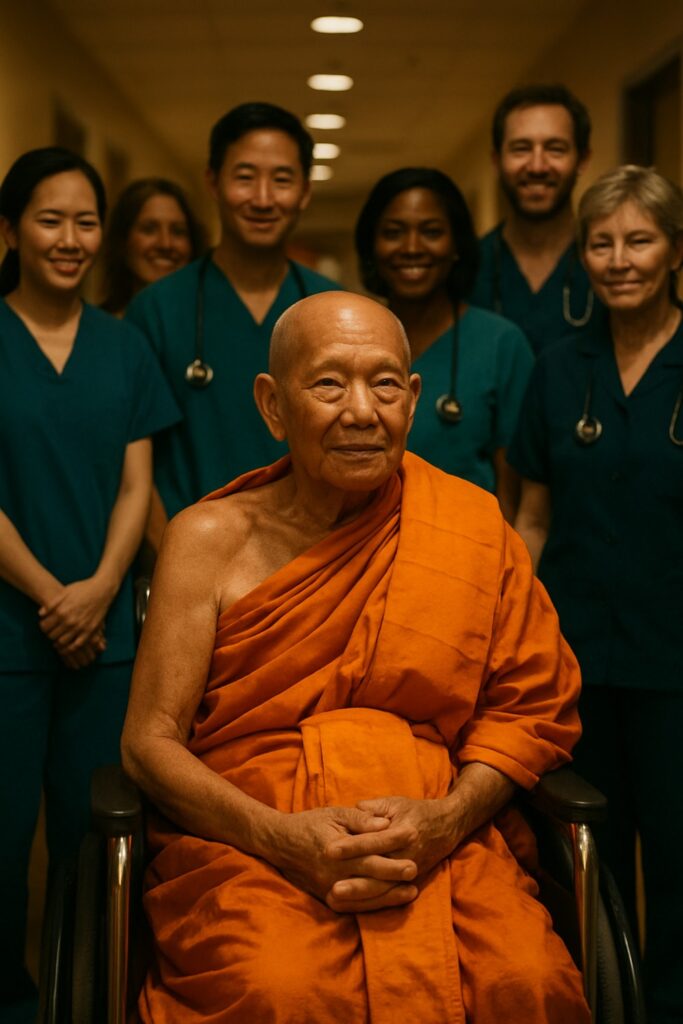
Forgiveness, in most traditions, is something you arrive at eventually — after the grief settles, after the legal process runs its course, after enough time has passed to make peace feel possible. Phra Ajarn Maha Dam Phommasan, a senior Theravada Buddhist monk on a 2,300-mile Buddhist monk peace walk, didn’t wait for eventually. He forgave from a hospital bed, hours after a vehicle took his leg on a Texas roadside. That gap — between what most people would feel and what he actually did — is the whole story.

The Ancient Tradition Behind One Monk’s Walk for Peace
Peace walks don’t begin on a roadside in Texas. They begin centuries earlier, in the forests and mountain passes of Southeast Asia, where Theravada Buddhist monks first codified the practice of walking as spiritual witness — not pilgrimage for personal gain, but movement as moral statement. In the Theravada tradition, which traces its roots back to the 3rd century BCE and remains dominant across Thailand, Laos, Cambodia, Myanmar, and Sri Lanka, monks walk vast distances during periods of conflict or societal suffering. The act is called a form of metta — loving-kindness in motion.
Maha Dam’s walk in 2024 carried that same centuries-old weight across American highways. It wasn’t symbolic in the abstract sense. It was a living demonstration of a doctrine that holds peace not as an ideal to be argued but as a practice to be embodied, mile after mile, in the heat and dust of a country he had chosen to call home.
He didn’t drive. He didn’t organize a convoy or a media team. He walked. Alone. Through the Texas heat, through small towns and long rural stretches where a monk in saffron robes must have seemed like something from another world entirely. That solitude wasn’t a logistical oversight — it was the point. In Theravada practice, the solo walking monk represents a particular kind of courage: the willingness to be present, unhurried, and undefended in a world that moves fast and defends hard. By the time he reached Dayton, Texas, he had already covered hundreds of miles on foot.
Communities along the route stopped, photographed, and sometimes walked alongside him for a stretch. A monk in motion through the American South draws attention not because it’s strange, but because it’s quiet in a way most of us have forgotten how to be. The walk was witnessed. Then the car came.
The Collision, the Hospital, and the Forgiveness That Stunned a Ward
Trauma medicine sees a great deal of human nature in its rawest form. Emergency physicians and nurses at Piedmont Healthcare in Georgia, where Maha Dam was eventually treated, are trained for the physiological crisis — the blood pressure drop, the surgical decisions made in minutes, the long recovery protocols that follow traumatic amputation. What they’re less prepared for is what arrived alongside the patient.
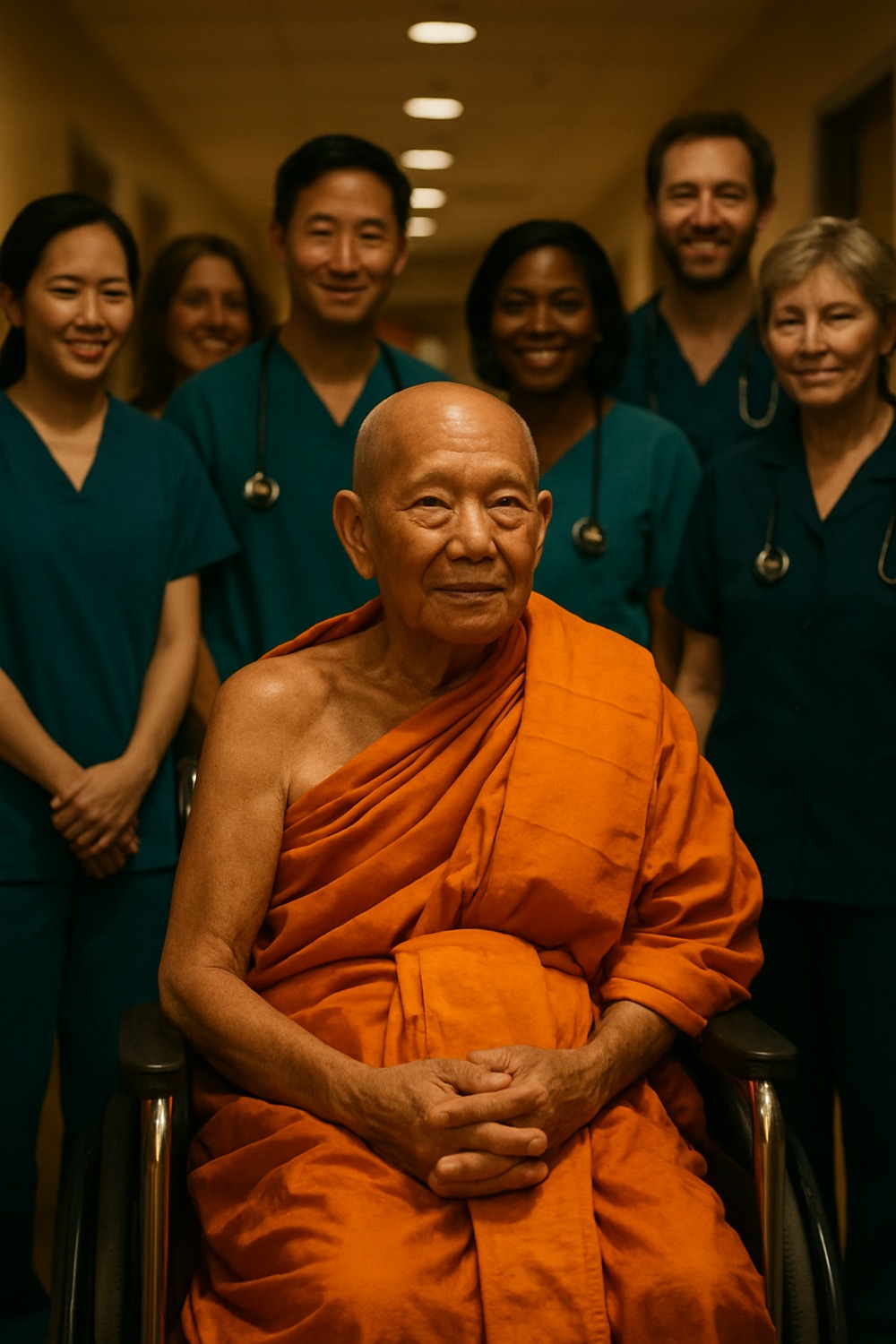
Medical staff who cared for Maha Dam described being visibly moved by his calm — not a sedated calm, not a dissociated calm, but an awake, present, chosen stillness. The kind of equanimity that takes decades of practice to build and that most of us, faced with the same catastrophic loss, simply wouldn’t be able to access. The parallels to other cases of extraordinary human resilience documented in clinical settings are striking — much like the medical teams who described similar awe when working on cases of unexpected survival, including those documented in fetal surgery cases like the story of a baby operated on before she was even born, where the composure of families under extreme medical pressure reshaped what caregivers thought resilience looked like.
From his hospital bed, Maha Dam offered forgiveness to the driver. Not privately, not through a lawyer, not months later after the shock had settled. Immediately. His words, reported by multiple sources present at the time, were precise: “Anger does not bring you peace.” There are no anger charges pending, no civil suit, no public campaign for punishment. In 2024, in an American legal and media culture exceptionally well-equipped to amplify grievance, he chose something older and harder. He chose to release it.
This isn’t naivety. Buddhist doctrine on forgiveness is not the same as forgetting or excusing harm — it is, rather, the refusal to allow harm to compound, to let the original injury become a permanent interior wound that travels with you. He had already lost his leg. He was not going to lose his peace as well.
What the Science of Forgiveness Actually Tells Us
Why does this matter? Because decades of research in psychology and neuroscience have quietly built an evidence base that supports exactly what he demonstrated.
Maha Dam’s response might read as extraordinary to a Western audience, but turns out the data has been pointing this direction for a long time. The Stanford Forgiveness Project, led by psychologist Dr. Fred Luskin and founded in 1998, has produced some of the most cited research in the field, documenting measurable reductions in stress hormones, blood pressure, and depression scores in subjects who underwent forgiveness training after serious harm. What most people misunderstand about this research is that the health benefits of forgiveness accrue to the person who forgives, not to the person forgiven. The brain’s threat-response system, centered in the amygdala, remains in a state of chronic activation when grievance is held. Forgiveness, in a neurological sense, is the act of telling that system the emergency is over. As Smithsonian Magazine’s reporting on forgiveness research has outlined, the physiological cost of sustained anger is not metaphorical — it is measurable, accumulative, and serious.
And here’s where the Buddhist monk peace walk forgiveness narrative intersects with hard science in a way that should surprise people: the monks and contemplatives who’ve practiced metta and forgiveness-based meditation for years don’t just report feeling better. Their neurological profiles look different. Neuroscientist Dr. Richard Davidson at the University of Wisconsin–Madison spent years studying long-term meditators and published findings in 2004 showing significantly higher activity in the left prefrontal cortex — associated with positive affect and emotional regulation — in experienced practitioners compared to control groups. Maha Dam had decades of training. His response in that hospital room wasn’t a performance of virtue. It was the output of a deeply conditioned nervous system doing what it had been trained to do.
A culture built on legal redress and emotional closure through confrontation finds this uncomfortable. What if the most effective path through catastrophic loss isn’t processing anger until it’s gone — but training the mind, over years, not to generate it in the same way at all? What Maha Dam demonstrated isn’t something most of us can replicate overnight. But it is something that can be learned.
History has a way of treating the people who ignored this kind of evidence unkindly — especially when that evidence keeps showing up wearing a face as undeniable as his.
Buddhist Monk Peace Walk Forgiveness: A Community’s Response
When Maha Dam returned to Wat Lao Buddha Khanti Temple in Snellville, Georgia, after months of surgery and recovery, his community did not greet him with mourning. They celebrated. This detail matters enormously. In many cultural contexts, a catastrophic physical loss — the amputation of a leg, the end of a 2,300-mile journey before its completion — would be framed as failure or tragedy. The community at Wat Lao Buddha Khanti reframed it as neither. The monk had walked into harm’s way in service of peace. He had responded to that harm with the very quality he had been walking to promote. In a tradition where intention carries as much weight as outcome (researchers of Buddhist philosophy actually call this the primacy of cetana — the mental factor of will), the walk’s interruption didn’t undo its meaning. Scholars at institutions including the University of Toronto’s Centre for Buddhist Studies have written extensively on how the Theravada view of kamma emphasizes intention over result, making the act of walking with compassion its own complete event, independent of whether Washington, D.C. was ever reached.
He came home. He came home without a leg and without anger.
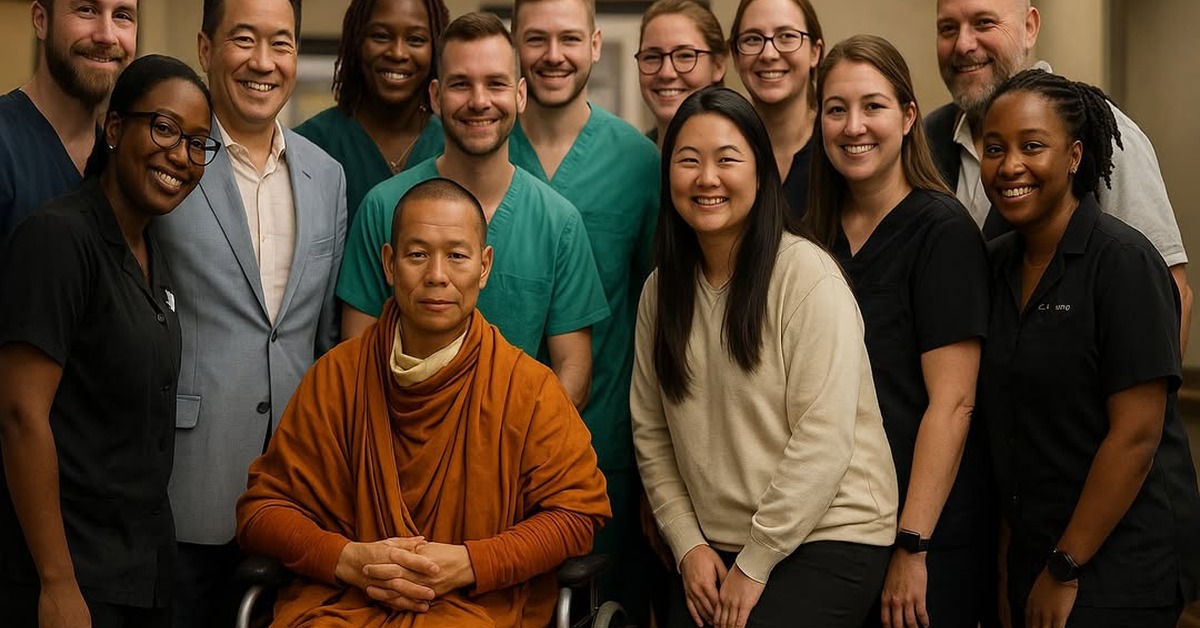
That is not a small sentence. The monks and laypeople at Wat Lao Buddha Khanti didn’t gather to console Maha Dam — they gathered to honor him. That shift from sympathy to recognition tells us something about what the community had built together: a framework for interpreting suffering that doesn’t require suffering to have been avoidable to be meaningful. For the people who saw him walk through that temple door, it may have been the most complete teaching he ever gave — not from a lecture, not from a text, but from what his body and his face showed them when he arrived. The celebration drew attention far beyond the immediate congregation, reported across local Georgia media in 2024.

How It Unfolded
- 3rd century BCE — Theravada Buddhism formalizes walking practice (dhutanga) as a form of spiritual discipline and metta cultivation across South and Southeast Asia.
- 20th century — Peace walks as public spiritual witness gain visibility globally, with monks walking through conflict zones in Vietnam, Cambodia, and later the United States during protests and periods of national division.
- 2024 — Phra Ajarn Maha Dam Phommasan begins his 2,300-mile peace walk from Fort Worth, Texas, to Washington, D.C., drawing community attention and media coverage along the route through the American South.
- 2024 — Maha Dam is struck by a vehicle near Dayton, Texas, loses his leg, and offers immediate public forgiveness to the driver from his hospital bed at Piedmont Healthcare — his response becoming internationally reported.
By the Numbers
- 2,300 miles — the planned length of Maha Dam’s peace walk from Fort Worth, Texas, to Washington, D.C. in 2024.
- Hundreds of miles completed on foot, alone, before the collision near Dayton, Texas.
- Stanford Forgiveness Project (est. 1998): documented statistically significant reductions in perceived stress in over 260 participants across multiple published studies.
- 2004 — Dr. Richard Davidson’s University of Wisconsin–Madison study found gamma wave activity in experienced meditators 25× higher than in non-meditating controls, published in the Proceedings of the National Academy of Sciences.
- Wat Lao Buddha Khanti Temple, Snellville, Georgia — one of over 1,000 Lao Buddhist temples established in the United States since the late 1970s following refugee resettlement waves from Southeast Asia.
Field Notes
- A 2005 study by Everett Worthington Jr. at Virginia Commonwealth University found that forgiveness interventions delivered in a single five-hour session produced the same measurable reductions in anger and depression as multi-week programs — suggesting that speed of forgiveness, when trained, is not the same as superficiality. This has a direct clinical parallel to the forgiveness practice Maha Dam embodies.
- Theravada monks on long solo walks traditionally carry only eight permitted possessions, including a robe, alms bowl, and needle — a material discipline that, researchers of contemplative practice argue, directly shapes the relationship between self and circumstance long before any crisis arrives.
- Traumatic amputation triggers the same neurological grief response as bereavement in many patients — yet Maha Dam’s documented lack of anger response is consistent with findings from a 2017 University of Oxford study on long-term meditators, which found atypically low amygdala reactivity to threat stimuli compared to age-matched controls.
- Researchers at institutions including Harvard Medical School’s Benson-Henry Institute for Mind Body Medicine still cannot fully explain why some individuals with no formal meditation training also exhibit rapid forgiveness responses following catastrophic injury — suggesting that neurological baseline, early attachment patterns, and cultural framework all intersect in ways that existing forgiveness models don’t yet account for.
Frequently Asked Questions
Q: What is the Buddhist monk peace walk forgiveness story, and why did it attract global attention?
In 2024, Phra Ajarn Maha Dam Phommasan — a senior Theravada Buddhist monk — was struck by a vehicle while conducting a 2,300-mile solo peace walk from Fort Worth, Texas, to Washington, D.C. He lost his leg in the collision. From his hospital bed at Piedmont Healthcare, he publicly forgave the driver with the words “Anger does not bring you peace.” The story spread internationally because it embodied, in a single undeniable moment, a principle most spiritual traditions preach but few people are seen to practice under real duress.
Q: Is Buddhist forgiveness the same as excusing the harm that was done?
No — and this is the most commonly misunderstood dimension of the practice. In Theravada Buddhist philosophy, forgiveness is not a statement about the moral status of the act that caused harm. It’s a deliberate refusal to allow that harm to continue compounding inside the person who was hurt. Maha Dam didn’t say the accident was acceptable. He said he wouldn’t carry anger about it. That’s not passivity — it’s one of the most disciplined choices a human nervous system can make, and it requires decades of practice to access instinctively.
Q: Can people without monastic training develop this kind of forgiveness response?
The research says yes — with significant caveats about time and method. The Stanford Forgiveness Project and multiple clinical trials conducted since 1998 have shown that structured forgiveness training produces measurable psychological and physiological benefits even in people with no prior meditation experience. The speed and depth of Maha Dam’s response, though, reflects a level of contemplative conditioning that can’t be replicated in a weekend workshop. Think of it as the difference between someone who jogs occasionally and an elite marathon runner — the underlying biology is the same, but the training gap is real and it matters.
Editor’s Take — Sarah Blake
What unsettles me most about this story isn’t the forgiveness itself — it’s the immediacy of it. Not after months of therapy, not after a settlement was reached, not after the anger had burned down to something manageable. Immediately. From a hospital bed. That’s not a human default. That’s a human achievement, built over years, visible only in the worst moment. We talk constantly about mental fitness and resilience culture, but Maha Dam shows what it actually looks like when someone has done the work so completely that it holds under catastrophic pressure. The rest of us are still warming up.
Somewhere on a Texas roadside, a 2,300-mile walk ended in the way it did. The route between Fort Worth and Washington still exists, unfinished. And yet the message arrived. It arrived in a hospital ward where medical staff stood quietly in the presence of something they hadn’t been trained to treat. It arrived in a temple in Georgia where a community chose celebration over grief. It arrived here, in the reading of it, where a question waits: not whether you could walk 2,300 miles, but whether you’ve practiced enough to hold your peace when the road turns entirely against you.


