The Monk Who Lost a Leg but Never Lost His Peace
Here’s the thing about a Buddhist monk peace walk forgiveness story: the tradition assumes you arrive. Maha Dam didn’t arrive. A car near Dayton, Texas, made sure of that — and what came next is the part that refuses to stay quiet. Two thousand three hundred miles, one catastrophic impact, one leg lost. And from a hospital bed, surrounded by people who had never witnessed anything like it: “Anger does not bring you peace.”
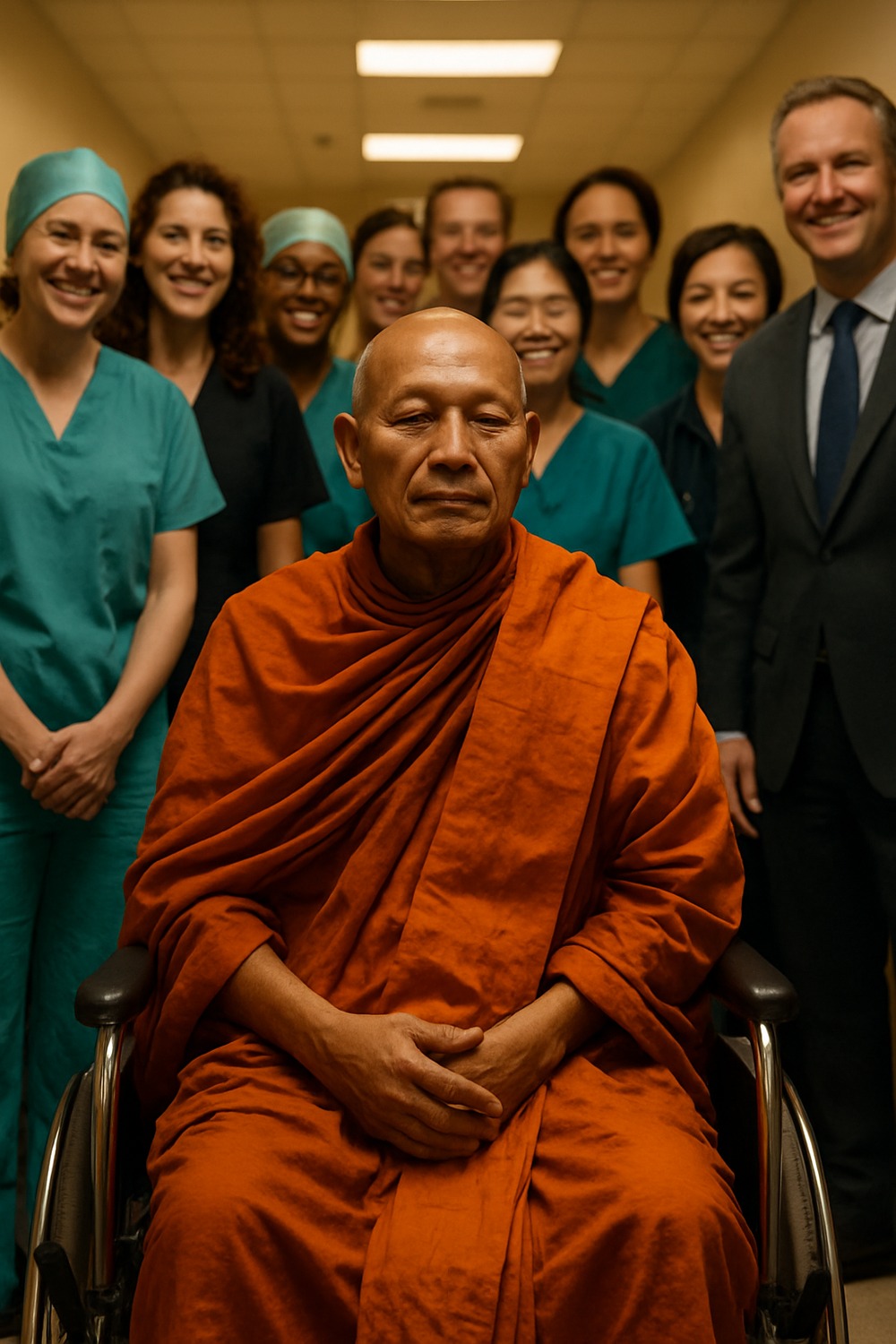
In 2024, Phra Ajarn Maha Dam Phommasan, senior monk at Wat Lao Buddha Khanti Temple in Snellville, Georgia, was walking from Fort Worth, Texas, to Washington, D.C. Near Dayton, a vehicle struck him. He lost his leg. He kept his purpose. How does a person hold that kind of stillness when the world has just taken something irreplaceable?
The Walk That Was Always Bigger Than Miles
Maha Dam didn’t begin his walk because it was easy. He began it because it wasn’t. Fort Worth to Washington, D.C. — roughly 2,300 miles through some of the flattest, most relentless asphalt terrain in America. For Maha Dam, the road itself was the practice. Buddhist monks have walked for peace as a form of engaged spirituality for centuries, a tradition formalized in the modern era by the Vietnamese monk and peace activist Thich Nhat Hanh, whose concept of “walking meditation” transformed how Western audiences understood movement as a moral act. Nhat Hanh taught that each step, placed with full awareness, was a vote for peace.
Maha Dam’s 2024 walk was precisely that — a slow, embodied statement that peace is worth suffering for. What nobody planned for was the car near Dayton. But in a deeply strange way, what happened next demonstrated the tradition more completely than the walking ever could.
In Theravada Buddhism — the tradition practiced across Laos, Thailand, and Cambodia — a monk’s body is understood as a vehicle for dharma, not an end in itself. Walking pilgrimages, known in Pali as carika, were historically undertaken by monks to spread teachings, to encounter suffering, and to demonstrate non-attachment to comfort. Maha Dam’s walk was firmly within that lineage.
Hundreds of miles into the journey. Headlights in the dark. A flash of impact that changed everything — and changed nothing about who Maha Dam was. That’s the part that stays with you.
From Hospital Bed to Living Teaching
Why does this matter? Because what the medical staff at Piedmont Healthcare encountered wasn’t a patient in crisis — it was something they had no training for.
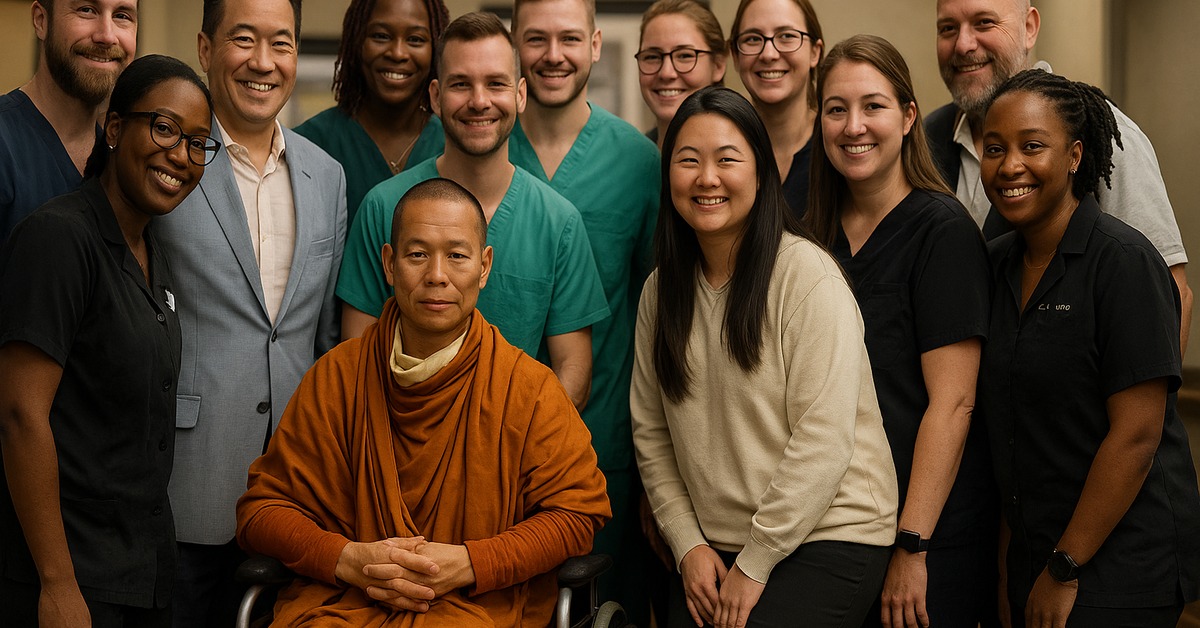
Surgeons worked for hours. The leg could not be saved. And yet nurses, doctors, orderlies came away describing an encounter that felt less like a medical event and more like a lesson they hadn’t expected to receive. Maha Dam asked about the driver — not with bitterness, but with concern. “Anger does not bring you peace,” he repeated, to person after person. In a healthcare setting that sees human beings at their most fractured, his composure rippled outward in ways that are difficult to quantify but impossible to miss. In some ways, his story echoes the kind of elemental endurance we see when examining survival under pressure — how organisms adapt to survive conditions that should overwhelm them, finding a way forward when every system is failing.
The medical team at Piedmont Healthcare later spoke publicly about the encounter. That almost never happens. It tells you something about the magnitude of what they witnessed.
Months of recovery followed. When Maha Dam returned home in 2024, the community at Wat Lao Buddha Khanti Temple gathered — not in relief alone, but in celebration of something harder to name: the integrity of a person whose values didn’t crack under impact. The Snellville temple, founded to serve a congregation drawn largely from Laotian and Southeast Asian diaspora communities in Georgia — a community that carries its own history of displacement and survival — became briefly and beautifully the center of something larger than itself.
Ancient Roots of the Peace Walk Tradition
To understand why Maha Dam walked at all, you have to go back roughly 2,500 years. After the historical Buddha’s enlightenment, he and his disciples spent decades in carika — walking village to village, teaching, begging, sitting beneath trees. Movement was inseparable from the mission. In the 20th century, that tradition was formalized into modern peace walks by figures like Thich Nhat Hanh and the Japanese Buddhist organization Nipponzan-Myohoji, which organized the first peace pagoda marches after Hiroshima. By the 1980s and 1990s, peace walks had spread across the United States, Europe, and Southeast Asia as Buddhist communities — often in diaspora — used physical pilgrimage to make their values visible in public space.
Smithsonian researchers have documented how Buddhist pilgrimage routes function as living geography, places where the spiritual and the physical refuse to be separated. Maha Dam’s 2024 Buddhist monk peace walk forgiveness demonstration fits squarely within that lineage — but it went further than most. What makes his story distinctly powerful is that the forgiveness element wasn’t planned. Most walks end with arrival. His was interrupted, violently, and what emerged from that interruption was an unscripted act of grace that no ceremony could have manufactured.
The forgiveness extended to the driver — immediate, unconditional, public — was the walk’s most radical mile.
Research from the Greater Good Science Center at UC Berkeley (researchers actually call this the “forgiveness-health link”), ongoing since 2001, has consistently shown that genuine forgiveness correlates with measurable reductions in physiological stress, anxiety, and cardiovascular strain. For Maha Dam, it wasn’t a strategy. It was simply what he was. That’s the thing about traditions tested to their limit — either they hold or they don’t. His held completely.
Why Buddhist Monk Peace Walk Forgiveness Endures
Forgiveness is one of the most studied and least understood phenomena in contemporary psychology and neuroscience. Stanford University’s Forgiveness Project, founded by Dr. Fred Luskin in 1999, spent years building clinical evidence for what monks had practiced for millennia: that releasing grievance isn’t weakness — it’s a sophisticated cognitive and emotional skill that fundamentally rewires how the nervous system responds to threat. Luskin’s work, published in peer-reviewed journals through the early 2000s, demonstrated that people trained in forgiveness practices showed lower heart rate, lower cortisol levels, and significantly reduced reported anger compared to control groups.
Maha Dam had no need of Stanford’s research. Decades of practice within the Theravada monastic tradition had already installed what Luskin’s subjects were learning in weeks. The history of treating people who ignored this kind of evidence — the evidence that contemplative practice builds something clinical trials can only approximate — has not been kind to the skeptics. The Buddhist monk peace walk forgiveness story isn’t a feel-good anomaly. It’s evidence of a technology that works.
Diaspora Buddhist communities across the United States have used peace walks as tools of cultural visibility and civic presence since at least the 1990s. For communities shaped by war, displacement, and resettlement, a monk walking 2,300 miles for peace isn’t a curiosity — it’s a statement. Wat Lao Buddha Khanti Temple in Georgia belongs to a network of Lao Buddhist temples that carry the weight of a community’s entire history of surviving the unthinkable. When the accident happened, their response — grief, gathering, celebration of his return — reflected exactly that historical depth. Peace was never abstract for them.
Maha Dam came back changed, and somehow exactly the same.
How It Unfolded
- Circa 500 BCE: The historical Buddha and early Buddhist monks begin the practice of carika, walking pilgrimages undertaken to spread teachings and embody non-attachment to comfort.
- 1947–1966: Nipponzan-Myohoji monks begin organizing peace walks from Hiroshima, establishing the modern template for Buddhist pilgrimage as public peace demonstration.
- 1982: Thich Nhat Hanh formalizes walking meditation as a distinct practice in his book The Miracle of Mindfulness, introducing it to a global Western audience.
- 2024: Phra Ajarn Maha Dam Phommasan begins his 2,300-mile Buddhist monk peace walk from Fort Worth, Texas, is struck by a vehicle near Dayton, loses his leg, publicly forgives the driver, and returns to his Snellville, Georgia community.
By the Numbers
- 2,300 miles: the planned route length of Maha Dam’s peace walk from Fort Worth, Texas, to Washington, D.C. in 2024.
- Stanford University’s Forgiveness Project (1999–2008) found forgiveness training reduced reported anger by up to 40% in clinical participants.
- Nipponzan-Myohoji has organized peace walks across more than 20 countries since the 1940s, totaling tens of thousands of collective miles walked.
- Greater Good Science Center at UC Berkeley has published over 50 peer-reviewed studies on forgiveness and wellbeing since its founding in 2001.
- Lao diaspora Buddhist temples in the United States number over 150 active institutions, serving communities that resettled primarily after 1975.
Field Notes
- Medical staff at Piedmont Healthcare who treated Maha Dam in 2024 later described the encounter publicly — an unusual step that reflects how profoundly his response to catastrophic injury affected people trained to remain professionally detached. It’s rare for healthcare workers to speak about a single patient’s composure in those terms.
- Theravada monks undertaking long-distance walks traditionally own almost nothing beyond three robes, an alms bowl, and a razor — meaning Maha Dam’s 2,300-mile journey was, by design, already an exercise in radical non-attachment before the accident tested it further.
- Neither Maha Dam nor his community ever publicly named or blamed the driver who struck him — a silence that speaks as loudly as any formal statement of forgiveness.
- Researchers at Stanford’s Forgiveness Project still can’t fully explain why forgiveness effects persist long-term in some individuals but not others — whether training can truly replicate what decades of contemplative practice builds, or whether there’s a threshold of commitment below which the physiological benefits simply don’t take root.
Frequently Asked Questions
Q: What was the purpose of Maha Dam’s Buddhist monk peace walk and why did it start in Fort Worth?
Maha Dam’s Buddhist monk peace walk forgiveness mission was intended as a physical demonstration of the possibility of peaceful coexistence, tracing a route from Fort Worth, Texas, to Washington, D.C. — a journey of approximately 2,300 miles. Fort Worth was the designated starting point, likely chosen for its geographic and symbolic position in America’s heartland. The walk drew on centuries of Buddhist pilgrimage tradition, where movement itself is understood as spiritual practice and public witness.
Q: How did Maha Dam respond to losing his leg, and did he pursue legal action against the driver?
Maha Dam responded to the accident with immediate and public forgiveness of the driver. From his hospital bed at Piedmont Healthcare, he explicitly declined to express anger, stating that “anger does not bring you peace.” No public record exists of legal action pursued by Maha Dam or his temple community against the driver. His response was entirely consistent with the Theravada Buddhist teaching that grievance causes additional suffering to the person who holds it — not only to the person it’s directed at.
Q: Is Buddhist monk peace walk forgiveness a common practice, or was Maha Dam’s walk unusual?
Long-distance Buddhist peace walks are a real and documented tradition, though not common enough to be routine. Most don’t attract significant media attention unless something extraordinary happens. What made Maha Dam’s walk singular wasn’t just its ambition — 2,300 miles is extraordinary by any measure — but what happened mid-route. His immediate forgiveness of the driver under conditions of catastrophic physical trauma is the element that distinguishes his story from the tradition it belongs to. Most walks arrive. His was interrupted, and the interruption became the message.
Editor’s Take — Sarah Blake
What catches me about Maha Dam’s story is that forgiveness under those conditions wasn’t performance — there was no audience, no prepared statement, no calculation of any kind. There was just a man in pain in a hospital bed, and the first thing he reached for was compassion for the person who put him there. We spend enormous energy building institutional frameworks for forgiveness — projects, studies, clinical trials — and here is a man for whom it was simply the next breath. That’s the gap worth sitting with.
Maha Dam’s walk was supposed to end in Washington, D.C. It didn’t. And yet what he demonstrated on a Texas roadside in 2024 — that a Buddhist monk peace walk forgiveness practice can survive the most extreme personal test imaginable — traveled further than 2,300 miles ever could. The question his story leaves behind isn’t really about him. It’s about what we’re each building inside ourselves, quietly, over years, that will either hold or won’t when the headlights appear without warning. What are you building?