The Monk Who Lost His Leg but Never His Peace
Here’s the thing about a Buddhist monk peace walk forgiveness story: the road is supposed to be the hard part. Two thousand three hundred miles of hot Texas tarmac, highway shoulders, and heat — that’s what should test a monk. Not a car appearing without warning. Not a surgery. Not waking up with one leg fewer than you had the morning before. Phra Ajarn Maha Dam Phommasan walked out of Fort Worth heading for Washington, D.C., and the road had different plans entirely.
Maha Dam is the senior monk at Wat Lao Buddha Khanti Temple in Snellville, Georgia. In the spring of 2023, he set out on foot across America to advocate for peace. A car struck him along a Texas highway. He lost his leg. He did not lose his faith, his composure, or his willingness to forgive the driver. What followed — recovery, homecoming, community — asks a question most of us spend our whole lives avoiding: how do you hold compassion steady when the world turns brutal without warning?
The Buddhist Monk Peace Walk That Changed Everything
Maha Dam’s walk was never casual. It was intentional, demanding, and deeply rooted in a tradition that stretches back more than two millennia. Dhutanga — the ascetic practice observed by Theravāda Buddhist monks — includes pilgrimage on foot as one of its highest forms of discipline. Monks who undertake such journeys do so understanding that discomfort is the curriculum. The road is the teacher. By 2023, Maha Dam had already logged hundreds of miles of that curriculum, his feet tracing the hot tarmac of American highways in robes instead of running shoes, drawing attention to a world he believed could choose peace over conflict.
The Wat Lao Buddha Khanti Temple community in Snellville had gathered to send him off. He walked with the kind of quiet conviction that doesn’t need a megaphone.
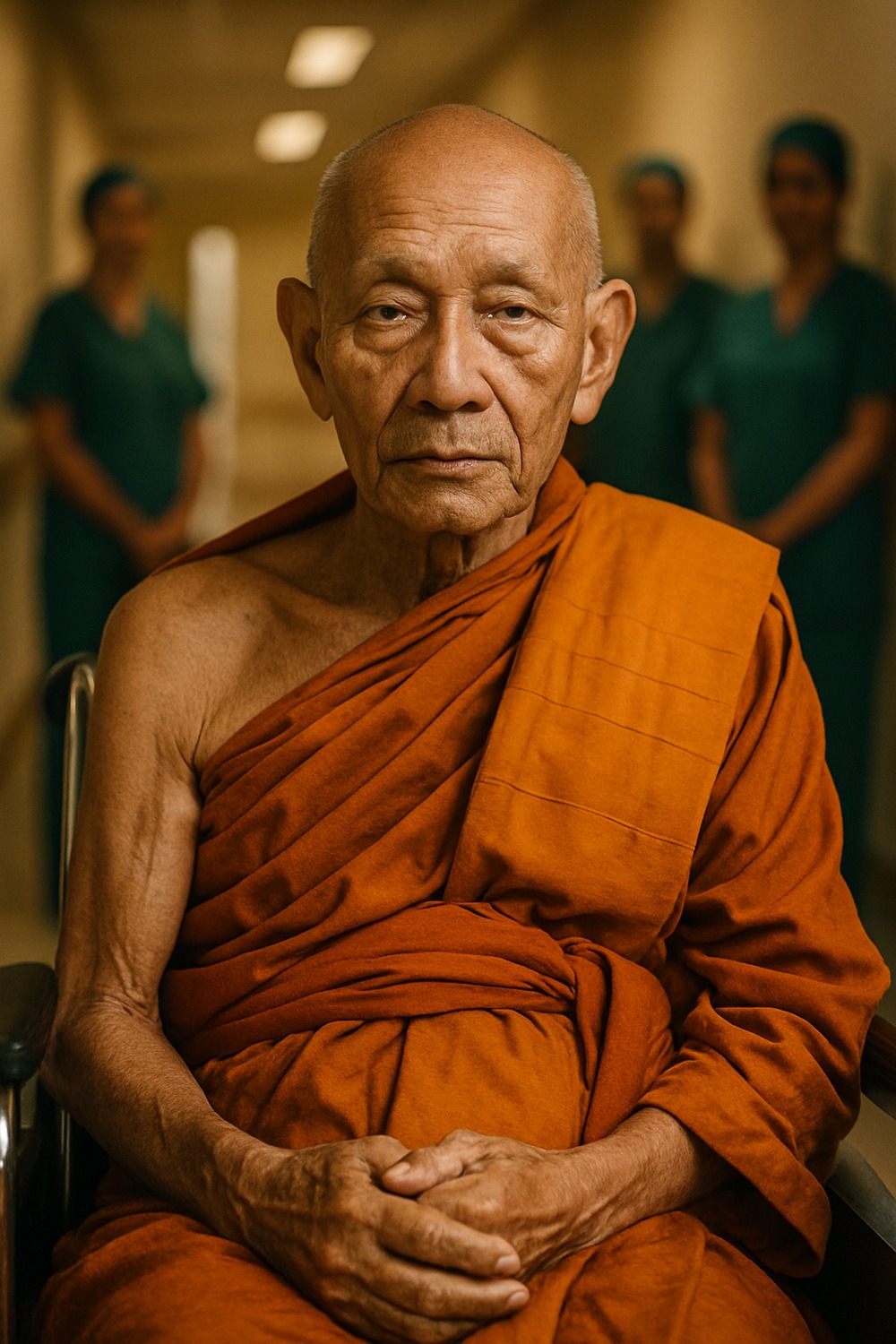
Then, near Dayton, Texas — a small city in Liberty County, roughly forty miles northeast of Houston — a vehicle struck him. The impact wasn’t survivable in the way most people mean the word. He survived, yes. But he lost his leg below the knee. Hours of surgery followed at Piedmont Healthcare, where medical staff later described being moved by the monk’s demeanor even in crisis. He didn’t curse the driver. He didn’t rage at the sky. He forgave — not as a performance of piety, but as a reflex. It’s the kind of response that stops people cold, because it makes you ask what you’d do in the same moment.
Not because of social media algorithms or viral engineering — the story spread fast because it was real, and people recognized it. Hospital corridors filled with a strange kind of quiet that grief and grace sometimes produce together.
Forgiveness as Practice, Not Performance
What does it take to build that kind of response? Not superhuman character — decades of rehearsal.
Forgiveness in the Theravāda tradition — the school of Buddhism dominant in Laos, Thailand, Cambodia, and Myanmar — isn’t a feeling you wait for. It’s a practice you build, the way a musician builds scales. Monks like Maha Dam spend years in structured meditation developing what’s called mettā, or loving-kindness (researchers actually call this the “most advanced and important stage” of the practice), a directed compassion that doesn’t exclude those who cause harm. Traditional mettā meditation specifically asks practitioners to extend warmth toward difficult people — those who’ve wronged them, strangers, even enemies. The practice didn’t begin in Maha Dam’s hospital room. It began long before the walk, long before Texas. It’s also worth drawing a parallel here — just as a tradition lasting only eleven seconds can carry centuries of meaning, a single act of forgiveness on a roadside can concentrate the weight of decades of inner discipline into one quiet, defining moment.
Maha Dam’s words — “Anger does not bring you peace” — circulated widely after the accident. Simple enough to fit on a bumper sticker. Deep enough to sit with for a year. In 2019, researchers at the University of California, Berkeley’s Greater Good Science Center published findings showing that forgiveness practices measurably reduce cortisol levels, lower blood pressure, and improve psychological resilience. The body registers the cost of holding grudges. Maha Dam’s refusal to blame the driver wasn’t just spiritually principled — it was, in the most clinical sense, protective.
And doctors and nurses at Piedmont Healthcare spoke about his presence in ways medical professionals don’t typically use for patients. Gentle. Calm. Steadying. The man who’d been hit by a car was somehow also the most composed person in the room.
Roots of the Peace Walk Tradition in Buddhist History
Peace walks have a long, serious history within Buddhism. Monks have walked vast distances since at least the 3rd century BCE, when Ashoka the Great — emperor of the Maurya dynasty and convert to Buddhism — dispatched monk-missionaries across Asia on foot, according to Smithsonian Magazine’s reporting on Buddhist pilgrimage traditions. Walking wasn’t incidental to the message. Walking was the message. The bodily commitment to peace, to slowness, to presence — it communicated something a speech or a pamphlet couldn’t.
In modern times, Buddhist peace walks in America became more prominent during the Vietnam War era, when monks including Thich Nhat Hanh urged Western audiences to consider non-violence not as passivity but as active, embodied discipline. Maha Dam’s 2,300-mile route from Fort Worth to Washington, D.C., followed in that same tradition — a living argument made with every step. Any honest accounting of that tradition has to acknowledge something uncomfortable: the monks who built it never promised safety, and never asked for it.
The Buddhist monk peace walk forgiveness dynamic Maha Dam embodied isn’t a new story, but the American context gives it particular texture. Walking from Texas to Washington, D.C., means crossing states with wildly different cultures, traffic patterns, and degrees of patience for a robed man moving slowly along a highway shoulder. Japanese Zen monks who conduct thousand-day walking retreats called kaihōgyō on Mount Hiei understand the same thing Maha Dam understood: vulnerability is intrinsic. You cannot walk for peace while insisting on perfect safety. The two are incompatible.
Maha Dam’s walk was cut short by violence, but the tradition it belongs to was built exactly for moments like this one. Not around them. Through them.
Coming Home: Community, Recovery, and What Endures
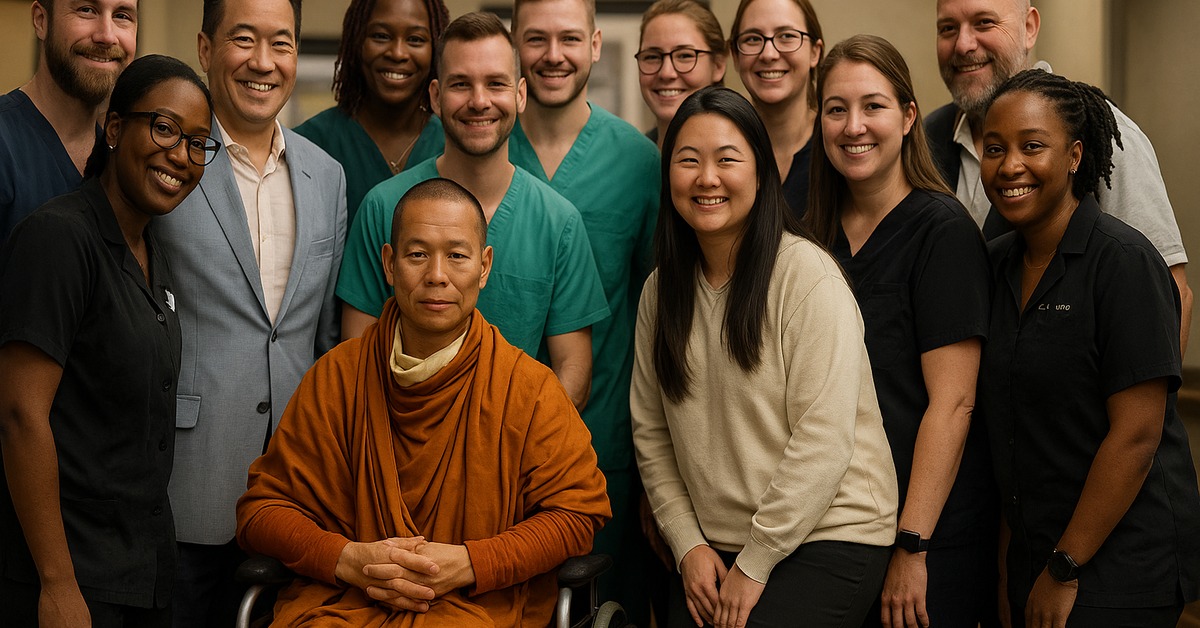
Months after surgery and rehabilitation, Maha Dam returned to Snellville, Georgia. His community at Wat Lao Buddha Khanti Temple didn’t receive him with solemnity — they celebrated. Loudly. Warmly. With the particular joy of people who understand how close they came to losing someone. Food, color, monks in orange robes, children running, elders folding their hands in prayer. Researchers at Emory University’s Center for Contemplative Science and Compassion-Based Ethics — a unit that’s studied community resilience in Buddhist communities since 2012 — have documented how shared spiritual practice amplifies individual coping responses. What Maha Dam modeled alone in a hospital room, his community could now carry collectively.
His return wasn’t just a homecoming. It was a demonstration.
His story also raised something quieter and harder. A Buddhist monk peace walk forgiveness narrative can be uplifting precisely because it’s exceptional. Most of us, struck by a car, stripped of a limb, lying in a hospital in a state we don’t live in, would not respond with equanimity — and the frameworks we live inside, legal, social, emotional, would tell us we were right not to. The question Maha Dam’s example poses isn’t whether his forgiveness is achievable for ordinary people. Evidence suggests the answer is yes, slowly, with practice. But that most of us never start is not a small thing to admit.
What he brought back to Snellville wasn’t a completed walk. It was something more durable — proof that the practice holds even when the road doesn’t.
How It Unfolded
- 3rd century BCE — Emperor Ashoka sends Buddhist missionaries on foot across Asia, establishing pilgrimage walks as a core form of peace advocacy in the tradition.
- 1960s–1970s — Thich Nhat Hanh leads peace walks in the West during the Vietnam War era, introducing American audiences to Buddhist non-violent action as an embodied discipline.
- Early 2023 — Phra Ajarn Maha Dam Phommasan departs Fort Worth, Texas, beginning his 2,300-mile peace walk toward Washington, D.C., representing Wat Lao Buddha Khanti Temple in Snellville, Georgia.
- 2023 — A vehicle strikes Maha Dam near Dayton, Texas; he undergoes emergency surgery, loses his leg, forgives the driver publicly, and later returns to his community in a celebrated homecoming.
By the Numbers
- 2,300 miles — the planned length of Maha Dam’s peace walk from Fort Worth, Texas, to Washington, D.C.
- 40 miles northeast of Houston — the approximate location of the collision near Dayton, Texas, placing it early in the walk’s eastern Texas leg.
- 2019 — the year UC Berkeley’s Greater Good Science Center published findings linking forgiveness practices to measurably lower cortisol levels and improved resilience.
- 1,000 days — the length of the kaihōgyō walking retreat undertaken by certain Japanese Tendai Buddhist monks on Mount Hiei, widely considered one of the most demanding physical-spiritual disciplines in any living tradition.
- 2012 — the year Emory University’s Center for Contemplative Science and Compassion-Based Ethics began formally studying community resilience within Buddhist practice communities in the United States.
Field Notes
- Nurses and physicians at Piedmont Healthcare reportedly described Maha Dam’s demeanor in the aftermath of emergency surgery as notably calm — not sedated calm, but alert and forgiving. Medical staff who’d seen thousands of trauma cases said his response was unlike anything they’d encountered. It circulated quietly through the hospital as something worth remembering.
- In Theravāda Buddhist mettā meditation, practitioners are specifically instructed to direct loving-kindness toward people who have harmed them — this isn’t incidental to the practice, it’s considered its most advanced and important stage. Maha Dam didn’t improvise forgiveness. He’d rehearsed it, in a sense, for years.
- The Japanese kaihōgyō monks of Mount Hiei walk the equivalent of the Earth’s circumference over seven years — roughly 25,000 miles — and carry a ritual dagger and rope with them, symbolizing their commitment to complete the walk or die. At 2,300 miles, Maha Dam’s walk belongs to the same tradition of using physical endurance as spiritual proof.
- Researchers still can’t fully explain why witnessing another person’s forgiveness appears to lower physiological stress markers in bystanders — the so-called “elevation” response documented by Jonathan Haidt at NYU’s Stern School of Business since 2003. Whether it’s empathy, moral modeling, or something else entirely remains genuinely open.
Frequently Asked Questions
Q: What was the purpose of Maha Dam’s Buddhist monk peace walk forgiveness journey across America?
Maha Dam undertook his 2,300-mile walk from Fort Worth, Texas, to Washington, D.C., as an act of advocacy for peace — a tradition rooted in Theravāda Buddhist practice that uses physical pilgrimage as a form of active non-violence. The walk was affiliated with Wat Lao Buddha Khanti Temple in Snellville, Georgia, where he serves as senior monk. His forgiveness of the driver who struck him extended the walk’s message beyond its route.
Q: How does Buddhist teaching on forgiveness actually work as a daily practice?
In the Theravāda tradition, forgiveness isn’t a spontaneous emotion — it’s a cultivated discipline. Monks practice mettā, or loving-kindness meditation, directing compassion deliberately toward difficult people, including those who’ve caused harm. This practice, repeated daily over years, builds what researchers describe as a “default toward openness” rather than defensiveness. Maha Dam’s response in the hospital was the result of long training, showing up exactly when it was needed most.
Q: Is a Buddhist monk peace walk forgiveness story like this historically unusual, or does the tradition expect this kind of resilience?
Many people assume this level of grace under trauma is exceptional or saintly — and by ordinary standards, it is. But the Buddhist peace walk tradition was never built on the assumption that the road would be safe. Monks undertaking dhutanga pilgrimage throughout history encountered bandits, illness, and extreme weather. The expectation wasn’t comfort. It was equanimity regardless of conditions. What makes Maha Dam’s story remarkable isn’t that he forgave — it’s that so few people in any tradition, Buddhist or otherwise, actually demonstrate it when the moment is real.
Editor’s Take — Sarah Blake
What stays with me isn’t the forgiveness itself — it’s the speed of it. No deliberation, no press release, no quiet contemplation period in which Maha Dam decided how to respond. The response was immediate, because the preparation was decades long. That’s the part we don’t talk about enough. We admire the moment without reckoning with the years of practice that made the moment possible. History has a way of treating the people who ignored this kind of evidence unkindly — the evidence that character is built in ordinary hours, not revealed in extraordinary ones. His walk may never reach Washington. But it’s already covered more important ground than most of us will in a lifetime.
Somewhere in Snellville, Georgia, a monk with one leg is still teaching — not because the road was kind, but because his practice held when the road wasn’t. That’s the thing about compassion as discipline rather than feeling: it doesn’t depend on favorable conditions. It shows up precisely when conditions are worst. The question Maha Dam’s story leaves behind isn’t whether forgiveness is possible. It’s whether we’re willing to build the daily practice that makes it real — and what we lose, year after year, when we choose not to.