


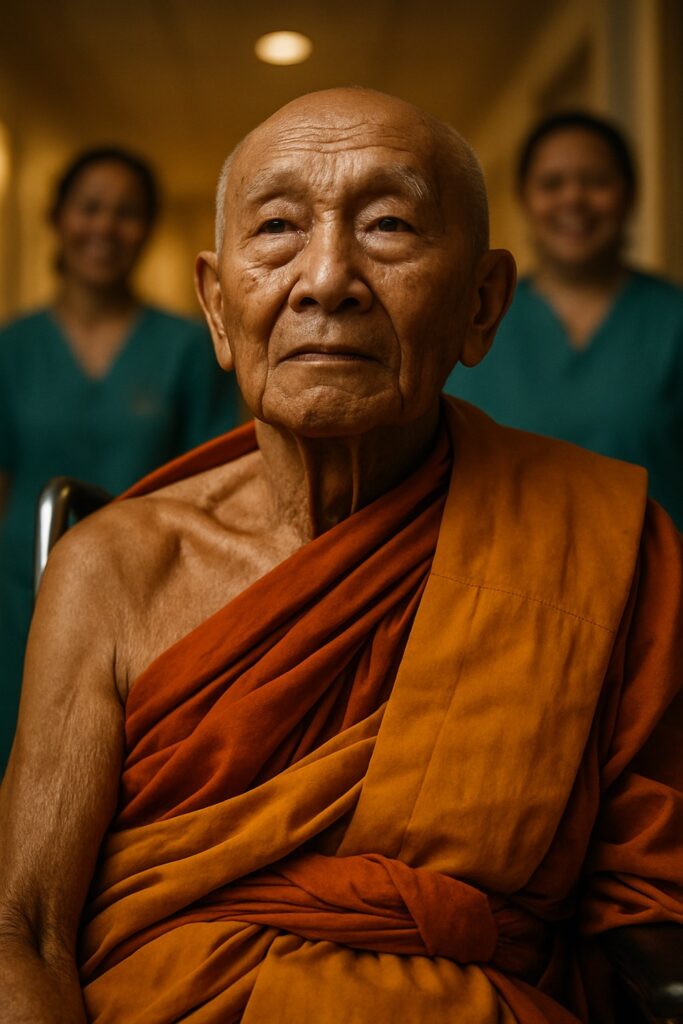
A Buddhist monk peace walk forgiveness story doesn’t begin in a hospital room — it begins in the question of what you’d do on the roadside after something takes everything from you in under a second. Phra Ajarn Maha Dam Phommasan was walking a 2,300-mile solo pilgrimage from Fort Worth to Washington, D.C., when a car struck him near Dayton, Texas. He lost his leg. What he did not lose — almost immediately, from a hospital bed — is the part that stops people cold.
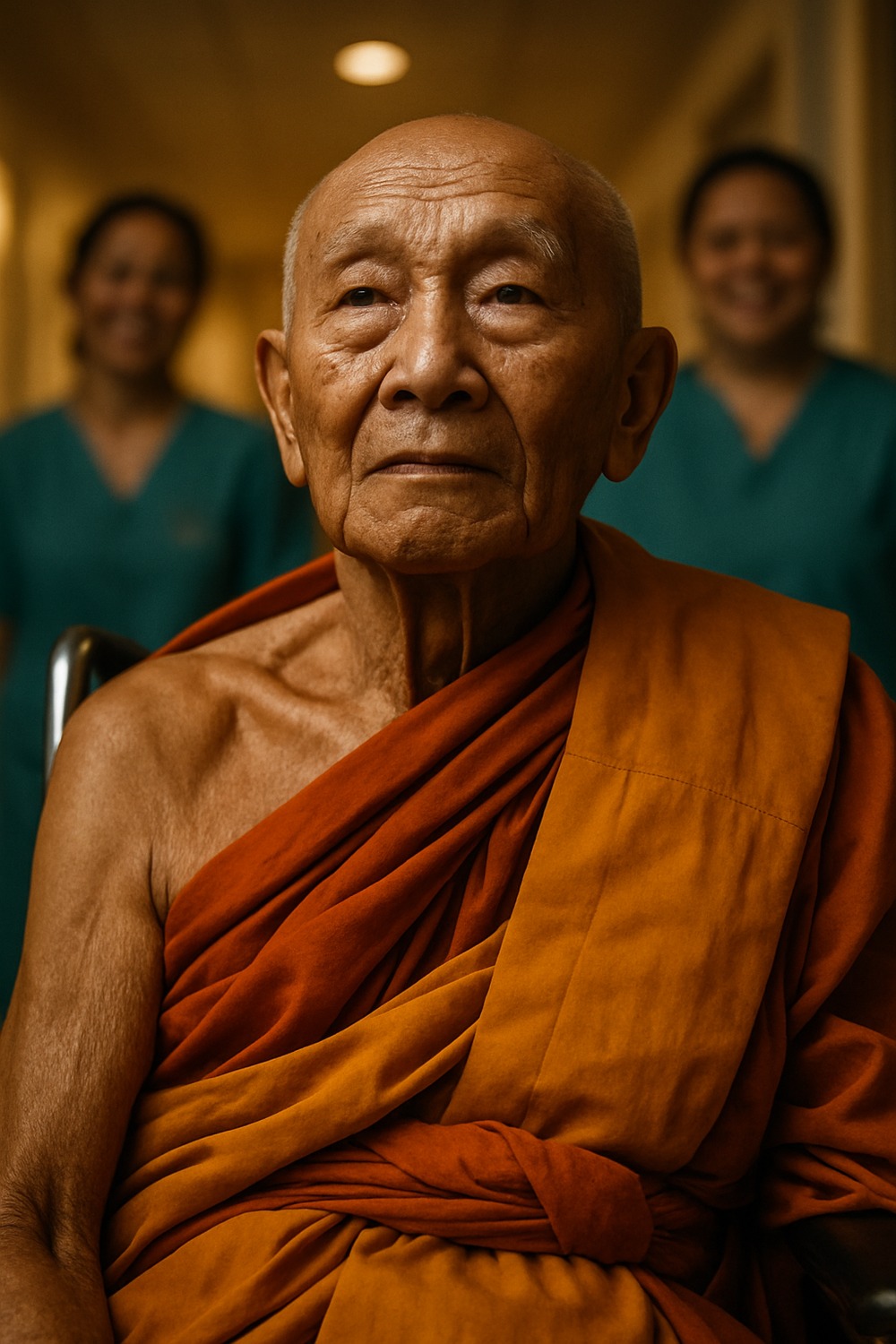
Maha Dam is the senior monk at Wat Lao Buddha Khanti Temple in Snellville, Georgia. His walk carried centuries of Theravada Buddhist tradition — solo, on foot, across the American South, as a living act of spiritual witness. When the collision happened, he was rushed to Piedmont Healthcare. His medical team expected grief, fury, the ordinary wreckage of a man robbed of a limb. What they witnessed instead left them visibly shaken — in the quietest possible way.



The Ancient Tradition Behind the Walk
Peace walks in the Theravada Buddhist tradition aren’t symbolic gestures. They’re physical commitments that stretch back centuries, rooted in the belief that the body itself can be offered in service of a larger intention. Monks across Southeast Asia have historically walked thousands of miles — through Myanmar, Thailand, Laos, Cambodia — as acts of witness during times of war, political upheaval, or community suffering. The practice draws on the concept of dhammayatra, a Sanskrit-derived term meaning “truth journey,” which gained wide recognition in Cambodia during the 1990s when monks led mass peace marches to protest the Khmer Rouge’s lingering violence. These walks are understood not as protests but as embodied prayers — the monk’s footsteps themselves becoming the message.
Maha Dam’s 2,300-mile route placed him squarely in that lineage. He wasn’t marching for attention. He was walking because the tradition said that sometimes, walking is the most precise response to a broken world. He’d already covered hundreds of miles before the collision. Alone. No entourage, no media escort, no support vehicle trailing behind with water and snacks. That aloneness was the point. The physical difficulty — blisters, heat, the grinding monotony of highway shoulders — wasn’t incidental to the pilgrimage. It was the pilgrimage. In Theravada practice, suffering endured with awareness is understood as a form of generosity. You’re not suffering for yourself. You’re holding it on behalf of something larger.
It’s a framework that makes what happened next easier to understand, though no less remarkable. When the car struck him near Dayton, Texas, Maha Dam didn’t just lose a leg. He was dropped without warning into the deepest possible test of everything his practice had built.
The road, it turned out, wasn’t finished with him yet.
What Forgiveness Looked Like From a Hospital Bed
Medical staff at Piedmont Healthcare weren’t prepared for what they encountered. Patients who’ve sustained traumatic amputations frequently experience acute psychological distress in the immediate aftermath — rage, denial, profound grief, sometimes suicidal ideation. The research on this is unambiguous. A 2022 study published by the American Psychological Association found that rates of post-traumatic stress disorder among traumatic amputees can exceed 50% within the first six months of injury, with anger and hypervigilance among the most commonly reported symptoms. What Maha Dam offered instead was something his caregivers struggled to name. Calm isn’t quite the right word — it implies passivity, a kind of blank absence of response. This was something more active. He was present. Fully present. And from that presence, he extended forgiveness to the driver who had taken his leg. Not eventually. Almost immediately. Stories like this one share something with those of patients who face devastating medical crises and emerge transformed — the body broken, the spirit somehow clarified rather than dimmed.
His words from that hospital bed have since circulated widely: “Anger does not bring you peace.” Seven words. No elaboration, no philosophical scaffolding. Just the sentence itself, standing there with the patient confidence of something that doesn’t need defending. The medical team reportedly stood in the room with him longer than they needed to. There was no protocol for this. You don’t chart a patient’s equanimity.
The driver faced no public condemnation from Maha Dam or his temple community. No lawsuit threats appeared in news coverage. The monk’s response closed a door that most people in that situation would have opened wide — the door of justified outrage. He walked through a different one.
The Neuroscience Beneath the Grace
Here’s the thing: forgiveness isn’t merely a spiritual posture. Researchers have been mapping its neurological and physiological signatures for decades, and the data is striking. A landmark study conducted by researchers at Stanford University’s Center for Compassion and Altruism Research and Education — published in 2015 — used fMRI imaging to compare the brain activity of subjects practicing compassion-based forgiveness with those ruminating on grievance. The forgiveness group showed measurably reduced activation in the amygdala, the brain’s primary threat-detection center (researchers actually call this “amygdala down-regulation”), along with increased activity in the anterior cingulate cortex, a region associated with emotional regulation and empathy. In plain terms: forgiveness, when it’s genuine, looks different in the brain than forced acceptance or suppressed anger. It’s an active neural state, not a passive one. A Smithsonian Magazine deep-dive on the science of forgiveness summarized it precisely: “Letting go of anger isn’t weakness. It’s one of the most metabolically demanding things a human brain can do.”
Why does this matter? Because what a Buddhist monk peace walk forgiveness response demonstrates neurologically isn’t that Maha Dam suppressed his anger — it’s that long-term contemplative practice appears to restructure the brain’s default response to threat entirely. A 2011 Harvard Medical School study led by Sara Lazar found that experienced meditators showed measurably greater cortical thickness in the insula and sensory cortices — regions associated with interoception and emotional awareness. Monks with decades of practice weren’t just calmer. Their brains had physically changed. The capacity Maha Dam displayed in that hospital room may not have been a miracle of willpower. It may have been the accumulated architecture of thousands of hours of disciplined attention.
That reframing matters. It suggests that what Maha Dam modeled isn’t superhuman. It’s the end point of a particular kind of training — available, at least in principle, to anyone willing to do the work. That’s either deeply comforting or quietly demanding, depending on where you’re sitting. The data left no room for the comfortable story that forgiveness like this is simply a gift some people are born with — and anyone paying attention to the neuroscience already knew it.
Buddhist Monk Peace Walk Forgiveness and What Comes After
Recovery from a traumatic amputation is not a single event. It’s a long, grinding series of events — surgeries, wound care, phantom limb pain, prosthetic fitting, physical therapy, psychological recalibration. The Amputee Coalition, a U.S.-based nonprofit tracking limb loss data since its founding in 1986, estimates that approximately 185,000 amputations occur in the United States each year, with traumatic causes accounting for roughly 45% of those cases. The physical and emotional recovery journey is well-documented — and it is rarely linear. Pain spikes unpredictably. Phantom sensations can be overwhelming. Losing a limb isn’t just a physical event; it disrupts a person’s felt sense of self in ways that can take years to rebuild. The timeline for returning to anything resembling a normal life typically stretches across six to eighteen months, and even then, “normal” is a word that requires recalibrating.
Maha Dam went through all of it. Months of surgery and recovery followed the collision. He wasn’t immune to the body’s demands. The difference, those close to him suggest, was the interpretive framework he brought to each stage of the process. In Buddhist practice, the body’s impermanence isn’t a tragedy to be avoided — it’s a fundamental teaching, confirmed rather than contradicted by injury and loss. The leg was gone. The walk wasn’t. His community at Wat Lao Buddha Khanti Temple in Snellville, Georgia, kept that truth visible for him throughout his recovery.
And when he came home, they celebrated. Not with the muted, cautious relief of people stepping around grief, but with genuine joy. He was met with color, music, and the particular warmth of a community that had held his intention while he couldn’t walk. The celebration itself was an act of faith — he had embodied something they all wanted to carry, and they were telling him: we saw it, and we’re holding it too.

How It Unfolded
- 1990s: The dhammayatra peace walk tradition gained international recognition when Cambodian monks led mass marches to protest residual Khmer Rouge violence in the aftermath of civil war.
- 2023: Phra Ajarn Maha Dam Phommasan departed Fort Worth, Texas, beginning his 2,300-mile solo peace walk toward Washington, D.C., as an act of Theravada Buddhist spiritual witness.
- 2023: A car struck Maha Dam near Dayton, Texas; he was transported to Piedmont Healthcare, where surgeons amputated his leg — and where he offered immediate, unconditional forgiveness to the driver.
- 2024: Following months of surgery and rehabilitation, Maha Dam returned to his community at Wat Lao Buddha Khanti Temple in Snellville, Georgia, where he was welcomed home with celebration.
By the Numbers
- 2,300 miles — the planned distance of Maha Dam’s solo peace walk from Fort Worth, Texas, to Washington, D.C.
- 185,000 — estimated annual traumatic and disease-related amputations in the United States each year (Amputee Coalition).
- 50%+ — the proportion of traumatic amputees who may experience PTSD symptoms within six months of injury (American Psychological Association, 2022).
- 2011 — the year Harvard Medical School researcher Sara Lazar published findings showing measurable cortical thickening in experienced meditators, suggesting long-term practice structurally alters the brain.
- Decades — the length of contemplative practice typically associated with the deepest neurological changes documented in studies of Buddhist monks and long-term meditators.
Field Notes
- Maha Dam was walking alone — no support vehicle, no companion — when the collision occurred near Dayton, Texas. That solitude was deliberate: in Theravada tradition, the pilgrim’s vulnerability is part of the offering, not a logistical oversight.
- Staff at Piedmont Healthcare reportedly remained in Maha Dam’s room longer than their duties required. No protocol exists for documenting a patient’s grace, but those who witnessed it haven’t described the experience as routine.
- Across Cambodia, Myanmar, and Thailand, the dhammayatra tradition has served as a tool for post-conflict reconciliation — suggesting that long-distance peace walks aren’t simply individual spiritual acts but historically proven instruments of community healing.
- Researchers still can’t definitively answer whether the forgiveness response documented in long-term meditators is a product of belief, neurological restructuring, or some interaction between the two. The brain imaging data is real; the causal direction remains genuinely contested.
Frequently Asked Questions
Q: What is the Buddhist monk peace walk forgiveness tradition, and how old is it?
Drawing on the dhammayatra practice — structured long-distance walking as a form of spiritual witness — the Buddhist monk peace walk forgiveness tradition has roots in early Theravada Buddhism and became internationally visible during Cambodia’s post-civil war reconciliation in the 1990s. Monks walk as embodied prayers, offering their physical suffering as an act of generosity on behalf of communities in conflict. In various forms across Southeast Asia, the tradition is at least several centuries old.
Q: How did Maha Dam forgive the driver so quickly after losing his leg?
Forgiveness in the Theravada Buddhist framework isn’t an emotional reaction — it’s a trained response built through decades of contemplative practice. Neuroscientific research, including a 2015 Stanford University study, suggests that experienced meditators show reduced amygdala activation and heightened activity in brain regions governing emotional regulation. That means the forgiveness Maha Dam extended wasn’t a suppression of anger — it reflected a fundamentally different neurological response to threat, shaped by years of disciplined meditation practice.
Q: Does forgiving someone who caused you harm actually help your own recovery?
A common misconception is that forgiveness primarily benefits the person being forgiven. The research tells a different story. Studies from Stanford University and the Amputee Coalition’s behavioral health literature consistently show that people who practice genuine forgiveness — rather than suppressed resentment — experience lower cortisol levels, reduced cardiovascular stress markers, and better long-term psychological outcomes. Forgiveness, in other words, is measurably good for the person doing the forgiving. Maha Dam’s calm in recovery may not be coincidental to his forgiveness — it may be partly caused by it.
Editor’s Take — Sarah Blake
What I keep returning to isn’t the forgiveness itself — it’s the timing. Not weeks later, not after therapy, not after legal counsel. Immediately. From a hospital bed, with a leg gone and the rest of his body in shock. We’ve spent years building cultural architecture around the idea that anger is a form of self-protection. Maha Dam’s response suggests the opposite: that the fastest route through catastrophic loss might not run through fury at all. That’s worth sitting with longer than this article allows.
There’s a version of this story that gets told as inspiration — monk loses leg, monk forgives, monk goes home, everyone feels moved and then moves on. But the more honest version is harder. It asks what it would actually cost you to respond the way Maha Dam responded. Not in theory. On a Texas roadside. In a hospital bed. In the first hours after something irreversible. The tradition he carries says the walk doesn’t end because the road gets brutal. It says that’s exactly when the walk matters most. What would it take to believe that — and then to keep going?


