The Caracal’s Secret: Speed, Leaps, and Hidden Signals
Here’s the paradox at the heart of the caracal: a forty-pound cat that makes gravity look negotiable. Slow the footage down enough and you can watch one twist mid-air, snatch two birds from separate trajectories, and return to earth without a sound — all within a single leap. Caracal speed and leaping ability are the parts that get documented, photographed, celebrated. But those impossibly tall, jet-black ear tufts? Scientists are only now starting to ask what they actually do.
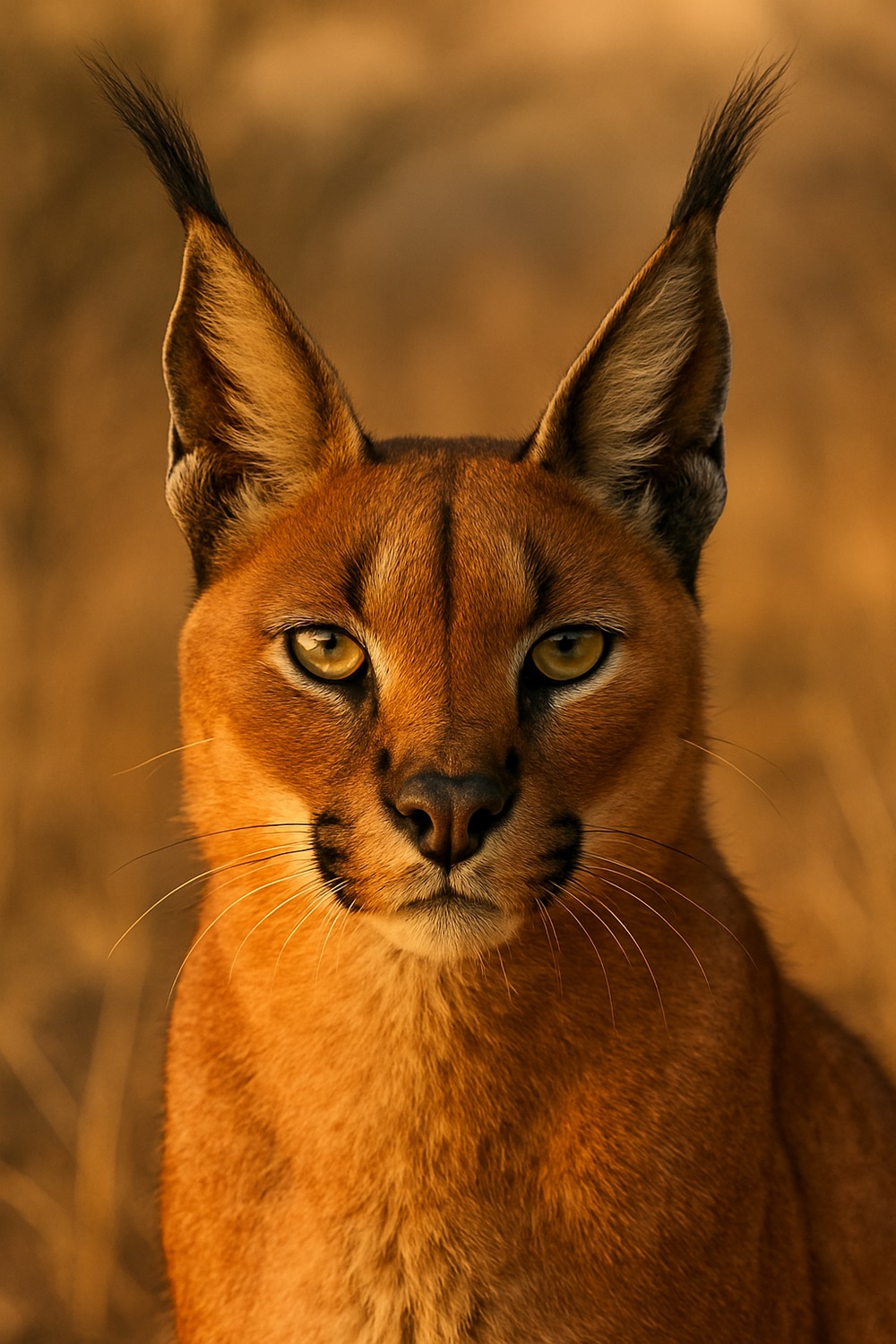
Built for Velocity and Air
The caracal’s body is an engineering problem that evolution solved aggressively. It can sprint close to 50 miles per hour — ahead of virtually every domestic animal alive, including the greyhound at full gallop. Those long, muscular hind legs store energy like compressed springs, releasing it in bursts that launch the cat up to ten feet from a dead stop. This isn’t a party trick. In environments where prey is scattered, fast-moving, and often airborne, vertical agility is the difference between eating and starving.
Biologists who’ve watched caracals hunt describe something that looks less like predation and more like aerial acrobatics — the cat spinning mid-leap to redirect its trajectory, using broad, flexible paws like paddles to bat birds out of formation before seizing them. The musculature required rivals that of a trained gymnast, scaled to body size.
Compared to other cats occupying similar ecological space, the caracal is in its own category. Servals share a lean build and leaping instinct (researchers sometimes call them the caracal’s more cautious cousin), but the caracal brings a heavier frame and considerably bolder temperament to the hunt. In studies conducted across Kenya and South Africa, researchers found caracals regularly taking prey larger than themselves — small antelope, the rock hyrax, which is a rotund and surprisingly well-defended mammal that most predators have the sense to avoid. Where landscapes demand constant movement, the caracal’s physical gifts make it one of the most efficient hunters in the African and Asian savanna systems it calls home.
The Language Written in Tufts
Stand close enough to a caracal and your eyes go straight to the ears. Rising from each tip is a plume of stiff, jet-black hair — roughly two inches long, forming one of the more dramatic visual signatures in the animal kingdom. For a long time, researchers assumed these tufts were ornamental. An evolutionary flourish. Nice to look at, functionally inert.
Turns out, that assumption is getting harder to defend. Several researchers studying captive and semi-wild populations have now recorded what appear to be deliberate, coordinated twitches of these ear tufts during social interactions. The movements are subtle, brief, highly contextual — occurring most often during encounters between individuals, particularly around food competition, potential mating, or territorial negotiation. Whether this constitutes a true communication system remains genuinely contested, but the evidence keeps accumulating.
And the hypothesis has solid theoretical backing. Dark, elongated ear tufts require pigment, protein, and energy that could go elsewhere. There’s a principle in animal behavior: the more costly a feature is to grow and maintain, the more likely natural selection found a function for it. Evolution doesn’t do decorative without a reason. Proponents of the tuft-signaling theory argue that in a species whose vocalizations — meows, chirps, purrs, the occasional startling hiss — already convey emotional states, a visual channel adds something vocalizations can’t: nuance across distance, in silence, in low light. Think of the difference between speaking words and adding hand gestures. Across the rocky outcrops of Central Asia at dawn, a rapid tuft movement might carry information that sound simply can’t.
Lives Lived in Shadow
Why does this matter? Because for an animal with such a wide distribution — Cape of Good Hope north through the Arabian Peninsula, across Iran, into India and Central Asia — we know remarkably little about how caracals actually live.
GPS collar studies have revealed home ranges stretching hundreds of square kilometers, with individuals rarely crossing paths on purpose. It’s solitary, mostly nocturnal, and it moves through landscapes in ways that frustrate field researchers who’ve dedicated years to the attempt. But genetic evidence complicates the simple “lone predator” story — it suggests caracals seek each other out beyond mating, which raises questions about the frequency and nature of those encounters (and this matters more than it sounds, given how little time they’d apparently need to spend together). Do they communicate information about prey availability? Do neighboring individuals develop relationships over time?
The answers are still out there somewhere, lost in the dark.
Nobody studying this animal seriously thinks the ear tufts are purely cosmetic anymore — and the field has shifted faster than the textbooks have caught up.
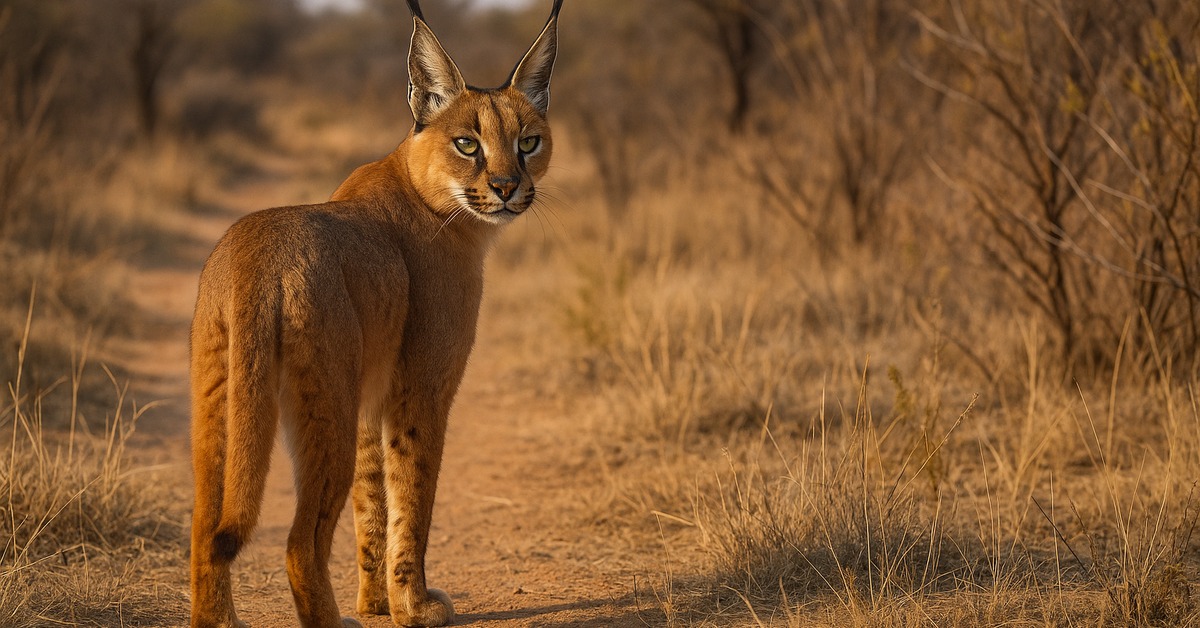
A Mystery Worth Chasing
Ancient Egyptian temple walls featured the caracal. Persian and Indian royalty kept them as hunting companions, prized for exactly the aerial acrobatics that still stop people cold on video today. And yet, scientifically, it’s underexplored in ways that would surprise you given its fame. Researchers are now deploying motion-triggered cameras, drone surveillance, and bioacoustic monitoring to capture the full behavioral repertoire of wild populations. Every answer tends to generate three new questions — which is exactly the kind of scientific dynamism that makes the caracal worth following.
The ear tuft question is one thread in a much larger tangle of unknowns. How do juveniles learn to hunt? Do siblings maintain contact after dispersal? What’s actually being communicated at scent-marking sites? History tends to be unkind to researchers who dismissed signals like these as decorative before the data came in. Each study peels back one layer and reveals another — and that’s not a frustration so much as an invitation.
How It Unfolded
- ~1500 BCE — Caracals depicted on Egyptian temple walls; earliest recorded human documentation of the species
- ~1000 CE — Persian and Indian courts begin training caracals for bird-hunting sport, exploiting their aerial leaping ability
- 2008–2015 — GPS collar studies in Kenya and South Africa begin mapping home range sizes, revealing ranges of several hundred square kilometers per individual
- 2020s — Bioacoustic monitoring and motion-camera arrays are deployed to study ear tuft signaling behavior in wild and semi-wild populations
By the Numbers
- ~50 mph — top sprint speed, faster than a greyhound at full gallop
- 10 feet — maximum vertical leap height from a standing start
- 2 inches — approximate length of the ear tufts
- Hundreds of square kilometers — typical home range recorded in GPS collar studies
- 3 continents — Africa, Asia, and the Middle East, where wild caracal populations are distributed
Field Notes
- Caracals have been documented taking prey larger than themselves, including small antelope and the well-defended rock hyrax
- Ear tuft twitches have been recorded most frequently during food competition, mating encounters, and territorial standoffs
- Genetic data suggests individuals seek out social contact beyond mating — contradicting the strict “solitary predator” model
- Servals are the caracal’s closest ecological neighbor but are generally considered less bold and less physically powerful
- Current field research combines drone surveillance, motion cameras, and bioacoustics to study behavior in the wild
Frequently Asked Questions
How fast can a caracal run?
Caracals reach speeds close to 50 miles per hour — faster than a greyhound in full gallop. Combined with explosive vertical leaping ability, this makes them one of the most athletically capable mid-sized predators on earth.
What are the caracal’s ear tufts actually for?
That’s the question researchers are actively working to answer. Early assumptions treated them as ornamental, but recorded tuft-twitching during social encounters has shifted the conversation. The current leading hypothesis is that they function as a visual communication channel — carrying nuance that vocalizations alone can’t provide.
Are caracals solitary?
Mostly, yes. Home ranges are vast and overlap is rare. But genetic evidence suggests they seek each other out more often than the “solitary predator” label implies — which makes the communication question considerably more interesting.
Where do caracals live?
Their range covers an enormous swath of the world: from the southern tip of Africa north through the Arabian Peninsula, into Iran, and across to India and Central Asia. They’re adaptable enough to thrive in arid savannas, rocky scrublands, and semi-desert terrain.
Were caracals ever domesticated?
Not domesticated in the modern sense, but extensively used. Persian and Indian royalty trained them as hunting companions — valued specifically for their ability to leap into flocks of birds and strike multiple targets mid-air. The practice is well-documented across several centuries.
Editor’s Take — Alex Morgan
What stays with me isn’t the leap — it’s the tufts. We’ve had footage of the aerial hunting for years. We’ve mapped the home ranges, clocked the sprint speed, documented the prey list. And we still can’t say with certainty what those two inches of black hair are doing at the tip of each ear. For an animal that’s been painted on temple walls and trained by emperors, that’s a remarkable gap. The caracal has been watched closely for three thousand years and it’s still deciding how much to show us.
What gets me about the caracal is that it’s been living alongside humans for centuries — revered, sketched on walls, weaponized for royal sport — and it’s still keeping secrets. We marveled at its speed. We documented its leaps. And still those black-tipped ears twitch with some purpose we haven’t decoded. In a moment when so much of the natural world feels mapped and catalogued to the edge of familiarity, the caracal offers something genuinely rare: an unresolved mystery, an intelligence moving through the world on its own terms, leaving only paw prints and questions behind.