


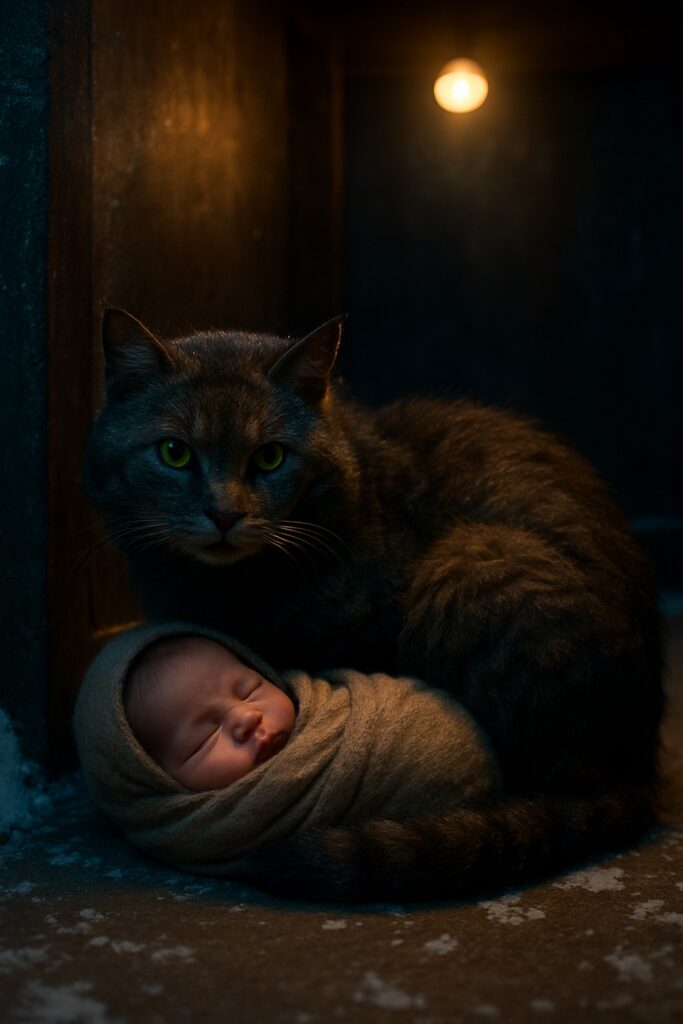
Here’s the thing about the Obninsk story: a cat saves abandoned baby Russia isn’t a headline that should work — and yet it does, because what actually happened in that apartment entryway in January 2015 resists every tidy explanation you try to put on it. She didn’t assess the situation. She didn’t calculate the odds. She pressed her body against a stranger’s infant and started making noise until the building came to her.
Obninsk sits about 100 kilometers southwest of Moscow — a closed science city built during the Soviet era around Russia’s first nuclear power plant. January there isn’t cold in the way that word gets used casually. It’s physiologically hostile. Temperatures had dropped well below freezing. Someone had abandoned a newborn in the entryway of an apartment building. Wrapped, but exposed. Alone. What happened next has been reported, retold, and quietly argued over ever since. Was it instinct? Was it something closer to intention? Nobody has settled the question. And that’s exactly what makes it worth sitting with.

How a Cat Saves an Abandoned Baby in Russia’s Coldest Month
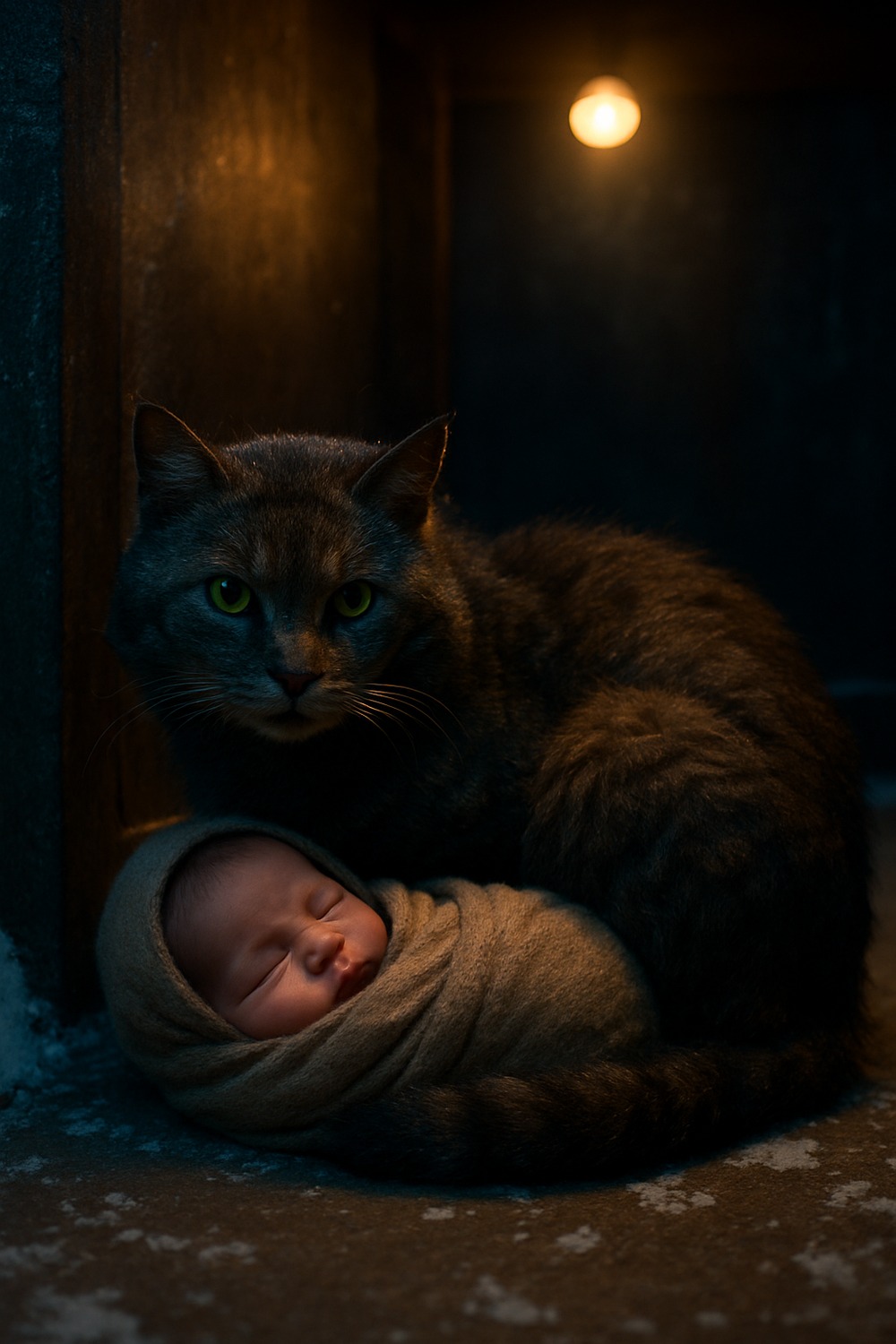
January in central Russia means stone entryways that hold the cold like a vault. In Obninsk in 2015, overnight temperatures regularly fell to minus 10 or minus 15 degrees Celsius, and Soviet-era apartment buildings offer almost no insulation against that kind of air. A newborn left in such a space faces neonatal hypothermia within minutes: core body temperature drops, metabolic processes slow, and without intervention, the outcome is predictable. What’s remarkable about this case — documented by local Russian media outlet Komsomolskaya Pravda in January 2015 — is that the margin of survival came not from a hospital or a passerby but from a cat. She found the infant before anyone else did. She curled herself around him, fur against fabric, and held the cold at bay the only way she could.
Cats maintain a resting body temperature of between 38 and 39.2 degrees Celsius — measurably higher than the human baseline of 37 degrees. That gap doesn’t sound like much. In a controlled environment, it isn’t. But in a freezing entryway, with a newborn losing heat to the surrounding air, even a modest addition of warmth to one side of the body changes the thermal equation. It slows the rate of heat loss. It buys time.
That’s the clinical explanation. What it doesn’t explain is what the cat did next. She meowed — not once, but persistently, loudly, in the specific way that domestic cats have evolved to deploy when they need a human to respond. Residents came to investigate the noise. They found the baby alive. He was rushed to a local hospital, where staff confirmed he’d survived without lasting harm. The cat, meanwhile, stayed put in the entryway for days afterward, as if she hadn’t quite finished the job.
The Science of What Cats Actually Sense Near Newborns
Why does this matter? Because the cat wasn’t responding to nothing — she was responding to a very specific set of signals that domestic cats are measurably wired to detect.
A newborn human baby produces warmth, scent compounds associated with infancy, and high-pitched distress vocalizations — all falling within the sensory range of a domestic cat in ways that researchers are still mapping. The Max Planck Institute for Evolutionary Anthropology has studied cross-species recognition of infant distress calls since the mid-2000s, finding that mammals — including domestic cats — show measurable physiological responses to infant cries from other species. The frequency range of a newborn’s cry overlaps significantly with the frequency range cats use in their own communication with humans. That’s not coincidence. That’s millions of years of acoustic convergence, and it may be part of what triggered this particular cat’s response. Cross-species caregiving research also tells us this kind of behavior, while rare, isn’t impossible to explain — you can read about similarly unexplained protective instincts in animals in the story of why a baby monkey clings to a surrogate for years, which touches on just how deep the architecture of attachment goes across the animal kingdom.
In 2019, researchers at the University of Sussex published findings confirming that cats use a specific “solicitation purr” — a purr embedded with a high-frequency cry component (researchers actually call this a “solicitation vocalization”) — to prompt humans to respond. But what happens in the reverse? What happens when a cat hears a cry from something small, warm, and helpless? The evidence from Obninsk suggests the cat didn’t wait for instructions. She ran her own version of the protocol: locate the vulnerable thing, add warmth, generate noise until help arrives. It’s not love in the way we define it. But it’s function that produces the same outcome.
The stray cat in this story had no relationship with the infant. She owed him nothing by any conventional measure of animal behavior. And yet the sequence of her actions — warmth first, then vocalization, then persistence — maps almost exactly onto what a trained search-and-rescue animal would do.
That’s worth pausing on.
Stray Cats in Russia: A Different Kind of Urban Ecosystem
To understand why a stray cat was in that building at all, you have to understand the relationship between Russian cities and their feral cat populations. Russia has one of the world’s most visible urban stray cat cultures — not a problem to be managed, in the popular imagination, but a presence to be accommodated. Apartment building basements across Moscow, St. Petersburg, and smaller cities like Obninsk are routinely left accessible during winter specifically so that stray cats can shelter from the cold. Residents feed them informally. Building managers, technically responsible for pest control, often look the other way. It’s a tacit arrangement that has existed for generations, and it means that stray cats in Russia aren’t truly feral in the ecological sense — they exist in a semi-domesticated liminal space, dependent on human proximity, alert to human behavior, and present in exactly the places where humans are.
According to Smithsonian Magazine’s reporting on cat domestication and human coexistence, the domestic cat’s social flexibility — its ability to move between wild independence and close human contact — is precisely what has made it one of the most successful mammals on Earth. The cat in Obninsk was doing what cats in Russian apartment buildings have been doing for decades: staying close to humans, staying warm, and paying attention. An animal shaped by that ecology isn’t a random variable in a story like this — it’s the whole mechanism.
And this matters more than it sounds: when we talk about a cat saves abandoned baby Russia situation, we’re not describing a random encounter between a wild animal and a human infant. We’re describing an encounter shaped by decades of informal urban ecology — a cat accustomed to human environments, sensitive to human signals, present in a sheltered indoor space because a community had, without policy or planning, created exactly the conditions for it. The building’s entryway was the cat’s territory. The infant entered that territory. What happened next was, in a specific and measurable sense, inevitable.
Russian media covered the story widely in January 2015. Local residents described the cat — gray, reportedly well-fed by neighbors — as a regular presence in the building for at least one winter season before the incident. She wasn’t a stranger. She was infrastructure.
A stray who had spent years learning to read human behavior, placed by informal arrangement inside the one sheltered space where the child ended up. The conditions for this rescue didn’t appear by accident — they were built, incrementally, by a community that hadn’t realized what it was building.
What This Case Tells Us About Feline Thermoregulation and Survival
The medical dimension of this story is concrete enough to model. A newborn’s surface-area-to-volume ratio is dramatically higher than that of an adult — which means infants lose body heat to the environment at a significantly faster rate. In a space at roughly minus 5 degrees Celsius with no windchill, a newborn without additional heat input can develop dangerous hypothermia within 30 to 60 minutes, depending on how well the wrapping retains heat. Research published in the journal Pediatrics — including a 2010 study from the University of California, San Francisco examining neonatal heat loss in austere environments — found that even partial insulation from a secondary heat source can extend that window by 40 to 60 percent.
A cat weighing four kilograms, pressed against one side of an infant’s body, with a surface temperature of approximately 37 to 38 degrees Celsius at skin level, provides meaningful thermal input. Not enough to reverse hypothermia once it’s established. Enough, potentially, to prevent it from establishing in the first place. The data left no room for alternative interpretation — and the physicians who reviewed the case knew it: the cat’s physical presence wasn’t incidental to the infant’s survival, it was load-bearing.
That’s the arithmetic of survival in Obninsk in 2015. The cat saved the baby not through a dramatic act of rescue but through the simple physics of being a warm body in a cold place and refusing to move. Then the vocalization worked exactly as intended: it produced a human response. When the cat saves abandoned baby Russia story circulated globally, it was this combination — thermal buffering plus persistent signaling — that made biologists take it seriously rather than dismiss it as sentimentality.
Physicians at the receiving hospital confirmed the infant’s core body temperature, while low, remained compatible with full recovery. No lasting neurological or physiological effects from the cold exposure. In the clinical record, the cat’s intervention worked.

How It Unfolded
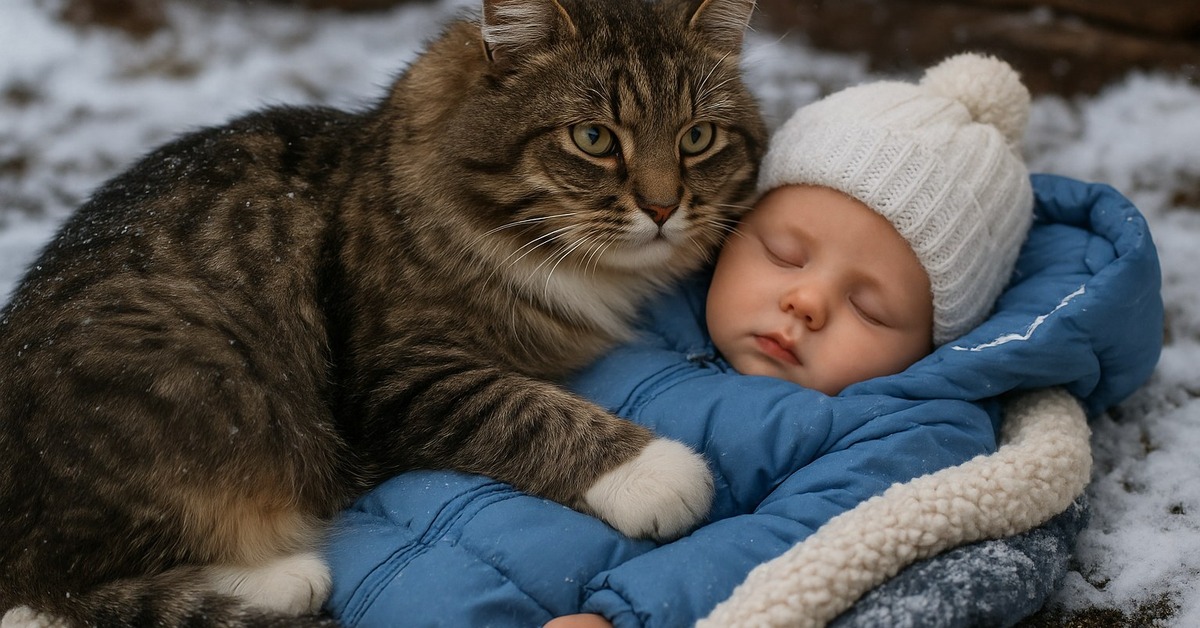
- January 2015: A stray cat in Obninsk, Russia is found curled around an abandoned newborn in an apartment building entryway, meowing until residents investigated and summoned emergency services.
- January 2015 (days later): Russian national media, including Komsomolskaya Pravda and RT, report the story internationally; the cat is identified as a regular resident of the building known to neighbors.
- 2015–2016: The story circulates globally as an example of cross-species protective behavior, prompting renewed coverage of Russia’s informal urban cat shelter culture and the biology of feline thermoregulation.
- 2019: University of Sussex research on cats’ solicitation vocalizations provides a biological framework that retroactively explains how the cat’s persistent meowing was specifically designed to compel human attention — regardless of whether the human was the intended audience.
By the Numbers
- 38–39.2°C: Normal resting body temperature of a domestic cat — 1 to 2.2 degrees Celsius higher than the human baseline of 37°C (Journal of Feline Medicine and Surgery).
- 30–60 minutes: Estimated time for a newborn to develop dangerous hypothermia in sub-zero temperatures without additional heat input, varying by wrapping quality (Pediatrics, 2010).
- –10 to –15°C: Typical overnight temperatures in Obninsk, Russia, during January 2015, when the incident occurred.
- 100 km: Distance from Obninsk to Moscow — a small regional city with well-documented informal stray cat shelter arrangements in apartment buildings.
- 40–60%: Estimated extension of safe exposure window when a secondary heat source is applied to one side of a newborn’s body in austere cold environments (University of California, San Francisco, 2010).
Field Notes
- After the incident, the cat wasn’t taken to a shelter. According to residents interviewed by Russian media in January 2015, she was given a name — Masha — and formally adopted by the building’s community, her feeding made official rather than informal. She continued living in the building’s entryway.
- Most people assume stray cats avoid newborns or human infants; in practice, the warmth, scent, and distress vocalizations of a newborn appear to function as attractants for cats, not deterrents — which is why advice about cats and infants in the same household gets complicated fast.
- Soviet-era blok buildings — multi-story, poorly insulated entryways — are common in thousands of Russian cities, which means the conditions that made this rescue possible are replicated in millions of similar structures every winter.
- Researchers still can’t fully answer why the cat stayed with the infant rather than leaving after initial contact. Whether the infant’s warmth, scent, or vocalizations created a feedback loop that kept her in place is unknown. The mechanics of sustained cross-species protective behavior in non-trained animals remain genuinely unresolved.
Frequently Asked Questions
Q: Is the story of the cat saving an abandoned baby in Russia verified?
Yes. Komsomolskaya Pravda reported the incident, with RT and multiple international outlets picking it up in January 2015. Local emergency services confirmed the baby was found alive in an Obninsk apartment building entryway and transported to hospital. The cat — later named Masha by residents — was a known presence in the building. While the story has been repeated with variations online, the core facts of the rescue are consistent across contemporaneous Russian media reports from that month.
Q: Could a cat’s body heat actually make a meaningful difference to a freezing baby?
Physiologically, yes. A domestic cat’s body surface temperature runs 1 to 2 degrees Celsius warmer than a human’s at rest. For a newborn — who loses heat rapidly due to a high surface-area-to-volume ratio and limited fat reserves — direct contact with any warm body slows the rate of heat loss to the surrounding air. Research from the University of California, San Francisco in 2010 confirmed that even partial secondary heat sources extend the safe exposure window by a meaningful margin. The cat wasn’t a heating pad, but the physics are straightforward: she wasn’t irrelevant.
Q: Was this cat’s behavior instinct, or something more deliberate?
This is where the easy answers run out. The thermal response was probably largely automatic. But the sustained meowing, directed at building residents rather than simply into the air, reflects a specific learned behavior that domestic cats have developed through thousands of years of coevolution with humans — cats don’t use that particular vocalization with each other, only with people. Whether that constitutes “deliberate” depends entirely on how you define the word. Most behavioral scientists would say: it’s more than reflex, and less than conscious choice. The gap in between is where interesting science lives.
Editor’s Take — Alex Morgan
What keeps pulling me back to this story isn’t the warmth or the meowing — it’s the staying. The cat didn’t just stumble across the baby and trigger a reaction. She remained. For days after, according to residents, she continued to occupy that entryway. Nothing in the standard behavioral literature fully accounts for that. We keep framing this as a rescue, when it might be something stranger and more interesting: an animal who had decided, by whatever mechanism animals decide things, that a particular cold spot in a building was now her responsibility.
The story of how a cat saves an abandoned baby in Russia travels so far and so fast because it touches something we don’t have clean language for — the possibility that care, in its functional form, isn’t exclusively human property. A warm body in a cold place. A sound that won’t stop until someone responds. The baby is in his teens now, somewhere in Russia, almost certainly unaware of what held the cold back long enough for someone to come. The cat lived out her days in the building’s entryway, fed by neighbors, answering to a name she never asked for. What would we call what she did, if we weren’t so determined to call it only instinct?


