How Cathay Pacific Flight CX880 Landed Before It Left
Cathay Pacific Flight CX880 crosses the International Date Line eastbound, and the calendar does something that feels less like aviation and more like a rumor about time — the January 1st passengers had just celebrated over Hong Kong, champagne still warm, simply stopped having happened yet. By touchdown at LAX, it was December 31, 2025. The year they’d rung in over the Pacific had, by every official measure, not yet arrived.
A Flight That Bent the Calendar
Cross the International Date Line heading west, and you lose a day. Cross it heading east — which is exactly what CX880 did, banking out over the Pacific toward Los Angeles — and you get one back. That’s the whole trick. The Date Line runs roughly along the 180th meridian through the central Pacific, and unlike the equator or the tropics, which reflect actual astronomical geometry, it’s a purely human invention (researchers actually call this a “civil boundary,” which somehow makes it sound even more arbitrary). The world needed a place where Tuesday became Wednesday, where one calendar year tipped into the next, and the middle of a largely empty ocean seemed like the least inconvenient place to draw that line.
Every so often, a commercial jet flies straight through it at the exact right moment. When that moment is just after midnight on New Year’s Day, the passengers get something the airline never scheduled and the ticket never promised.
The Science Behind the Sorcery
Here’s the thing about time zones: they’re not magic, but they manufacture situations that feel indistinguishable from it. Earth turns 360 degrees every 24 hours, 15 degrees of longitude per hour, and the planet’s 24 time zones were carved up to match. The Date Line is just where that accumulated debt gets officially settled. Fly eastward fast enough across enough of them and you chase the clock backwards, hour by hour, until the date itself starts sliding. Pilots have understood this arithmetic for decades — but knowing the mechanism doesn’t fully dissolve the strangeness of watching your phone tick back to a year that’s technically already happened.
What makes the New Year’s version of this so strange is the emotional freight the date carries. Any eastbound Date Line crossing technically arrives on an earlier calendar date than it departed — that happens on Tuesday-to-Monday flights constantly, and nobody tweets about it. But when the date being erased is January 1, and the date being restored is December 31, you’re not nudging a weekday. You’re rewinding the ball drop. You’re giving passengers two genuine shots at the one moment the whole world agrees to treat as a collective starting gun. That’s not arithmetic. It’s something else entirely.
CX880 covers roughly 7,200 miles between Hong Kong and Los Angeles, typically 11 to 13 hours depending on routing and wind. Cathay Pacific runs it regularly. There’s nothing exotic about the aircraft or the crew or the route. What made New Year’s 2026 different was pure timing: departure roughly 30 minutes past midnight Hong Kong time, aimed at a city sitting 16 hours behind. The plane didn’t need to outrun physics. Touchdown in LA came with the ball drop still ahead of them — and not a single passenger had done anything to earn it except buy a ticket.
How It Unfolded
- 1884 — International Meridian Conference in Washington, D.C. establishes Greenwich as the prime meridian and creates the framework for global time zones, implicitly requiring a Date Line in the Pacific.
- 1995 — Kiribati repositions its portion of the Date Line so the entire nation shares a single calendar day, making it one of the first places on Earth to greet each new year.
- Early 2000s — Transpacific commercial aviation reaches a frequency where date-reversal crossings become routine, though largely unremarked outside aviation circles.
- January 1, 2026 — Cathay Pacific Flight CX880 departs Hong Kong just after midnight and lands in Los Angeles while 2025 is still technically in progress, generating widespread attention on social media.
By the Numbers
- 7,200 miles — approximate distance between Hong Kong and Los Angeles on CX880’s route
- 11–13 hours — typical flight duration depending on routing and headwinds
- 16 hours — the time zone gap between Hong Kong (UTC+8) and Los Angeles (UTC−8)
- 180th meridian — the approximate longitude of the International Date Line through the central Pacific
- 24 — number of time zones Earth’s surface is divided into, one per hour of rotation
- 15 degrees — longitude covered per hour of Earth’s rotation, the basis for all time zone arithmetic
- 1995 — year Kiribati moved its Date Line boundary, making it the first nation to enter each new year
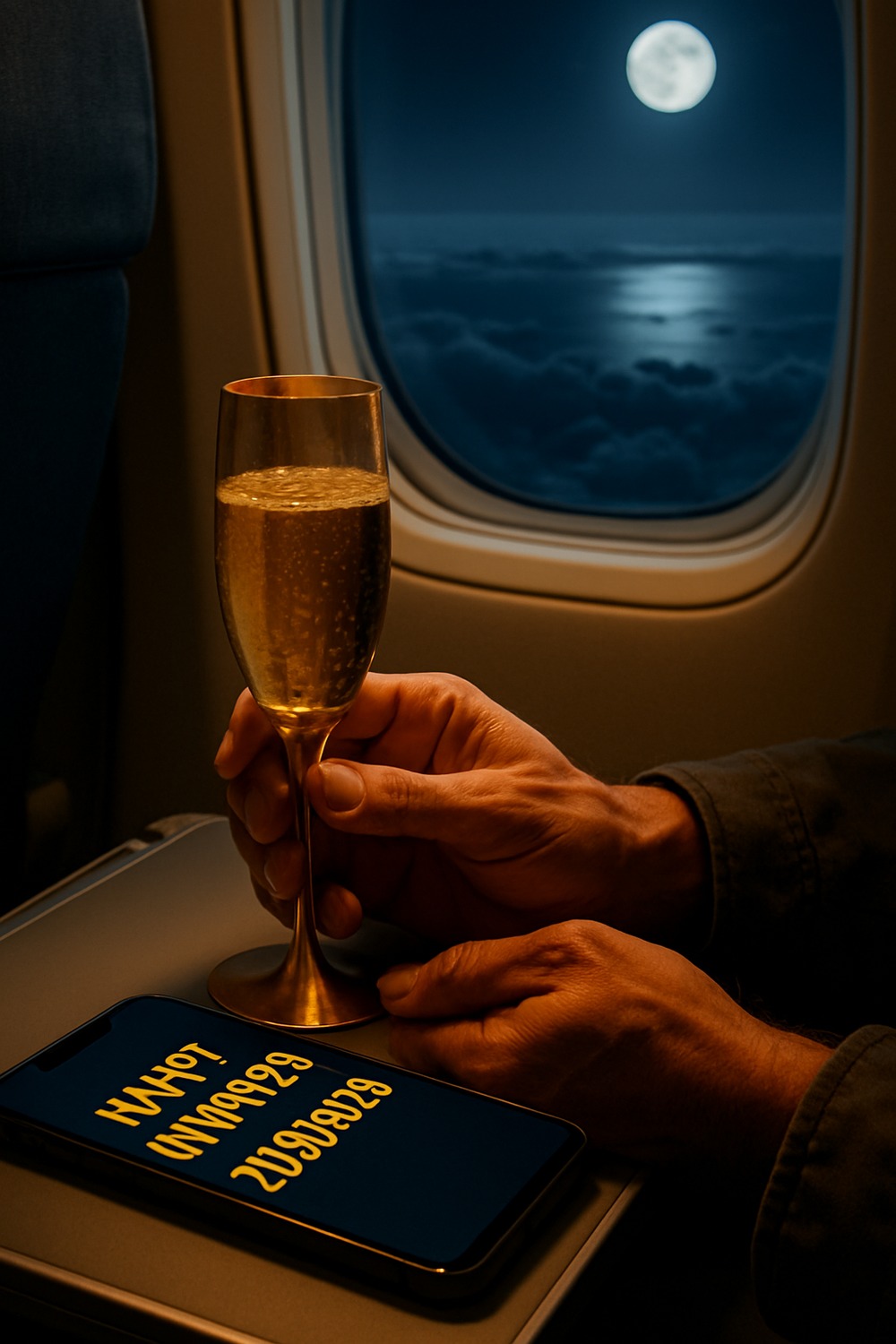
CX880 Wasn’t Flying Alone
Flights out of Tokyo, Taipei, and Seoul were threading the same needle that night — all of them sitting on the eastern edge of Asia’s time zone cluster, all of them departing just after local midnight on January 1, all of them aimed at North American cities. The toast somewhere over the ocean, the long dark hours, and then the flight deck announcement that local time in Los Angeles was, somehow, still the 31st. Some passengers reportedly whooped. Some laughed. A few apparently just stared at their armrests trying to reconstruct the math.
Nobody planned the gift.
And what these flights collectively produced was something no airline scheduled deliberately and no algorithm generated as a marketing moment. It emerged from the interaction of departure windows, time zone arithmetic, and a decision made in the 19th century about where to put a line in the ocean. It just arrived, carried by geometry and scheduling, to hundreds of passengers who hadn’t necessarily known to expect it. In a world where every experience has been packaged and optimized, that kind of accidental wonder is genuinely difficult to manufacture — and that might be exactly why it hit so hard.
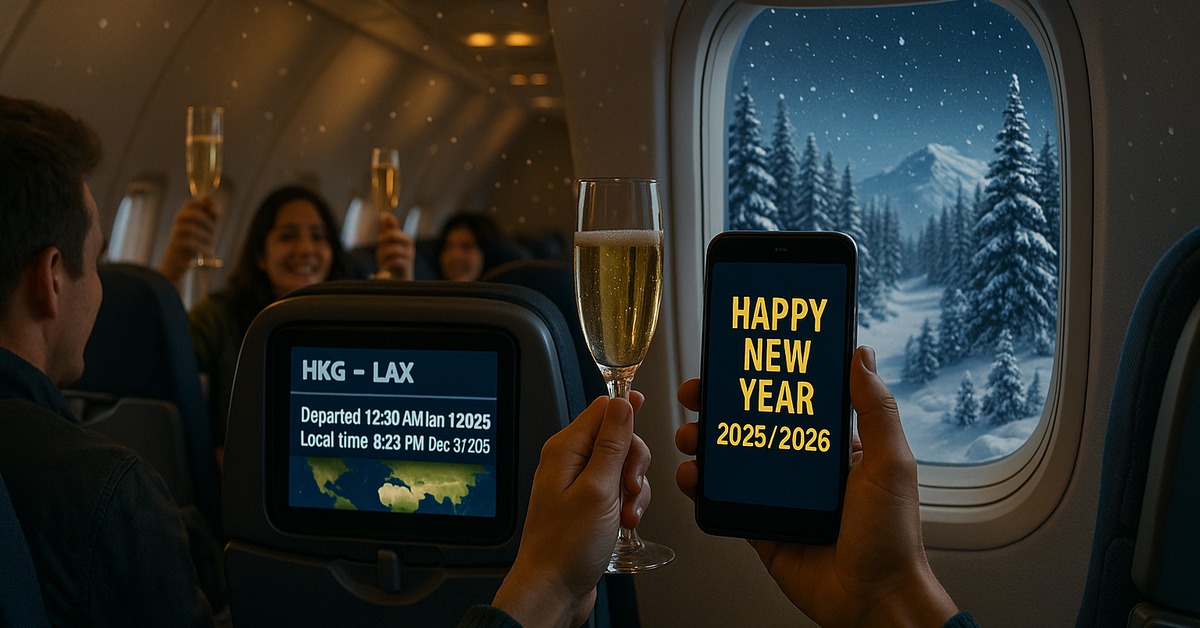
A Second New Year’s Eve — What Would You Do With It?
Picture landing at LAX and watching your phone blink back to December 31. Friends in Hong Kong are already nursing their hangovers, already halfway through January 1. But you’re standing at the luggage carousel with the night technically still ahead of you, West Coast parties still hours from their own midnight. Do you go? Do you call someone? Do you sit in an airport bar and simply hold the knowledge that you’ve already seen the year turn and somehow walked back out through the door into the previous one? There’s no correct answer. The passengers on CX880 faced exactly that choice, and they answered it every possible way.
What makes the calendar fold so disorienting isn’t the arithmetic — it’s the assumption it ruptures. Frequent transpacific travelers develop a practiced indifference to this: diplomats, journalists, business people who’ve done the Pacific crossing enough times that date changes register as mild inconveniences rather than revelations. But for first-timers, especially on a night as loaded with collective meaning as New Year’s Eve, the effect hits differently. It reveals the calendar as a negotiated document. Useful, yes. Widely honored, absolutely. But occasionally negotiable, particularly at 35,000 feet above open ocean.
What the Date Line Tells Us About Time Itself
Why does any of this matter? Because the Date Line is where the fiction of universal time becomes impossible to ignore.
That line was a byproduct of the 1884 International Meridian Conference in Washington, D.C. — the same gathering that installed Greenwich as the prime meridian. Nations needed a rational framework for coordinating commerce and navigation across a globe that telegraph cables were rapidly shrinking, so they divided the world into zones and drew the line. But the Date Line has never been straight. It zigzags to accommodate political and economic preferences: islands that would rather share a date with their nearest trading partner than be split across two. Kiribati moved its portion of the line in 1995 so the entire nation could share the same calendar day. Nobody talks about this much, but time zones have always been partly political — and that’s a fact the aviation age has done almost nothing to disguise.
History has a way of treating the people who ignored this kind of evidence unkindly — the evidence being that the calendar was always a human construction, not a natural law, and CX880 made that visible to anyone still paying attention at 35,000 feet.
So when CX880 exploits this system and returns passengers to the previous year, it’s doing something that only feels like magic. The universe doesn’t register January 1. The stars don’t reset. Earth’s rotation doesn’t pause or acknowledge the date. Only we decided that one particular midnight is the hinge on which everything swings, and the Date Line, more than any other feature of the system, is where that human authorship becomes impossible to ignore. Cross it on the right flight at the right hour and the curtain pulls back — just for a moment, just enough to remember who drew it in the first place.
Field Notes
- The International Date Line is not a fixed straight line — it deviates significantly from the 180th meridian to keep island nations and territories on the same calendar page as their political or economic partners.
- Passengers who cross the Date Line westbound on New Year’s Eve skip from December 31 to January 2, losing January 1 entirely — the mirror image of what CX880’s eastbound passengers experienced.
- Eastbound Date Line crossings that produce a date reversal happen on ordinary days throughout the year; the New Year’s version is remarkable only because of the specific date involved, not the mechanics.
- Some travelers now book transpacific eastbound flights departing on January 1 specifically to experience the “second New Year’s Eve” — a niche tradition that social media has quietly amplified since the mid-2010s.
- The flight crew’s announcement that the local date had rolled back is reportedly a standard part of transpacific New Year’s departures for Cathay Pacific, though passenger reactions vary from wonder to mild confusion.
Frequently Asked Questions
Q: How can a flight land before it takes off when crossing the International Date Line? It doesn’t break physics — it exploits the calendar. Flying eastward across the Date Line moves the clock back 24 hours on the calendar specifically, not in actual elapsed time. CX880’s flight duration was completely normal. The crossing simply accumulated enough eastward time zones that the local date at the destination landed earlier than the departure date. The clock kept moving forward. The calendar briefly didn’t.
Q: Does this happen on every flight from Hong Kong to Los Angeles? Not quite. The calendar-reversal only becomes notable when departure time is close enough to midnight that the 16-hour gap between Hong Kong and Los Angeles pushes arrival back to the previous date. Afternoon or evening departures from Hong Kong typically arrive the same calendar day in LA, or one day behind at most. It’s the specific combination — Date Line crossing plus a just-after-midnight departure window — that produces the New Year’s replay.
Q: Are passengers aware they’ll get two New Year’s Eves when they book these flights? Most aren’t, turns out. Travel experts say the majority of passengers on these transpacific New Year’s crossings are simply going somewhere — family, business, holiday plans — and discover the bonus date only when the crew announces it or their phone resets. But awareness has grown on social media, and some travelers now book eastbound New Year’s crossings deliberately, specifically for the novelty of celebrating twice.
Editor’s Take — Sarah Blake
What stays with me about CX880 is not the time zone arithmetic — that part is almost tediously explainable. It’s the moment the phone resets and a passenger who already toasted the new year realizes the night is, by every legal and social convention, still theirs. The calendar hands them a door back in. Most people don’t know what to do with found time. The ones who do — who walk straight out into a Los Angeles New Year’s Eve already knowing what’s coming — they understand something the rest of us keep forgetting: the clock was always a suggestion.
What CX880 did in the first hours of 2026 required no special technology, no trick of physics, nothing beyond flying east across an ocean and following rules humanity wrote for itself over a century ago. The passengers who toasted one year, crossed a line in the dark Pacific, and found themselves handed the night back — they got something rare. Not a glitch. A reminder. The calendar is a map we drew, and the Date Line is where the edges meet, slightly imperfectly, in the middle of the water. Sometimes you cross it at exactly the right moment, and the map folds just enough to give you one more night.