


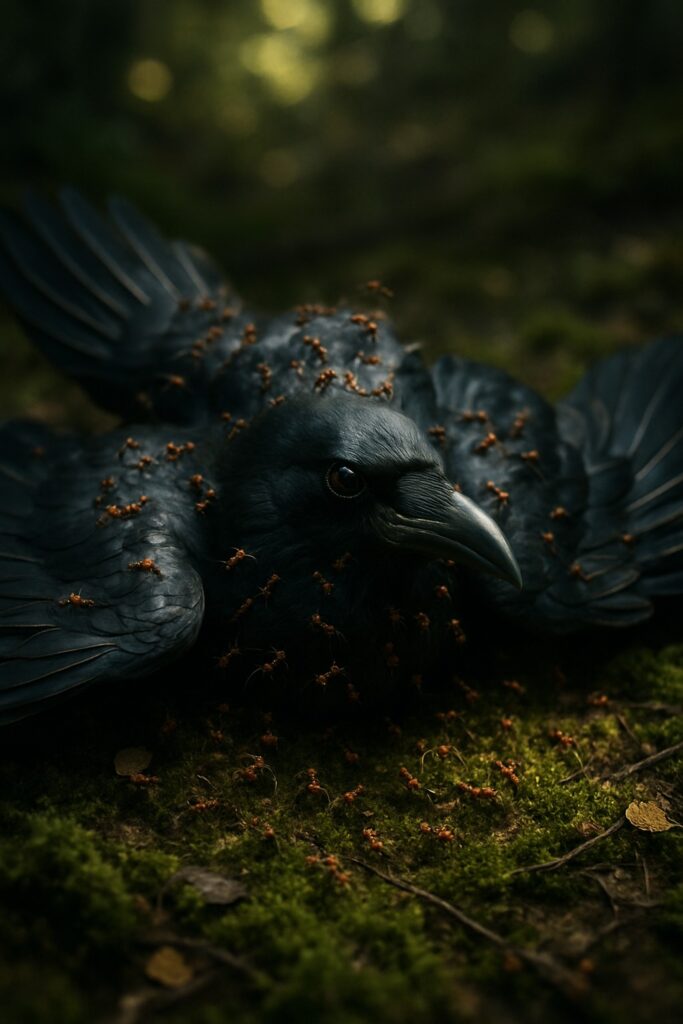
Crow anting behavior doesn’t look like medicine. It looks like a bird having a breakdown — wings splayed, body flattened against the dirt, shuddering while ants swarm through its feathers. And yet this is one of the most deliberate acts of self-medication documented in the animal kingdom, playing out in backyards and city parks and old-growth forests, mostly unobserved, for millions of years.
Every summer, ornithologists and backyard birdwatchers across North America spot crows doing something deeply strange — collapsing onto ant mounds, stretching their wings flat, and holding position while thousands of insects swarm through their feathers. It lasts minutes. Then the crow stands, shakes, and walks away like nothing happened. What exactly is going on beneath those feathers, and why would a bird intelligent enough to use tools voluntarily lie inside an ant colony?

What Crow Anting Behavior Actually Looks Like Up Close
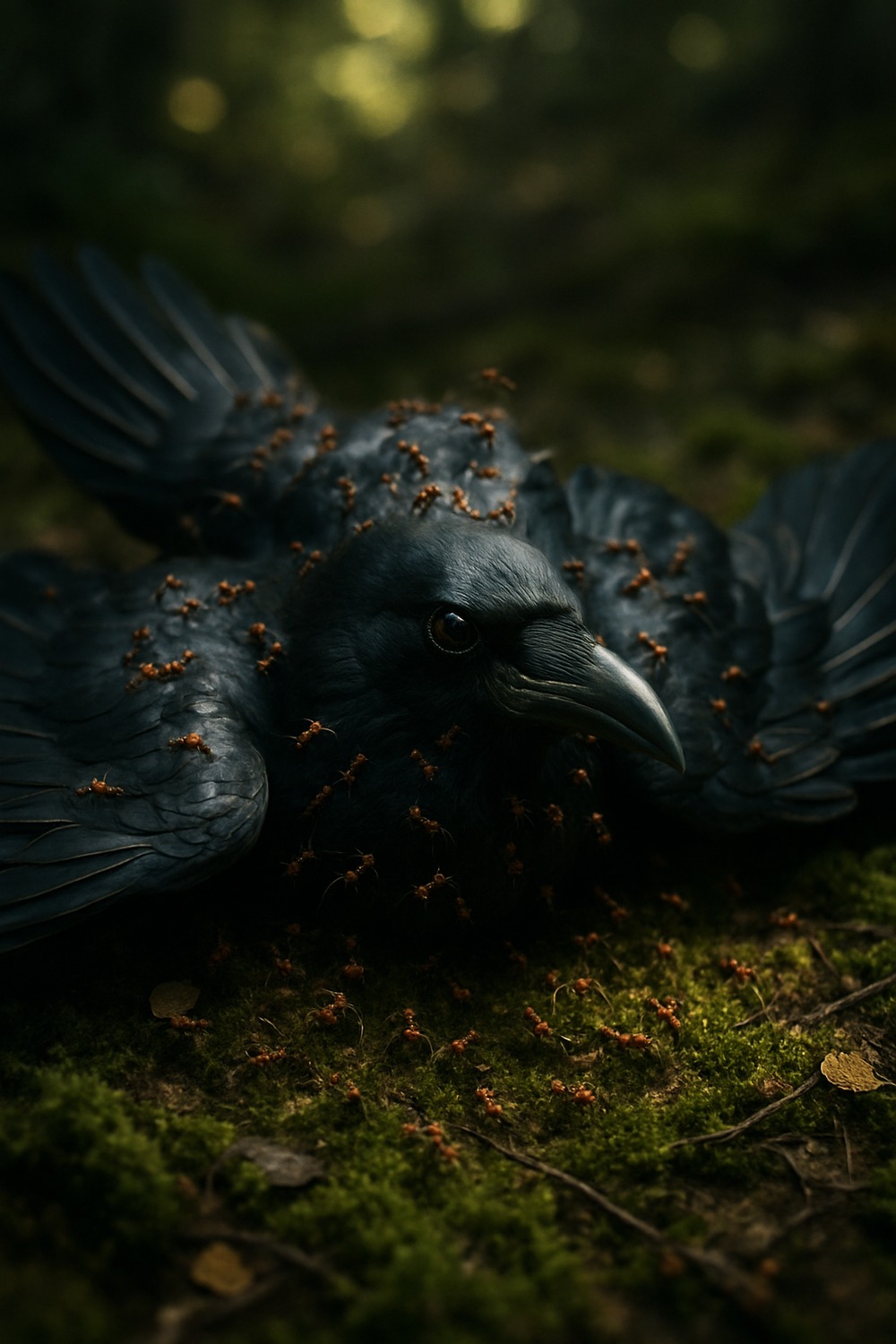
Crows don’t stumble onto ant mounds by accident. They locate colonies — often of the genus Formica, the wood ants — and then adopt a very specific posture: body horizontal, wings drooped and spread, tail fanned, feathers slightly raised to expose the skin beneath. According to research catalogued by the Cornell Lab of Ornithology, this posture is consistent enough across individuals that ornithologists treat it as a recognizable behavioral category. The behavior was formally described in scientific literature as early as the 1930s, but it took decades before researchers connected it consistently to formic acid as the active chemical agent.
The ants don’t bite willingly — they spray defensively, which is exactly what the crow is provoking. Agitated by the intrusion, they begin firing jets of formic acid from their abdominal glands. The crow doesn’t flee. It shudders, adjusts its wings, and occasionally picks ants up in its bill and rubs them directly against its feathers in what researchers call “active anting” — as opposed to the passive version, where the bird simply lets the insects swarm. Both methods achieve the same chemical result. The acid saturates the feathers and penetrates to the skin. The bird looks distressed. It probably isn’t.
Field observers from the British Trust for Ornithology have noted that crows sometimes return to the same ant mound multiple days in a row during peak molting season, suggesting this isn’t impulsive or accidental. It’s scheduled. The forest floor, for a crow in late summer, is a standing appointment.
The Chemistry That Turns Ants Into Medicine
Formic acid — chemical formula HCOOH — is the compound that makes ant bites sting. At high concentrations it’s genuinely corrosive. At the doses a bird absorbs during anting, it does something far more useful: it disrupts the waxy cuticle of feather lice and mites, the microscopic parasites that spend their lives inside a bird’s plumage. These parasites don’t just cause irritation. Heavy louse infestations have been shown by researchers at the University of Utah to reduce feather quality, impair flight aerodynamics, and in some cases compromise thermoregulation. Parasites are not a minor inconvenience for birds — they’re a survival variable.
And crows appear to have developed a behavioral solution that doesn’t require a single gene mutation, just observation and learned repetition. The same instinct that draws a crow to use a stick as a tool seems to draw it toward formic acid as a topical treatment. Much like how the desert-adapted jackrabbit uses its enormous ears to regulate body temperature, this is biology finding an elegant engineering solution from available materials.
The acid also appears to soothe skin irritation during molting. In late summer and early autumn, when crows replace their flight feathers, the exposed skin at each follicle becomes inflamed and sensitive. Formic acid has mild anti-inflammatory properties. Whether crows “understand” this mechanically is unknowable — but the timing of peak anting activity correlates precisely with peak molting season, a pattern documented by researchers at the Max Planck Institute for Ornithology in Germany across multiple corvid species between 2008 and 2015.
Here’s the thing about what the acid does next: it makes the ants themselves easier to eat. After a good anting session, crows have been observed consuming the spent ants directly. The formic acid concentration in a sprayed ant drops sharply after discharge. The bird gets its chemical bath and a protein meal from the same encounter. Efficiency like that doesn’t happen by accident.
Over 200 Species Do This — And Some Have Gone Further
Why does this matter beyond crows? Because the distribution of the behavior is the real story.
Crows don’t have a monopoly on anting. More than 200 bird species practice some version of it, including European starlings, blue jays, American robins, and wild turkeys. Songbirds do it. Raptors do it. Documented on every continent except Antarctica, anting isn’t a quirk of corvid intelligence — it’s a convergent behavioral solution that evolved independently across wildly different bird lineages. According to a comprehensive review published in the journal Ibis in 1997 by researcher Lovie-Jeanne Lovette at the Cornell Lab of Ornithology, anting appears in species that share no recent common ancestor, suggesting the behavior was “discovered” multiple times by different bird groups encountering the same parasitic pressure. What crow anting behavior represents, in that context, isn’t unusual intelligence — it’s an unusually well-studied example of a widespread avian strategy.
Some species have taken it further. Birds in Central and South America have been observed using millipedes as anting substitutes — rubbing the arthropods through their feathers to release benzoquinones, chemicals that serve a similar anti-parasitic function to formic acid. Others use citrus peel. Wild birds in urban Japan were observed in the early 2000s using mothballs. American crows in several U.S. cities have been documented picking up cigarette butts and rubbing them into their plumage, presumably drawn to residual nicotine, which has known insecticidal properties. The behavior profile stays consistent. Only the raw material changes. For a full examination of this behavioral flexibility across species, the Smithsonian Magazine’s coverage of avian tool use and behavioral flexibility provides valuable wider context.
What this distribution pattern tells researchers is significant. The parasite problem is ancient and universal. The formic acid solution is elegant and low-cost. Hundreds of unrelated species landing on the same answer suggests the chemistry works reliably enough to be worth encoding in behavior — even without any bird ever understanding the molecule.
Crow Anting Behavior and What It Reveals About Avian Intelligence
Crows occupy a specific tier in the conversation about animal cognition. Studies at the University of Cambridge, particularly the work of behavioral ecologist Nathan Emery in the early 2000s, established that corvids — crows, ravens, jays, and jackdaws — demonstrate planning, self-recognition, causal reasoning, and cross-species empathy at levels that rival great apes. Anting adds a different dimension to that picture. It isn’t problem-solving in the moment. It’s preventive healthcare — behavior that addresses a future discomfort before it becomes critical (researchers actually call this anticipatory self-medication, and it’s vanishingly rare outside primates). That requires the bird to connect the act with the outcome across a time delay that isn’t immediate. Whether crows learn anting through observation, individual trial and error, or some combination of both is still under investigation — but juvenile crows have been documented attempting it, imperfectly, alongside adult crows who are doing it correctly, which suggests social transmission plays a role.
That social learning dimension matters. If crow anting behavior is transmitted culturally — parent to offspring, flock member to flock member — then it functions more like a tradition than an instinct. And traditions can evolve. The cigarette butt documentation from North American urban crows, first noted in field reports in the 1990s and confirmed more rigorously by the late 2010s, suggests the behavior is flexible enough to incorporate novel materials as they become available. That’s not what an instinct does. That’s what a learned practice does when it encounters new conditions.
A behavior this adaptable, running quietly through 31 million birds in North America alone, deserves more attention than it gets from cognitive science.
Researchers at the University of Washington’s crow research program, led by John Marzluff, have documented how quickly urban crows adopt new behaviors when old solutions become unavailable. Change the environment, and the crow finds the next-best equivalent. The anting response appears to follow the same adaptability curve — the behavior persists because the parasite problem persists.
Where to See This
- North American city parks with mature deciduous trees are your best bet — Golden Gate Park in San Francisco, Central Park in New York, and Stanley Park in Vancouver all host resident American crow populations that have been observed anting near ant mounds in late summer (July through September). Arrive early, stay low, and look near the edges of open grass where tree canopy meets lawn.
- Cornell Lab of Ornithology (allaboutbirds.org) maintains a documented behavioral library including anting records submitted by citizen scientists across North America — it’s the best single resource for tracking seasonal observations and confirmed anting sightings near your location.
- If you want to attempt observation yourself, look for black ant mounds (Formica species) in partially shaded woodland clearings on warm afternoons. Crows tend to ant on calm, humid days. The posture is unmistakable once you’ve seen it — wings fully drooped and splayed, body flat, no movement for 30 seconds or longer.
By the Numbers
- Over 200 bird species have been documented practicing anting, across every continent except Antarctica (Lovette, Ibis, 1997).
- Feather lice infestations can reduce a bird’s flight efficiency by up to 9%, according to University of Utah studies published in 2003 — a margin significant enough to affect predator evasion.
- Formic acid spray from a single Formica wood ant measures approximately 0.01 mg per discharge; a full anting session across an active colony delivers an estimated several hundred micrograms of acid to the plumage.
- American crow populations in North America number approximately 31 million individuals, giving anting behavior an enormous geographic and ecological footprint (Partners in Flight, 2019).
- Oldest confirmed written description of bird anting in scientific literature dates to 1831, though the behavior wasn’t formally linked to formic acid’s anti-parasitic properties until the mid-20th century.
Field Notes
- In 2018, wildlife photographers in London’s Hampstead Heath documented a carrion crow spending nearly eleven minutes in active anting posture on a wood ant mound — one of the longest single sessions on record for a wild crow. The bird appeared completely unresponsive to nearby dog walkers during the episode, suggesting deep behavioral absorption.
- Some crows perform anting in rain, which dilutes the formic acid — making the behavior less chemically effective but still observed, which researchers interpret as evidence that the posture may also have a sensory or thermoregulatory component beyond pure parasite control.
- Not all anting involves discomfort. Crows have been observed appearing to enter trance-like states during passive anting sessions, with slowed blink rates and reduced muscle tension — a physical profile that more closely resembles relaxation than defensive agitation.
- Researchers still can’t fully explain why some individual crows within the same flock never ant, even when nestmates do it regularly. Whether this represents individual variation, learned avoidance, or simply behavioral flexibility is unanswered — and it complicates the cultural transmission hypothesis considerably.
Frequently Asked Questions
Q: Is crow anting behavior harmful to the crows?
No evidence suggests crow anting behavior causes lasting harm under normal conditions. Formic acid concentrations involved are too low to damage skin or feathers at typical exposure durations. The behavior does cause visible shuddering, which observers sometimes mistake for distress, but this appears to be a physical response to the acid’s irritant effect rather than injury. Crows that ant regularly show lower parasite loads than those that don’t, suggesting the net health outcome is positive.
Q: Do crows specifically seek out certain ant species?
Yes — and this is one of the more impressive cognitive aspects of the behavior. Crows show strong preference for ant species with high formic acid output, particularly Formica wood ants and, in some regions, fire ants of the genus Solenopsis. They don’t ant on all ant species indiscriminately. This selective preference implies the bird has learned to distinguish chemically productive colonies from those that aren’t — a discrimination that requires either learned recognition or sensory detection of the acid itself, possibly through smell or taste.
Q: Is anting the same as dust bathing or sun bathing in birds?
A common misconception is that anting is just a variant of other comfort behaviors like dust bathing or sunbathing. It isn’t. Dust bathing removes excess oil and physical debris. Sunbathing may assist with vitamin D synthesis or parasite desiccation. Anting delivers a specific chemical agent — formic acid or its analogues — to the feathers and skin with measurable anti-parasitic effects. The postures can look similar from a distance, which is why anting went undescribed for so long, but the mechanism and the outcome are categorically different from either heat or dust-based comfort behaviors.
Editor’s Take — Alex Morgan
What stops me here isn’t the formic acid or the parasite chemistry — it’s the cigarette butt. A crow in a city, surrounded by concrete and noise, encountering a piece of human detritus and reasoning its way to: this has something useful in it. That’s not instinct adapting to a new environment. That’s a tradition under pressure, searching for the next available tool. We tend to define intelligence by what animals do with their minds in controlled lab settings. Crows are doing something harder — improvising solutions in a world that wasn’t built for them.
Crow anting behavior sits at the intersection of chemistry, cognition, and ecological pressure — a behavior so ancient it predates human medicine, yet flexible enough to incorporate nicotine from a discarded cigarette. Turns out there are 31 million American crows in North America alone, each one carrying a parasite load, each one navigating the same problem their ancestors solved by lying down on an ant mound. The question that stays with you isn’t whether this counts as intelligence. It’s what else they’ve figured out that nobody’s thought to document yet.


