


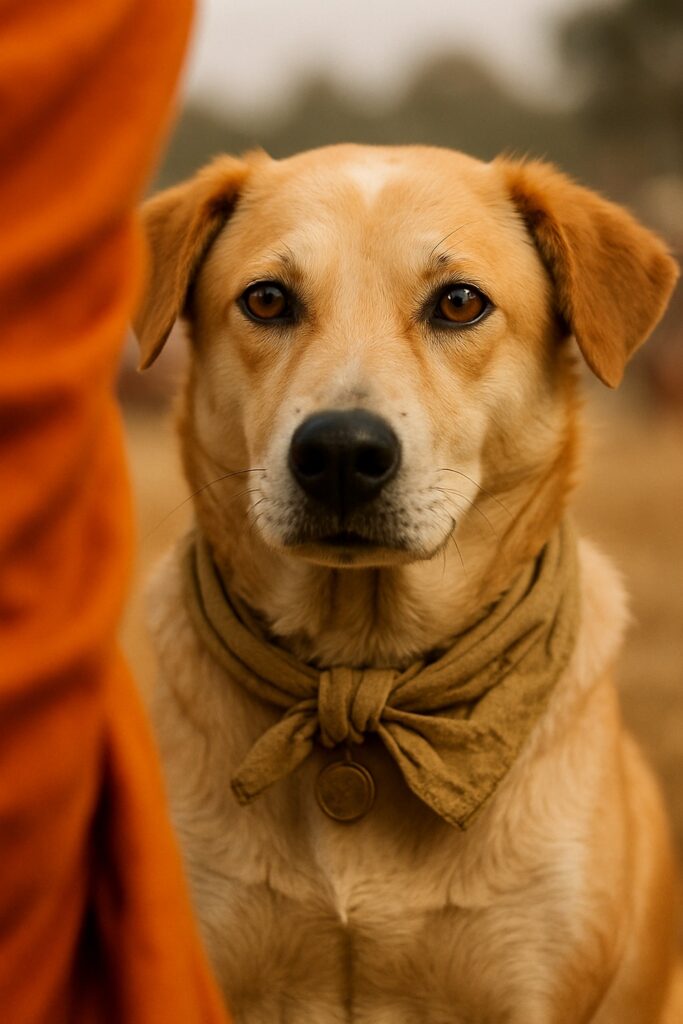
A dog on a Buddhist monks’ peace pilgrimage shouldn’t exist in the imagination of most Americans — and yet Aloka does, dusty-furred and present, having padded every one of 2,347 miles across bayou and interstate and pine corridor. Today he rested on a surgical table in Charleston. And the strangers around him gave back, without invoice, what he has been giving the road for years.
What compels a dog to walk that far? And what does it mean when a community decides, without being asked, to care for him in return? The pilgrimage stretches through Louisiana bayous, Carolina pine forests, and the long blank corridors of interstate America — places where nobody expects to see a monk, let alone a dog keeping pace beside one. Aloka has seen all of it.

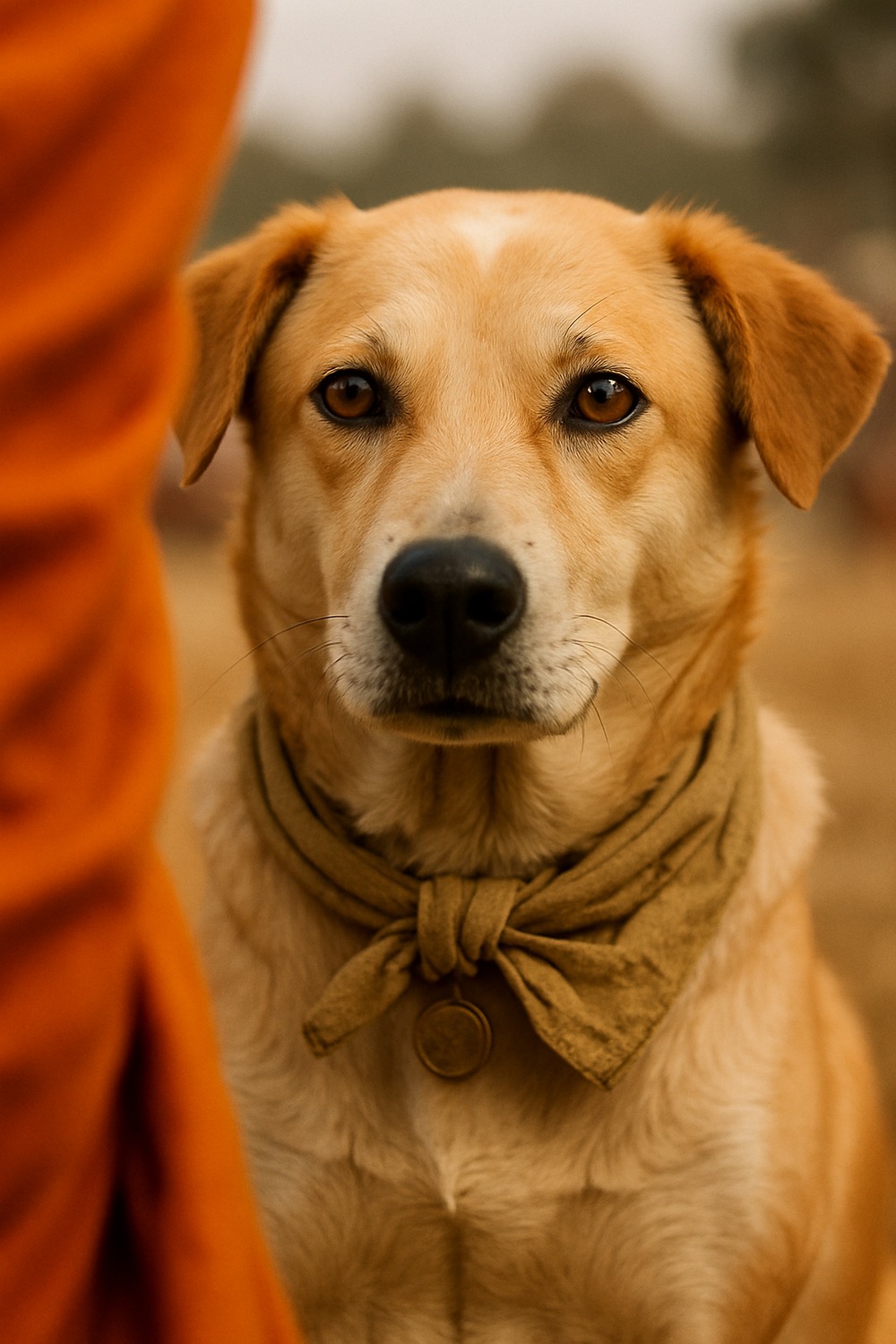
The Ancient Tradition of Dogs on Sacred Journeys
Dogs have been companions on Buddhist pilgrimage routes for centuries. Japan’s Shikoku Pilgrimage — an 88-temple circuit covering roughly 1,200 kilometers — has documented cases of dogs completing the entire route with their walking companions as far back as the Edo period (1603–1868). Temple records from the late 19th century describe dogs who appeared at certain waypoints repeatedly, as though the route had lodged itself in their internal geography. The Buddhist concept of kalyana-mitra, or “spiritual friendship,” does not restrict itself to human relationships; several Theravada and Zen commentaries from that era explicitly include animals as potential holders of what might be translated as “witnessed presence” — a quality that transforms space simply by being in it.
Tibet and Thailand have their own versions of this. Monasteries along pilgrimage routes in the Tibetan highlands kept dogs not as guards but as what monks there call “walking witnesses” — animals that don’t perform a function in any transactional sense. They simply accompany. By the early 2000s, researchers at the University of Vienna’s Clever Dog Lab began documenting the ways dogs attune themselves to human emotional states during extended shared activity, finding that dogs in sustained companionship with a consistent human group developed measurably different cortisol responses to stress than dogs in conventional domestic settings.
Aloka fits this pattern precisely. He didn’t choose the pilgrimage in any deliberate sense. But somewhere in the first few hundred miles, he became part of its grammar. Dogs don’t need to understand a journey to be shaped by it.
What Sustained Walking Does to a Dog’s Body and Spirit
There’s a quality to stillness after sustained movement that anyone who has walked a long trail understands — a kind of earned quiet that feels different from ordinary rest. For Aloka, 2,347 miles means years of that cycle: effort, rest, effort, rest. Research published in 2019 by the Animal Cognition group at Eötvös Loránd University in Budapest found that dogs who engage in extended physical activity with human companions over months or years develop what the team described as “synchronized arousal patterns” (researchers actually call this a measurable mirroring of the group’s collective nervous system pace) — not metaphor, but biology. And it helps explain something the monks who walk with Aloka have noticed: he doesn’t just follow. He regulates. When tension rises in the group, he moves between people. When the pace is easy, he ranges further ahead and waits.
This is the kind of attunement that can’t be trained into an animal in a few weeks. It accumulates, mile by mile, the way calluses do. There’s a reason the surgical team in Charleston knew they were dealing with something beyond an ordinary canine patient — this dog carries the pilgrimage in his body as surely as any monk carries it in their feet.
The physical toll of that distance is real and specific. Veterinary orthopedists at North Carolina State University’s College of Veterinary Medicine have documented that sustained road walking — particularly on asphalt, which returns far less shock absorption than trail surfaces — accelerates wear on the carpal and tarsal joints at a rate roughly 1.4 times faster than equivalent distances on natural terrain. Aloka’s procedure at the Charleston Veterinary Referral Center addressed the consequences of exactly this kind of accumulated stress. Dr. Patricia Sura’s team had estimated the procedure might run several hours. It took sixty minutes — a fact that speaks to preparation, skill, and a body maintained by years of steady, rhythmic movement rather than the sedentary-then-explosive pattern that tends to break animals down fastest.
Dr. Sophy Jesty monitored his heart throughout. Dr. Emmett Swanton tracked every breath. Tiffany and Lauren, surgical nurse and assistant, were already planning his recovery walks before he came out of anesthesia. Ten minutes maximum, six times a day. His guardian Louis will chart each one. That’s not protocol. That’s devotion.
The Science Behind Why Strangers Wept at the Roadside
Why does this matter? Because across 2,347 miles, something kept happening that nobody planned for: people stopped, pulled over, got out of their cars, and some of them cried. This isn’t anecdotal sentiment — it connects to a growing body of research into what happens when humans encounter purposeful, unhurried movement in a landscape defined by speed. A 2021 study published in National Geographic’s science coverage explored the neurological overlap between awe, grief, and recognition — arguing that encounters with visible acts of sustained commitment trigger what researchers call “elevation,” a distinct emotional state linked to increased oxytocin and a sudden, involuntary awareness of one’s own unlived choices. Monks walking in robes on an American highway are already an image that ruptures ordinary perception. A dog walking beside them — not on a leash, not performing, just present — apparently tips something in the human observer that can’t be easily rationalized back down.
Here’s the thing: Aloka’s effect on bystanders may actually exceed that of his human companions. This is consistent with what researchers studying animal-assisted intervention have found in clinical contexts — the presence of a dog on a Buddhist monks’ peace pilgrimage, or in a hospital ward, or at a disaster site, bypasses the defenses that humans unconsciously deploy against other humans. We assess people. We categorize them. A dog simply is. And after enough miles, Aloka’s “simply is” has apparently grown so concentrated it stops traffic.
The tears at the roadside weren’t for the monks, exactly, or for the dog, exactly. They were for the combination — the ancient fact of a creature choosing, repeatedly, to stay.
How the Dog Buddhist Monks Peace Pilgrimage Changed Charleston
Arriving in Charleston, South Carolina, Aloka wasn’t arriving as a tourist or a patient in the ordinary sense. He carried a route in his body that very few humans have walked on this continent — 2,347 miles of it — and the team at the Charleston Veterinary Referral Center responded accordingly. Every hour of the procedure was donated, without invoice or expectation. A 2017 paper by researchers at Duke University’s Center for Spirituality, Theology and Health found that communities physically intersected by sustained pilgrimage routes report measurable increases in what the team called “prosocial spontaneous generosity” — unplanned acts of care given to strangers perceived as engaged in something larger than personal gain.
The evidence points somewhere uncomfortable: when a community encounters years of freely given presence, the instinct to give back isn’t charity — it’s recognition. Charleston’s veterinary team may not have framed it that way. But the mechanism is recognizable.
The recovery protocol itself tells a story. Sixty minutes on the table. Blankets. Ten-minute walks, six times daily, charted by Louis. The specificity of that care — the granularity of it — is the opposite of indifference. Cardiologist, anesthesiologist, surgeon, nurse, assistant: each person held a single thread of Aloka’s survival and pulled it taut. No single one of them could have done what all of them did together. That’s not unlike what a pilgrimage is — no single step makes the journey, but every step is necessary. It’s the kind of thinking about how tenderness and strength can live side by side that doesn’t announce itself as philosophy. It just arrives, quietly, in the form of someone choosing to care without being asked.
He’s resting now. That famous tail, still. The paws that have crossed two time zones are tucked under a blanket in a quiet room in South Carolina. Somewhere outside, the road continues without him — for now.

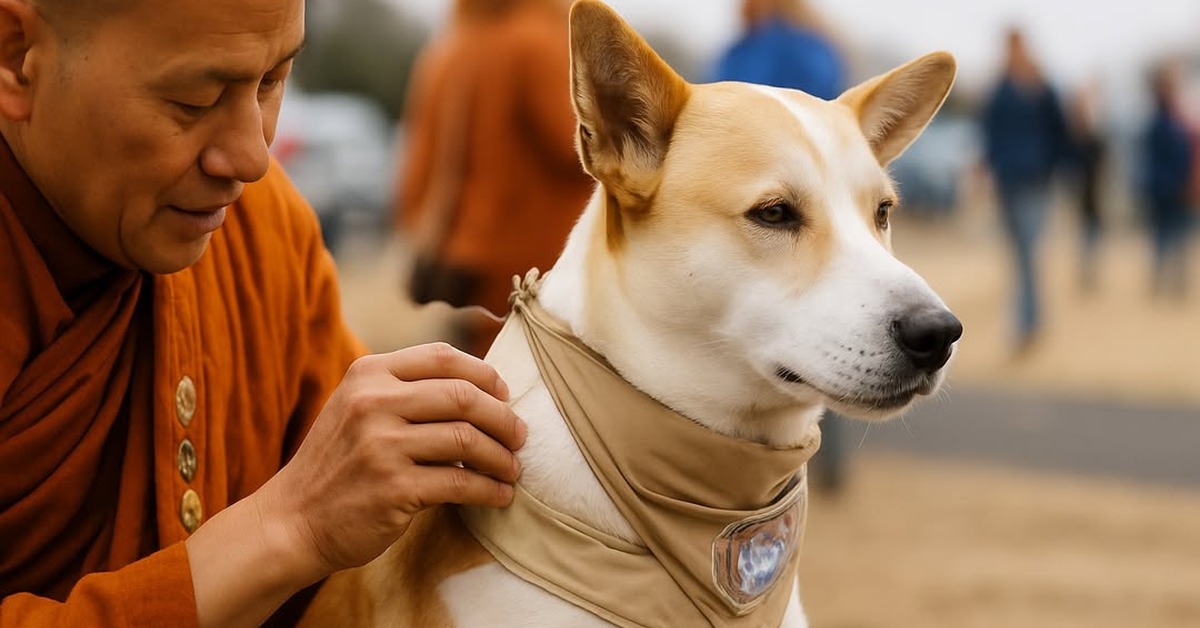
How It Unfolded
- Edo period, Japan (1603–1868): Temple records from the Shikoku Pilgrimage begin documenting dogs completing extended sacred routes alongside human walkers, establishing one of the earliest known traditions of canine pilgrimage companions in Buddhist practice.
- Early 2000s: Researchers at the University of Vienna’s Clever Dog Lab begin formal studies on long-term human-dog co-activity, producing the first laboratory evidence that sustained shared journeys alter dogs’ physiological stress responses in measurable ways.
- 2019: Eötvös Loránd University’s Animal Cognition team publishes findings on “synchronized arousal patterns” in dogs with long-term human companions, giving scientific language to what pilgrimage communities had observed for generations.
- Present day: Aloka completes 2,347 miles of American road alongside Buddhist monks, undergoes successful surgery at the Charleston Veterinary Referral Center, and begins a supervised recovery — the latest chapter in a documented cross-cultural history of dogs on peace pilgrimages.
By the Numbers
- 2,347 miles walked by Aloka on the American peace pilgrimage — equivalent to the straight-line distance from Miami, Florida to the Canada-US border at Minnesota.
- 60 minutes: duration of Aloka’s surgical procedure, against specialist estimates of several hours — a reflection of both team preparation and the dog’s sustained physical conditioning.
- 88 temples across approximately 1,200 kilometers make up Japan’s Shikoku Pilgrimage, the oldest documented Buddhist route with records of canine companions (Edo period records, 17th–19th century).
- 1.4×: the rate at which asphalt walking accelerates joint wear in trailing dogs compared to natural terrain, per North Carolina State University’s College of Veterinary Medicine research on working dogs.
- 10 minutes maximum, 6 times daily: Aloka’s prescribed post-surgical recovery walk schedule, designed by surgical nurse Tiffany and assistant Lauren, and logged by his guardian Louis.
Field Notes
- Buddhist monks on the Shikoku Pilgrimage in Japan traditionally walk in the spiritual presence of the monk Kūkai, wearing white to symbolize the readiness to die on the road. Dogs who completed portions of the route with pilgrims in the 19th century were sometimes given their own white cloth markers by temple gatekeepers — a form of acknowledgment that has no Western equivalent.
- Aloka doesn’t walk on a leash for the pilgrimage miles. His continued presence alongside the monks is entirely voluntary — which, from a behavioral standpoint, is precisely what makes him extraordinary. Dogs can and do leave human groups. He hasn’t.
- Turns out the Duke University study on prosocial generosity in pilgrimage-adjacent communities (2017) found the effect was strongest not in religious communities but in secular ones — suggesting that what moves people to give isn’t shared belief but visible sustained commitment, regardless of its source.
- Researchers still can’t fully explain why dogs attune so precisely to group emotional states over long shared journeys. The synchronized arousal data from Budapest is compelling, but the underlying mechanism — whether it’s primarily olfactory, visual, or something else entirely — remains an open question that no study has yet resolved cleanly.
Frequently Asked Questions
Q: What is the history of dogs on Buddhist monks’ peace pilgrimages?
Dogs have accompanied Buddhist pilgrims across Asia for centuries, with the most documented tradition found on Japan’s Shikoku Pilgrimage, where Edo period temple records (1603–1868) note canine walkers completing the full 1,200-kilometer route. In Tibet and Thailand, monastery dogs on highland routes were kept as “walking witnesses” rather than guards. Aloka’s American pilgrimage adds a new chapter to this cross-cultural history, making him one of the most well-documented canine pilgrimage companions in the Western world.
Q: How does long-distance walking affect a dog’s health over years?
Sustained walking on hard surfaces — particularly asphalt — accelerates wear on a dog’s carpal and tarsal joints at roughly 1.4 times the rate of natural terrain, according to research from North Carolina State University’s College of Veterinary Medicine. Over years and thousands of miles, this accumulates in ways that require specialized veterinary attention. The counterbalancing benefit is that rhythmic, sustained activity also builds cardiovascular fitness and maintains a healthy weight, which is why Aloka’s surgical procedure took sixty minutes rather than the several hours initially estimated.
Q: Why do people cry when they see pilgrimage animals like Aloka on the road?
The common assumption is simple sentimentality — people love dogs, and a dog on a long walk is charming. But the research suggests something more specific is happening. Studies on the emotion of “elevation” show that witnessing sustained, purposeful commitment in another being triggers neurological responses linked to oxytocin release and a sudden awareness of one’s own choices. A dog on a Buddhist monks’ peace pilgrimage isn’t performing or seeking attention. That involuntary quality — presence without agenda — appears to be what bypasses human defenses and produces genuine emotional response in bystanders.
Editor’s Take — Sarah Blake
What strikes me most about Aloka’s story isn’t the miles — it’s the voluntary nature of every single one of them. He was never required to stay. That’s the detail I keep returning to. We have enormous amounts of research on what dogs do when they’re trained, commanded, or constrained. We have very little on what they choose when none of those forces apply. Aloka has been choosing this pilgrimage, step by step, for years. That’s not a feel-good footnote. That’s a question about consciousness and commitment that we don’t yet have the science to fully answer.
But the road that made Aloka is still out there — bayous and pine forests and the long hot corridors of interstate America, waiting for the next set of footfalls. Right now, in a quiet room in Charleston, the most traveled dog on the continent breathes steadily under a blanket, his paws finally still. Whatever he carries in those miles — whatever accumulates in a body that has chosen, again and again, to keep walking toward something — it will still be there when he’s ready to go again. The question is whether we, watching from the roadside, are paying close enough attention to learn something from it.


