


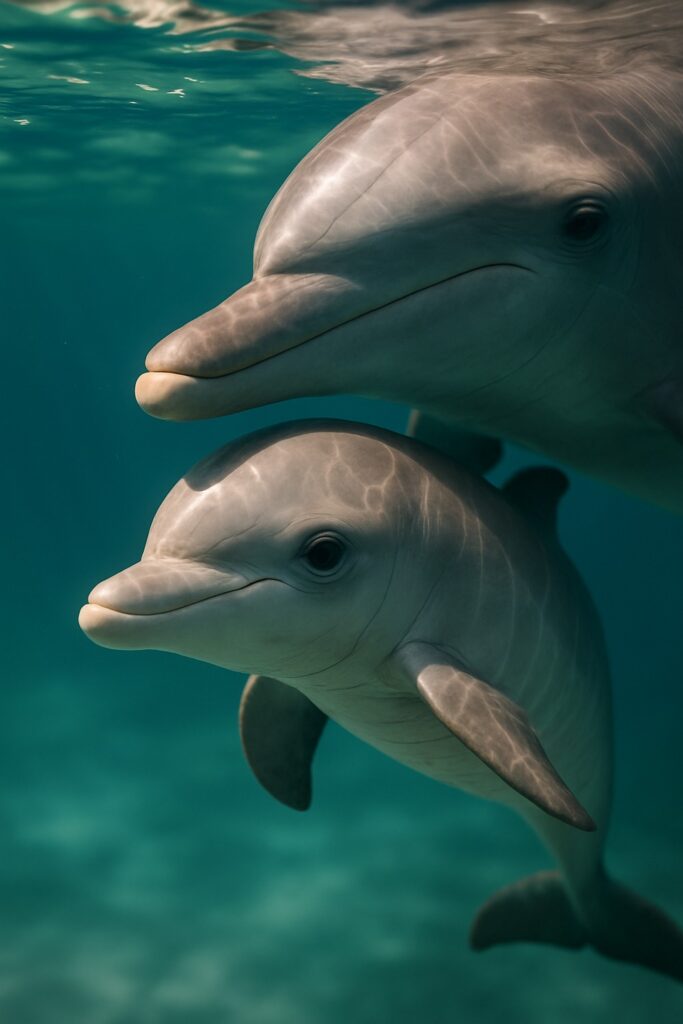
Before a dolphin calf can leap, before it knows how to draft a bow wave or read a current, it already knows one thing: its mother’s voice. Bottlenose dolphin calves can recognize and respond to their mother’s unique signature whistle almost immediately after birth — a finding that lands differently the longer you sit with it. Most animals take days, weeks, sometimes months to build that kind of recognition. These animals arrive at it. Which tells you something unsettling about the ocean noise we’ve been adding to their world.

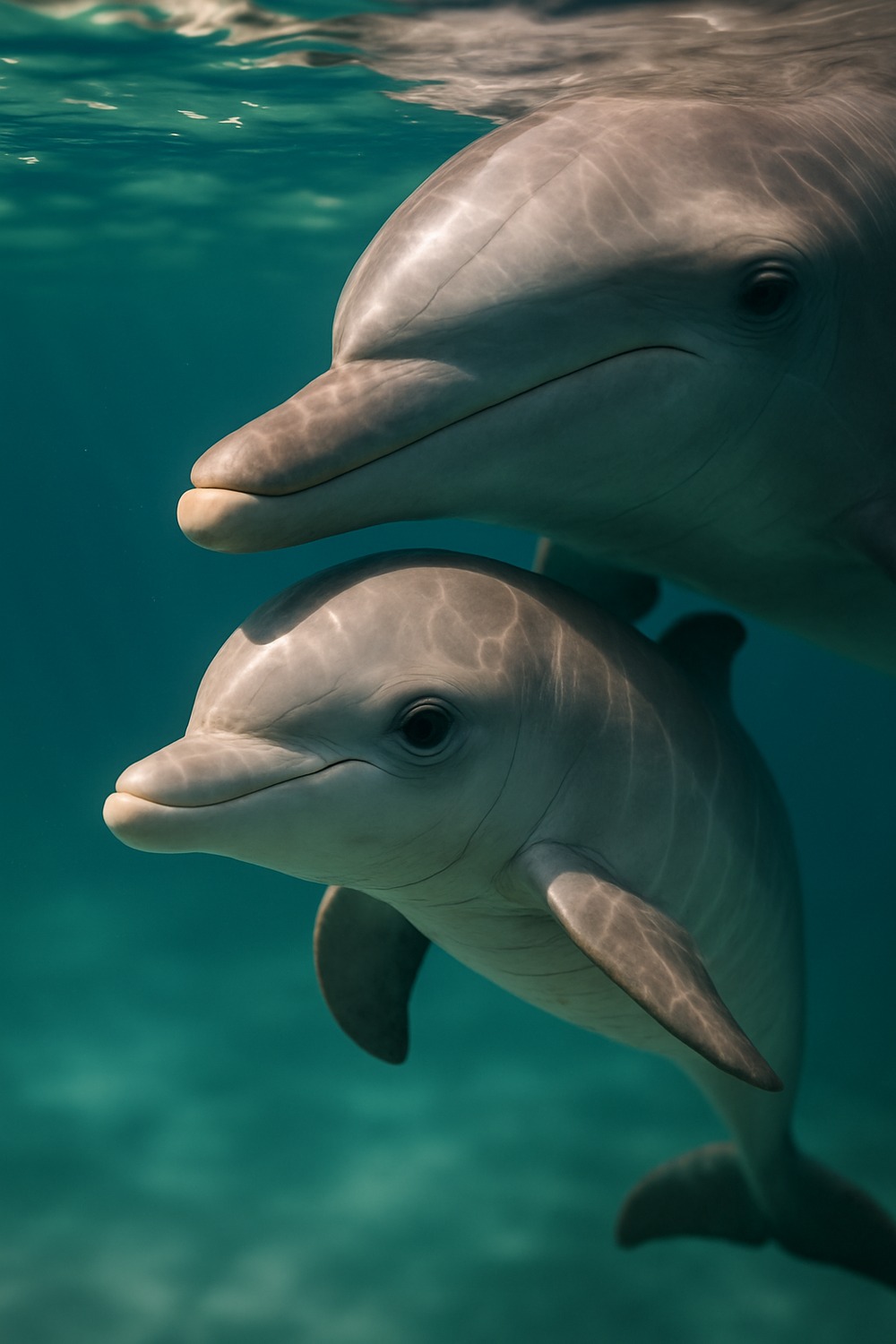
A Voice Like a Name Beneath the Waves
Every bottlenose dolphin carries its own sound. Scientists call it a signature whistle — a frequency-modulated call that functions, in the most practical sense, like a name. Dolphins develop these whistles early and keep them for life, using them to announce their presence, stay in contact with family, and coordinate movement across open water. In murky coastal environments where visibility drops to just a few meters, these acoustic identifiers aren’t a convenience. They’re the whole system.
A mother separated from her calf by a surge of current or the press of a moving pod uses this whistle to call her young one back. What the Tangalooma researchers found, though, is that calves don’t gradually learn to respond to this call over days or weeks. They respond almost immediately — suggesting that the neural machinery for rapid acoustic recognition arrives fully primed at birth.
Working along the sheltered waters of Moreton Bay, the team recorded multiple birth events and tracked how newborn calves oriented their bodies and adjusted their swimming in response to their mother’s vocalizations. Using hydrophones to capture the underwater soundscape in fine detail, scientists isolated the exact moments a mother’s signature whistle reached her calf and measured what happened next. The calves, still visibly unsteady in the water column, consistently turned toward the source of the call with a speed and accuracy that surprised even the researchers watching. These were animals with zero prior acoustic experience — and yet they were threading a three-dimensional sound environment with the confidence of someone who’d been practicing.
Wired for Sound From the Very Start
Here’s the thing: they have been practicing. Dolphin fetuses spend approximately twelve months in the womb, and for much of that time they’re exposed to their mother’s vocalizations. Sound travels through biological tissue far better than light ever could. A developing calf is, in effect, bathed in its mother’s acoustic world long before it meets the ocean.
That prenatal exposure appears to prime the auditory cortex for fast recognition of familiar sound patterns (researchers actually call this prenatal acoustic imprinting, and it matters more than the tidy phrase suggests). Birth, then, isn’t the start of acoustic learning for a dolphin calf. It’s a continuation of something already underway. The brain of a newborn dolphin is proportionally large and neurologically sophisticated — the product of millions of years of evolutionary pressure on animals that live and die by their ability to process social information quickly.
Rapid acoustic recognition isn’t just a biological curiosity, either. It’s a survival imperative. In a moving pod, a calf that can’t quickly lock onto its mother’s call risks separation in conditions that don’t forgive delay. Predators, strong currents, the sheer physical press of other bodies — all of it creates scenarios where a slow response could be fatal. Unlike terrestrial mammals that can fall back on scent or sight, dolphin calves operate primarily through sound in a fluid, three-dimensional environment.
Five minutes trying to locate a friend in a crowded swimming pool gives you a pale but humbling appreciation for the problem. The evolutionary pressure to get this right, and fast, has been relentless — shaping the dolphin’s neurological development not just after birth, but well before it.
Social Bonds Built in Sound
Why does this matter beyond the mother-calf moment? Because what begins as survival mechanics may be the foundation of one of the most complex social systems in the animal kingdom.
Dolphin pods are built from shifting alliances, long-term friendships, and communication networks that researchers are still working to decode. Scientists hypothesize that early vocal recognition lays the cognitive groundwork for the broader social learning that defines dolphin life. A calf that rapidly internalizes its mother’s call may be better positioned to distinguish between calls of other pod members, potentially accelerating the development of a social awareness it’ll depend on for the rest of its life. How calves enter that social world — and how their earliest acoustic experiences shape the bonds they’ll carry for decades — offers a new way of reading dolphin society entirely. The signature whistle, in that light, isn’t just a name. It’s a first lesson in belonging.
The data points in one direction: acoustic identity precedes social identity in these animals. A conclusion that feels obvious once you see it, and humbling that it took this long to confirm.

A Warning Carried on the Current
None of which makes the next part easy to write.
Commercial shipping, military sonar, underwater construction, recreational watercraft — together they’ve raised ambient noise levels across many of the world’s most biologically productive marine environments. The ocean is getting louder, and for dolphins whose survival is built entirely on acoustic clarity, that noise pollution is a threat researchers struggle not to undersell. And if a newborn calf can’t cleanly hear its mother’s signature whistle through a roar of anthropogenic sound, the bond that should form in those first critical minutes may be weakened before it properly begins.
The same exquisite sensitivity that makes dolphins extraordinary communicators makes them profoundly exposed to interference. Conservation efforts protecting dolphin habitats have to reckon with this — not just physical space, but acoustic space. The sonic territory within which these animals live, call to each other, and survive. Treating noise pollution as a secondary concern, given everything this research reveals, is a choice that future generations of marine biologists will find difficult to explain.
How It Unfolded
- 1960s — Peter Tyack and early cetacean researchers first describe dolphin vocalizations as individualized; the concept of a “signature whistle” begins taking shape in the literature.
- 1993 — Research formally establishes that bottlenose dolphins possess stable, individually distinct signature whistles maintained across their lifespan.
- 2006 — Studies of dolphin mother-calf pairs confirm that mothers modify whistle production during the weeks immediately after birth, now understood as a form of vocal labeling directed at the calf.
- 2020s — Fieldwork at Moreton Bay, Queensland, using high-sensitivity hydrophone arrays captures birth events in real time, revealing that calf acoustic recognition occurs within minutes — not days — of birth.
By the Numbers
- ~12 months — gestation period during which dolphin fetuses are exposed to maternal vocalizations
- Minutes — time after birth within which calves demonstrably orient toward their mother’s signature whistle
- Decades — duration over which a dolphin retains and uses its signature whistle across its life
- 3–5 kHz — approximate frequency range of many bottlenose dolphin signature whistles
- 1,500 m/s — speed of sound through seawater, roughly four times faster than through air — the medium these animals evolved to master
Field Notes
- Moreton Bay, Queensland, is one of the few coastal sites where researchers can observe wild dolphin births in relatively controlled conditions, making it uniquely valuable for neonatal behavioral studies.
- Signature whistles are so individually distinct that researchers can identify specific dolphins by whistle alone — a level of vocal individuality rare outside primates and humans.
- Dolphin calves have been documented mimicking their mother’s whistle in early life before eventually developing a unique signature of their own — a process that may parallel early human language acquisition more closely than many researchers initially assumed.
- Anthropogenic ocean noise has measurably increased in frequency and intensity over the past fifty years, with documented effects on dolphin communication range, stress hormone levels, and pod cohesion.
Frequently Asked Questions
- Do dolphin calves recognize their mother’s voice at birth? — Evidence from fieldwork at Moreton Bay suggests yes: calves orient toward their mother’s signature whistle within minutes of birth, well before any learned association could have formed. The recognition appears to be primed by prenatal acoustic exposure during the twelve-month gestation period.
- What is a dolphin signature whistle? — A signature whistle is a frequency-modulated vocalization unique to each individual dolphin. It functions similarly to a name — used to announce identity, maintain contact within a pod, and re-establish connection after separation. Dolphins develop their signature whistle early in life and retain it for decades.
- How does ocean noise affect dolphin communication? — Elevated ambient noise levels from shipping, sonar, and construction compress the effective range of dolphin vocalizations, interfere with signature whistle recognition, and have been linked to increased stress responses and disrupted pod behavior. For newborn calves, this interference arrives at the most critical window of acoustic bonding.
- Are bottlenose dolphins the only dolphins with signature whistles? — Signature whistles have been most thoroughly documented in common bottlenose dolphins, but similar individually distinct vocalizations have been recorded in other dolphin species and in killer whales. The bottlenose remains the most studied, partly due to its coastal accessibility. You can find more coverage of dolphin behavior and cognition research at This Amazing World’s animal section.
- Can dolphin calves identify other pod members’ voices as well? — Early evidence suggests that rapid maternal recognition may scaffold broader social acoustic learning — meaning calves that quickly lock onto their mother’s call may develop the capacity to distinguish other pod members’ whistles faster. This remains an active area of research.
Editor’s Take — Alex Morgan
What stays with me isn’t the birth moment itself — it’s the twelve months before it. A calf arriving in open water already carrying the sound of its mother’s voice, already oriented toward it, already prepared. We talk about dolphins as intelligent animals and reach for the obvious evidence: tool use, mirror tests, problem-solving. But this is something quieter and, I think, more profound. A mind shaped in darkness, by sound alone, before it’s ever had a choice in the matter. The ocean noise problem doesn’t feel abstract after you understand that.
The dolphins of Tangalooma have handed us something remarkable. Through a hydrophone and a careful scientific eye trained on the drama of a birth, they’ve shown us that the bonds holding dolphin society together aren’t fragile things assembled slowly over time. They’re urgent. Immediate. Written into the architecture of the brain before the animal ever surfaces. A calf that knows its mother’s voice before it’s drawn ten breaths tells you everything about the kind of intelligence evolution builds when the stakes are high enough. As ocean noise grows and these animals navigate an increasingly disrupted acoustic world, the question isn’t really whether dolphins are smart enough to adapt. It’s whether we’re honest enough to admit what we’re asking them to adapt to — and whether we’ll do anything about it.


