


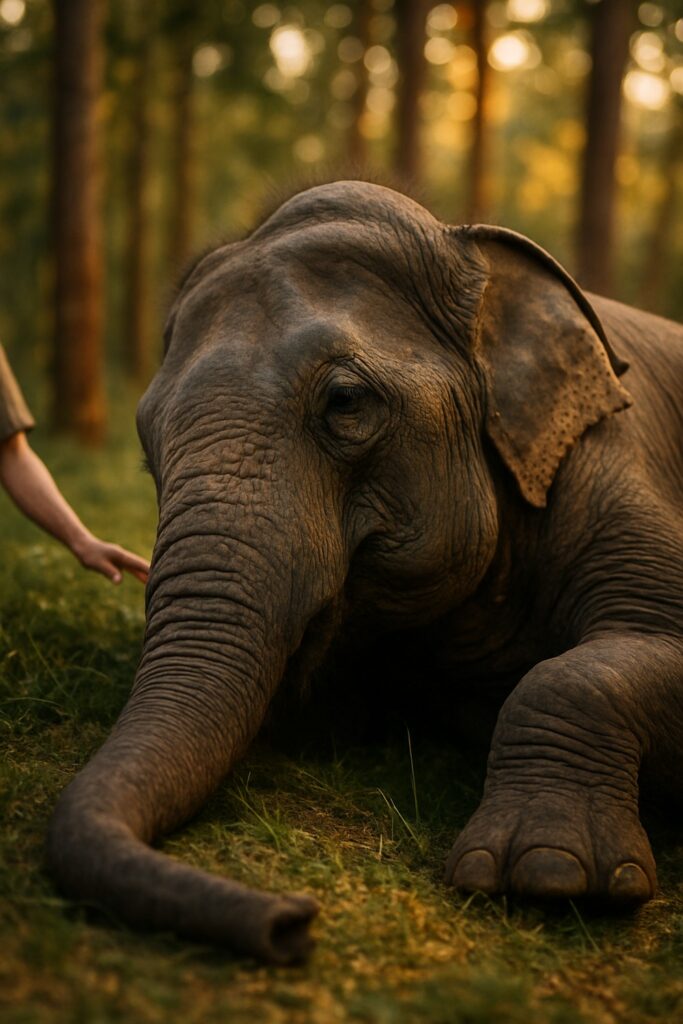
Somboon was somewhere around 70 years old when she finally slept lying down for the first time anyone could remember. Not a doze. Not a lean. She folded her entire body onto the ground and surrendered to it.
Born somewhere in northern Thailand in the 1940s, she’d hauled timber, ferried tourists, and carried the kind of working load that accumulates quietly across decades until it becomes almost incomprehensible. When rescuers brought her to Elephant Nature Park, nobody had a clear picture of what recovery would look like for an animal this old, this worn, this trained by a lifetime of not being allowed to stop. What the caregivers witnessed in those first weeks — and then one specific evening — stopped several of them cold.
Why This Elephant Sanctuary Rescue Broke Everyone’s Hearts
Researcher Joyce Poole has spent decades watching elephants, and what she’s documented doesn’t read like animal behavior research — it reads more like a clinical record of a species that experiences grief and fear in ways that map uncomfortably close to our own. According to the Asian elephant’s Wikipedia entry, wild populations have declined by at least 50% over the last three generations, driven by habitat destruction and exactly the kind of captive exploitation Somboon lived through. So what does that kind of life actually do to an elephant’s mind?
It rewires them. That’s not a metaphor.
Years of unpredictable pain and commands teach an animal to stop trusting stillness. Somboon didn’t just arrive at Elephant Nature Park with damaged joints and worn footpads. She arrived having learned, across roughly seven decades, that relaxing was a form of danger. Her body had organized itself entirely around that lesson.
She Carried 44,000 Pounds. And Never Let Go.
That’s a rough estimate of the cumulative load Somboon is believed to have hauled across rain-soaked Thai forests and packed tourist roads. Forty-four thousand pounds. Caregivers at Elephant Nature Park — one of the most respected elephant sanctuary rescue operations in Southeast Asia — documented the physical toll when she arrived: damaged joints, worn footpads, the structural fatigue that doesn’t resolve quickly and sometimes doesn’t resolve at all. You can read about other extraordinary animal survival stories at this-amazing-world.com.
But the physical damage wasn’t what stayed with the staff.
It was the way she stood. Always braced. Shoulders slightly forward, weight distributed like she was expecting something to shift under her. Even in total quiet, with no threat anywhere near her, Somboon held herself like something was about to go wrong. Caregivers recognized it immediately. That posture wasn’t random. It was learned. Decades of it, compressed into muscle memory.
The Sleep Thing Nobody Tells You About Elephants
Here’s something that kept me reading about this for another hour when I first came across it: elephants can technically sleep standing up, and they often do for short rest cycles. But actual REM sleep — the deep, restorative kind that heals tissue and consolidates memory — requires them to lie down completely. Physiologically necessary. And it only happens when an elephant feels, at some fundamental level, completely safe.
In healthy wild herds, younger elephants lie down regularly. Older ones do too, watched over by the group around them. For any elephant sanctuary rescue worth the name, caregivers know this is the real benchmark. Not whether the elephant is eating. Not whether she’s walking the grounds. Whether she’ll lie down.
Somboon hadn’t met that benchmark in approximately 70 years.
Decades of fear had overwritten whatever instinct once told her body it was okay to be horizontal. The question that haunted her caregivers wasn’t complicated. It was just devastating. Would she ever unlearn it?

The Moment Everything Changed for Somboon
Trauma in animals doesn’t dissolve because the circumstances change. You can move a suffering elephant to the softest grass in Thailand and her nervous system will still be running the same old calculations. It took days of Somboon moving slowly across the sanctuary grounds — sniffing the loamy soil, listening to an unfamiliar quiet, no commands coming, no chains, no packed earth beneath her feet. Just space. And then, one evening, her body language shifted in a way the caregivers recognized before they could fully articulate what they were seeing.
A loosening. Almost imperceptible at first.
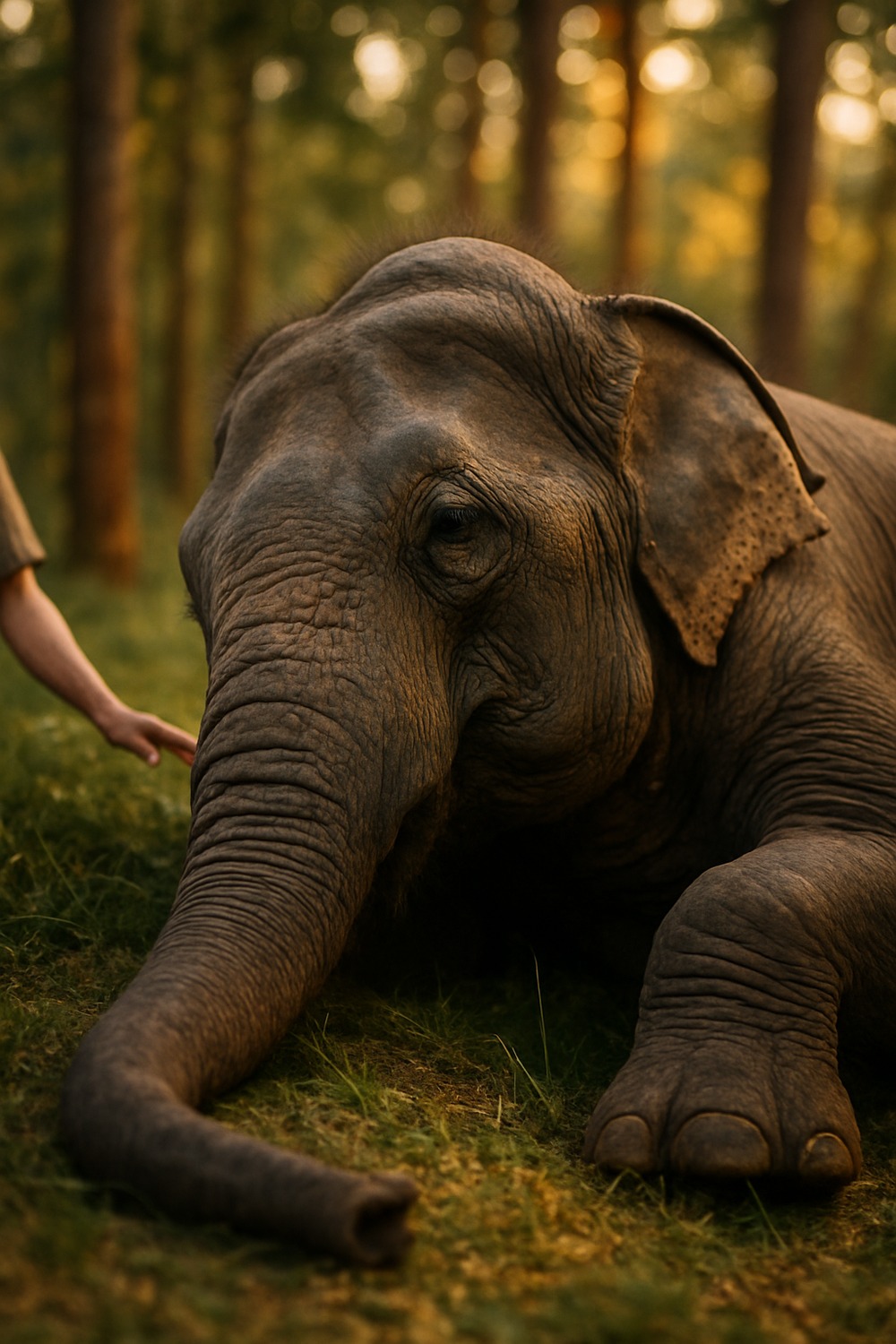
She hesitated near a patch of grass. Sniffed the ground one more time. And then, with a long exhale that the caregivers described afterward as something close to a sigh, Somboon folded her enormous body down onto the earth. Not a rest. Not a doze. A full, surrendered, deep sleep — the kind she hadn’t known since she was a calf moving through the forest somewhere beside her mother. The staff stood in silence. A few of them wept.
By the Numbers
- Roughly 40,000 Asian elephants remain in the wild (IUCN Red List, 2023) — down from hundreds of thousands a century ago. The species is classified as Endangered.
- In the wild, elephants spend 18–20 hours daily foraging and moving. Captive elephants often spend more than 60% of their time stationary — a confinement that produces measurable physical and psychological deterioration over time.
- Oldest confirmed captive Asian elephant: 86 years. Which means Somboon, born in the 1940s, is among the oldest known surviving individuals anywhere on record.
- Elephant Nature Park in Chiang Mai has rescued over 200 elephants since 1995.

Field Notes
- Elephants return to the bones of deceased herd members — sometimes years later — and touch the remains gently with their trunks. Researchers have documented this in both African and Asian species, repeatedly, across different sites and populations.
- The temporal lobe. Proportionally larger and more structurally complex in elephants than in almost any other land animal — which is part of why the psychological wounds of captivity run as deep as they do.
- Wild Asian elephants have been recorded traveling up to 50 miles in a single day following seasonal food. A working elephant in captivity may spend its entire life within a radius of just a few miles — a confinement that researchers believe fundamentally alters neurological development, not just behavior.
What Somboon’s Sleep Actually Means
There’s a reason the story of one elderly elephant lying down made people stop scrolling. It’s not complicated. It’s because her story makes something abstract — prolonged suffering, the slow erosion of an animal’s ability to trust the world — suddenly very visible. Suffering can be quiet. It can last for decades. And recovery, when it finally arrives, can look like the simplest thing imaginable.
The larger picture is harder to sit with. With only 40,000 Asian elephants remaining in the wild and populations continuing to fragment under deforestation and human encroachment, every ethical elephant sanctuary rescue operating right now is working against a current that doesn’t slow down. They’re doing it one animal at a time, one small threshold of trust at a time, with no guarantee that the animal on the other end has enough years left to fully heal.
Turns out, sometimes the threshold looks like an old elephant sniffing a patch of grass for a long moment before deciding, finally, that it might be okay.
Somboon woke up the next morning on that same patch of ground. She ate. She moved slowly through the sanctuary. She was still healing — still is. But something had crossed over that previous evening that hadn’t crossed in 70 years. She’d trusted the world enough to let her body go. That’s not a small thing. For more stories that are harder to shake than they should be, there’s more at this-amazing-world.com.


