


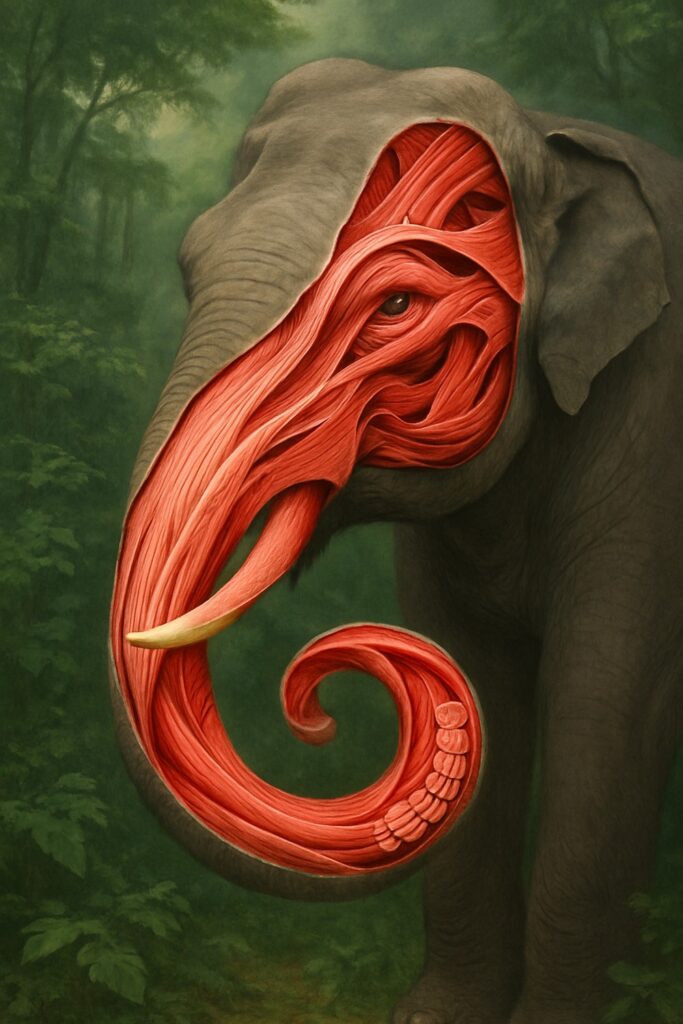
Nobody set out to count the muscles in an elephant’s trunk. That’s the part that makes the number so strange when you finally hear it: 40,000. Somewhere between 40,000 and 150,000 individual muscle fascicles, depending on how fine you slice the tissue samples — compared to the roughly 600 skeletal muscles in your entire human body.
Stand close enough to an elephant in the Maasai Mara and you’ll hear it before you’ve really processed what you’re watching. The trunk inhales with this deep, resonant whoosh — like wind moving through a hollow log — and then wraps itself around something impossibly small with a precision that frankly has no business existing in an animal that size. The gap between that brute power and that delicate touch is the whole story.
Why Elephant Trunk Muscles Rewrite What We Know About Strength
Researcher Andrew Schulz at Georgia Tech has spent serious time studying trunk mechanics, and what his team found is that the structure doesn’t function like a limb at all. It’s a muscular hydrostat — same category as an octopus arm or a human tongue. No bones. No rigid skeleton. Just coordinated muscle and fluid pressure working together. Which raises the obvious question: how does something with no skeleton lift 250 kilograms?
We associate strength with structure. Steel beams, rigid frames, bones. The trunk breaks that assumption completely. Muscle alone, organized with enough complexity, can outperform almost any skeletal system on the planet. It’s a different engineering philosophy. A genuinely alien one.
The Trunk Does Things Your Arm Simply Can’t
Your arm bends at the elbow, rotates at the shoulder. That’s more or less the full menu. An elephant’s trunk can bend, twist, compress, elongate, and curl at any point along its entire two-meter length — simultaneously, in different directions, with no joint involved anywhere. It’s the biological equivalent of a hydraulic arm with infinite pivot points. For context on just how far this kind of anatomical strangeness goes, this-amazing-world.com has been cataloguing nature’s most surprising engineering solutions for years, and the trunk still makes their list.
Turns out the behavioral range is the part that really gets you. Ripping a mopane branch clean off a tree, then thirty seconds later stroking a newborn calf with something that looks unmistakably like tenderness. Same appendage. The same animal. It forces you to rethink what a body part even is.
Sensing Water Underground: Elephant Trunk Muscles Aren’t Just Brawn
Here’s where it gets genuinely strange.
The tip of the trunk — in African elephants it splits into two distinct “fingers” — is packed with mechanoreceptors, the same nerve endings found in human fingertips. Elephants have been documented detecting water buried up to three meters underground, using seismic vibrations combined with chemoreception through the trunk’s sensitive tip. They don’t just smell the water. They feel it vibrating through the earth. The trunk processes raw force and delicate sensory information at the same time, in the same structure.
Most animals specialize. Claws grip. Antennae detect. Legs move. The trunk does all of it simultaneously, and that raises a question researchers are still chewing on: what else is it processing that we haven’t figured out how to measure yet?
This Is Where the Science Gets Genuinely Unsettling
Elephant calves are born not knowing how to use their trunks.
They trip over them. Swing them around. Some calves suck on their trunks the way human babies suck their thumbs — almost certainly because they genuinely haven’t worked out what the thing is for yet. It takes months, sometimes over a year, to develop full trunk coordination. That learning curve exists because elephant trunk muscles don’t run on instinct alone. The elephant has to learn to use them, which implies a level of neural complexity that scientists are still in the process of mapping. That last fact kept me reading for another hour after I first found it.
It’s not just a body part. It’s a skill.

The Trunk’s Hidden Language No One Fully Understands Yet
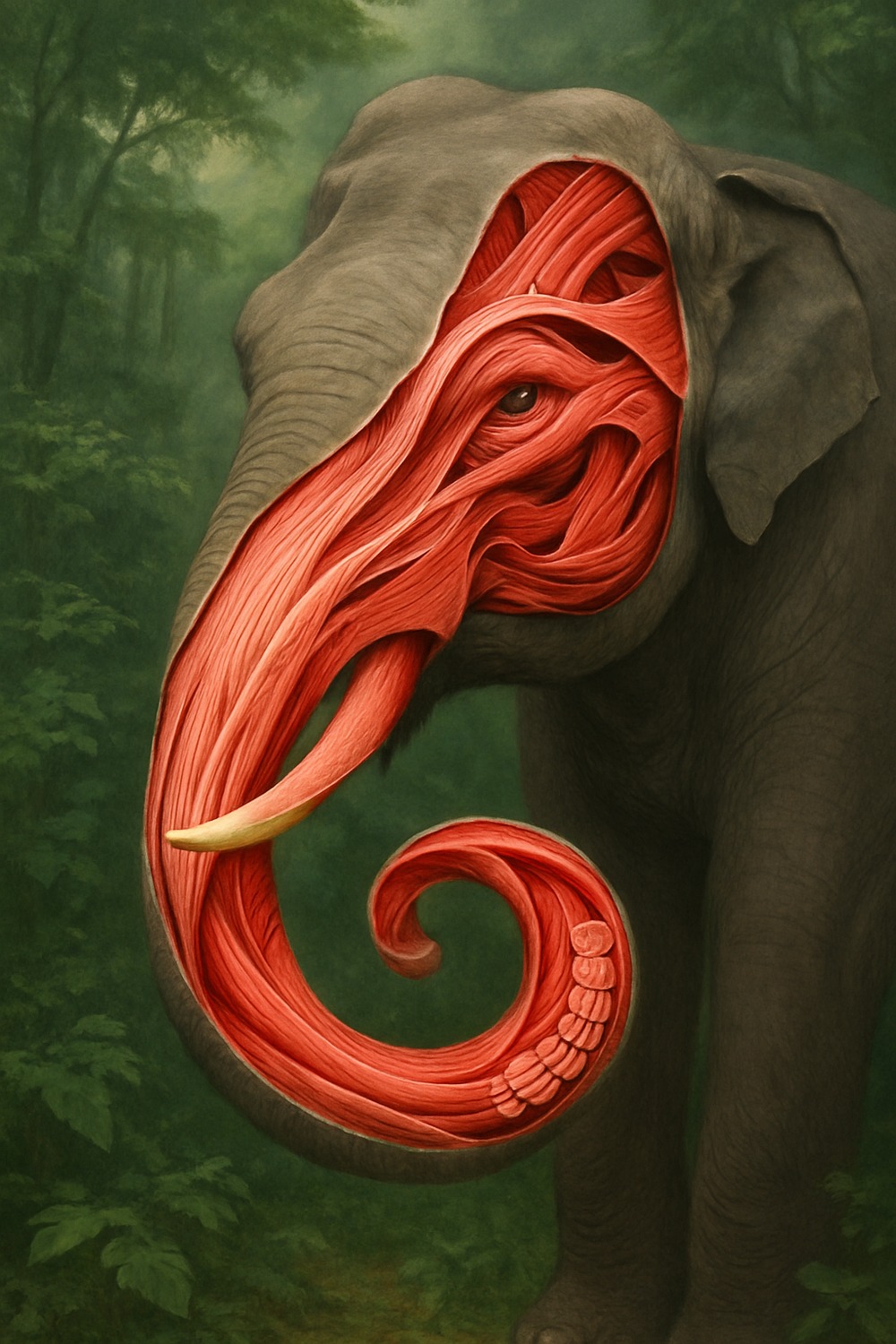
The trunk isn’t only a tool. It’s a communication device running constantly in the background of herd life. Elephants use trunk posture, tip position, and physical contact to convey social information across the group — a raised trunk signals alarm, a trunk draped over another elephant’s back reads as comfort, and dominant bulls use trunk-to-mouth contact in ways that appear to be reading another elephant’s recent chemical history, tasting and smelling simultaneously like a biological hard drive scan. Researcher Karen McComb at the University of Sussex documented that elephants can identify over 30 individuals by trunk-touch alone.
What that means practically: a herd of elephants is running a constant, low-frequency social network through physical contact, and the trunk is the primary interface. It isn’t just useful to the individual elephant.
It’s load-bearing for the entire community.
By the Numbers
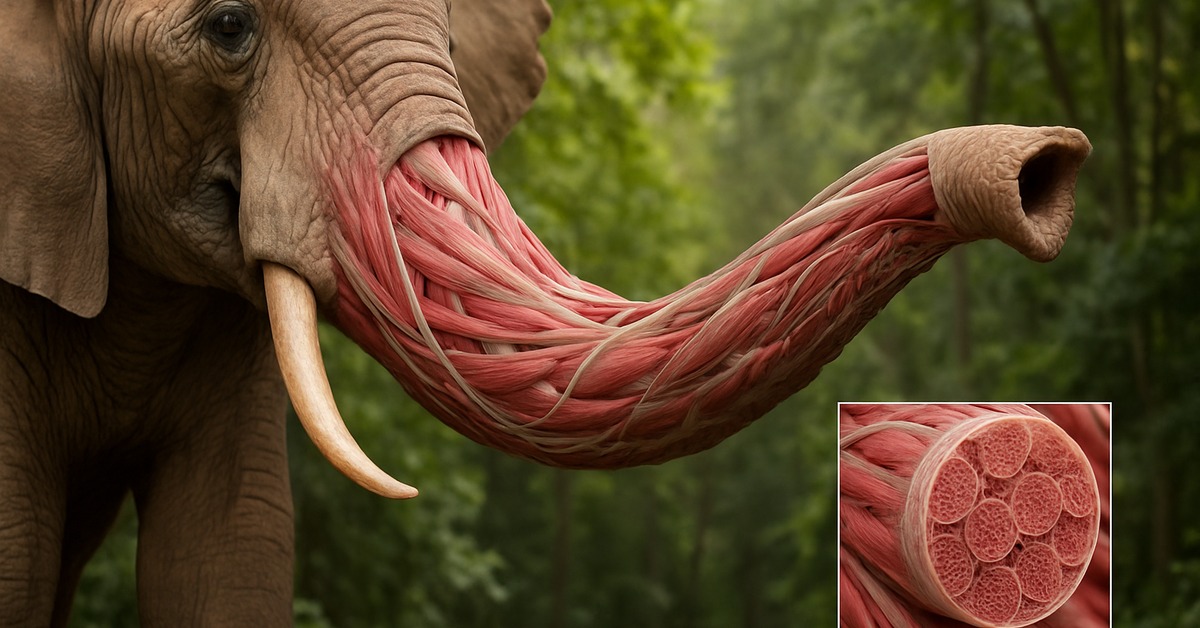
- Between 40,000 and 150,000 individual muscle fascicles identified in trunk tissue, per studies in the Journal of the Royal Society Interface (2021) — the exact count shifts depending on tissue resolution during analysis.
- A full-grown African elephant can lift objects over 250 kg with its trunk, yet the same trunk retrieves a single tortilla chip from the ground without breaking it. Researchers measured that force differential at over 100,000 to 1. Let that sit for a second.
- Holds up to 8 liters of water per draw.
- The trunk grows to roughly 2 meters in length and can weigh up to 130 kg on its own — meaning it outweighs most adult humans before the rest of the elephant enters the picture.

Field Notes
- Elephants have been observed picking up and examining the bones of deceased herd members with their trunks. Some researchers interpret this as recognition, possibly mourning. The mechanism is still debated, and honestly the debate is as interesting as any conclusion.
- Two trunk-tip “fingers” on African elephants vs. one on Asian elephants — finer pinch precision, similar to the difference between a pinch grip and a wrap grip in human hands.
- Elephant trunks produce infrasound — vibrations below the threshold of human hearing — that travel several kilometers through the ground. Other elephants pick these signals up through their feet, and likely through the sensitive skin of the trunk tip resting directly on the earth.
Why the Elephant Trunk Muscles Story Matters Beyond Biology
Engineers have been studying elephant trunk muscles for years, and not purely out of curiosity. The design solves problems that rigid robotics keeps running into walls on. Soft robotics — machines built from flexible, pressure-driven materials rather than metal joints — is one of the fastest-growing fields in engineering right now, and the trunk’s muscular hydrostat model has directly shaped the design of surgical robots, search-and-rescue tools, and deep-sea exploration arms. Nature spent 55 million years iterating on this. We’re catching up.
Beyond the labs, though, something simpler is at stake. African forest elephant populations dropped by 86% over 31 years, according to IUCN data. What disappears isn’t just an animal. It’s a cognitive and biological system we’ve barely started to understand, encoded in 40,000 muscles we’re only now beginning to map properly.
Evolution doesn’t optimize for simplicity — it optimizes for survival, and sometimes survival demands seventy times more complexity than any engineer would think to spec out. An appendage that can uproot a tree and comfort a grieving calf in the same afternoon is telling us something about what bodies become when given enough time and enough pressure. There’s more of this kind of thing at this-amazing-world.com, and the next one is somehow stranger.


