



Elephants detect earthquakes — and the April 2020 footage from San Diego Zoo Safari Park made that claim impossible to dismiss. Before a single staff member on site registered ground movement, an entire African elephant herd had already closed ranks around two calves. The seismic sensor networks governments have spent billions building still struggle with the exact problem these animals solved, apparently, sometime in the Pleistocene.
A 5.2-magnitude quake had ruptured near Julian, California — modest by regional standards, but enough to trigger one of the most precisely timestamped examples of animal seismic response ever captured on camera. What the footage showed wasn’t panic or randomness. It was coordination. The herd moved as a unit, in silence, with a speed that raised a question the data hasn’t fully answered yet: how early, exactly, does the signal arrive?
How Elephants Read Seismic Signals Through Their Feet
Elephants don’t just walk on the earth — they listen to it. Packed into the fatty tissue and bone of an elephant’s foot are clusters of Pacinian corpuscles, mechanoreceptors tuned to detect low-frequency vibrations traveling through the ground. These aren’t general-purpose sensory cells. They’re specialized for infrasound — the same frequency range produced by distant thunderstorms, the footfalls of other elephant herds, and, crucially, the seismic waves that precede and accompany earthquakes.
Biologist Caitlin O’Connell-Rodwell, whose decades of fieldwork in Namibia transformed the scientific understanding of elephant communication, has documented how herds freeze, lean forward, and shift weight onto their front feet when seismic signals arrive — postures that maximize ground contact and sensory intake. Signals travel up through the leg bones and into the inner ear, where cochlear structures that process airborne sound can also interpret ground-borne vibration. Elephants don’t choose between hearing and feeling — they integrate both simultaneously, a level of sensory fusion that most mammals, including humans, simply don’t have.
In Etosha National Park, O’Connell-Rodwell observed elephants responding to playback vibrations from as far as 32 kilometers away. Detection at distance. Identification of meaning. Coordinated response. The animals didn’t merely register the signal — they identified it as a warning call from a different herd and reacted accordingly. That’s not instinct alone. That’s a sensory system refined over millions of years.
The Safari Park Footage That Changed the Conversation
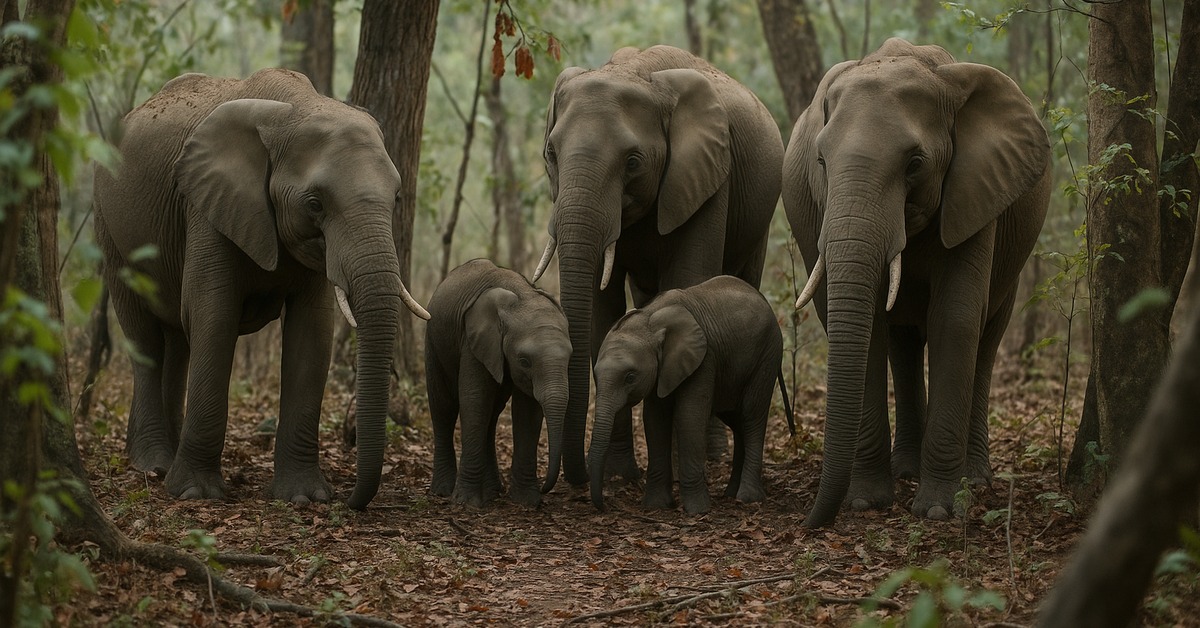
What the cameras caught in April 2020 wasn’t the product of a planned experiment. Routine security footage — the incidental kind science occasionally gets lucky with — recorded a herd of African elephants forming a protective barrier around calves Zuli and Mkhaya. No vocalisation captured on audio. No visible threat. Just the ground moving below, and the elephants moving with it.
The herd’s response unfolded in under three seconds from the first detectable ground motion. Adults turned outward, flanks pressed together. The two calves were pulled inward and completely encircled. The 5.2-magnitude quake registered primarily as surface waves — the type that travel horizontally and are most strongly felt at ground level — which are exactly the wave type that Pacinian corpuscles in elephant feet are thought to be most sensitive to. Keepers noted afterward that no human on site had registered the quake before the elephants moved, with staff estimating the animals beat the shaking by several seconds.
That margin is everything.
Much like certain animals wired to respond to threats invisible to human perception — creatures operating on entirely different sensory frequencies — the elephants’ reaction was a reminder that human perception captures only a thin slice of what’s actually happening. Animals that evolved alongside geological forces often carry warning systems we’ve barely begun to map.
A Sensory Ability Millions of Years in the Making
Elephants didn’t develop this ability for earthquakes specifically. Seismic sensitivity is an evolutionary byproduct of a communication system built for the savanna — a landscape where visual contact is limited by dust, vegetation, and sheer distance. Over millions of years, African elephant populations developed infrasonic vocalisation that travels through the ground as well as the air, allowing herds spread across kilometers to stay in contact. The ability to detect ground vibration became the receiving end of that system.
A National Geographic investigation into elephant seismic communication documented how matriarchs — the herd’s oldest and most experienced females — show the strongest seismic response, suggesting the ability deepens with age and accumulated learning rather than being purely hardwired. What makes the Safari Park observation particularly striking is what it implies about how elephants detect earthquakes through a channel that existing early warning systems aren’t monitoring.
Japan, the United States, and the European Union have invested billions in seismic sensor networks — sophisticated, sensitive, and fast. But they still struggle with the last-second warning problem: the gap between detection and alert dissemination. An animal responding to initial P-waves before S-waves and surface waves arrive is, in effect, doing something those networks aspire to do. The biology got there first.
And honestly, that gap in institutional attention — the data on elephant seismic response accumulating for decades while formal early warning programs looked almost everywhere except at the animals already doing the job — is the kind of oversight that looks worse the longer you stare at it.


Can Elephants Detect Earthquakes Early Enough to Matter?
How small a seismic event can elephants detect earthquakes through? The threshold remains partially unanswered, but the available data is striking. Researchers have observed elephant behavioral changes during events as small as magnitude 2.5 in controlled observation settings. A 2001 study in the Journal of the Acoustical Society of America by O’Connell-Rodwell and colleagues demonstrated that elephants could detect artificially generated seismic signals at frequencies between 10 and 40 Hz at distances previously considered beyond biological detection range. The pattern holds consistently: larger events produce more pronounced and coordinated responses, but even minor seismic activity triggers subtle behavioral shifts like sudden stillness or weight redistribution.
Timeline matters enormously here. Earthquakes produce two types of body waves: P-waves, which travel fastest and carry less destructive energy, and S-waves, which arrive later but cause most of the damage humans feel. Seismic monitoring networks detect P-waves and use that lag time — often just seconds — to issue alerts before S-waves arrive. If elephants are responding to P-waves or even pre-seismic ground noise, they’re functioning as a biological analog to that exact system (researchers actually call this the “P-wave advantage,” and it’s the holy grail of earthquake early warning design). Every second of that interval is warning time.
Research teams in Japan and India have begun tagging wild elephant populations with GPS and accelerometer units specifically to map behavioral changes around seismic events. Early results suggest behavioral anomalies — increased movement, herd clustering, directional shifts — begin registering up to twenty minutes before significant seismic events in some cases. The data is still accumulating. But that window, if confirmed at scale, changes the conversation entirely.
What This Means for Early Warning Systems Worldwide
Animal-based earthquake detection isn’t a new idea — it’s an ancient one that science has repeatedly struggled to validate with rigorous methodology. Chinese historical records dating back over two thousand years document unusual animal behavior before major seismic events: snakes emerging from hibernation in winter, fish leaping from rivers. The challenge has always been the same: anecdote isn’t data, and correlation isn’t mechanism. The 1975 Haicheng earthquake in China, where local authorities partially credited unusual animal behavior in their decision to issue an evacuation order that saved thousands of lives, remains the most cited — and most contested — case in the literature.
But the Safari Park footage is different. It’s timestamped, camera-verified, and cross-referenceable against USGS seismic records to the second. That’s mechanism, not folklore.
What changes if this kind of biological sensing is integrated into formal warning systems? Turns out the honest answer is: we don’t fully know yet. Elephants detect earthquakes in ways that are real and documentable, but building a reliable detection protocol around animal behavior requires understanding variability — why some animals respond and others don’t, why the same animal might ignore a tremor one day and react strongly to a smaller one the next. Stress levels, reproductive status, recent experience, and herd hierarchy all appear to influence seismic response. That complexity doesn’t make the signal useless. It makes it harder to standardize.
In Sri Lanka, wildlife researchers monitoring elephant corridors near active fault zones have noted consistent pre-quake movement toward higher ground — a shift in foraging direction, a slightly earlier return to known refuge points. Subtle, but measurable. In a country with limited seismic infrastructure, measurable is everything. There’s a matriarch in Yala National Park, locally known to rangers for decades, whose movement patterns have been correlated with three separate seismic events since 2018. She’s not a scientific instrument. But she might be pointing toward one.

How It Unfolded
- Millions of years ago — African elephant populations develop infrasonic ground-based communication across savanna environments, laying the biological foundation for seismic sensitivity
- 2001 — O’Connell-Rodwell and colleagues publish Journal of the Acoustical Society of America study confirming elephant detection of artificial seismic signals at frequencies between 10 and 40 Hz, at distances previously considered beyond biological range
- 2004 — Etosha National Park fieldwork documents elephant responses to playback vibrations from 32 kilometers, establishing detection range benchmarks still referenced in current research
- April 2020 — San Diego Zoo Safari Park security cameras capture herd protective formation around calves Zuli and Mkhaya within three seconds of initial ground motion from the Julian, California 5.2-magnitude quake — the most precisely verified seismic response event on record
By the Numbers
- 5.2 — magnitude of the April 2020 Julian, California earthquake that triggered the Safari Park herd response, verified by USGS seismic records
- Elephants can detect seismic vibrations at frequencies as low as 14 Hz through ground contact, well below the human auditory threshold of 20 Hz
- 32 kilometers — maximum distance at which O’Connell-Rodwell’s Namibia field studies recorded elephant seismic detection responses to playback signals
- Protective herd formation at San Diego Zoo Safari Park formed in under 3 seconds from initial ground motion — faster than the average human startle response of 0.5–1.5 seconds to a perceived threat
- 415,000 African elephants remain in the wild as of 2023 (IUCN Red List), representing a diminishing reserve of this living seismic-sensing capacity across natural habitats
Field Notes
- Moving first among all adults, the matriarch of the Safari Park herd pivoted toward the southeast before any other elephant reacted — a body orientation consistent with the Julian, California epicenter location, a detail researchers flagged while reviewing the footage.
- Elephants carry three distinct clusters of Pacinian corpuscles in each foot, with the highest density in the toe pads — the region making first and most sustained contact with the ground during what researchers call the “seismic listen” posture, a characteristic flat-footed stance observed repeatedly before seismic events.
- Asian elephants may carry a slightly different seismic sensitivity profile than African elephants, owing to differences in foot morphology and fatty pad thickness — a distinction current research hasn’t fully resolved but one that could matter significantly for detection range and frequency response.
- Why some individual elephants within the same herd show stronger seismic responses than others during identical events remains an open question — whether hierarchy, age, physical variation, or prior experience with seismic activity drives the difference hasn’t been resolved.
Frequently Asked Questions
Q: How do elephants detect earthquakes before humans can feel them?
Elephants detect earthquakes through specialized mechanoreceptor cells called Pacinian corpuscles, concentrated in the fatty pads of their feet. These cells are sensitive to low-frequency ground vibrations — including the P-waves that travel ahead of the more destructive S-waves in a seismic event. Because P-waves arrive before the shaking humans feel, an elephant responding to P-wave ground motion can react several seconds before a person in the same location registers anything. The April 2020 Safari Park event documented this gap in real time.
Q: Could elephant seismic detection actually be used in early warning systems?
Theoretically possible, but practically complex. The biological signal is real — elephants respond to seismic events, and the response is fast. Individual variation, herd dynamics, stress levels, and environmental noise all affect how consistently any given elephant responds to a given event. Researchers in Japan and Sri Lanka are currently fitting wild elephants with accelerometers to build datasets large enough to establish behavioral baselines. Until that data matures, integration into formal warning infrastructure remains a research goal rather than an operational one.
Q: Is this the same ability that makes animals predict earthquakes in folklore?
The folkloric idea of animals predicting earthquakes is much broader — and much less reliable — than what the Safari Park footage documents. Most historical anecdotes involve behavior in the hours or days before an earthquake, which is difficult to verify and nearly impossible to separate from coincidence. What’s different here is precision: a timestamped camera record showing a specific behavioral response within seconds of a verified seismic event. That’s mechanism, not prophecy. It doesn’t confirm that elephants can sense earthquakes hours ahead — it confirms they respond to initial seismic waves faster than human perception does. A narrower claim, but a more defensible and ultimately more useful one.
Editor’s Take — Dr. James Carter
The Safari Park footage is the rarest thing in behavioral biology: a clean, timestamped, unambiguous data point. No confounds, no observer effect, no post-hoc rationalization. What it shows is that a viable P-wave detection system has been operating in African elephant populations for millions of years — and that the earthquake early warning field has been, with a few notable exceptions, too invested in silicon to look at it seriously. The accelerometer studies now underway in Japan and Sri Lanka are overdue. The matriarch in Yala deserves a collar.
There’s something quietly humbling about watching that Safari Park footage. An entire herd, moving in silence, reading a message written in stone and transmitted through their feet — a language that predates human language by millions of years. We’ve built satellites and sensor arrays to listen to the earth. Elephants never stopped. The question isn’t just what we can learn from their biology. It’s what we’ve been drowning out with our own noise — and what else the earth has been trying to tell us all along.


