The Eyelash Viper: Costa Rica’s Jeweled Ambush Artist
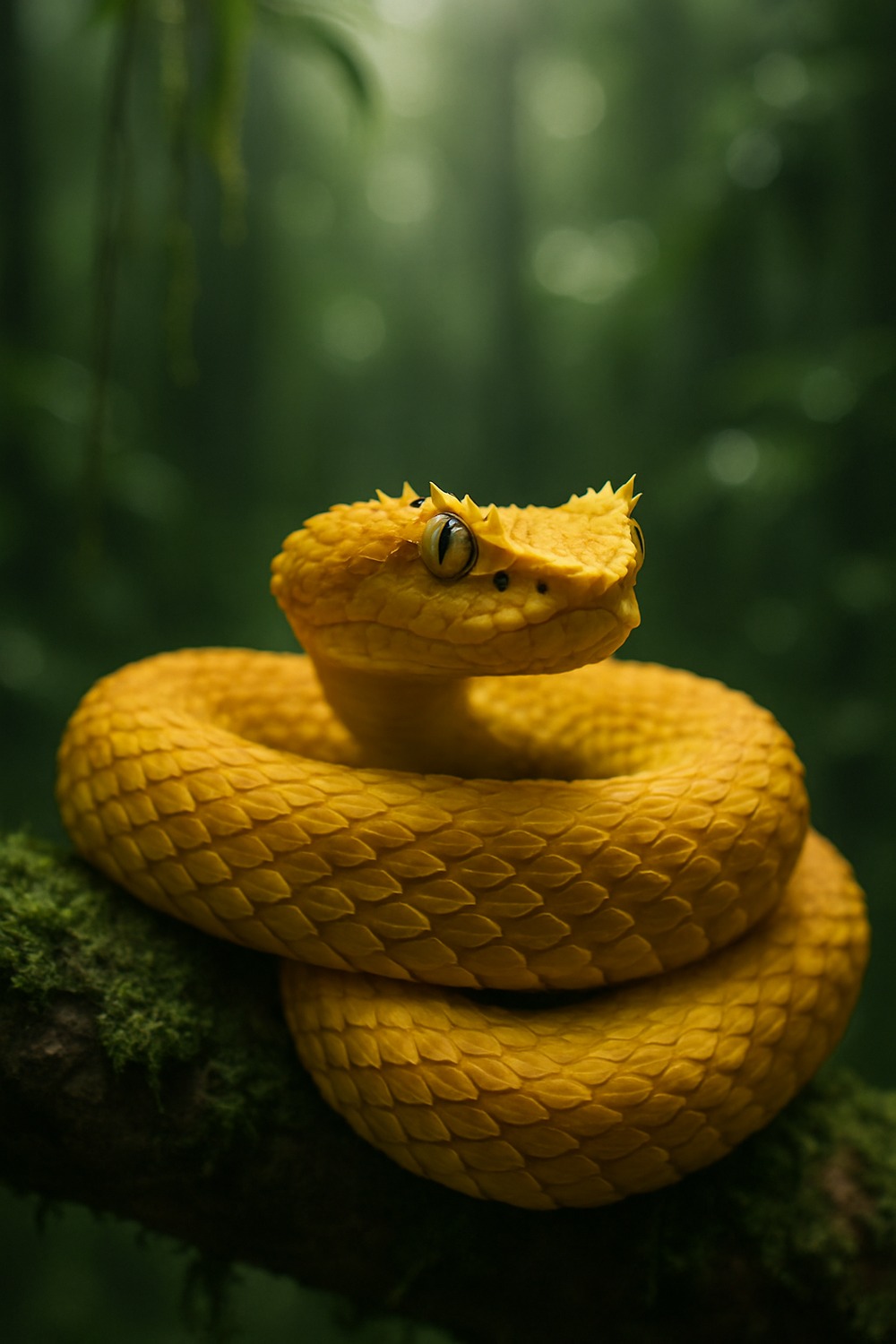
Here’s the thing about the eyelash viper — it doesn’t look like a predator. It looks like a mistake. Draped across a heliconia stem in the Costa Rican cloud forest, Bothriechis schlegelii is banana-yellow, motionless, and fringed with what appear to be actual eyelashes above each eye. The forest offers no warning. The snake offers none either.
One of the most visually arresting snakes in the Western Hemisphere, and one of the least understood. It lives almost entirely in trees, hunts without moving for days, sees heat the way we see light, and wears a face that biologists still can’t fully explain. The forest keeps its secrets. So does this snake.
Key Facts
- The eyelash viper, Bothriechis schlegelii, carries hemotoxic venom and lives almost entirely in trees in Costa Rican cloud forests.
- Smithsonian Tropical Research Institute documented in 2018 that Bothriechis vipers spend up to 73% of active hours on a single substrate without repositioning.
- The Instituto Clodomiro Picado in San Jose has produced antivenom for Central American pitvipers since 1970, reducing regional fatality rates by an estimated 90% over five decades.
- Strike speed is estimated at under 0.1 seconds, documented through high-speed video by the Universidad de Costa Rica in 2018.
- As of 2024 there were approximately 2,400 verified iNaturalist observations of the species across 12 countries.
In short: The eyelash viper Costa Rica forests harbor, Bothriechis schlegelii, is an arboreal ambush predator with hemotoxic venom and modified scales above its eyes. It strikes in under 0.1 seconds, spends up to 73% of active hours on one branch, and is treated with antivenom produced since 1970 by the Instituto Clodomiro Picado.
The Eyelash Viper’s Face: What Those Scales Actually Do
What you’re seeing above each eye aren’t lashes in any biological sense. They’re modified, elongated keeled scales — superciliary scales — and they give Bothriechis schlegelii a profile that looks almost deliberately theatrical. A 2012 study from the Universidad de Costa Rica examined scale morphology across multiple Bothriechis species and found that superciliary scale development was significantly more pronounced in populations living in high-canopy, high-humidity zones — suggesting an ecological driver tied directly to forest structure. The leading hypothesis involves camouflage: in a world of broken light, dangling moss, and overlapping leaf edges, a disruptive outline might help the snake disappear into its arboreal environment. Herpetologists have debated this since the 19th century, and nobody has landed on a clean answer. You can read more about the species’ full taxonomic history and distribution on Wikipedia. Some researchers lean toward sexual selection, noting that scale elaboration varies between males and females in ways that don’t map neatly onto habitat type.
Then there’s the color problem. Eyelash vipers are famously polymorphic — meaning individuals within the same population can look wildly different. Yellow, green, brown, reddish, even pale grey. The yellow morph, called the “oropel” form in Costa Rica and Panama, is so striking that locals have built folklore around it for centuries. This color variation has nothing to do with diet or age. It’s genetic. And it throws the camouflage hypothesis into question all over again, because a banana-yellow snake coiled on a green bromeliad isn’t hiding from anything.
Maybe it’s mimicking something. Or maybe color and scale shape are solving two entirely different evolutionary problems at once — which would mean the face this snake wears is the result of competing pressures pulling in opposite directions, frozen into a single improbable form.
Field researchers working in the Monteverde Cloud Forest Reserve have photographed the same individual vipers returning to the same perches across multiple seasons. This isn’t random wandering — it’s site fidelity, a behavioral trait more commonly associated with territorial mammals than ambush reptiles. The forest remembers them. They, apparently, remember the forest.
Ambush Architecture: How the Viper Hunts from the Treetops
Why does this matter? Because understanding how the eyelash viper hunts means rethinking the forest itself as a three-dimensional structure with predators stationed at every layer.
Frogs move through the understory on one level, bats on another, hummingbirds on a third. The eyelash viper has effectively positioned itself at the intersection of all of them — coiled on a branch, a flowering cluster, or a heliconia leaf, waiting. Sometimes for a full day. Sometimes longer. This hunting strategy — called sit-and-wait predation — demands extraordinary patience and an extraordinary sensory toolkit. The pit organs tucked between the nostrils and eyes detect infrared radiation with remarkable precision, allowing the viper to target warm-blooded prey in complete darkness. The snake’s strike is among the fastest recorded for any ambush predator in the neotropics. You’d think this would put the eyelash viper in the same ecological bracket as another legendary ambush specialist — the green anaconda, whose own aquatic ambush strategy has reshaped our understanding of how large predators shape prey behavior across entire ecosystems. But the viper works at a radically different scale, in a radically different medium: vertical, arboreal, and shockingly still.
Keeled scales along the eyelash viper’s body function like micro-grapples, creating friction against bark and rough plant surfaces that allows the snake to hold positions a smooth-scaled species couldn’t maintain. Researchers at the Smithsonian Tropical Research Institute documented in 2018 that arboreal vipers in the Bothriechis genus spend up to 73% of their active hours in contact with a single substrate — one branch, one cluster of bromeliads — without repositioning. That figure is startling. It means most of what this snake does, it does from a fixed point in space.
Its diet spans tree frogs, small lizards, hummingbirds, and occasionally small bats. Researchers working in Corcovado National Park have documented strikes occurring within 0.1 seconds of prey contact — fast enough to catch a bird mid-hover. The viper doesn’t chase. The forest delivers.
Venom That Punches Far Above Its Weight Class
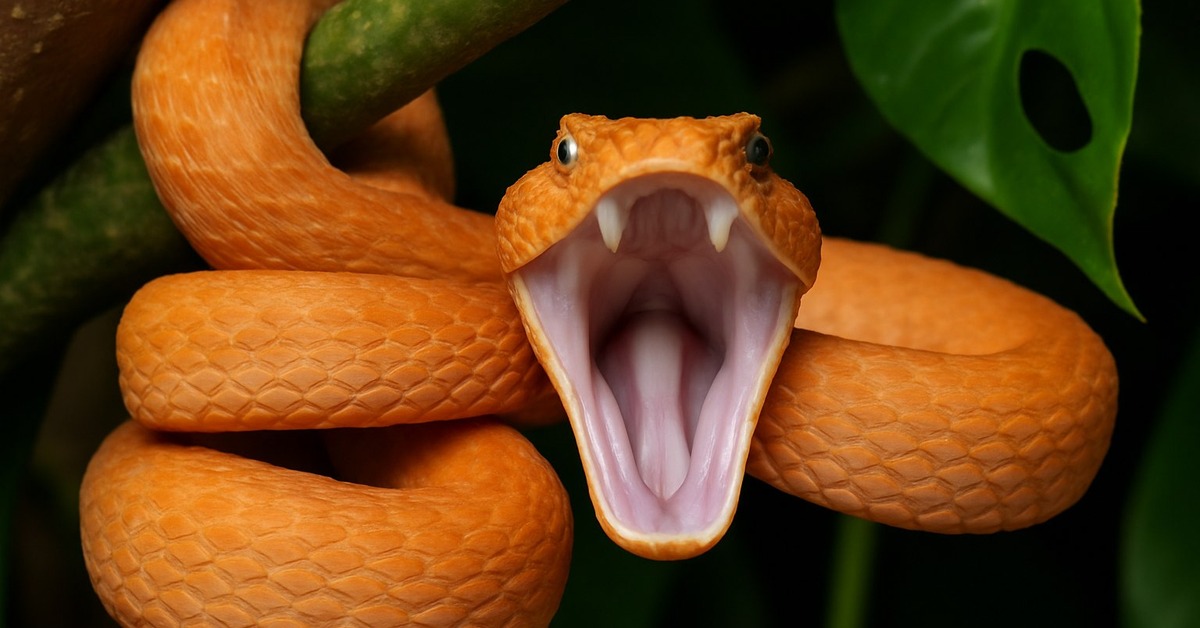
As a pitviper, Bothriechis schlegelii carries hemotoxic venom — designed to break down blood and tissue rather than paralyze the nervous system like a cobra’s. But hemotoxic doesn’t mean slow. Within minutes of a bite, hemorrhagic compounds begin disrupting clotting factors throughout the bloodstream, triggering what toxicologists call “consumptive coagulopathy” (researchers actually call this one of the most destabilizing venom effects in the pitviper family) — a condition where the blood simultaneously clots everywhere and nowhere. A 2020 review published in Smithsonian Magazine noted that Central American pitviper envenomations account for a disproportionate share of snakebite-related medical emergencies in rural communities, partly because workers in banana and heliconia plantations encounter these snakes without realizing it — the yellow morph, in particular, is nearly invisible on a bunch of ripe bananas. Since 1970, the Instituto Clodomiro Picado in San José has been developing and distributing polyvalent antivenom for this region, dramatically reducing fatality rates from pitviper bites across Central America.
What makes the venom biochemically interesting isn’t just its lethality — it’s its specificity. Research from the University of Costa Rica published in 2016 identified several novel phospholipase A₂ enzymes in B. schlegelii venom that differ significantly from related species, even within the same genus. This suggests rapid venom evolution, possibly driven by prey-specific selective pressure. Venom, it turns out, is as much a record of evolutionary history as it is a weapon.
A species shaped this precisely by what it hunts deserves more scientific attention than it currently gets — and the gap between what we know about this venom and what we’ve actually studied is, frankly, an indictment of how arboreal neotropical snakes get deprioritized in research funding.
And none of this makes the viper aggressive by nature. Plantation workers, hikers, and field researchers are bitten almost exclusively because they reached for something they couldn’t see. The snake had been there the whole time. Waiting, as it always is.
Conservation Pressure and the Eyelash Viper’s Uncertain Future
Stretching from southern Mexico through Colombia, Ecuador, and into Venezuela, the eyelash viper’s range sounds vast — until you map it against deforestation rates. Cloud forests and lowland humid forests are among the most threatened ecosystems in the Americas. According to Global Forest Watch data from 2023, Costa Rica recovered significant canopy cover between 1990 and 2010 through aggressive reforestation policy, but habitat fragmentation continues to isolate snake populations in ways that satellite images can’t fully capture. Arboreal species like the eyelash viper are disproportionately vulnerable to fragmentation because they can’t cross open ground safely — a gap of cleared land between two forest patches might as well be an ocean. The IUCN currently lists the species as Least Concern, but several herpetologists affiliated with the Serpentarium de Costa Rica have argued publicly since 2019 that this designation doesn’t reflect localized population collapses in heavily farmed regions of Honduras and Guatemala.
Illegal wildlife trade compounds the problem. The eyelash viper’s dramatic appearance makes it a target for the exotic pet market, and while CITES Appendix II listing provides some legal protection, enforcement in rural exporting regions is inconsistent. Confiscated animals are rarely returned to wild populations — captive-born individuals lack the environmental conditioning that makes arboreal ambush hunting viable. A viper raised in a glass enclosure doesn’t know where to look for a heliconia stem. That knowledge, it seems, is learned, not hardwired.
Instituto Clodomiro Picado currently maintains breeding populations for antivenom research, which has had the unintended benefit of creating detailed behavioral datasets on captive animals. Researchers there have begun comparing captive locomotion patterns with GPS-tagged wild individuals — small sample sizes so far, but the data is already complicating assumptions about how much of this snake’s behavior is instinct and how much is acquired through early environmental experience.
Where to See This
- Monteverde Cloud Forest Reserve, Costa Rica — one of the best-documented locations for eyelash viper sightings, particularly along the Sendero Bosque Eterno trail during the wet season (May–November). Night walks guided by local naturalists offer the highest encounter probability.
- The Instituto Clodomiro Picado (Universidad de Costa Rica, San José) conducts public education programs on venomous snakes and maintains a living collection for antivenom research — their facility tours are open to researchers and visiting scientists by appointment.
- The iNaturalist observation map for Bothriechis schlegelii currently contains over 2,400 georeferenced sightings and is searchable by elevation, color morph, and month — an underused tool for anyone serious about tracking wild populations.
By the Numbers
- Approximately 2,400 verified iNaturalist observations of Bothriechis schlegelii recorded globally as of 2024, spanning 12 countries.
- Strike speed estimated at under 0.1 seconds — documented through high-speed video analysis by researchers at the Universidad de Costa Rica in 2018.
- Up to 73% of active hours spent on a single substrate without repositioning, per Smithsonian Tropical Research Institute field data from 2018.
- Instituto Clodomiro Picado has produced antivenom for Central American pitvipers since 1970, reducing regional fatality rates from snakebite by an estimated 90% over five decades.
- Viable, connected forest within the eyelash viper’s roughly 2.1-million-square-kilometer range has declined by an estimated 35% since 1990 (Global Forest Watch, 2023).
Field Notes
- In 2014, a field team working in Tortuguero National Park, Costa Rica, photographed an eyelash viper in active pursuit of a red-eyed tree frog on a vertical surface — a movement behavior previously considered atypical for sit-and-wait ambush predators in this genus. The footage remains one of the few documented examples of active arboreal pursuit in the species.
- Nearly all oropel color morph sightings — the vivid yellow form — are documented below 800 meters elevation, suggesting that color polymorphism may track altitude-specific selective pressure rather than being purely random within populations.
- Eyelash vipers have been found coiled inside heliconias sold at flower markets in Costa Rica and Panama, having been transported unknowingly from plantations. At least three documented bites between 2010 and 2022 occurred at retail flower stalls, not in the field.
- Researchers still can’t explain why superciliary scale elaboration varies so dramatically between individuals of the same sex within a single population. If it’s purely camouflage, the variation should correlate with microhabitat. It often doesn’t — and that gap in the data remains genuinely unresolved.
Frequently Asked Questions
Q: Is the eyelash viper dangerous to humans?
Yes — but bites are almost always accidental. The eyelash viper is not aggressive and won’t pursue humans. Most recorded bites happen when someone accidentally touches or grabs a snake they couldn’t see. Its hemotoxic venom causes serious tissue damage and clotting disruption, and untreated bites can be fatal. With antivenom — widely available in Costa Rica — fatality rates are very low. If bitten, seek hospital care immediately; do not attempt to suck venom or apply tourniquets.
Q: Why does the eyelash viper come in so many colors?
Color polymorphism in the eyelash viper is genetic, not environmental. The same clutch of eggs can produce yellow, green, and brown offspring. The mechanism isn’t fully understood, but researchers believe it may be maintained by a form of negative frequency-dependent selection — predators learn to avoid the most common color form, which gives rarer morphs a survival edge. Over time, this keeps multiple color forms in circulation within a population, with no single form dominating.
Q: Do eyelash vipers really never touch the ground?
Almost never, but not literally never. Hunting, resting, mating, and giving birth (it’s viviparous, not egg-laying) all happen in the tree layer. Ground contact is rare and typically brief, most often observed when a snake transitions between vegetation patches. Captive individuals kept in ground-level enclosures consistently attempt to climb any vertical surface available, regardless of whether prey is present — which suggests the behavioral commitment to arboreal living runs deeper than simple habit.
Editor’s Take — Alex Morgan
What strikes me most about the eyelash viper isn’t the venom or the camouflage or even those absurd lashes — it’s the patience. A snake that can hold the same position on the same branch for two or three days is doing something we don’t have a clean cognitive framework for. We call it ambush strategy, but that word makes it sound calculated. It might be closer to a kind of physiological stillness we can’t access. The forest builds predators we don’t fully have the language to describe yet.
Motion isn’t the point for the eyelash viper. It hangs there in the understory — jeweled, patient, biochemically complex, and profoundly indifferent to our presence — while the cloud forest shifts around it in gradients of green. We build field stations, run GPS tags, map color morphs against altitude, and still end up staring at a snake on a branch, genuinely unsure what it’s doing or why it looks the way it does. There’s something clarifying about that uncertainty. Not every predator owes us an explanation.
Illustrations are AI-generated. Article fact-checked and human-edited. Our editorial standards.