When Precision Missiles Strike Sanctuaries: Beit Shemesh
A place built for refuge shouldn’t be the one that collapses. And yet at 7:19 p.m., when the stone walls of a Beit Shemesh synagogue were full of families finishing evening prayers, the Fateh-110 missile found exactly that — a sanctuary, a ceiling, and then rubble where neither had been a moment before.
Beit Shemesh sits at one of the oldest crossroads in the ancient world, where the Judean hills fall away toward the coastal plain. Armies have moved through this valley for three thousand years. The city’s name means “House of the Sun.” That night, religious texts lay scattered in the rubble, and twenty-eight people were pulled wounded from the wreckage. Nine didn’t come home. What does it mean when a place built for refuge becomes the target?
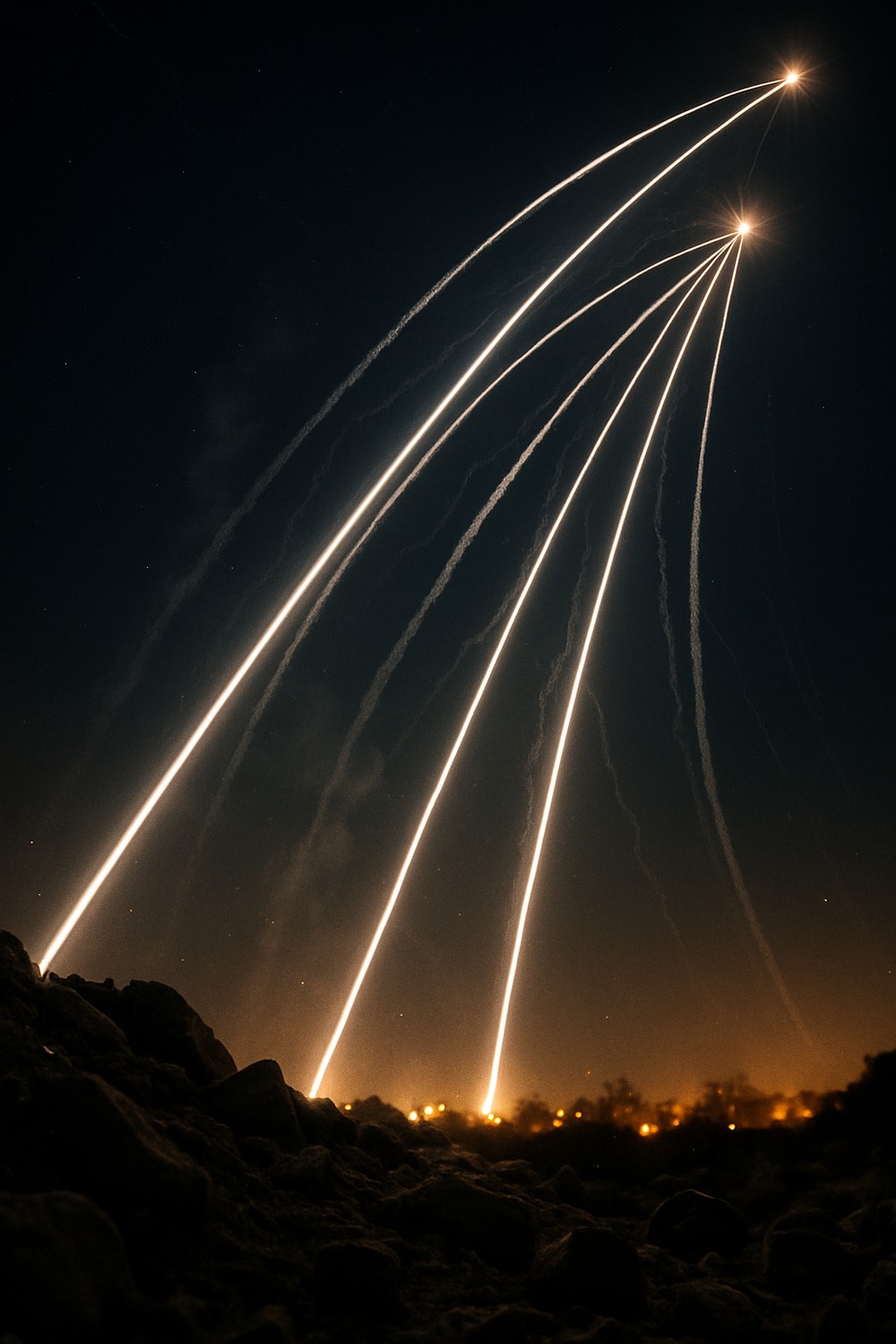

The Fateh-110: Iran’s Precision Weapon Finds Its Mark
Here’s the thing about the Fateh-110: it isn’t a crude device lobbed in a general direction and left to chance. Developed by Iran’s Aerospace Industries Organization beginning in the early 2000s, it’s a solid-fueled, short-range ballistic missile that went through successive variants improving guidance, range, and lethality across two decades of iteration. The version that struck Beit Shemesh had a range of approximately 300 kilometers and — by the assessment of military analysts at the International Institute for Strategic Studies — accuracy to within a few meters of its programmed target. That’s not a weapon designed to terrorize neighborhoods indiscriminately. It’s a weapon designed to find a specific building. On this night, it found one.
The Fateh-110 missile has been documented in conflicts across the region since at least 2012, deployed by Iranian-aligned forces in Syria, used in strikes inside Iraq, and fired directly from Iranian territory in retaliatory salvos. What changed over those two decades wasn’t just the missile’s range — it was the politics surrounding its use. Iran has increasingly relied on direct-fire ballistic strikes rather than proxy delivery as part of what military planners call a “forward deterrence” posture. The Fateh-110 became the instrument of choice for strikes designed to send a message that could not be disavowed or attributed to a third party. When Israeli and American aircraft struck targets near Tehran in the days before this attack, the response was calibrated to be unmistakable. Precision, in this context, isn’t just technical. It’s rhetorical.
The missile arrived from Iranian territory. Not from Lebanon. Not from Gaza. That geographic fact matters enormously — it marks a threshold that military planners had long modeled but rarely seen crossed so directly, and it changes every calculation about what comes next.
A City Built to Survive, and What Survives It
Beit Shemesh has been preparing for this kind of night for years. Home to 150,000 people — a mix of secular, religious, and ultra-Orthodox Jewish communities — the city had invested heavily in reinforced shelters beneath homes, apartment blocks, and houses of worship. Israel’s Home Front Command had issued updated shelter specifications after the 2006 Lebanon War, after the 2014 Gaza conflict, after every escalation that reminded civilians their geography put them inside the range of someone’s arsenal. The bomb shelter beneath the synagogue had been built to those standards.
It collapsed anyway. This is the paradox at the heart of civilian defense architecture: you build for the threat you can model, and the Fateh-110 missile striking Beit Shemesh represented a threat the models had acknowledged but the infrastructure hadn’t fully solved. It’s a pattern that echoes through history — the idea that places of meaning, of ritual, of communal gathering, have always drawn both worshippers and weapons. The ancient oak ecosystems described in studies of centuries-old organisms holding entire communities together offer a quiet parallel: the things most worth protecting are often the most exposed.
Among the dead were three teenage siblings. A mother and her adult daughter. Another mother and her son. The demographic reality of who was killed — families gathered for evening prayer — tells you something specific about timing and intent, whether that intent was algorithmic (target the building at peak occupancy) or simply the outcome of a missile that doesn’t distinguish between a structure and the people inside it. Israel’s Magen David Adom emergency service documented the response in real time: twenty-eight wounded extracted from the site across several hours, some requiring surgery for blast injuries and crush trauma consistent with structural collapse.
The wounded included children. What the engineers who designed the shelter didn’t fully account for — what perhaps no shelter specification fully accounts for — is a precision strike landing close enough to compromise the structural integrity of the reinforced space itself. Close enough, in this case, meant direct.
Three Thousand Years at This Crossroads
Beit Shemesh appears in the Hebrew Bible as the place where the Ark of the Covenant was returned by the Philistines after its capture — a story of contested sacred objects moving across a landscape that has never really stopped being contested. Archaeological surveys conducted by the Hebrew University of Jerusalem between 2006 and 2019 at Tel Beit Shemesh, the ancient mound just outside the modern city, revealed continuous occupation from the Bronze Age through the Iron Age. What those excavations show is a community that sat squarely on the trade and military route connecting the Mediterranean coast to Jerusalem — armies moved through this valley because they had to, the path of least elevation, the place where forces could stage before pushing into the hills. Smithsonian Magazine’s examination of the Ark’s journey traces exactly this geography, the valley floor that became a recurring stage for the ancient world’s power struggles. Beit Shemesh was never simply a quiet town. It was always a place where larger forces met.
The Crusaders understood this. The Ottoman forces understood it. The armies that fought through the Aijalon Valley during the 1948 Arab-Israeli War understood it. Every military force that has ever wanted to control the road between the coast and Jerusalem has had to reckon with this particular stretch of ground. The Fateh-110 missile striking Beit Shemesh in the twenty-first century is, in one sense, a technological update to a conflict that has been running for three millennia. The weapons change. The geography doesn’t.
That continuity isn’t poetic. It’s operational. Terrain shapes war in ways that don’t expire — the hills that provided defensive advantage to Iron Age commanders are the same hills that make certain trajectories predictable for modern missile guidance systems.
The Fateh-110’s Architecture of Precision and Its Limits
Why does this matter? Because the gap between technical precision and human consequence is where the real argument lives.
Understanding what the Fateh-110 missile can and can’t do in Beit Shemesh and elsewhere requires looking at how its guidance system actually works. The missile uses an inertial navigation system updated by GPS correction during flight — a combination that gives it what defense analysts at the RAND Corporation described in a 2021 assessment as “near-CEP” accuracy, meaning it lands within a circular error probable of roughly 10 meters of the designated target. For context: a 10-meter CEP means half of all missiles fired at a given coordinate will land within 10 meters of that point. Compare that to the Scud missiles Iraq fired at Israeli cities during the 1991 Gulf War, whose CEP was measured in hundreds of meters. The evolution from that era to this one represents a transformation in what’s militarily possible, and what’s politically deniable.
Precision, it turns out, doesn’t shrink a blast radius. The Fateh-110’s warhead — typically in the range of 450 to 650 kilograms of high explosive depending on the variant — creates a zone of near-total destruction that guidance can place accurately but cannot reduce. A missile that lands exactly where it’s aimed still kills everyone within its lethal radius. The guidance system determines where the center of that radius falls. This is the mechanical reason why precision weapons and mass civilian casualties are not mutually exclusive — and why arguments about “targeted strikes” require interrogation of what “targeted” actually means in physical terms.
Treating precision as a moral defense for what these weapons do on impact is an argument the evidence has long since outrun.
And researchers at Amnesty International and Human Rights Watch have spent years documenting this distinction in conflict zones from Yemen to Syria, cataloguing strikes where the technical precision of the weapon was not in question but the nature of the target — or the people inside it — was. The Fateh-110 in Beit Shemesh adds to that record. A weapon that finds its mark precisely is still a weapon.

How It Unfolded
- 2002 — Iran’s Aerospace Industries Organization publicly reveals the first Fateh-110 variant, a solid-fueled ballistic missile designed to replace older liquid-fueled systems.
- 2012 — Variants of the Fateh-110 are confirmed deployed in Syria by Iranian-aligned forces, marking the weapon’s first documented use in a regional proxy conflict.
- 2022 — Iran fires Fateh-110 and Zolfaghar missiles directly at targets in Iraqi Kurdistan, crossing a threshold by launching from Iranian territory without proxy intermediaries.
- 2025 — A Fateh-110 missile strikes a synagogue in Beit Shemesh during evening prayers, killing nine and wounding twenty-eight, in a direct retaliatory strike from Iranian territory following Israeli and American airstrikes near Tehran.
By the Numbers
- ~300 km — maximum range of the Fateh-110 variant assessed to have struck Beit Shemesh (IISS Military Balance, 2023).
- ~10 meters — circular error probable (CEP) of GPS-corrected Fateh-110 guidance, compared to 300–500 meters CEP for Scud-B missiles used in the 1991 Gulf War.
- 9 killed, 28 wounded — confirmed casualties from the Beit Shemesh strike, including three teenage siblings from one family.
- 450–650 kg — estimated warhead mass of operational Fateh-110 variants, sufficient to collapse reinforced concrete shelters at point of impact.
- 150,000 — population of Beit Shemesh at the time of the strike, a city that had grown from fewer than 10,000 residents in 1948.
Field Notes
- Solid-fuel propulsion gives the Fateh-110 a launch preparation time measured in minutes rather than hours — unlike older liquid-fueled ballistic missiles, which require extensive and observable fueling operations that satellite surveillance can detect. This makes the Fateh-110 significantly harder to intercept before launch.
- The Aijalon Valley, through which ancient armies approached Jerusalem and near which Beit Shemesh sits, is named in the Book of Joshua as the site where, according to the text, the sun stood still during battle — a passage that makes Beit Shemesh, “House of the Sun,” a location with layers of solar and martial symbolism going back to at least the Iron Age.
- Israel’s Iron Dome system is designed primarily to intercept short-range rockets and artillery shells, not ballistic missiles; the Arrow missile defense system, designed for ballistic threats, has documented interception success rates — but interception is not guaranteed, and a single failure carries consequences measured in lives.
- Researchers still can’t fully answer how civilian shelter standards should be revised to account for precision ballistic strikes at point-of-impact rather than near-miss distances (and this matters more than it sounds). Current specifications were developed around blast-wave and fragmentation modeling, not direct structural impact — a gap that the Beit Shemesh strike has forced military engineers to re-examine.
Frequently Asked Questions
Q: What makes the Fateh-110 missile different from the rockets typically fired at Beit Shemesh and other Israeli cities?
The Fateh-110 is a precision-guided ballistic missile, not an unguided rocket. Rockets fired from Gaza or Lebanon — Qassam, Grad, or Katyusha variants — have CEPs measured in hundreds of meters, meaning they land somewhere in a general area. The Fateh-110 uses inertial navigation corrected by GPS to achieve accuracy within roughly 10 meters of a programmed coordinate. It also carries a far heavier warhead, typically 450 to 650 kilograms of high explosive, compared to the 5 to 20 kilograms typical of short-range rockets.
Q: Why did the reinforced shelter beneath the synagogue fail to protect the people inside?
Israeli shelter specifications are engineered around blast-wave and fragmentation threats from near-miss detonations — a missile or bomb that lands close to a building and sends a pressure wave and shrapnel through it. The Fateh-110 strike on Beit Shemesh appears to have been a direct impact or near-direct impact, which generates forces that exceed what reinforced shelter construction is typically rated to absorb. Structural collapse of the building above the shelter likely transferred loading directly onto the shelter’s ceiling, which was not designed to bear that kind of dynamic load.
Q: Does firing from Iranian territory change the strategic significance of this strike?
Significantly, yes. Most previous strikes on Israeli territory were launched from Lebanon (Hezbollah), Gaza (Hamas and Islamic Jihad), or Syria — all involving a degree of proxy distance that allowed Iran to deny direct responsibility. A Fateh-110 missile launched from Iranian soil carries Iran’s direct fingerprint. Military analysts at RAND and the Washington Institute for Near East Policy have noted since at least 2022 that Iran’s willingness to conduct direct-launch strikes represents a qualitative escalation — collapsing the distinction between Iranian support for proxy forces and Iranian direct military action.
Editor’s Take — Sarah Blake
What stays with me isn’t the missile’s specifications — it’s the shelter that didn’t hold. For years, people in Beit Shemesh reinforced the spaces beneath their synagogues and apartment blocks on the understanding that doing so was the rational response to an irrational situation. They were right to build those shelters. They were also building to yesterday’s threat. The Fateh-110 changes the engineering conversation as much as it changes the political one — and the families pulled from that rubble are the evidence.
Beit Shemesh has been a crossroads for three thousand years, and the logic of crossroads has never really changed: whoever controls the route controls what moves along it. What’s changed is the weapon, and what precision means when it arrives at a house of worship at 7:19 in the evening. Stone walls have always come down eventually. What the Fateh-110 missile’s strike on Beit Shemesh forces us to confront is how quickly they can come down now — and whether there is any architecture, any shelter depth, any technical specification, that keeps pace with a guided warhead that knows exactly where it’s going.