


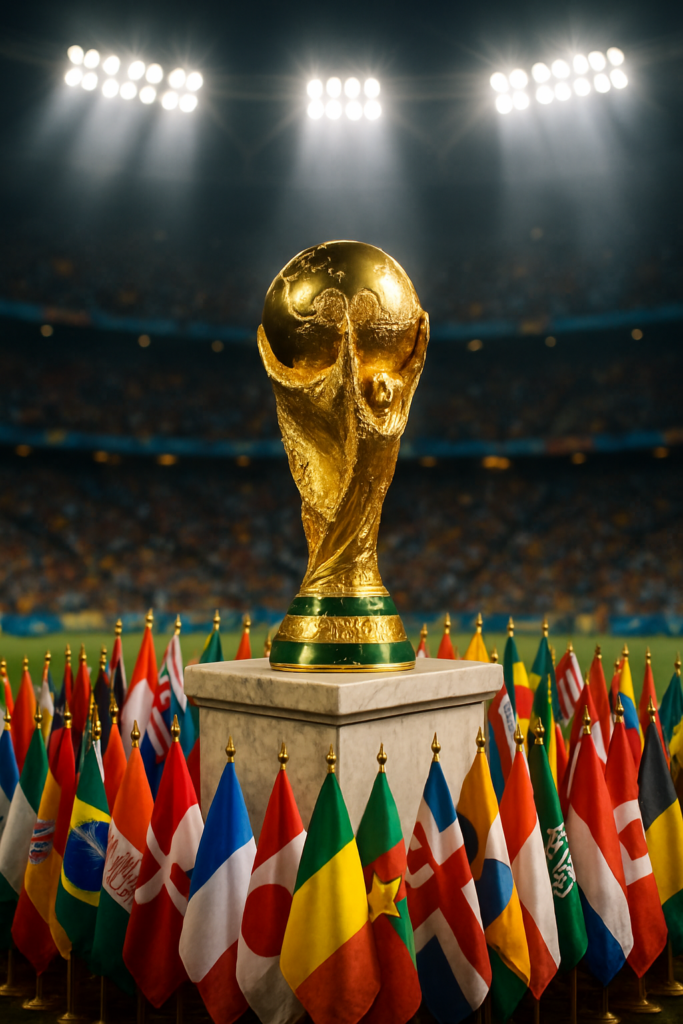
Every peace prize tells you something about the people giving it. The FIFA Peace Prize — Football Unites the World — tells you something about the moment we’re living in. Announced by FIFA President Gianni Infantino at the ceremonial draw for the 2026 FIFA World Cup in Washington, D.C., the award didn’t just surprise the room. It detonated in it. And the inaugural recipient — former United States President Donald Trump — made sure the detonation echoed.

A Prize Born on the World Stage
Washington was never going to be a neutral backdrop. Already saturated with political symbolism, the city hosted the final draw ceremony for a tournament the United States is co-hosting alongside Canada and Mexico — continental ambition made flesh, with the cameras to match. Infantino, who has spent years positioning football as humanity’s great connector, framed the new award as a natural extension of FIFA’s mission. The organization’s official statement described it as honoring individuals who make “extraordinary contributions to peace,” a mandate broad enough to park a stadium through.
That language leaves generous room for future interpretation — and, just as inevitably, future controversy. By embedding the prize’s debut inside one of the most-watched events on the 2026 World Cup calendar, FIFA guaranteed the kind of global visibility that no press release could buy.
Subtle it wasn’t. Effective? Undeniably. Cameras caught the exact moment Infantino handed Trump the award, framing the exchange as proof of football’s capacity to transcend partisan division. FIFA called it an embodiment of the sport’s “unifying power” — a phrase that has become something of a house mantra in the organization’s communications. Critics noted immediately that the timing, coinciding with American political prominence and a World Cup on U.S. soil, was unlikely to be accidental. The debate ignited before the ceremony’s cameras had even cooled.
Why Trump? Unpacking FIFA’s Reasoning
What, precisely, earned Trump the first-ever FIFA Peace Prize? FIFA offered thin specifics. Public statements leaned on thematic language — communities brought together, nations drawn closer — without anything resembling a detailed accomplishment list. That ambiguity was either strategic or revealing, depending on your level of charity toward the organization.
Trump’s presidency was defined by sharp polarization, a combative foreign policy posture, and a governing style that a significant portion of the world’s population found divisive rather than healing. Handing him a peace prize struck many observers as not just ironic but incongruous. The wall metaphor wrote itself, and commentators worldwide obliged.
Here’s the thing — FIFA appeared to be working on a different frequency entirely. In the organization’s calculus, the symbolic weight of football and the spectacle of a World Cup can recast almost any figure, even the most contested one, as a bridge-builder. Whether that calculus is admirable or troubling is a question worth sitting with.
History has a way of treating the people who made this kind of call unkindly — especially when the paperwork never materialized to justify it.
There’s also a harder-edged pragmatism to consider. Trump’s administration steered the early stages of the United States’ successful bid to co-host the 2026 tournament, and his relationship with Infantino has been widely described as warm. Hosting a commercially prosperous, politically smooth World Cup on American soil requires goodwill at the highest levels. FIFA’s governing bodies have never been squeamish about navigating difficult political terrain — from Cold War-era tournaments through the modern age of sports diplomacy — and whether this decision represents calculated pragmatism or something more troubling remains, for now, a fiercely open question.
Football’s Long History With Political Power
None of this is new. Football has served as both mirror and megaphone for political reality since its earliest international competitions in the twentieth century. Travel back to the trenches of 1914, where British and German soldiers set down their rifles on Christmas Day and, by most accounts, kicked a ball between them. That story has been told so many times it risks losing its power. It shouldn’t. It remains the most honest argument football has ever made for itself.
Consider the other extreme: in 1969, a World Cup qualifying match between Honduras and El Salvador became the flashpoint for actual military conflict — the Football War (researchers actually call this one of the clearest examples of sport as geopolitical accelerant), brief and brutal, a reminder that the game can amplify tension as readily as it dissolves it. The spectrum between those two moments is where every discussion of football and politics has lived ever since.
And FIFA’s own campaigns around refugee inclusion, gender equality, and racial justice have signaled an institution increasingly willing to wade into contested territory — with the authority of the world’s most-watched sport squarely behind it. The FIFA Peace Prize is, in that sense, less a departure than an escalation.
How It Unfolded
- 1914 — British and German soldiers reportedly play football during the Christmas Day truce in the trenches of World War I, establishing the sport’s earliest mythology as peacemaker.
- 1969 — The Football War erupts between Honduras and El Salvador following a World Cup qualifying match, demonstrating football’s capacity to inflame as well as unite.
- 2018 — FIFA launches formal campaigns around refugee inclusion and social justice, signaling a shift toward overt political engagement under Infantino’s leadership.
- 2026 — The FIFA Peace Prize is unveiled at the 2026 World Cup final draw ceremony in Washington, D.C., with Donald Trump named as its inaugural recipient.
An Annual Award, An Evolving Legacy
Why does this matter? Because now that the prize exists, questions accumulate fast — and there are no structures yet to answer them. Will future nominations involve public input? Will an independent panel apply transparent criteria? FIFA has published no detailed guidelines. “Extraordinary contributions to peace” remains the full extent of the framework — which is either visionary flexibility or a governance red flag, and possibly both simultaneously.
Anyone who’s followed FIFA closely over the years might lean toward the latter. But the opportunity here is real, and it would be a mistake to dismiss it entirely. Football’s global reach is unmatched by any diplomatic institution on earth.
A prize that genuinely spotlights peacemakers who’d otherwise go unrecognized — people doing difficult work in difficult places, not figures who already command the world’s attention — could be something worth having. Whether FIFA seizes that possibility or trades it for political optics will define this award’s legacy far more decisively than its contentious opening night.
Editor’s Take — Sarah Blake
What stays with me isn’t the controversy — it’s the vacancy at the center of it. FIFA announced a peace prize with no selection panel, no published criteria, no appeal process, and no precedent. They handed it to one of the most polarizing figures of the modern era and called it unity. The prize could yet become something genuine: football has earned that possibility. But an institution that waited until a World Cup draw to invent its own moral authority probably shouldn’t be surprised when the world treats the whole thing as theatre.
Football has always carried humanity’s hopes and contradictions inside it — a game simple enough to play anywhere, powerful enough to bind strangers across every kind of border. The FIFA Peace Prize is an audacious wager that sport can do more than entertain. That it can actually move something. Whether Donald Trump was the right first symbol of that ambition is a question that’ll run for years. But the conversation itself — loud, global, passionate, bitterly divided — is perhaps the most football thing about this entire moment. The beautiful game has always given the world something to argue about. Somewhere in that noise, if you listen for it, there’s usually something to hope for too.


