Why Fire Eels Vanish Into Sand — And Love Every Second
Fire eel burrowing behavior is one of those things that breaks your brain a little the first time you see it — not because it’s rare, but because your instincts read it completely backwards. What looks like a fish in distress is actually a fish at its most composed. The corkscrew dive, the disappearing act, the snout left poking above the sand like a periscope. All of it deliberate. None of it panic.
Deep in the silty, slow-moving rivers of Southeast Asia, a fish the color of glowing embers is simply going home. Into the mud. On purpose. Striped, serpentine, and surprisingly clever — the fire eel has solved a hunting problem that most predators never even attempt.
Fire Eel Burrowing Behavior: What’s Actually Happening
Fire eels belong to the genus Mastacembelus, a group of spiny eels found across South and Southeast Asia. Not true eels — they’re spiny-rayed fish — but they move like eels, think like predators, and live like ambush specialists. Researchers studying freshwater fish ecology, including work cited by ichthyologist Maurice Kottelat, have documented how these fish use soft substrate environments as functional habitat rather than just resting spots.
So what drives them underground?
The burrowing reflex is wired deep into their biology. Not a response to danger, not a symptom of illness. They burrow because the mud is where they belong — their office, their kitchen, and their bedroom, all at once. You can read more about Mastacembelus on Wikipedia’s entry for the genus, but the taxonomy is honestly the least interesting part of this story.
How They Vanish: The Mechanics of the Dive
Watch a fire eel burrow and you’ll immediately understand why people mistake it for distress. The fish angles its pointed snout downward, works its long muscular body in a slow corkscrew — almost hypnotic — until only the tip of its face pokes above the surface. One moment there’s a vivid, foot-long fish in your tank. The next, there’s just a patch of sand with two tiny eyes and a snout.
That exposed snout isn’t an accident. It’s strategic. The eel can still breathe, still sense water movements, still detect the chemical trails left by passing prey — all while technically invisible. The fish does this every single day, often multiple times, with zero awareness of how unsettling it looks to everyone watching. For more on how fish use sensory organs to detect their environment, check out this piece on This Amazing World about underwater sensory systems.
Not Fear — This Is the Fire Eel’s Hunting Strategy
Here’s the thing: fire eel burrowing behavior gets misread constantly — by hobbyists, by casual observers, sometimes even in care guides. People see a fish hiding and assume it’s scared, stressed, or sick.
Why does this matter? Because the misread has real consequences for how people keep these fish, and for how seriously we take their ecological role.
Burying itself is how the fire eel hunts. Tucked into the substrate, nearly invisible, it waits for worms, small crustaceans, or insect larvae to wander within striking range. Then it lunges — fast, precise, and completely unexpected by whatever just became dinner. Think of it like a trapdoor spider. But wetter. And longer.
The ambush strategy is common across predatory animals, but fire eels have refined it specifically for shallow, often silty river systems where visibility is low and food moves slowly along the bottom. Patience isn’t a virtue for these fish. It’s the whole game plan.
Exactly how fire eels detect prey while fully buried is still being studied (researchers actually call the relevant sensory system the lateral line — the organ that picks up vibrations in the water column). They likely combine that lateral line sensitivity with olfactory cues, but the precise mechanism hasn’t been nailed down yet. Which raises the obvious question of why, given how common these fish are in both wild habitats and home aquariums, nobody’s pinned that down conclusively.
Some questions about common animals stay unanswered for a long time — and this one feels like it shouldn’t.
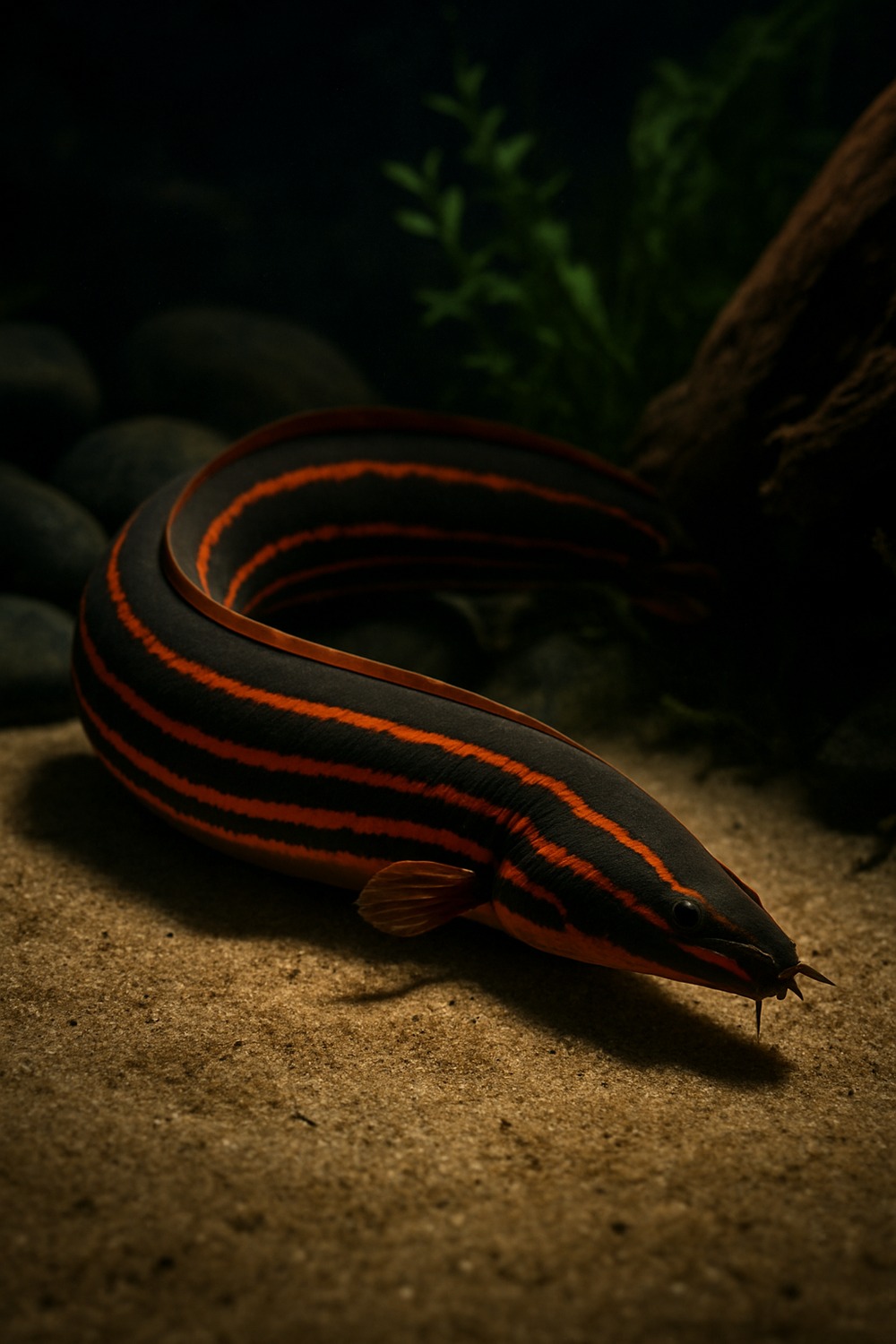
The Snout That Stays Above the Sand
Turns out, that exposed snout is doing several jobs at once. Fire eels breathe by gulping air from the surface — capable of surviving in low-oxygen water, a critical adaptation for the sluggish, sometimes oxygen-depleted rivers they call home. Keeping the snout exposed while buried means they can still access oxygen without fully emerging. Stay hidden, stay fed, stay breathing. It’s a genuinely economical piece of biology.
Fire eels carry a distinctive pointed rostrum — that elongated, flexible tip — packed with sensory receptors and believed to function almost like a probe, picking up minute changes in water pressure and chemical composition. When a worm wriggles past in the dark, the eel knows about it before it sees it. It feels the water change.
And that level of environmental awareness — operating while technically doing nothing visible — is the part that kept me reading about this fish for another hour after I thought I was done.
Where to See This
- Mekong River basin, Thailand and Cambodia — the slow-moving, silty tributaries are prime fire eel habitat; best observed during the dry season (November–April) when water levels drop and substrate becomes accessible for observation.
- The Aquatic Animal Health Research Institute (AAHRI) in Bangkok, Thailand, actively studies freshwater species of the Mekong basin, including spiny eels and their habitat requirements.
- For a closer look without a flight to Southeast Asia: many public aquariums with Southeast Asian freshwater exhibits keep fire eels — the Tennessee Aquarium (USA) and the ZSL London Aquarium (UK) have both featured them. Watch the substrate, not the open water.
By the Numbers
- Fire eels can reach up to 1 meter (about 3.3 feet) in length in the wild, making them one of the larger spiny eel species documented in Southeast Asian river systems (FishBase, 2022).
- Over 70 recognized species in the Mastacembelus genus — spread across freshwater habitats from Africa to Southeast Asia.
- In captivity, fire eels have been recorded living over 10 years with proper substrate depth and environmental enrichment, significantly longer than individuals kept without burrowing opportunity.
- A fire eel can bury itself completely in soft sand in as little as 30 seconds.
Field Notes
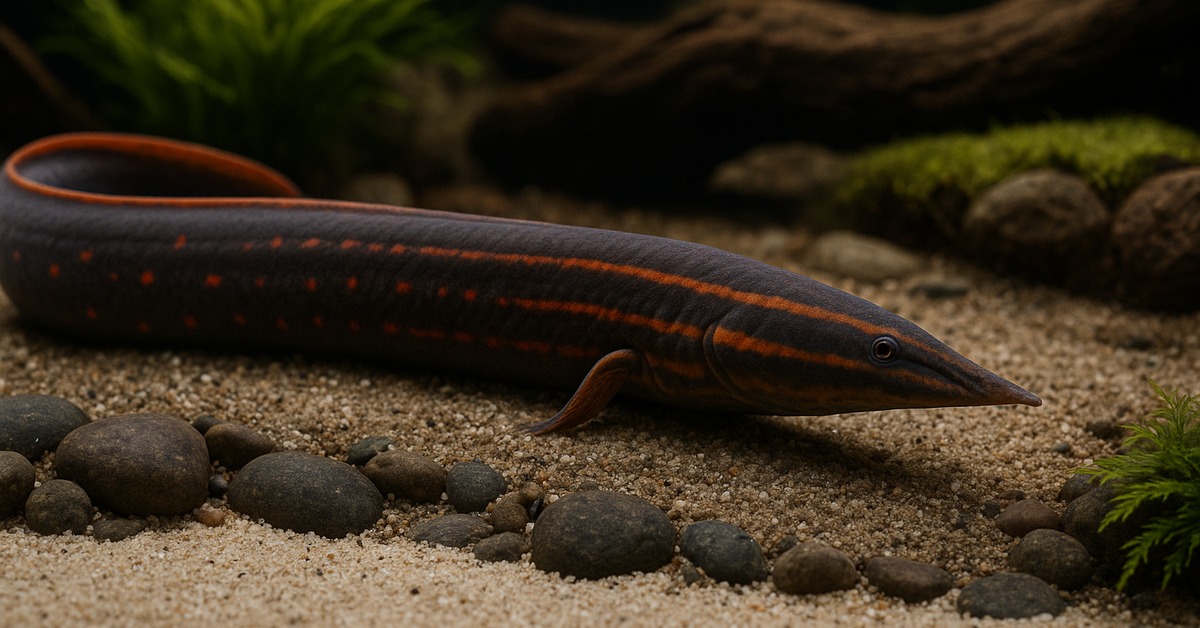
- Fire eels kept in tanks without adequate substrate — sand or fine gravel at least 3 inches deep — show markedly increased surface activity and restlessness. Burrowing isn’t optional enrichment; it’s a genuine behavioral need, closer to sleep deprivation than inconvenience when denied.
- Not venomous, despite the name — the “fire” is the vivid red-and-black patterning, nothing more.
- Dorsal spines can cause minor puncture wounds if handled without care.
- Some aquarists have observed fire eels sharing burrows with other members of the same species — a social behavior that’s rarely documented in wild populations and suggests there may be more to their social lives than solitary ambush predation. Nobody’s studied this closely yet, which feels like an oversight that gets more glaring every year.
Why Fire Eel Behavior Matters Beyond the Aquarium
Fire eel burrowing behavior isn’t just a quirky party trick. These fish turn over sediment, aerate riverbeds, and regulate populations of bottom-dwelling invertebrates. Remove them from an ecosystem — through overfishing for the aquarium trade or habitat destruction — and you lose a quiet but significant ecological force. Researchers studying benthic communities in Southeast Asian rivers are increasingly paying attention to what happens to substrate health when burrowing species disappear.
But the pressures are building faster than the research. The aquarium trade has put serious strain on wild fire eel populations across parts of Thailand, Cambodia, and Vietnam. Habitat loss from river damming and agricultural runoff compounds the problem — these fish need soft substrate, low current, and clean water, and those conditions are getting harder to find in rivers managed for agriculture or hydropower. A species that evolved to disappear into the riverbed is now disappearing from it for entirely different reasons.
Treating a specialist species as decoration in a glass box, stripped of the substrate it needs to function, is exactly the kind of slow harm that doesn’t look like harm until you add up the numbers.
Editor’s Take — Alex Morgan
What gets me about fire eels is how completely they’ve been misread — not by scientists, but by the people who keep them. I’ve watched aquarists stress over a buried fish, adding medication to water that didn’t need it, for a behavior that’s the animal at peak health. The burrowing isn’t a red flag. It’s the whole point. These fish are telling you exactly what they need, every single day, and the message keeps getting lost in translation. Pay attention to the substrate. The eel already has.
Fire eels are one of those animals that reward you for paying attention. They look dramatic, they behave strategically, and they’ve figured out something most creatures never manage: how to disappear without going anywhere at all. That’s not a trick. That’s a few million years of evolution solving a very specific problem with an unexpectedly elegant answer. If this kind of story keeps you up at night, there’s more at this-amazing-world.com — and the next one is even stranger.