


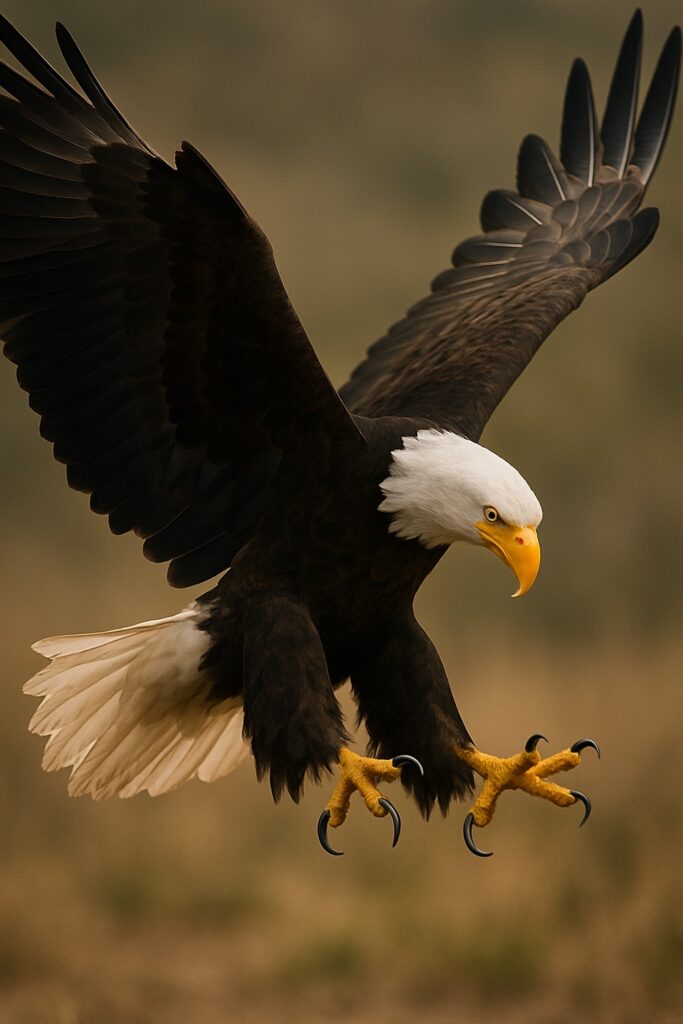
Nobody handed golden eagles this ability. It just accumulated, over millions of years, into something that makes our best optical technology look like a rough draft.
Right now, somewhere over a Scottish hillside or a Mongolian steppe, an eagle is watching a world you and I will never access. Not because we lack the altitude. Because we lack the eyes. What’s happening behind those amber irises is genuinely unlike anything in human experience — and the biology behind it keeps getting stranger the deeper you go.
How Golden Eagle Vision Actually Works in Detail
Start with the numbers. A golden eagle packs roughly one million photoreceptor cells into a single square millimeter of retina — about five times the density found in human eyes. According to research cited by the Golden Eagle Wikipedia entry, visual acuity in Aquila chrysaetos is estimated at 20/4 or better, meaning the bird sees at 20 feet what a person with perfect vision would need to stand four feet away to resolve. Ornithologist Graham Martin has spent decades studying avian vision and describes raptor eyes as “optically extreme” even by bird standards.
So what does extreme actually look like?
It looks like watching a rabbit twitch its ear from two miles out. It looks like reading terrain we’d call a blur. The eye itself is so large relative to skull size that a golden eagle can’t move it in the socket at all — the whole head has to turn. That’s not a limitation. That’s a trade-off the species made somewhere deep in evolutionary time, and it chose resolution. Decisively.
Two Foveas Change Everything About Seeing
Here’s where golden eagle vision gets structurally weird. Most vertebrates — including humans — have one fovea per eye. The fovea is the small pit at the back of the retina packed with cone cells, the part responsible for your sharpest focus. You’re using yours right now to read this sentence.
Eagles have two foveas per eye.
Researchers call them the central fovea and the temporal fovea. You can read more about extreme animal sensory systems in our deep dive on this-amazing-world.com. One fovea handles close-range focus — the vole crouched in the grass sixty meters below. The other holds the distant horizon, scanning for rivals or prey on a ridge a kilometer away. Both. At once. No switching, no compromise, no moment where the bird has to choose between near and far. That dual-fovea system is something no camera lens and no human eye has ever replicated. We’ve built telescopes and microscopes and bifocals precisely because we can’t do what the eagle does naturally, without thinking about it, every single waking moment.
Golden Eagle Vision Detects What We Simply Cannot
The story gets stranger. Golden eagle vision extends into the ultraviolet range — wavelengths completely invisible to the human eye. And this isn’t a quirky footnote. Small mammals like voles and mice communicate through urine trails. To us, an open field looks like an open field. To an eagle overhead, those same trails glow in UV like neon signs on a dark street — a lit map the prey animal leaves behind of its own movements, completely unaware it’s doing so.
That last fact kept me reading for another hour.
Scientists studying this have concluded that eagles don’t just see better than we do. They see a categorically different version of reality, one layered with information we’re permanently locked out of. A mouse never stands a chance. Not because it’s slow. Because it’s broadcasting its location in a frequency it doesn’t even know exists.

The Eye Itself Is a Feat of Engineering
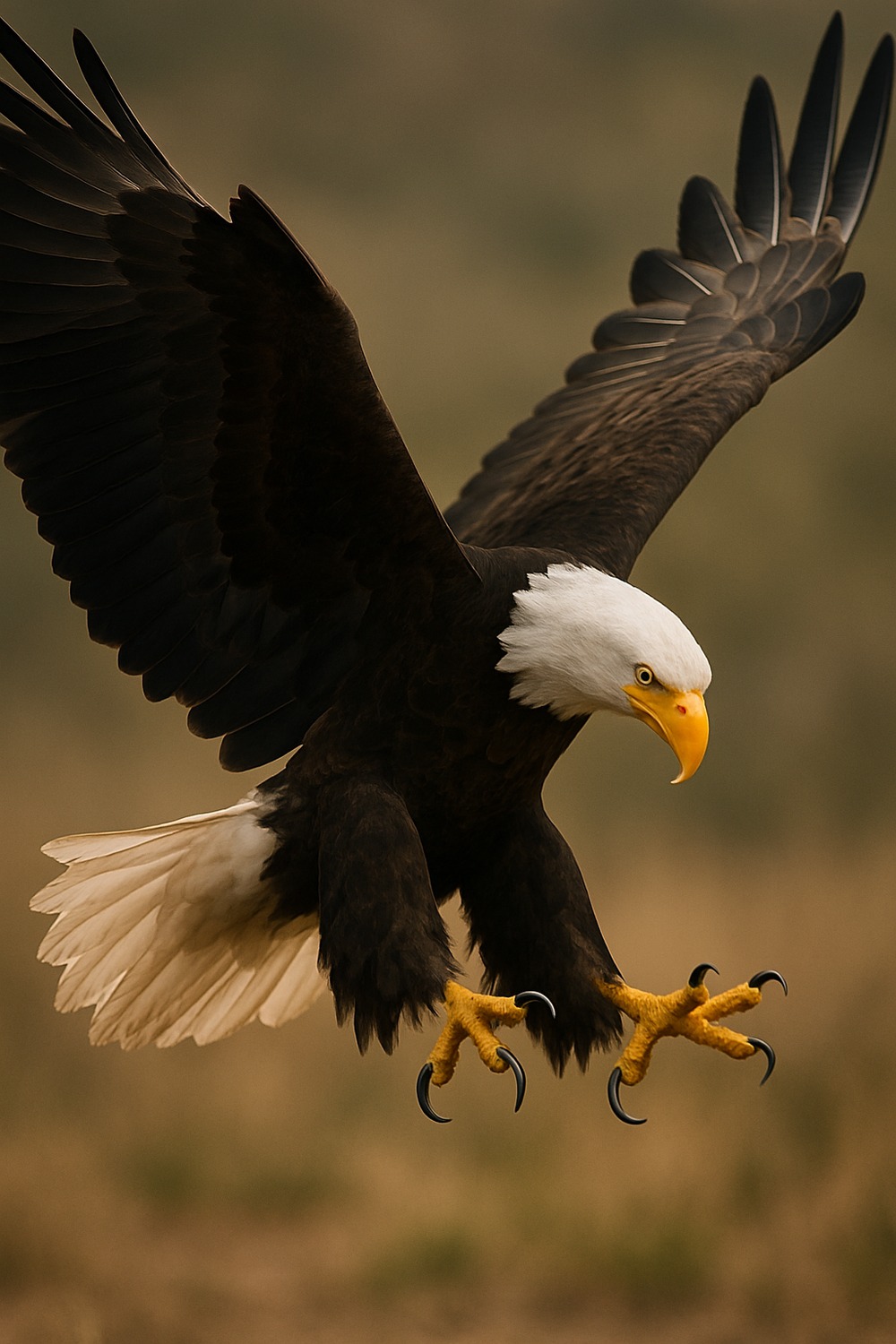
The physical structure of the eagle’s eye is as remarkable as what it captures. The eyeball of a golden eagle is roughly the same size as a human eye in absolute terms — despite the bird weighing maybe four kilograms. If human eyes were proportionally as large, they’d be the size of billiard balls. Eagles compensate for the immovable eye with a neck capable of rotating 270 degrees. But the optics themselves — the cornea curvature, the lens density, the depth of the retinal bowl — are built for one thing. Maximum light capture, maximum resolution, minimum distortion at distance. The cornea is notably flatter than in most birds, which reduces chromatic aberration and keeps the image clean at extreme range.
And when the eagle dives — reaching speeds over 150 miles per hour in a stoop — a transparent third eyelid called the nictitating membrane sweeps across the eye every few seconds. It moistens the surface, clears debris, and keeps the image locked while the bird moves faster than most cars on a highway. The whole system is still running, still tracking, still computing distance and trajectory, all the way down.
By the Numbers
- Visual acuity estimated at 20/4 — five times sharper than human 20/20, per comparative ophthalmology studies from the early 2000s.
- One million photoreceptor cells per square millimeter of retina, compared to approximately 200,000 in humans — a fivefold difference in raw packing density that cascades into every other visual advantage the bird has.
- Dive speeds exceeding 150 mph (240 km/h), with visual lock maintained on the target throughout the entire stoop sequence.
- UV trail detection — rodent urine paths invisible to every wavelength humans can process, effectively a secret information channel that exists in plain sight.

Field Notes
- Golden eagles have been documented hunting prey as large as young deer and foxes. Their vision lets them assess size, health, and movement patterns long before committing to an attack — which is why they’re precise hunters rather than opportunistic ones.
- Ranges across the entire Northern Hemisphere, Ireland to Japan.
- The genus Aquila chrysaetos is ancient enough that this eye design predates most human ancestors — fossil records suggest the visual system you’re reading about has been solving the same problems for millions of years, unchanged because it didn’t need to change.
- Flicker fusion rate significantly higher than humans, meaning what registers to us as continuous motion or blur may appear to the eagle as distinct, readable frames. Slow-motion, essentially, without the camera.
Why Golden Eagle Vision Still Matters to Us
Golden eagle vision has become a serious research target for engineers and medical scientists. The dual-fovea system has inspired lens designs for surveillance technology and drone cameras. UV sensitivity has informed work on sensors that could detect biological traces in search-and-rescue operations. And the sheer photoreceptor density has pushed ophthalmologists to ask harder questions about why human vision evolved its particular trade-offs — speed of processing versus raw resolution, color range versus night sensitivity.
Studying an eye that solved those problems differently opens up what we thought we understood about seeing itself.
But there’s also something simpler here. We share this planet with an animal that experiences it in a way we genuinely can’t fully imagine. That matters, not just scientifically. It matters as a reminder that what we perceive as reality is one version. One channel. Edited heavily by the limits of our own biology.
Somewhere above a highland ridge right now, an eagle has locked onto something you wouldn’t notice if you were standing ten feet away. It’s been doing this for millions of years, with eyes that make our best camera optics look like a rough draft. We built entire scientific fields trying to understand a system that evolution assembled quietly, one photoreceptor at a time. If this kind of thing keeps you up at night, there’s more waiting at this-amazing-world.com.


