Eagles See a World You Can’t — Here’s What They Notice
Nobody told the vole it was already visible. It’s been sitting motionless in the grass for thirty seconds, completely convinced that stillness is the same thing as hiding. It isn’t. Not even close.
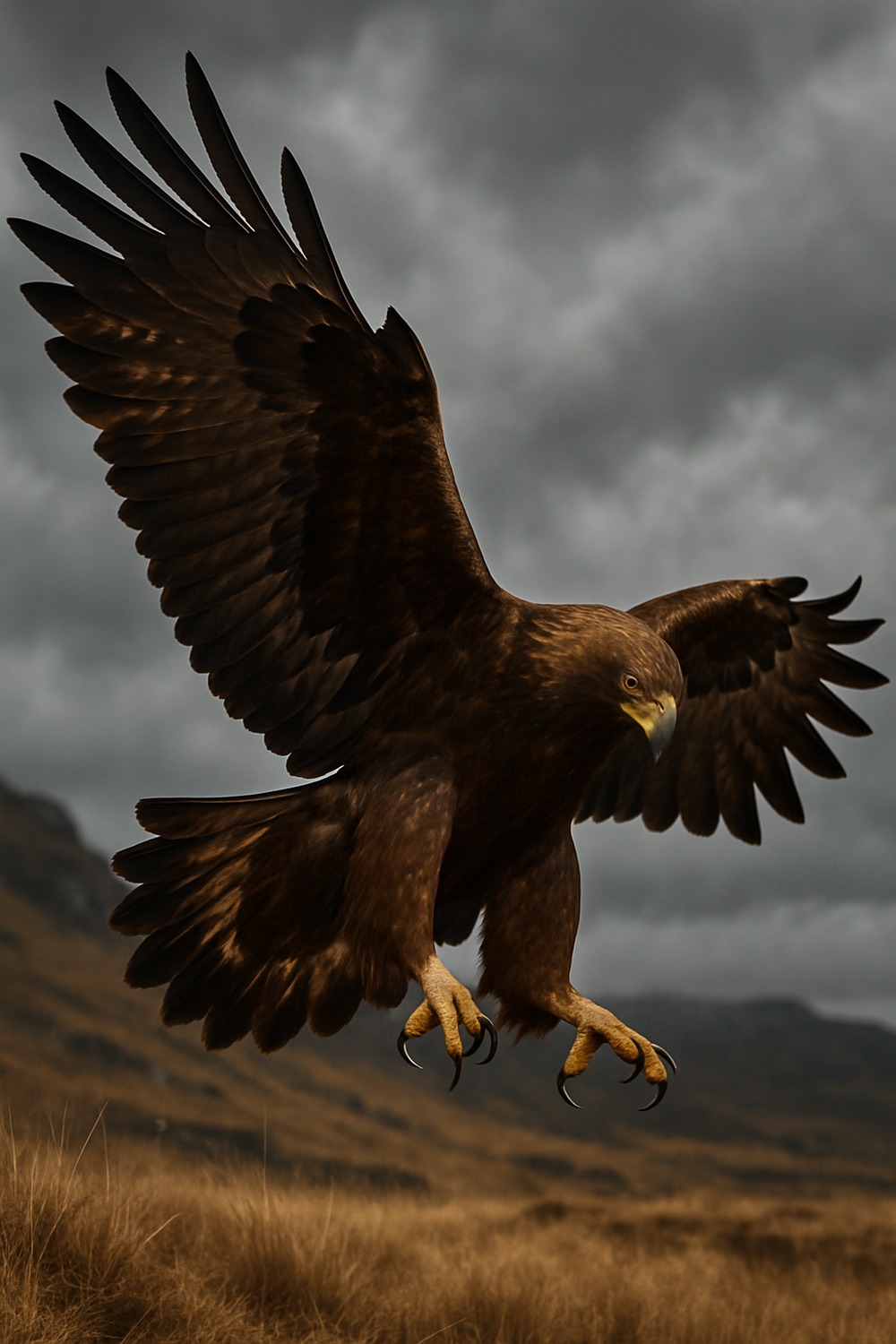
High above a Scottish hillside, a golden eagle tilts its wings and begins to drop. The vole is maybe half a mile below. The eagle clocked it nearly a minute ago — not because it has freakishly good eyes in the way we normally mean that, but because it’s literally seeing a different version of the world. A version with extra layers. Glowing ones.
Eagle Vision Ultraviolet: What They Actually See
Most people know eagles have sharp eyes. That part’s fine, everyone knows that. What doesn’t get talked about nearly enough is the UV thing.
Golden eagles — and many raptors — can detect ultraviolet light, a wavelength our eyes can’t process at all. Here’s what makes that genuinely weird: rodents like voles leave urine trails as they move through grass. Those trails glow under UV light. Researcher Jonah Katz and colleagues studying raptor visual systems have noted this likely turns a grassy meadow into something closer to a lit-up highway system for a hunting eagle. A field that looks empty and green to us is, from above, apparently covered in luminous arrows saying *prey was here, and here, and here.*
The mouse thinks the grass is cover. The eagle is reading a map the mouse accidentally drew.
Two Foveae: Nature’s Strangest Optical Upgrade
Humans have one fovea per eye. That’s the small pit in the retina where your sharpest focus happens — the reason you have to move your eyes to read this sentence, because only that tiny zone is actually crisp. Eagles have two foveae per eyeball. Two.
One points forward for close-range detail. One points sideways for wide-angle distance vision. What that means practically: an eagle can lock pin-sharp focus on a vole directly below while simultaneously keeping the mountain ridge a mile away in crisp detail. No switching. No blurring. No choosing between them. According to Wikipedia’s overview of the golden eagle, this dual-fovea system is one of the defining features of the species’ predatory success — and honestly, that last fact kept me reading for another hour, because no camera ever built handles two focal distances simultaneously without moving a single part. Not a DSLR. Not a cinema lens. Not a military drone. Eagles just… do this.
Natively. Since before we had a word for optics.
One Million Receptors Per Square Millimeter
The numbers here are the kind you have to reread.
Golden eagles pack up to 1,000,000 photoreceptor cells per square millimeter of retina. Humans manage around 200,000 in our sharpest zone. Roughly five times the density — five times the raw visual information landing on their retina every second. So even if you stripped out the UV capability entirely, even if you took the dual foveae away, their eyes are still operating in a completely different category in plain ordinary visible light. You can explore more about extraordinary animal senses at this-amazing-world.com, where this kind of rabbit hole goes considerably deeper.
And it’s not just resolution. Eagles have a higher flicker-fusion rate — they process motion faster than we do, estimated around 100 Hz versus our roughly 60 Hz. A wingbeat that blurs for us lands sharp and clean for them. They don’t just see more detail. They see faster than we do. Both things, at once.
What a Two-Mile View Actually Means
A golden eagle can spot a rabbit from two miles away. That’s not bar trivia — it’s a figure supported by multiple studies on raptor visual acuity, and it’s worth sitting with for a second to understand what eagle vision ultraviolet capability actually means when you put it in context.
Two miles is roughly the distance at which a car on a flat road becomes a dot. Eagles see a rabbit at that distance. Reportedly, they can read whether it’s limping.
An eagle soaring over a Mongolian steppe isn’t passing over empty landscape. It’s scanning several square miles simultaneously, tracking movement, reading UV trails, running what amounts to a constant real-time threat assessment across terrain we’d need binoculars just to begin to parse. The horizon isn’t a limit for them. It’s a workspace.
And that raises a question nobody fully has an answer to yet: what does it actually feel like to process that much visual information at once?
The UV World Hidden Inside Every Field
Turns out, the ultraviolet layer of an eagle’s world isn’t only about hunting. It may also play a role in navigation, mate selection, and — here’s the part that made me genuinely pause — possibly reading weather patterns during migration. UV light scatters differently at different altitudes and humidity levels. Some scientists believe raptors may use those UV gradients to gauge atmospheric conditions while crossing mountain ranges. The research is ongoing, still being mapped out. But what’s already confirmed is stranger than the speculation: the visible spectrum we assume is “normal” vision is, in biological terms, a fairly narrow slice of what’s actually available out there.
We built our entire concept of seeing around one species’ constraints. Our own. Eagles were under no such constraint, took a completely different evolutionary path, and the result is a sensory system we’re still reverse-engineering with equipment far less elegant than the thing we’re trying to understand.
By the Numbers
- Up to 1,000,000 photoreceptor cells per square millimeter in eagle retinas — compared to roughly 200,000 in humans, approximately 5x the density (source: Journal of Experimental Biology, raptor visual acuity studies)
- Prey spotted from approximately 3.2 km (2 miles)
- The golden eagle’s range covers 67 countries across four continents — Scottish Highlands to Mongolian steppe — making it one of the most widely distributed raptors on Earth
- Visual flicker processing estimated around 100 Hz versus our roughly 60 Hz, meaning fast motion that smears into blur for us stays sharp and distinct for them
Field Notes
- Golden eagles don’t just use UV vision for hunting — studies on European kestrels found that UV-visible vole runways increase strike accuracy by up to 50%. That makes the UV layer a primary hunting tool, not a bonus.
- Can’t rotate in the socket. Eagle eyes are so large relative to skull size that they’re essentially fixed in place — so to track prey, eagles move their entire head, which explains the rapid, distinctive head-tilting you see in captive birds.
- The two-fovea system creates a small blind spot directly in front of the beak, which is why eagles tilt their head sideways to examine something close up.
Why Eagle Vision Rewrites What We Think We Know
Eagle vision ultraviolet capability isn’t just a cool animal fact to file away. It’s a reminder that we’ve built our understanding of the world — our science, our art, our technology — through the filter of one specific set of eyes. One species. One narrow slice of available spectrum. We’ve been walking through a world that’s simultaneously lit up in frequencies we can’t detect, mapped in detail we can’t resolve, and processed at speeds we can’t match, and we’ve largely been calling that world complete.
Eagles have been reading the UV annotations on every field and hillside for millions of years. Long before we knew UV light existed. Long before we had instruments sensitive enough to detect it.
“Seeing clearly” is a relative concept. The version of the world we experience as total and whole is, in reality, just one channel out of many running simultaneously. Eagles are tuned to a different channel. A richer one.
A golden eagle tilting over a ridge isn’t just hunting. It’s operating inside a layered, multi-spectrum world that we can barely model mathematically, let alone perceive. And somewhere far below, a vole is sitting perfectly still in the grass, certain that stillness makes it invisible. It doesn’t. It never did. If this kind of story keeps you up at night, there’s more at this-amazing-world.com — and the next one is even stranger.