


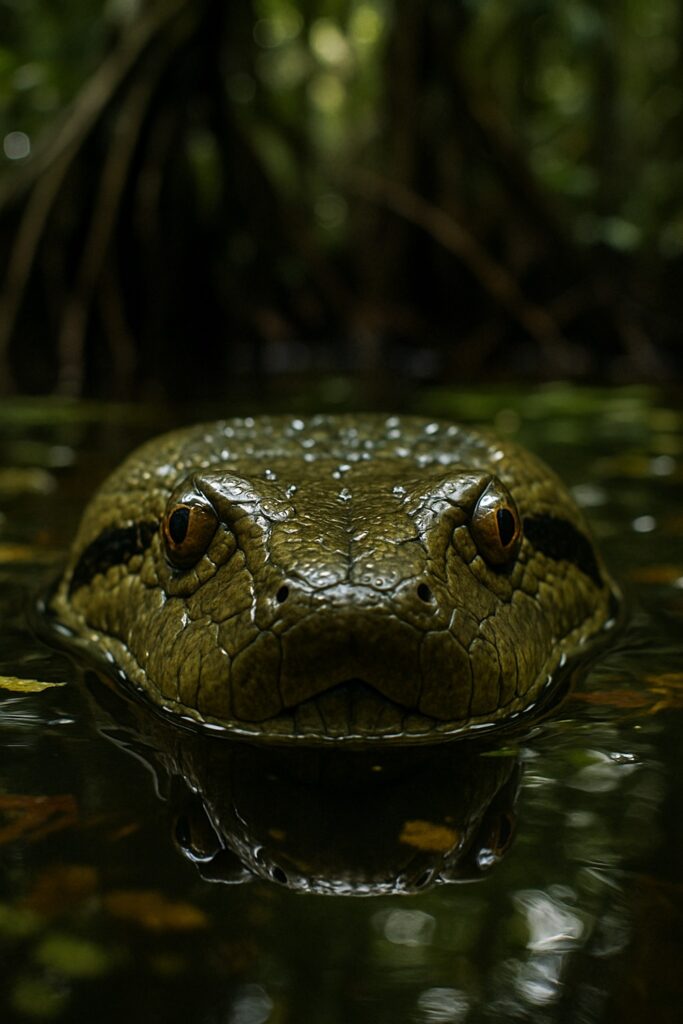
The green anaconda, Eunectes murinus, is supposedly one of the most dangerous animals in the Amazon — and yet the paradox that defines it is this: the more dangerous it actually is, the less you’re likely to see it coming. Not because it hides. Because the river *is* it. Amber eyes at the waterline, a body the color of cold tea and dead leaves, coiled somewhere between a submerged root and your next step — this is a reptile so fully integrated into its aquatic world that separating predator from habitat feels almost philosophical.

Built for the Depths
Females can stretch past eight metres and weigh more than two hundred kilograms — the heaviest snakes on Earth, by a wide margin. Their muscular, cylindrical bodies are wrapped in smooth olive-green scales broken by dark oval blotches, coloration that mimics the dappled light falling through dense riverbank canopy almost perfectly. Unlike land-adapted constrictors, an anaconda submerged moves with something close to frictionless elegance. A subtly flattened, paddle-like tail pushes them through still or slow-moving water with minimal effort, banking calories for the explosive, single-strike hunts that define how it feeds.
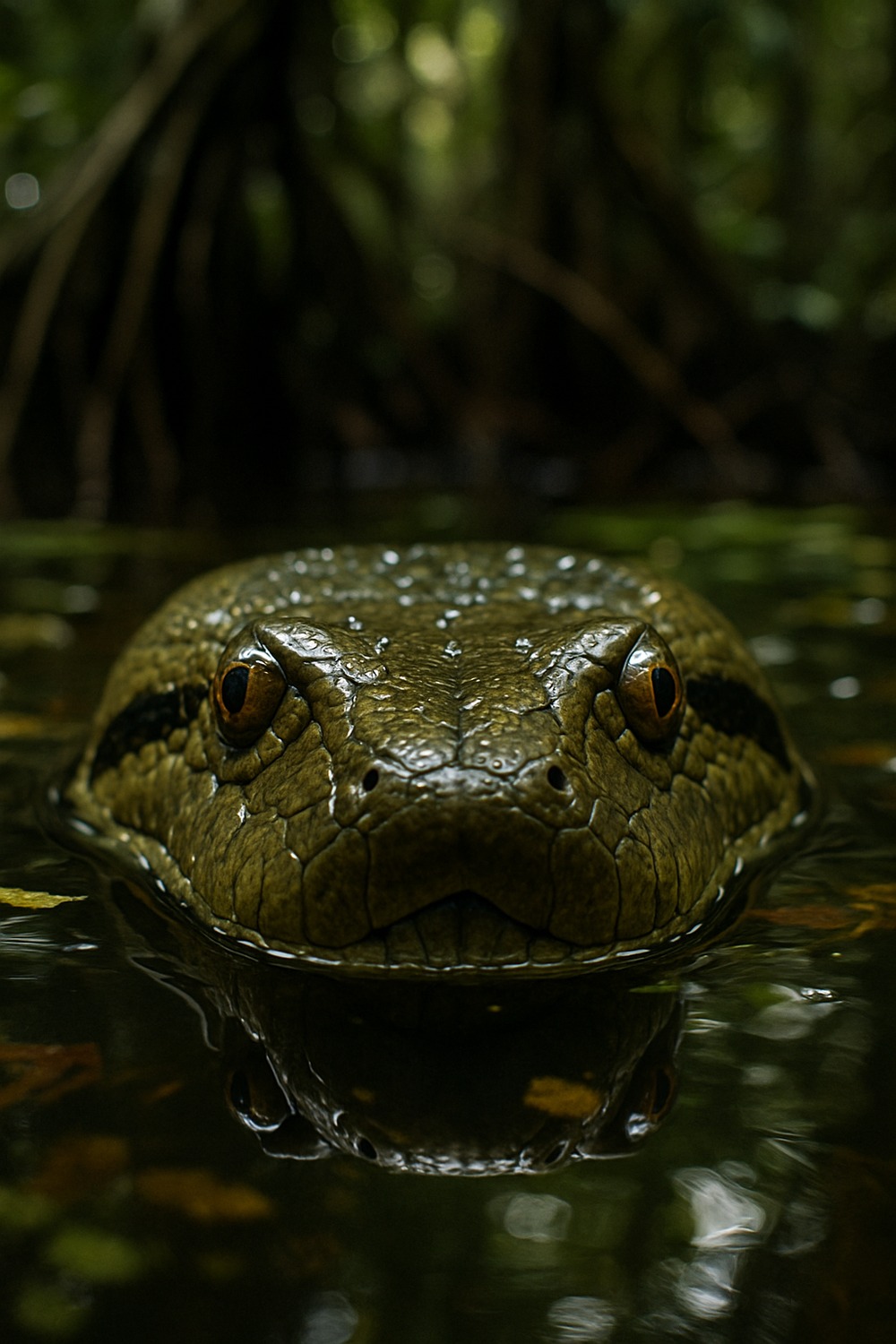
Every anatomical detail makes the same argument: this animal belongs in the river. Researchers studying anaconda morphology have noted that the nostrils and eyes sit remarkably high on the skull — what’s formally described as “periscopic positioning” (researchers actually call this one of the most efficient surveillance adaptations in any living reptile). The snake keeps virtually its entire body underwater while still breathing and scanning the riverbank above the waterline. Add to it the infrared-sensitive pit organs flanking the jaw, which register the heat signatures of warm-blooded prey even in near-zero visibility, and you’ve got a predator that perceives its environment across multiple sensory channels at once — watching, smelling, feeling for warmth — all while looking, to the casual observer, like a mossy log.
The Art of the Ambush
Why does this matter? Because every calorie an anaconda doesn’t spend chasing prey becomes mass, and mass is the whole game.
Green anacondas don’t chase. They wait at the water’s edge and exploit a simple fact of life in the tropics: everything eventually has to come down to the river to drink. When a suitable animal wanders into range — capybaras, caimans, deer, large birds, even jaguars, all documented as prey — the anaconda moves with a speed that observers consistently describe as shocking for something that size. It seizes the prey in recurved teeth before throwing loops of its body around the struggling animal. Death follows through constriction — not by crushing bones, as Hollywood prefers, but by preventing the cardiovascular system from circulating blood.
Prey loses consciousness in seconds.
Field biologists working in the Venezuelan llanos and Brazil’s Pantanal have recorded anacondas holding the same hunting position for days without moving, occasionally submerging fully and resurfacing to breathe without ever abandoning the spot. This metabolic efficiency runs deep: a large anaconda that’s secured a substantial meal may not hunt again for weeks — sometimes months — redirecting caloric resources toward growth and reproduction rather than constant foraging. It’s a patience most humans couldn’t manage for twenty minutes, and it explains a lot about the telephone-pole body.
Myths, Misunderstandings, and Ecological Reality
Few animals have been done dirtier by cinema than the anaconda. Films have cast them as man-hunting monsters of implausible size — a reputation that has fed fear and persecution across their entire South American range. The scientific reality is less dramatic and considerably more interesting. Documented, verified attacks on adult humans are vanishingly rare, and herpetologists are consistent on this point: anacondas generally treat people as disturbances to avoid, not opportunities to exploit.
Here’s the thing — the cultures that have lived with these snakes longest understood this long before the data did. Indigenous communities across the Orinoco and Amazon basins have coexisted with anacondas for thousands of years, many regarding them with something close to reverence. What those communities recognized instinctively, ecologists now confirm in hard numbers: anacondas function as keystone regulators of freshwater ecosystems, keeping populations of large herbivores and mid-level predators in check and maintaining the ecological balance of floodplain environments that entire food webs depend on.
Treating a keystone species as a movie villain is exactly the kind of mistake that costs an ecosystem its structure before anyone notices it’s gone.

A Species Under Pressure
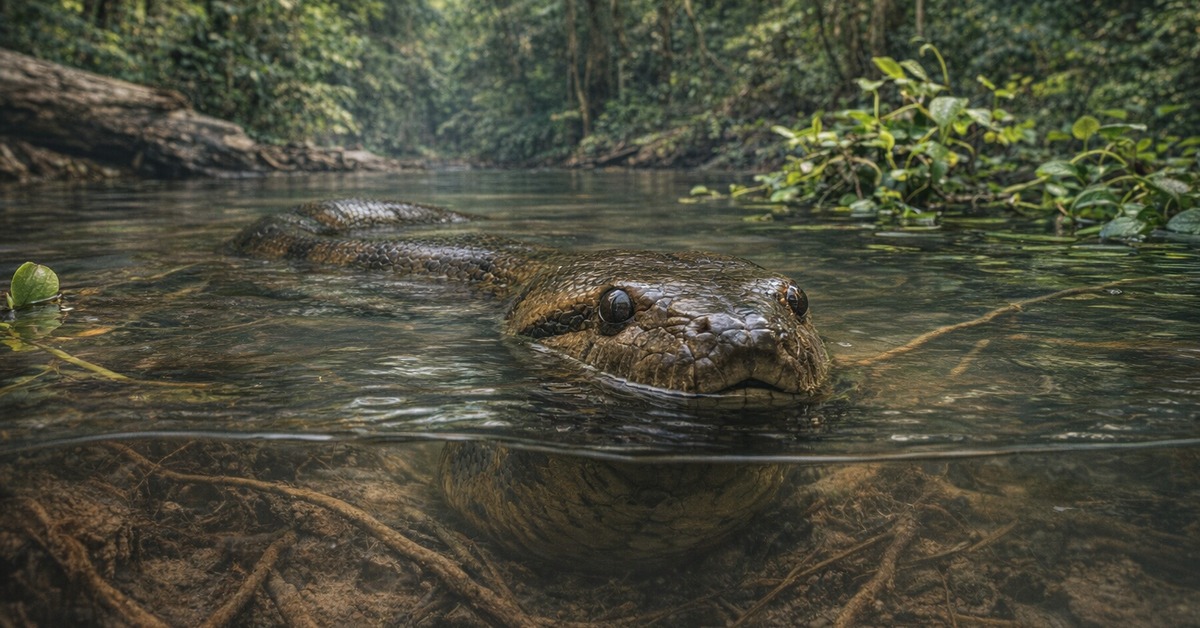
And yet, formidable as they are, green anacondas are running into problems. Agricultural expansion, dam construction, and urban encroachment fragment the wetland corridors these snakes need for movement, foraging, and reproduction. Road mortality takes a steady toll on individuals crossing between water bodies. Hunting persists in certain regions, driven by the skin trade and by fear in roughly equal measure.
Accurate population data remains elusive — anacondas are notoriously difficult to census in dense vegetation and turbid water, and scientists can’t say with confidence whether overall numbers are stable, declining, or locally wiped out. That data gap is itself a conservation crisis. Without baseline figures, detecting a population collapse before it’s already happened becomes nearly impossible.
How It Unfolded
- 1990s — Systematic field studies in the Venezuelan llanos begin producing the first reliable behavioral data on wild anaconda hunting and thermoregulation patterns.
- 2002 — Researchers formally document “periscopic positioning” as a defined morphological adaptation, linking skull architecture to ambush efficiency in aquatic environments.
- 2013 — Large-scale satellite telemetry studies in Brazil’s Pantanal reveal multi-month fasting cycles and seasonal movement corridors, reshaping conservation planning.
- 2024 — Growing recognition of anacondas as keystone regulators prompts calls for hydrological monitoring programs tied directly to anaconda habitat health across the Amazon and Orinoco basins.
By the Numbers
- 8+ metres — maximum confirmed length for large females
- 200+ kg — maximum recorded weight, making Eunectes murinus the heaviest snake species on Earth
- Weeks to months — fasting duration after a substantial kill
- Near-zero visibility — conditions in which pit organs can still detect warm-blooded prey
- Days — duration field-recorded anacondas have held a single ambush position without moving
Field Notes
- Constriction kills not by breaking bones but by arresting blood circulation — cardiovascular shutdown, not skeletal trauma
- Eyes and nostrils positioned on the top of the skull allow the snake to breathe and scan while almost fully submerged
- Olive-green coloration with dark oval blotches provides near-perfect camouflage against dappled riparian light
- Males are significantly smaller than females — one of the most pronounced sexual size dimorphisms among large constrictors
- Seasonal flood pulses in the Amazon and Orinoco systems are critical for access to hunting grounds, thermal refugia, and nest sites
FAQ
Are green anacondas actually dangerous to humans?
Verified attacks on adult humans are extremely rare. Herpetologists consistently note that anacondas tend to avoid people rather than target them. The fearsome reputation owes far more to cinema than to documented behavior.
How do anacondas kill their prey?
Through constriction — specifically by preventing blood from circulating through the cardiovascular system. The prey loses consciousness rapidly. Bones are rarely broken in the process, despite what films suggest.
What do green anacondas eat?
Capybaras are a primary prey species, but documented meals include caimans, deer, large birds, and in rare cases jaguars. Prey size is broadly limited by what the snake can physically subdue and swallow.
Where do green anacondas live?
Across the Amazon and Orinoco river basins — Venezuela, Brazil, Colombia, Peru, Bolivia, and surrounding lowland regions. They strongly prefer slow-moving or still water: swamps, marshes, and flooded forest edges.
Are green anacondas endangered?
Not currently listed as endangered, but population data is unreliable, habitat loss is accelerating, and scientists lack the baseline numbers needed to detect decline early. Conservation concern is growing.
How do anacondas locate prey in murky water?
Through multiple overlapping sensory systems: vision (eyes positioned high on the skull), chemoreception (the forked tongue sampling airborne particles), and heat-sensing pit organs along the jaw that detect infrared signatures from warm-blooded animals even in near-total darkness.
Editor’s Take — Alex Morgan
What strikes me most about the anaconda isn’t the size — it’s the stillness. I’ve stood in Pantanal shallows and watched a guide point to what I’d been staring at for two full minutes without seeing. The river had been the snake the whole time. That’s not metaphor; that’s the actual management challenge. You can’t protect something that’s invisible in the data the same way it’s invisible in the water. The absence of baseline population counts isn’t a gap waiting to be filled — it’s a clock, already running.
Climate change layers on additional uncertainty. Shifting rainfall patterns across the Amazon and Orinoco basins could disrupt the seasonal flood pulses that anacondas depend on to reach hunting grounds, nest sites, and thermal refugia. Prolonged droughts may pack predators and prey together around shrinking water bodies in ways that stress both. Extreme flooding could scatter animals across terrain they’re poorly equipped to navigate. Researchers are calling for long-term monitoring programs that track not just anaconda numbers but the broader hydrological health of the systems they inhabit. Because the green anaconda isn’t just a record-breaking reptile — it’s a barometer, a living measure of whether one of Earth’s most irreplaceable ecosystems is holding together or quietly coming apart. To protect the Amazon’s water, we’d do well to start by respecting what already rules it.


