


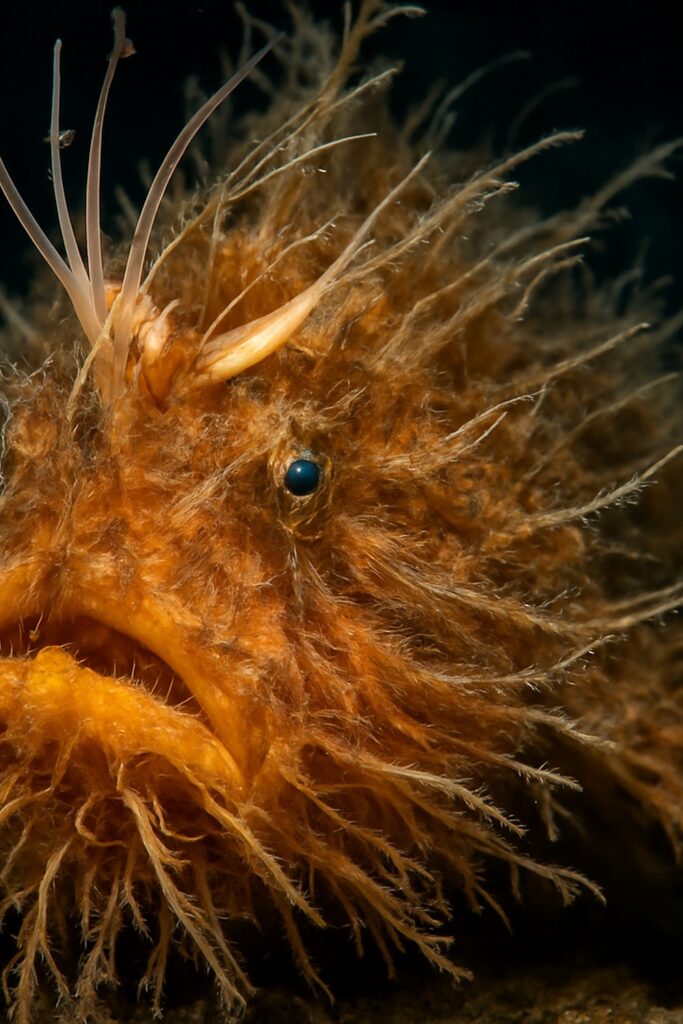
Nobody’s looking at it. That’s the whole point. Somewhere on a reef off Mozambique or along Australia’s northern coast, something is sitting in plain sight, being completely, deliberately invisible — and it’s been doing it for hours.
It’s not sleeping. It’s not hiding exactly, either. It’s waiting. And it’s better at waiting than almost anything else alive in the ocean. The hairy frogfish predator doesn’t chase its food. It becomes part of the furniture until dinner walks close enough to inhale.
What Makes the Hairy Frogfish Predator Unstoppable
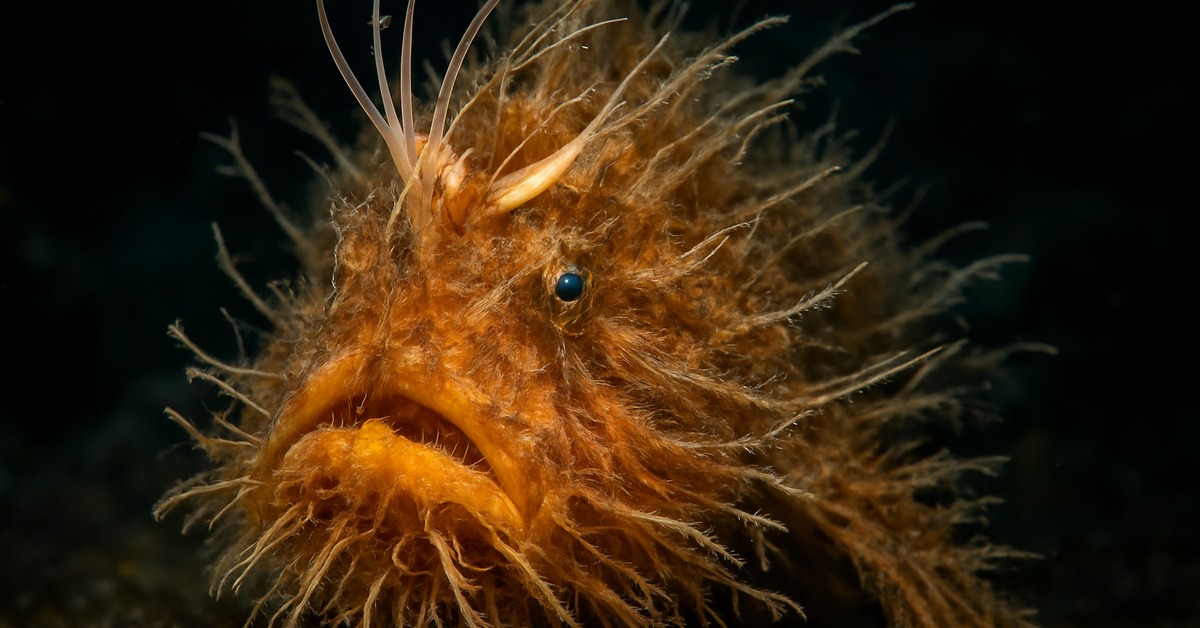
The Antennarius striatus — striated frogfish, hairy frogfish, take your pick — tops out around 7.9 inches. Barely the length of a smartphone. Marine biologist Rachel Arnold, who’s spent years documenting anglerfish behavior across the Indo-Pacific, describes it as “deceptively architectural.” Not just hidden. Structurally convincing. The fish doesn’t merely hold still next to a sponge; it becomes the sponge, down to texture and color and the way it sways in a slow current. Divers have reportedly hovered inches away — actual inches — without registering that anything alive was there.
Those “hairs” covering its body aren’t hairs. They’re dermal spinules, tiny skin filaments that shatter the fish’s outline into something that reads to the brain as algae, or encrusted rock, or just visual noise. Evolution spent a long time on this particular trick.
It shows.
The Lure That Tricks an Entire Ocean
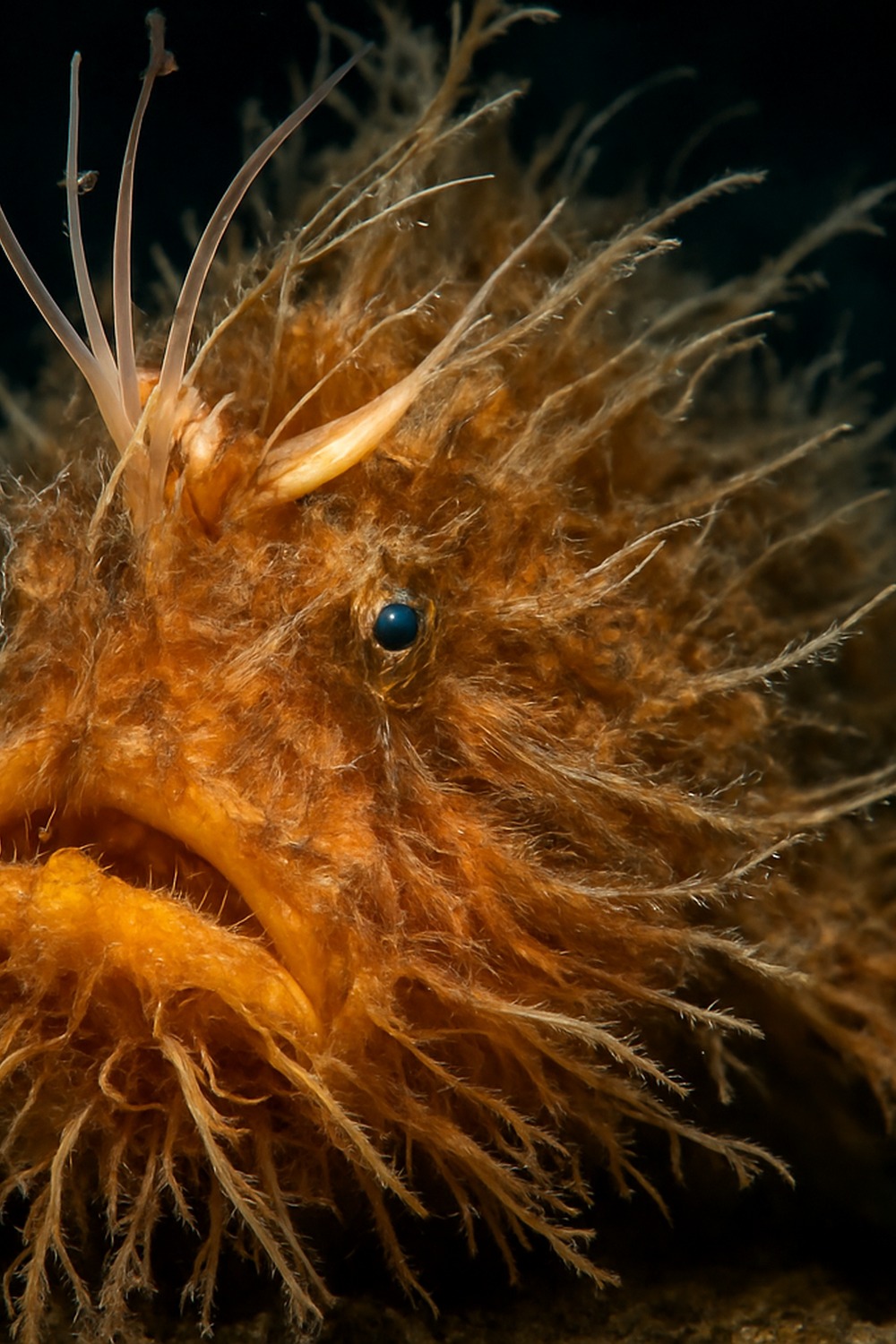
Perched above that cavernous mouth is a modified dorsal spine called an illicium — a built-in fishing rod, essentially. At its tip is the esca, a fleshy lure the frogfish wiggles like a worm or a small crustacean, depending on what’s around and what it’s hungry for. The esca’s shape varies dramatically between individual fish. Some mimic shrimp with enough precision that prey fish approach with zero visible hesitation. You have to respect the commitment to the bit.
What makes the actual strike strange — and that last fact kept me reading for another hour — is that the frogfish doesn’t use teeth to catch prey. It uses pressure. The mouth expands so fast it creates a violent inward rush of water, and the prey gets vacuumed in before its nervous system can even register that anything happened.
Six milliseconds. Faster than a camera flash.
How It Changes Color Without Even Trying
The hairy frogfish predator isn’t locked into one look. Over days or weeks it can cycle through pale cream, rusty orange, deep yellow, near-black — whatever the surrounding sponges and corals are doing. This isn’t fast like a cuttlefish doing its strobing light show. It’s slower. More like a long, deliberate makeover than a reflex. Marine biologists think environmental cues trigger the shift, though the exact mechanism is still being worked out.
Which raises an obvious question: if it’s already functionally invisible, why keep getting better at it?
Because “almost invisible” gets you killed. On a reef, there’s no such thing as close enough. Every flaw in the disguise is an opening for something larger to notice you first, and on a coral reef, something larger is always around.
The Walk That Shouldn’t Work But Does
The frogfish doesn’t swim the way fish are supposed to swim. It walks — using its pectoral and pelvic fins like stubby, slightly ridiculous limbs to haul itself across the seafloor. It looks like a fish doing an impression of something that’s never watched another fish move. Slow, lumbering, deeply undignified. But it gets the hairy frogfish predator to new hunting ground when the old spot stops producing, and dignity was never really part of the strategy.
When walking isn’t fast enough, it jet-propels itself, forcing water out through small gill openings near its pectoral fins. So: master of disguise, vacuum-mouthed ambush predator, occasional rocket. Not bad for something the size of a bar of soap.
And the jaw. A frogfish’s mouth can expand to twelve times its resting volume. Twelve times. That’s how it swallows a cardinalfish that technically shouldn’t fit — because the rules of “should” stop applying pretty quickly down here.

The Disguise Goes Deeper Than You Think
Here’s the thing: it’s not just visual. The frogfish’s skin texture, its posture, the almost imperceptible way it sways with the current — all of it is calibrated to match whatever surface it’s chosen as its backdrop. Turns out it can also match the chemical scent profile of certain sponges, which means chemically-sensitive prey species get no warning signal either. Nothing smells wrong. Nothing looks wrong.
Smell-based camouflage. That’s a sentence that didn’t need to exist until this fish came along.
What it means practically is that prey fish aren’t just visually fooled. They’re fooled by every sense available to them. Every input says: nothing there. And then there isn’t, because it’s already inside the frogfish’s stomach before the message finishes arriving.
By the Numbers
- Six milliseconds — total time for a completed strike, making it one of the fastest predatory movements recorded in any vertebrate, per research published in Copeia (2005).
- Mouth expansion reaches roughly 12x resting volume, which is what allows it to take prey up to twice its own body length.
- Antennarius striatus has been documented anywhere from shallow tide pools down to 210 meters depth — one of the widest vertical ranges of any frogfish species.
- Can hold position in a single spot for up to 30 days, moving only when prey stops showing up. One of the most sedentary active predators in the marine world — which is a genuinely strange combination of words.

Field Notes
- No swim bladder — frogfish are slightly negatively buoyant, meaning they naturally drift toward the seafloor. Accidentally perfect for an ambush predator whose entire strategy requires staying exactly where it is.
- If an aggressive prey animal bites the esca off, it grows back. The frogfish literally regrows its bait. Takes a few weeks, but still.
- Female frogfish produce something called an egg raft — a buoyant mass that can hold up to 180,000 eggs, which floats near the surface until the larvae hatch. The contrast between that and the adults’ near-total sedentary existence on the seafloor is a little hard to picture.
Why the Frogfish Changes How We See Predators
We think of predators as things that move. Lions that sprint. Sharks that circle. Eagles folding into a dive. The hairy frogfish predator dismantles that template entirely. It succeeds through radical stillness — patience so absolute it starts to look less like a behavior and more like a superpower. And it’s not alone in this; the ocean is full of creatures that have landed on the same counterintuitive solution: don’t chase, don’t burn energy, let food come to you. But the frogfish executes that strategy better than almost anything else alive.
In a world that rewards speed and aggression, a lumpy seven-inch fish figured out that the smartest move is often no move at all.
That’s not laziness. That’s millions of years of optimization arriving at an answer most predators never find.
Right now, somewhere on a warm reef, a hairy frogfish is parked on a sponge, wearing the sponge’s colors, swaying its little lure in the current, not moving, not rushing, not needing to. It’s been doing this for millions of years and it’s very, very good at it. Nature’s best tricks tend to be the quiet ones. If this kind of thing keeps you up at night, there’s more waiting at this-amazing-world.com — and the next one is stranger.


