


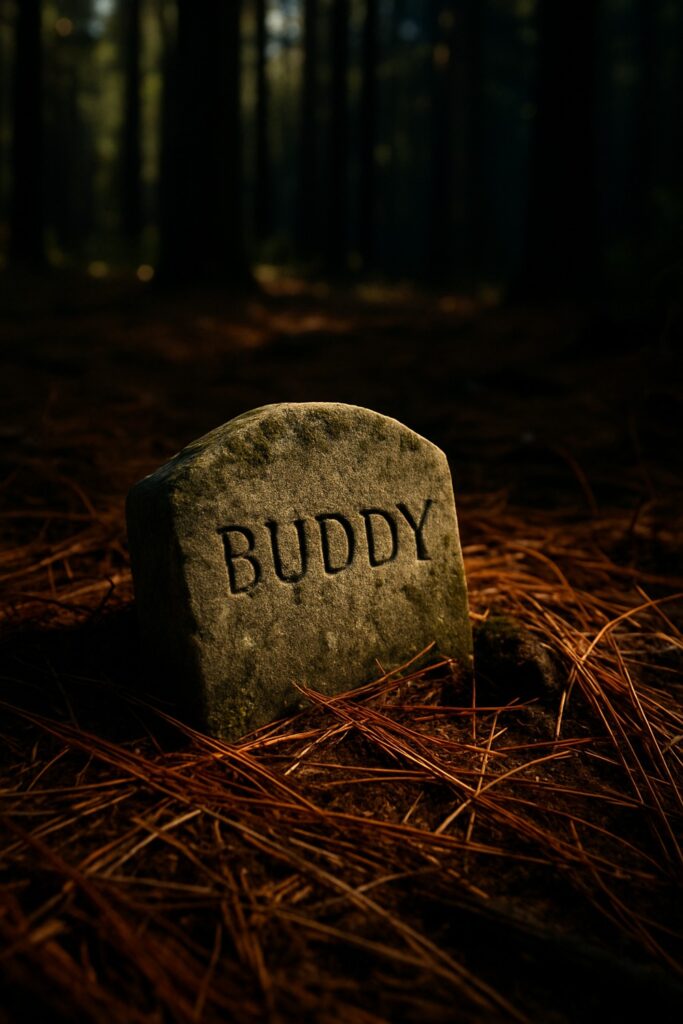
Somewhere in Kiroli Park, a dog named Buddie has been waiting eighty winters to be found. That’s the paradox at the center of the pet grave found in Louisiana park land outside West Monroe — a deliberate act of commemoration, stone-cut and intentional, that then disappeared completely into the forest floor. It took another dog to find it.
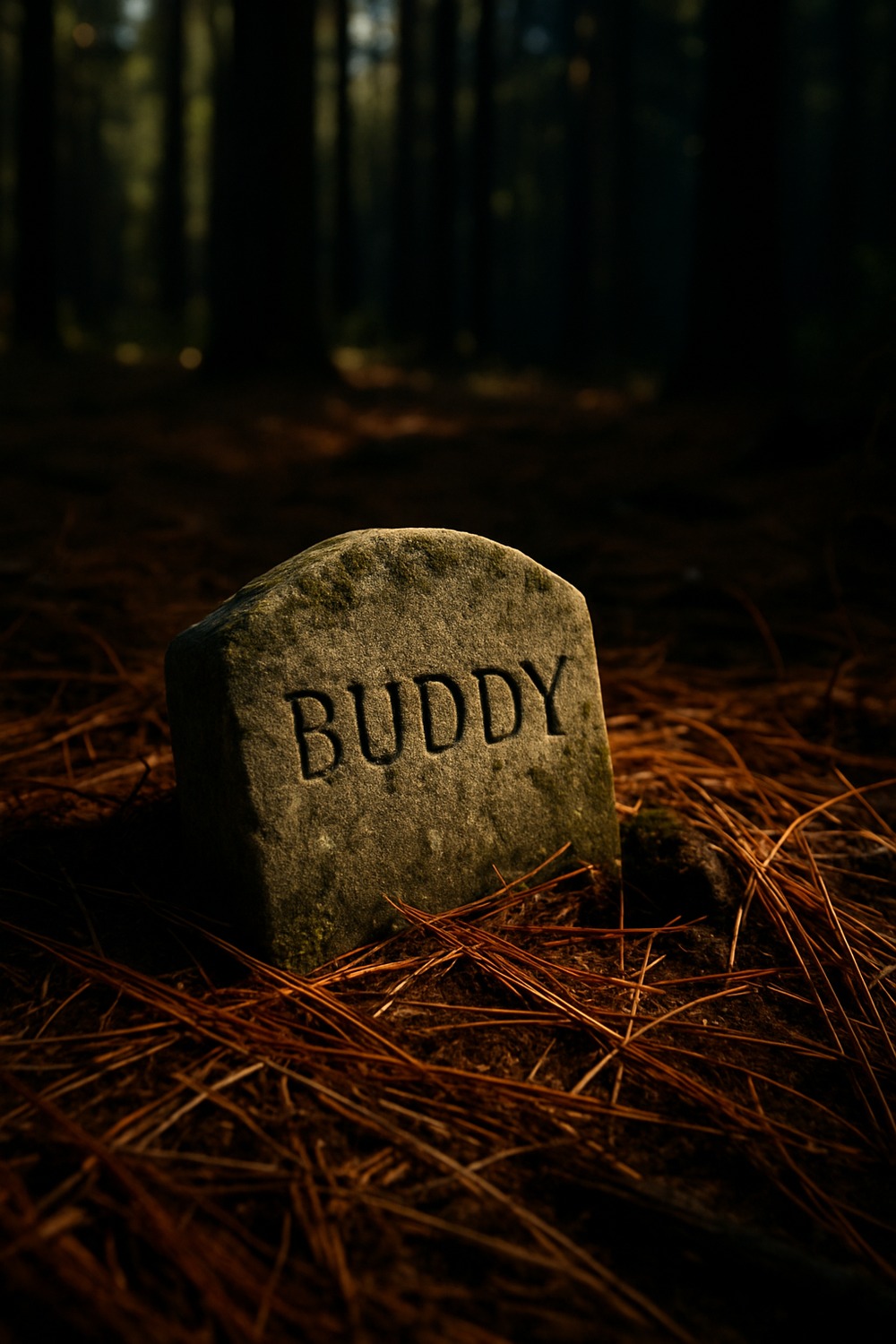
Zach Medlin was walking his dog through Kiroli Park when the animal stopped, nose low, and tugged sideways off the path. A pale tip of stone caught Zach’s eye. He knelt, swept pine needles aside with both hands, and uncovered an engraved marker — small, worn smooth at the edges, but still legible. A pet’s name. A date. An inscription soft with grief. The park had kept this story for decades without anyone asking it to speak.

The Pet Grave Found in Louisiana Park Land
Kiroli Park covers roughly 120 acres of rolling piney woods and hardwood bottomland on the eastern edge of West Monroe, Louisiana. Locals jog through it on Tuesday mornings without looking down. Developed in the mid-twentieth century, its oldest corners carry the layered quiet of land that’s been lived beside for a very long time. When Zach Medlin swept that marker clean in 2023, what emerged was a name — Buddie — and an inscription worn to near-softness by Louisiana’s cycling heat and rain. The stone wasn’t large. It wasn’t elaborate. But someone had it made, carried it into the woods, and placed it with intention.
Pet burial practices in the early-to-mid twentieth century were almost entirely informal in the American South. Pet cemeteries as formal institutions didn’t gain any real cultural traction in the U.S. until Hartsdale Pet Cemetery in New York — founded in 1896 — began to normalize the idea of a marked grave for a companion animal. Outside those rare formal spaces, most pets were buried quietly at the back of a yard, and the stones, when they existed at all, were usually fieldstones with nothing written on them.
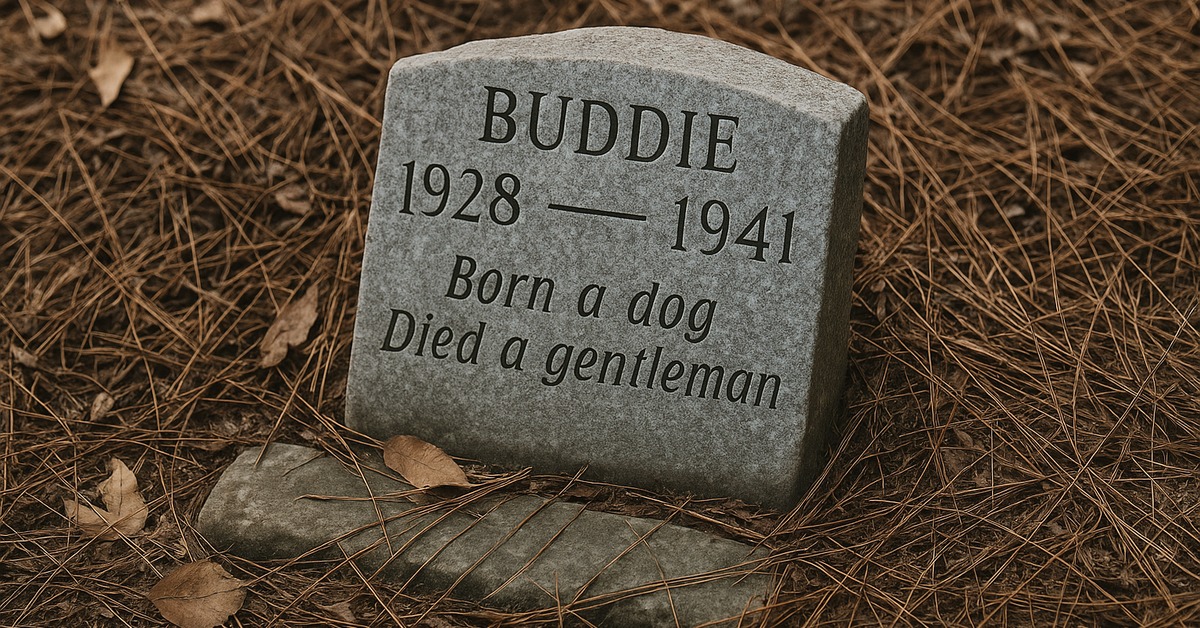
What makes Buddie’s grave different is the engraving. Someone paid for lettering. That costs money, requires planning, demands a trip to a stonecutter or monument shop. It’s not a grief performed in an hour and forgotten — it’s a grief that sat with itself long enough to become deliberate. The inscription’s exact wording has softened too far for a full transcription, but the phrase that survives speaks plainly of love. Short sentences say the most when there’s real feeling behind them.
Loblolly pine litter is extraordinarily good at concealment. The needles mat and compress into a dense, acidic layer that can swallow low objects within a few years. That the stone’s tip remained visible at all is something close to luck — or, if you’re inclined that way, something close to refusal.
What Dogs Meant to Families in the 1940s
Why does this matter? Because the grief visible in Buddie’s stone only makes sense when you understand what dog ownership looked like in mid-century Louisiana. Dogs in the 1940s were working animals first for most American households — hunting companions, farm dogs, yard dogs — but the attachment was no lesser for it. It often ran deeper, in fact, because the relationship was daily and physical and unmediated by the kind of consumer pet industry that now exists to absorb and redirect that bond. There were no grief counselors for pet loss, no Instagram memorials, no cremation urns. If you felt the loss of a dog in 1943, you felt it privately, and if you marked it, you marked it in stone or not at all. The emotional architecture of that relationship deserves more credit than history has given it — not unlike what we now understand about how humans form profound attachments to non-human companions, something explored in unexpected places like the research into why baby monkeys cling to surrogate objects for years, which speaks to how deep the wiring for attachment actually runs across species lines.
According to the American Veterinary Medical Association, dog ownership in the United States hovered around 32 million households in the 1950s — a figure that sounds large until you realize the country’s population at the time was roughly 150 million people. Dogs were common, but the culture around pet loss had almost no public infrastructure. The AVMA’s 2022 survey placed dog-owning U.S. households at approximately 48.3 million. The emotional vocabulary around pet grief has expanded enormously in that same period — grief support groups, veterinary hospice care, memorial jewelry. Buddie’s stone predates all of that by decades. Turns out the people who felt this grief most acutely were also the ones with the fewest sanctioned ways to express it.
Buddie’s owner didn’t have the language we have now. They had a stonecutter’s chisel and a piece of ground under pine shade. That was enough to say what needed saying.
Forests as Keepers of Human Stories
Parks like Kiroli hold an underappreciated function: they archive. Root systems and acidic soils that seem to consume history actually slow decomposition for certain materials — stone, fired clay, dense hardwood. Forest floors in the American South are layered with objects from earlier centuries that surface only when roots shift, erosion opens a seam, or a curious dog pulls left instead of right. The Smithsonian’s National Museum of Natural History has documented dozens of cases where routine forest clearing or park maintenance in the southeastern United States has uncovered markers, foundations, and personal objects that weren’t part of any formal historical record (researchers actually call this landscape archaeology, and it’s increasingly treated as an urgent discipline). These aren’t dramatic excavations. They’re quiet recoveries, usually made by someone who wasn’t looking.
No plaque marks Buddie’s location. No historical society has formally catalogued the stone. Its preservation was accidental — a function of a marker being harder than pine litter and a dog being curious about something its owner had no reason to investigate. The pet grave found in Louisiana park land at Kiroli fits exactly into this pattern of intimate history surviving not through institutional effort, but through the sheer stubbornness of physical objects and the randomness of who walks where on a given afternoon.
And what this implies is uncomfortable if you think about it too long. For every Buddie whose stone broke the surface, how many didn’t? How many markers slipped two inches deeper into the duff and passed the point of visibility? The forest keeps its own records. We only see the ones it chooses to show us.
Why Small Monuments Carry Enormous Weight
Archaeologists at the University of Tennessee’s Department of Anthropology have spent years studying what they term “vernacular memorialization” — the informal, non-institutional ways that ordinary people mark death and loss across cultures and time periods. Their research, much of it published between 2015 and 2022 in the journal Historical Archaeology, consistently finds that small, personal grave markers carry a disproportionate informational load compared to formal cemetery monuments. A formal headstone tells you a name, dates, perhaps a religious affiliation. A vernacular marker — a carved stone left under a pine tree — tells you what the person valued, how they processed grief privately, and what relationships they considered worth the effort of commemoration.
Buddie’s marker falls squarely in this category. It wasn’t placed for an audience. It wasn’t placed to impress. Someone needed the loss to exist somewhere physical, somewhere they could return to. The weight of that act is inseparable from its era — Americans in the 1940s were living through extraordinary public grief, with World War II alone claiming over 400,000 American lives between 1941 and 1945. Private grief, domestic grief, the grief of losing a dog, had almost no sanctioned space in that emotional landscape. Here is where the evidence stops being neutral: a person who carves an animal’s name into stone during a world war isn’t being sentimental — they’re insisting on the full breadth of what it means to be human. That insistence, quiet and expensive and entirely private, is worth more than most public monuments.
Zach Medlin didn’t know any of that when he knelt in the dirt. He just saw a stone and swept it clean.
Sometimes the most significant act is simply the decision to look.

How It Unfolded
- 1896 — Hartsdale Pet Cemetery in New York became the first formal pet burial ground in the United States, establishing that a companion animal’s death could be publicly and permanently marked.
- 1940s — Buddie’s grave marker was placed in what is now Kiroli Park, West Monroe, Louisiana, during an era when informal pet burial was the norm and engraved stones for animals were extraordinarily rare.
- 1972 — Kiroli Park was formally developed and opened to the public by the City of West Monroe, incorporating the wooded acreage where the grave already lay undisturbed beneath decades of pine litter.
- 2023 — Zach Medlin’s dog led him off the path during a routine walk, and Medlin uncovered the stone by hand, bringing Buddie’s story into public view for the first time in living memory.
By the Numbers
- 90 million — approximate number of dogs owned in the United States as of 2023, according to the American Pet Products Association’s National Pet Owners Survey.
- 120 acres — the approximate size of Kiroli Park in West Monroe, Louisiana, large enough to contain decades of unmarked history within its tree cover.
- 80 — estimated winters the grave marker endured beneath the forest floor before Zach Medlin uncovered it in 2023.
- 48.3 million — U.S. households owning at least one dog in 2022, compared to roughly 32 million in the 1950s, a 51% increase (AVMA, 2022).
- 1 in 3 — proportion of pet owners in a 2021 Human-Animal Bond Research Institute survey who reported their grief over a pet’s death was comparable in intensity to losing a human family member.
Field Notes
- Loblolly pine needles decompose slowly due to their high resin content and acidic chemistry, creating a mat that can compress to several inches thick over decades — enough to fully conceal a low-profile stone marker within five to ten years of placement, depending on rainfall and foot traffic patterns.
- Engraved pet grave markers from the 1930s and 1940s are rare enough that when they surface, they’re often mistaken initially for child graves — the scale and emotional register of the inscriptions are frequently identical.
- Kiroli Park’s oldest oak trees predate the park’s 1972 formal opening by at least a century, meaning the forest floor beneath them has been accumulating and concealing objects since before Louisiana’s Civil War-era settlements in the region were dismantled.
- Researchers still can’t definitively determine what motivated individual families to commission engraved pet markers in the mid-twentieth century versus those who buried with no marking at all — the socioeconomic and emotional variables involved resist clean categorization, and no systematic study of vernacular pet memorialization in the American South before 1960 has yet been completed.
Frequently Asked Questions
Q: Is the pet grave found in Louisiana park at Kiroli officially protected or catalogued?
As of 2023, the marker uncovered by Zach Medlin had not been formally catalogued by any historical preservation body or municipal authority in West Monroe. Louisiana’s State Historic Preservation Office maintains records of formal cemeteries and registered historic sites, but vernacular markers on public park land occupy a legal gray area. The stone’s long-term protection depends largely on public awareness — and, for now, on nobody moving it.
Q: How common were engraved pet grave markers in the 1940s American South?
Engraved pet markers from that era are genuinely uncommon. Most mid-century pet burials in the American South involved unmarked graves or simple fieldstones with no lettering. Commissioned engraving required access to a monument shop and the willingness to spend money on an animal’s memorial — neither of which was culturally standard in the 1940s. When marked pet graves from this period are found, they’re typically associated with families of some financial means or with unusually strong human-animal bonds that broke from the social norm of the time.
Q: Why do people assume forests and parks don’t contain historical markers?
Many American parks were developed over land that had been farmed, lived on, or used for private burial for generations before any public designation — the assumption that parks are purely natural spaces is a modern projection. Kiroli Park’s acreage was private land before its development, and the grave’s placement there reflects a moment when this was simply someone’s chosen ground, not a public space at all. Forests absorb objects slowly, which creates the illusion of emptiness. It’s not emptiness. It’s concealment.
Editor’s Take — Sarah Blake
What stays with me isn’t the stone — it’s the decision to engrave it. In the 1940s, with the world in the middle of a catastrophic war and grief everywhere in the air, someone in West Monroe stopped and said: this dog deserves a marked place. That quiet defiance of scale — insisting that a small loss matters even when large losses surround you — is not a sentimental impulse. It’s a serious one. The pet grave found in Louisiana park land tells us more about how humans survive grief than most formal monuments ever will.
Parks don’t just hold picnic tables and walking trails. They hold the previous versions of the places they replaced — the private yards, the homesteads, the shaded corners where people buried the things they loved. Buddie’s stone survived 80 winters not because anyone protected it, but because it was made to last and placed where the forest would eventually close around it. Somewhere beneath the pine litter of parks across the American South, there are more stones like this one. More names. More inscriptions softened by rain but not yet gone. What would we understand about ordinary human grief if we found them all?


