


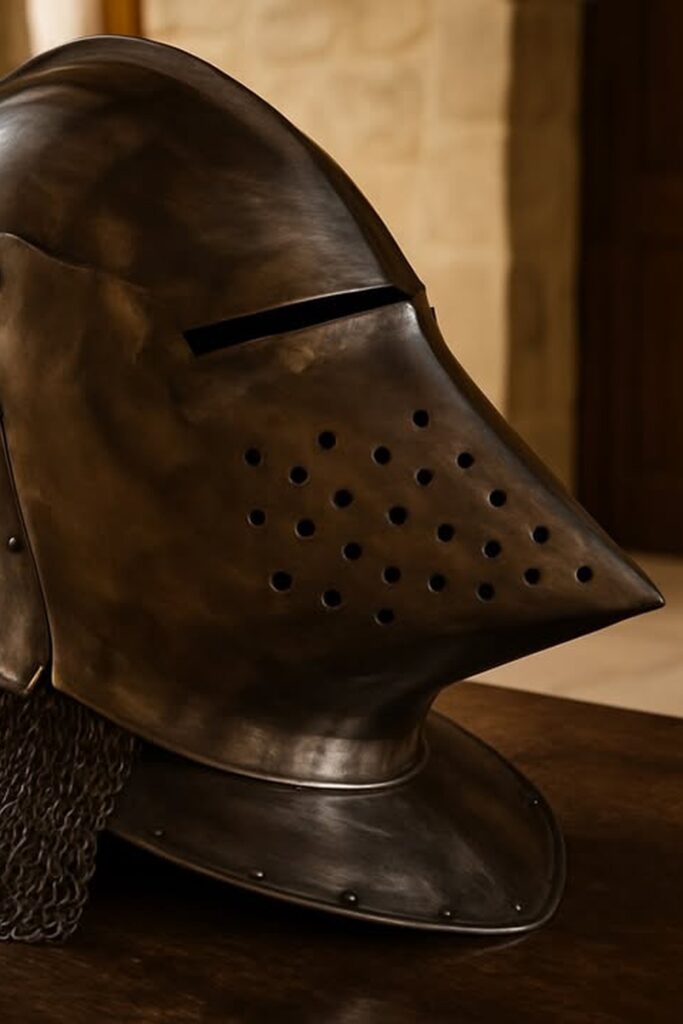
It is 1347. You are standing inside eleven months of siege, baking inside a steel shell, and you cannot see anything above eye level. The man next to you just passed out. You haven’t been struck once.
That’s the hounskull bascinet in a sentence. Not a weapon — a survival calculation made out of forged steel, worn on the skulls of 14th-century knights who needed to walk into some of history’s most concentrated violence and somehow walk back out. A replica sits at Tryon Palace in North Carolina today. People who’ve held one describe it as the moment medieval warfare stops being an abstraction.
The Hounskull Bascinet Helmet’s Strange Design Wasn’t an Accident
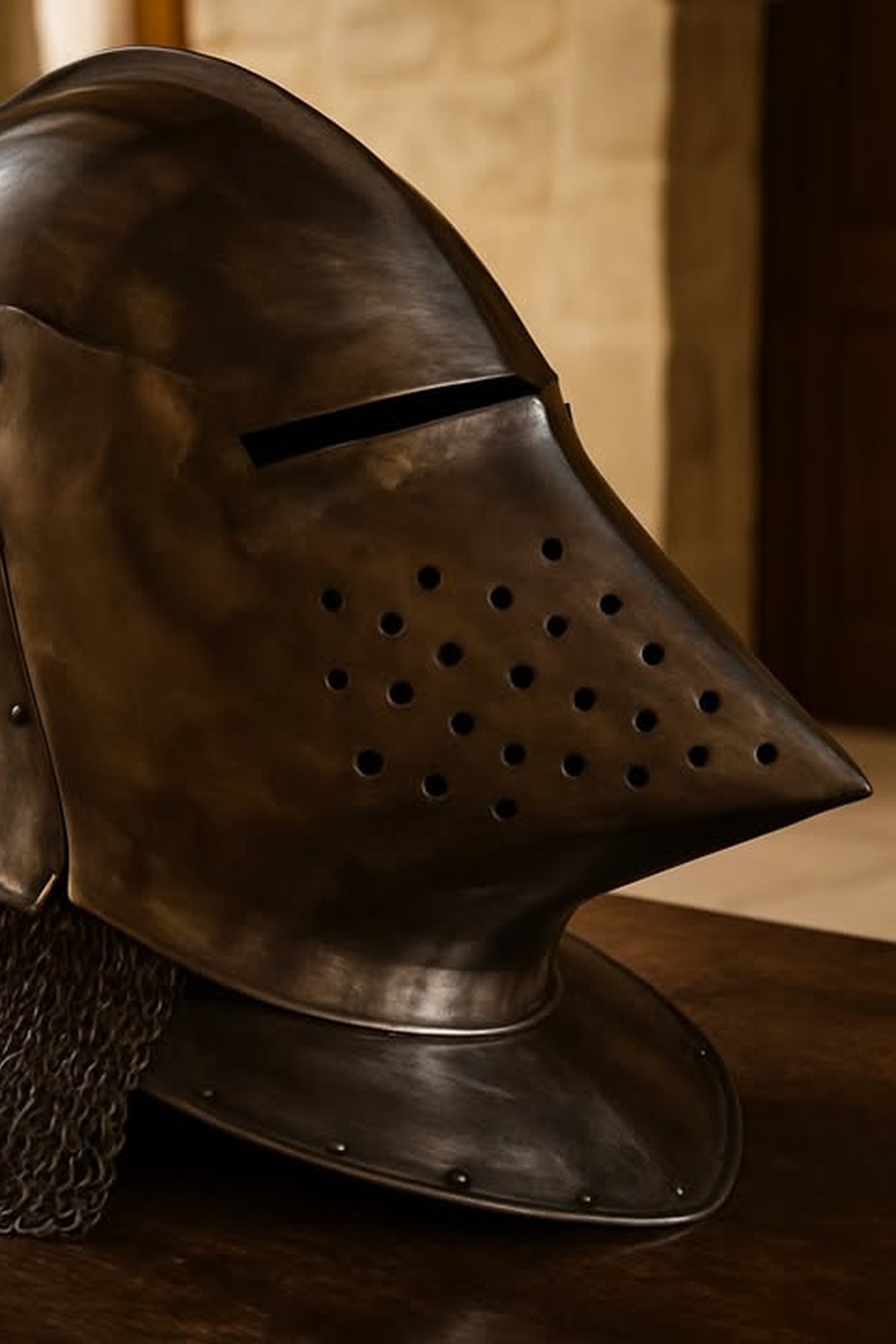
That long, pointed visor — the one that makes the whole thing look vaguely dog-like, which is exactly where the name “hounskull” comes from — wasn’t a stylistic quirk. It was a calculated geometric answer to a very specific question: how do you stop a lance tip from caving in a human face?
Alan Williams, a medieval arms historian who studied metallurgical samples from surviving helmets at the Wallace Collection in London, found that smiths were experimenting with angled surfaces as early as the 1360s to redirect force rather than simply absorb it. An angled surface turns a direct strike into a glancing one. The blade slides off the slope instead of punching straight through. Tilt your chin correctly and the geometry works in your favor. Don’t, and the force concentrates at a single point.
It’s the same principle used in modern ballistic helmets and armored vehicles. Just forged in a 14th-century smithy.
That last fact kept me reading for another hour.
Knights Engineered Survival Under Impossible Conditions
The hounskull bascinet didn’t arrive in isolation. It was one milestone in an ongoing arms race between offense and defense that churned across medieval Europe for centuries — as detailed in our deep dive on the history of human survival technology. Every weapon upgrade forced a counter-upgrade in armor. The hounskull was a peak moment in that cycle, effective enough that it spread rapidly across England, France, and the Holy Roman Empire within decades of its first appearance.
What’s strange about that spread is how it happened. No blueprints. No manufacturing standards. No central authority coordinating anything across an entire continent. Smiths saw it. They copied it. They improved it. Knowledge moved through journeymen craftsmen and captured battlefield equipment — and somehow a coherent design philosophy emerged anyway. Which raises the obvious question: why does that keep surprising us? People have always been good at copying things that keep them alive.
The Siege of Calais Revealed a Hidden Design Problem
It is August 1346. Edward III’s English forces have ringed the city of Calais. Nobody’s going anywhere for eleven months.
Inside those enclosed steel visors, men were suffocating. Summer heat, minimal airflow, metal conducting temperature directly to the skull. The solution was already built into many hounskull designs before the siege even began: rows of tiny perforations punched along the snout’s surface. Not decoration. Ventilation. Those small holes were the difference between a knight who could still fight and one who collapsed before the French arrived.
The same perforations appear on helmets recovered from German and Italian collections dated to the same period. But there’s a trade-off baked into every one of those holes — each perforation is a structural weakness, and each one is a potential entry point for a blade tip under pressure. The smiths knew this. They punched the holes anyway. A man who can breathe is more useful than a theoretically stronger helmet worn by an unconscious soldier. That’s not a small insight. That’s engineering ethics, worked out in iron.
What You Actually Experienced Inside That Helmet
Put the hounskull bascinet on — really imagine it — and the world immediately shrinks. The visor slit, typically around 3 to 5 centimeters in height, reduces your entire field of vision to a narrow horizontal strip. Left and right peripheral vision: gone. Anything above eye level: gone. Below your chin: gone. You’re looking at the world through a letterbox. Historians who’ve worn replica helmets describe the experience as genuinely disorienting, particularly when moving quickly or trying to track multiple opponents at once.
Sound gets muffled. Your own breathing fills your ears. Metal conducts summer heat and winter cold directly to your skull. And that 2.2 kilogram weight — distributed entirely across your head and neck — builds into real physical exhaustion across hours of movement. Knights didn’t just train to fight. They trained to fight while experiencing something close to sensory deprivation.
That single strip of visible chaos was everything. Your entire battlefield. Your entire life.

The Real Training Behind Wearing One of These
The helmet was only as good as the man wearing it. Medieval combat manuals — particularly the German Fechtbücher (fighting books) compiled by masters like Johannes Liechtenauer — include specific techniques for fighting inside enclosed helmets. Fighters were taught to move their entire torso to compensate for lost peripheral vision. To listen differently. To develop spatial awareness that didn’t rely on sight at all.
It was, in a very real sense, trained blindness.
Archaeological evidence from tournament grounds in England and France shows repeated impact patterns on surviving bascinet visors, concentrated precisely at the geometric angles designed to deflect them. The training worked. Knights were hitting the right spots, and the helmet was redirecting the force. The design and the discipline were reinforcing each other — in ways that kept men alive in conditions that should have killed them reliably.
By the Numbers
- 2.2 kilograms — total weight of a complete hounskull bascinet with aventail (chain mail neck guard), roughly equivalent to wearing a large bag of flour on your skull across an entire campaign day (Wallace Collection, London)
- Visor slit height on surviving examples: 3 to 5 centimeters, cutting vertical field of vision by roughly 85%
- The Siege of Calais ran 11 months, August 1346 to August 1347 — long enough that heat management inside enclosed helmets stopped being a discomfort and became a strategic variable
- Modern ballistic helmet designs still use the same core deflection principle as the hounskull’s angled visor. Six hundred years. Same geometry.

Field Notes
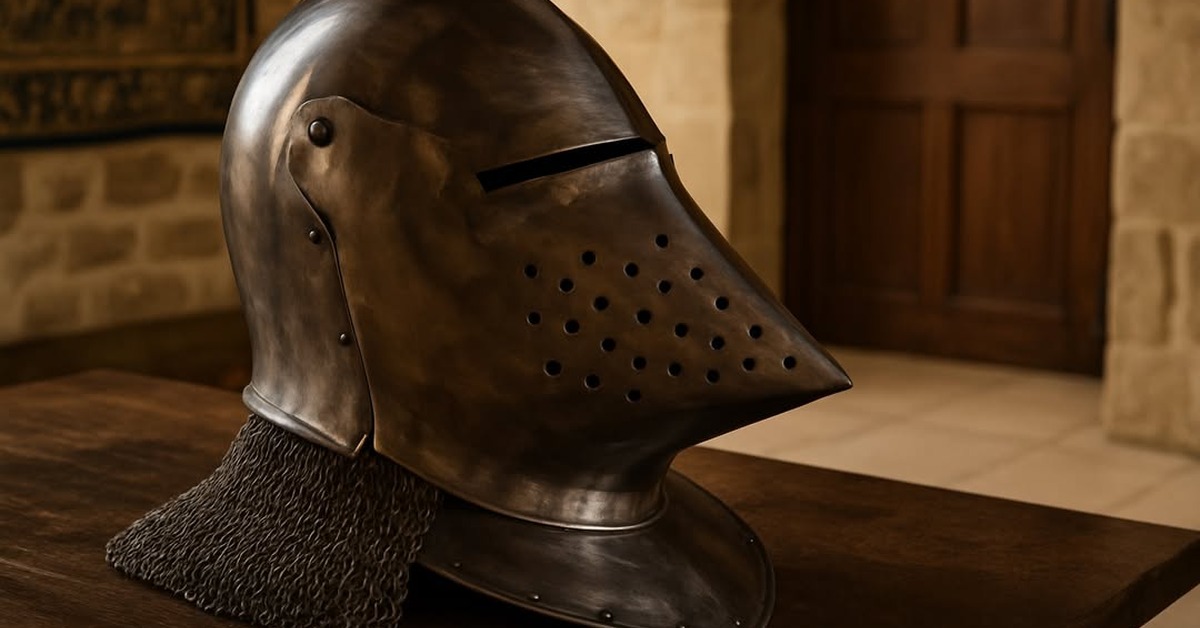
- “Hounskull” is the English name — in German, the same helmet was called “Hundsgugel,” meaning “dog’s throat.” Different language, same snout.
- Many surviving hounskull bascinets show evidence of multiple repairs: dents hammered back out, perforations reinforced, visors replaced entirely. These weren’t single-campaign equipment. They were maintained across years of use, patched back together after every engagement that didn’t kill the man wearing them.
- The aventail — the chain mail curtain attached around the helmet’s base to protect the neck and lower face — added significant extra weight and heat. Some knights removed them in non-combat situations, trading protection for the basic ability to cool down.
Why This Helmet Still Matters Centuries Later
The hounskull bascinet is a physical argument about human ingenuity under pressure. Every design choice — the deflecting angle, the ventilation holes, the narrow visor slit — represents someone solving a problem with the materials and knowledge available to them, in a world where getting it wrong meant death on a specific Tuesday afternoon in a French field. Medieval smiths didn’t have materials science or computational fluid dynamics. They had fire, iron, and generations of hard-won knowledge about what kept people alive long enough to fight again.
And they built something modern engineers still recognize as fundamentally sound.
What the hounskull really tells us is that survival has always been a design problem. Every era faces its version of a sword swinging toward its face. Every era finds people willing to sit down, work the problem, and engineer an answer — however imperfect, however costly, however uncomfortable to actually live inside.
Hold a replica hounskull bascinet and you’re holding a specific human moment: someone decided that half-blind, baking inside two kilograms of steel, was still better than the alternative. They weren’t wrong. The men who wore these helmets walked into some of history’s worst violence and walked out again. That’s the whole story. That’s always been the story. More strange survival engineering lives at this-amazing-world.com — and the next one is even stranger.


