


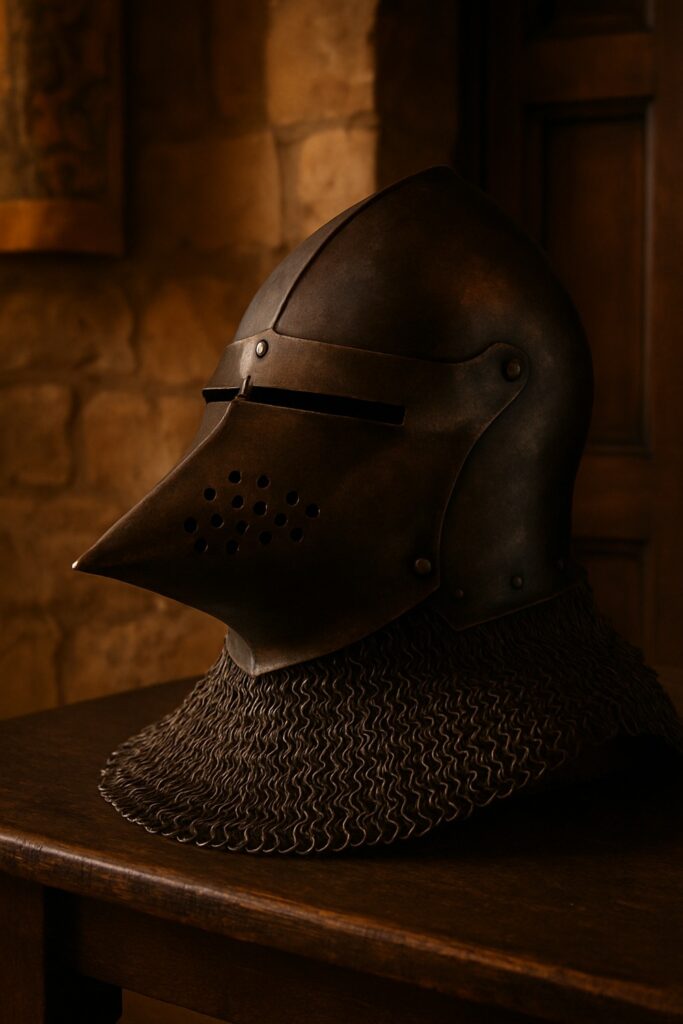
It is 1346, somewhere outside Calais, and the man trying to kill you has no face. Just a steel snout, a thin dark slit where eyes should be, and the sound of boots in mud getting closer.
That’s the hounskull bascinet — and once you understand what it actually was, the pig-face nickname stops being funny. This wasn’t a costume. It was a piece of engineering refined through decades of people dying when the previous version failed, and the story of how it worked is genuinely strange.
What Made the Hounskull Bascinet Helmet So Terrifying
The bascinet, according to medieval arms historian Claude Blair, evolved rapidly through the 14th century as warfare changed and archers became deadlier. The hounskull variant — named for its elongated visor — appeared around the 1340s and spread quickly across European battlefields. Its pointed snout wasn’t decorative. It was engineered to deflect lance tips and sword thrusts away from the face.
So how did knights even see through it?
A narrow horizontal slit. Sometimes just 10 to 15 millimeters tall — roughly the width of your thumb at the knuckle. Vision compressed into a thin strip of chaos: flashing blades, mud, horses, the blur of men trying to kill you. And knights trained to fight this way. They learned to read an entire battle through that sliver of steel-framed world, and they did it well enough to survive.
How the Snout Shape Actually Saved Lives
Here’s what most people don’t realize about medieval armor: the shape of the visor mattered as much as the thickness of the metal. The angled, forward-jutting profile of the hounskull bascinet meant that a lance or sword striking the face didn’t hit flat — it hit at an angle, glancing off rather than punching through. It’s the same principle modern bulletproof vests use. Deflection, not just absorption.
For more on how medieval warriors engineered survival, this-amazing-world.com has dug into some remarkable stories.
The weight was real, too. Tryon Palace in North Carolina houses a replica that comes in at nearly 2.2 kilograms — just for the helmet. Add a full suit of plate armor, a sword, and shield, and a knight was carrying somewhere between 15 and 25 kilograms of steel into battle.
Every degree the visor could deflect danger was worth its weight in survival.
The Breathing Problem Nobody Talks About
Imagine wearing a sealed steel box over your head in summer. Now imagine someone is actively trying to kill you. That’s the problem the hounskull bascinet had to solve — not just protection from blades, but keeping the man inside it conscious enough to use them.
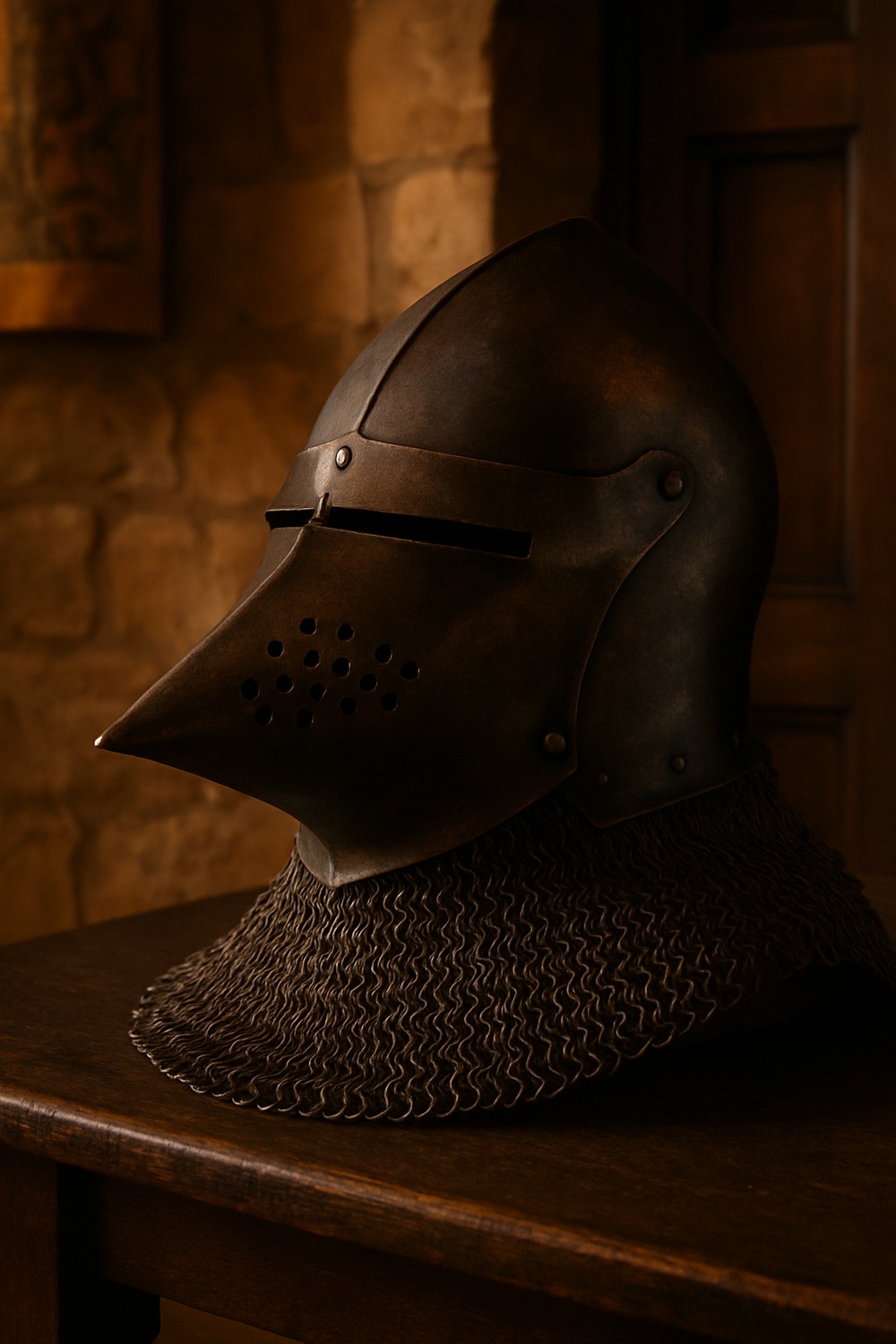
Rows of small perforations lined the snout, punched through steel in tight, deliberate patterns. Not decorative. They were the difference between a functioning fighter and a man about to black out in his own armor.
On France’s rain-soaked fields during the Hundred Years’ War, or under the punishing sun of the Siege of Calais in 1346, knights were sweating through linen padding, chainmail, and plate. The perforations channeled air toward the nose and mouth. Poorly placed, they could also channel a crossbow bolt.
Every design decision was a negotiation between breathing and dying.
The Psychological Weight of the Pig Face
There’s something deliberately unsettling about the hounskull bascinet that historians don’t always sit with long enough. When you faced one in battle, you weren’t looking at a human face. You were looking at a steel animal — blank, expressionless, inhuman. No eyes visible. No mouth. Just a cold metal snout and a thin dark slit where a person used to be.
It turned men into something else. Something harder to sympathize with. Something harder to look in the eye and hesitate.
Medieval armies were practicing psychological warfare long before the term existed, and the hounskull bascinet was part of it — probably not by design, but it didn’t need to be intentional to work.

What It Actually Felt Like Inside the Helmet
We don’t have to entirely guess. Living history groups and museum conservators have spent time wearing replica hounskull bascinets, and their accounts are consistent enough to be striking. Sound arrives muffled and distorted — voices become indistinct at ten feet. The world smells like hot metal and damp linen. Peripheral vision drops to almost nothing.
That last detail kept me reading for another hour.
Because it means every knight who fought in one of these helmets had essentially trained themselves to operate with a perceptual handicap that would disorient most people within minutes. The experience isn’t like wearing protective gear. It’s closer to being trapped in a very small, very loud room that someone keeps hitting with a hammer — except you’re also expected to win a fight.
And yet they did. Their bodies adapted. Their senses recalibrated. A man who’d spent a decade fighting in a hounskull bascinet could read a battle in fragments, triangulate danger by sound and movement, and respond before a modern person would even register a threat. Skill built on thousands of hours of deliberately limited experience.
By the Numbers
- Emerged around 1340–1360, right as the Hundred Years’ War (1337–1453) was forcing rapid changes in European military technology.
- A full suit of 14th-century plate armor weighed between 15 and 25 kilograms — roughly what a modern traveler hauls through an airport in a large carry-on, except worn on the body while someone tries to stab you.
- Vision slit as narrow as 10 millimeters — about the diameter of a pencil — while still providing enough sightline for trained knights to fight effectively at close range.
- The Siege of Calais in 1346–1347 lasted 11 months. Knights wore this equipment through an entire cycle of seasons, from summer heat to winter cold, which says something about how livable the design actually was.

Field Notes
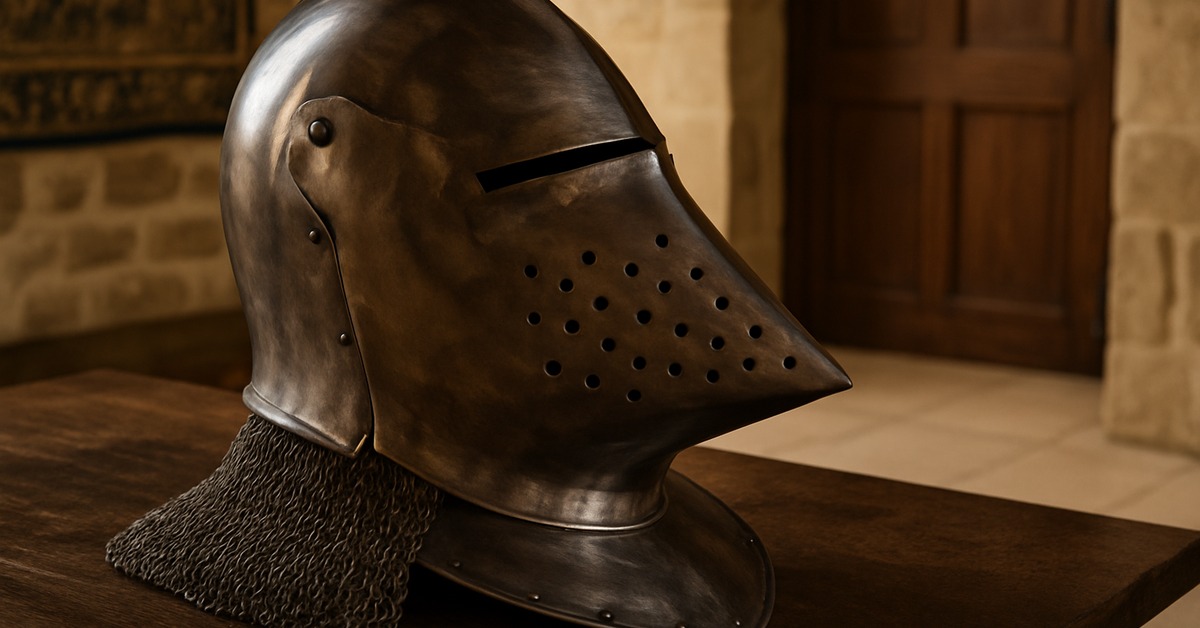
- “Hounskull” is an anglicization of the German Hundsgugel, meaning “dog’s hood.” Medieval soldiers were already comparing it to an animal’s face in their own time — the nickname wasn’t invented later.
- Some surviving examples show deliberate asymmetry in the breathing perforations — more holes positioned toward the air intake side, fewer near the eye slit. Individual smiths were experimenting with airflow engineering centuries before the concept had a name. Nobody assigned them that problem. They just noticed men were passing out.
- Visor attached via pivoting mechanism at the temples.
- Which means knights weren’t walking around blind between engagements — they flipped the pig face up like a visor and became human again. There’s something almost funny about that image, honestly.
Why the Hounskull Bascinet Still Matters Today
It is a perfect case study in constrained design. Every feature — the angled snout, the narrow slit, the perforated breathing holes, the pivot mechanism — came from trial, error, and the very specific feedback loop of actual battle. No computer modeling. No wind tunnel testing. Just generations of smiths refining a design because the alternative was watching their customers die.
What it also tells us is something about human adaptability that doesn’t get said plainly enough. The knights who wore these helmets didn’t just tolerate the limitations. They mastered them. They built entire fighting styles around a thumbnail-wide view of the world.
And they won battles doing it.
The pig-faced helmet wasn’t grotesque by accident. It was a tool shaped by centuries of violence into something that genuinely worked — strange, brutal, and quietly brilliant. The next time you feel like your circumstances are limiting you, remember the knight staring out through a 10-millimeter slit at a charging cavalry line. He couldn’t see much. He knew exactly what mattered. If this kind of story keeps you up at night, there’s more at this-amazing-world.com — and the next one is even stranger.


