The Helmet That Gave Medieval Knights a Fighting Chance
It is 1346, somewhere outside Calais, and a man is standing in a steel shell he cannot see out of, cannot hear through, and cannot breathe easily inside. He’s been wearing it for hours. Someone is about to hit him in the face with a sword. The helmet is the only reason this is a story about survival and not just a death.
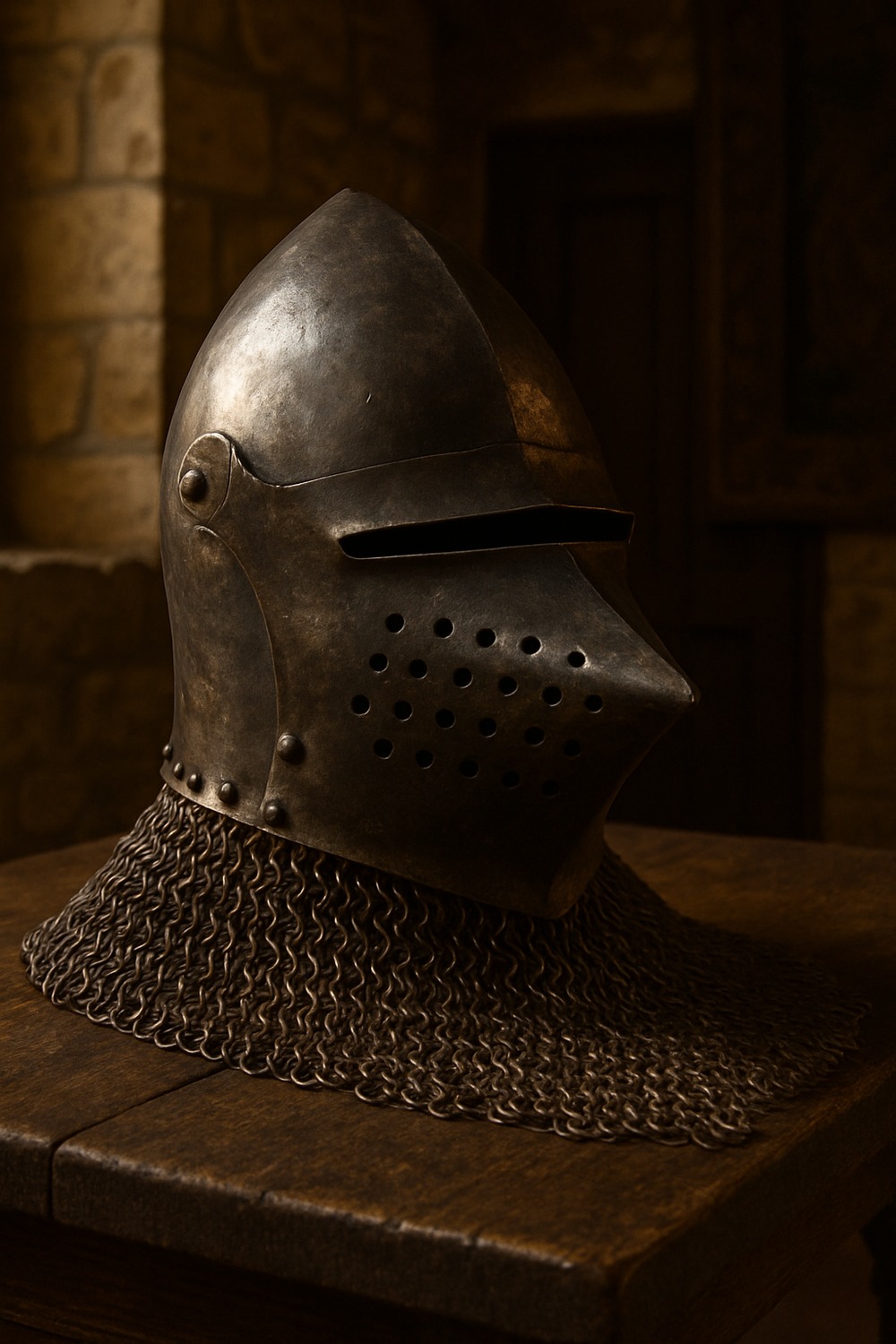
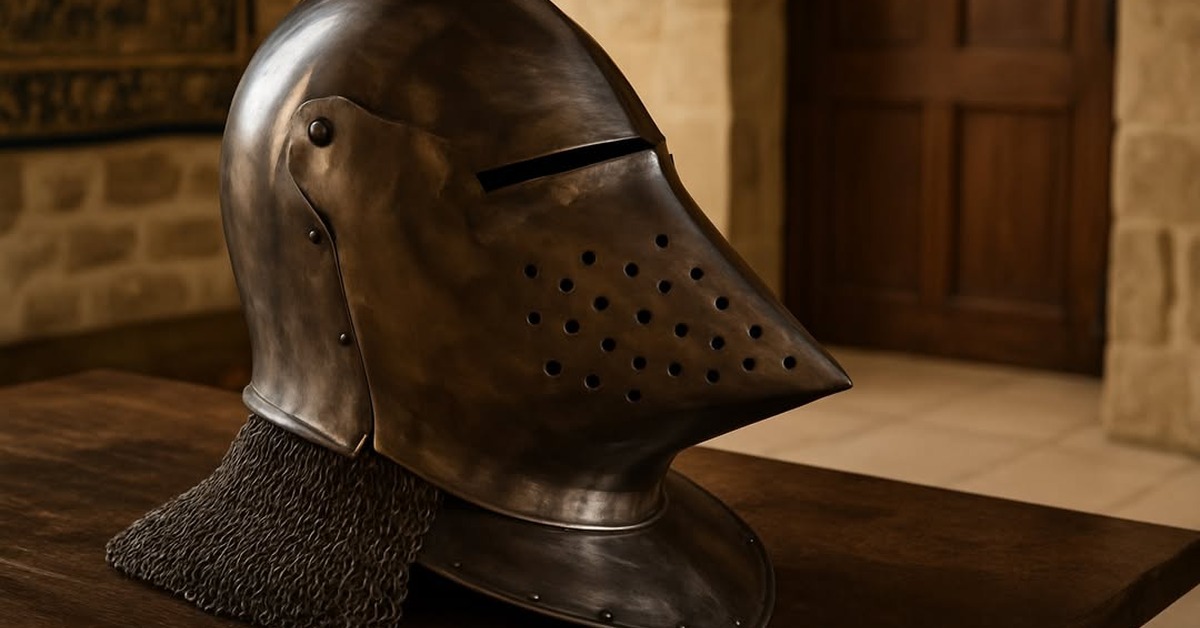
The hounskull bascinet looks strange even now — that long, jutting visor, pushed forward like an animal’s snout, like something between a knight and a hunting dog. It looks theatrical. It isn’t. Pull one down from a museum display case, turn it over, and the whole design snaps into focus. Every angle is load-bearing logic. Every millimeter of forged steel is answering a specific, lethal question.
The Hounskull Bascinet Helmet’s Brutal Physics Explained
The visor works on a principle any structural engineer would recognize: deflection, not absorption. A flat surface struck head-on transfers force directly through to whatever’s behind it — in this case, a human skull. An angled surface redirects that force. The weapon skids off. The energy goes sideways instead of inward.
Medieval armorers didn’t have the vocabulary for this. They had something better: decades of watching what happened to the men who wore the wrong design.
According to historian Alan Williams, whose metallurgical research at the Wallace Collection in London analyzed actual surviving helmets, the best 14th-century examples were engineered with a sophistication that holds up against modern protective equipment. The hounskull bascinet specifically solved three distinct problems with a single shape: the elongated profile moved the impact point away from the face, the space between visor and nose created airflow, and the whole structure achieved rigidity without stacking on unnecessary weight. One design. Three solutions. That’s not accident. That’s iteration that somebody paid for in failures first.
Knights Trained to Fight Nearly Blind and Deaf
The visor slit on a standard hounskull bascinet is approximately 2–3 centimeters high. That’s it. That’s the window a knight had onto a battlefield — charging cavalry, loose ground, incoming arrows, the man directly in front of him trying to kill him — compressed into a horizontal strip roughly the width of your thumb.
Peripheral vision: gone. Hearing: muffled to near-uselessness inside the steel. And they fought in this. Extended engagements, sometimes hours long, moving constantly, taking impacts to the head, doing all of it through a slot narrower than a mail slot.
Tournaments weren’t primarily entertainment. They were rehearsal for exactly this kind of sensory deprivation. Men spent years drilling movements until the restricted visor became almost irrelevant — the body already knew the geometry, the footwork, the angles of attack. The eyes were secondary. What mattered was what the muscles remembered. For more on how extreme human adaptation shaped history’s most dangerous professions, this-amazing-world.com has been pulling on threads exactly like this one.
The Tiny Holes That Kept an Army Alive
Look at the snout of a surviving hounskull bascinet and you’ll see rows of small perforations punched along the visor’s length. They look decorative at first — like a craftsman adding some finishing detail. They’re not decorative.
It is the summer of 1346. Edward III’s forces are settling in for what will become a nearly twelve-month siege outside Calais. Knights are living in their armor through a northern French summer, sun beating down on enclosed steel, and the hounskull bascinet — with its sealed visor design — is turning into something close to a suffocation chamber. Those holes were ventilation. The difference between a fighter still standing and one already down.
The engineering trade-off was brutal and specific. Every perforation you punch into a visor is a potential entry point for a blade tip or an arrowhead. Armorers had to calculate exactly how small each hole needed to be — large enough that air moved through, small enough that nothing sharp fit through. Some got it wrong. The men wearing those helmets discovered the error in the worst possible way.
That last fact kept me reading for another hour.
A Replica That Changes Everything You Think You Know
A replica hounskull bascinet sits at Tryon Palace in North Carolina, and visitors who’ve actually lifted it describe the same sequence: surprise at the weight, then a kind of quiet, sobered respect.
Reading that medieval armor weighed between 15 and 25 kilograms for a full harness is one thing. Holding just the helmet — 2.2 kilograms of dense forged steel — and trying to honestly imagine wearing that for hours of running and fighting and taking impacts directly to the head is something else entirely. The weight in your hands makes it real in a way photographs simply don’t. That’s when medieval warfare stops being a historical abstraction. That’s when it becomes something visceral.
And the hounskull bascinet wasn’t worn occasionally. Knights trained in it. Traveled in it. Fought extended engagements in it.
The Helmet Evolved Because Men Kept Dying
The hounskull bascinet didn’t arrive fully formed. It was the product of decades of hard, lethal feedback.
Earlier bascinet designs used visors that sat closer to the face — less deflection geometry, worse ventilation, flatter impact surfaces. The hounskull form emerged during the mid-14th century, during a period of intense large-scale conflict: the Hundred Years’ War grinding across France, the brutal campaigns of the Black Prince, the wars of the Italian city-states. Each engagement produced survivors, and the survivors often knew exactly why the men beside them hadn’t made it. That information traveled back to the workshops. Armorers adjusted. The snout got longer. The angle got steeper. The holes got refined.
The bascinet’s evolution is essentially a ledger of what kept killing people, written in forged steel over roughly fifty years.
What’s worth sitting with is how fast this iteration happened without any modern tools — no impact testing labs, no computational modeling, no standardized materials science. Just craftsmen watching what failed, talking to the men who wore the equipment, and adjusting. The hounskull bascinet wasn’t a finished design. It was a living one, still being corrected when the next campaign started.
By the Numbers
- 2.2 kg — just the helmet; a full late-14th-century plate harness could reach 25 kg total, distributed across the body (Wallace Collection, London)
- Nearly 12 months — the Siege of Calais (1346–47), the engagement that stress-tested every design limitation of contemporary armor under prolonged field conditions
- 2–3 cm — the height of the visor slit on a typical hounskull bascinet, compressing the wearer’s effective field of vision to less than 10% of normal human sight
- Up to 2.3 times — the increase in metabolic cost of movement in full plate armor compared to unarmored movement, according to a 2011 biomechanical study at the University of Leeds; in practical terms, knights were burning a half-marathon’s worth of exertion during a standard engagement, inside a steel shell they could barely see out of
Field Notes
- “Hounskull” — also “houndskull” — comes from the visor’s resemblance to a dog’s snout
- In German, the same helmet type is called the Hundsgugel, meaning “dog’s hood.” The visual comparison showed up independently across different cultures, which suggests the resemblance was genuinely hard to miss.
- Known weak point: the visor hinge
- Surviving examples show evidence of repeated repairs to the hinge mechanism — the most mechanically stressed point on the entire helmet — indicating armorers knew it was a problem and kept reinforcing it throughout the design’s working life, never quite solving it completely.
- Knights frequently removed visors between engagements rather than raise them, because early hinge mechanisms were nearly impossible to operate quickly while wearing gauntlets; later designs introduced spring-loaded and pivot-mounted visors built specifically for single-handed operation under combat conditions
What This Helmet Still Teaches Us About Survival
The hounskull bascinet is 700 years old and it’s still making an argument.
Every feature on it is the answer to a question somebody paid for with their life. The angled visor exists because straight visors failed. The ventilation holes exist because men suffocated. The elongated snout exists because shorter profiles left too much flat surface for weapons to push against. The whole object is a record of what went wrong, corrected in steel, worn on the head of the next man who needed it to work.
That instinct — to engineer rather than simply endure, to look at a thing that’s killing people and ask what can be changed — runs through all of recorded history. It shows up in medieval armorer’s workshops and modern materials labs and everywhere in between. The helmet is one example. But it’s an unusually honest one, because you can hold it in your hands and feel exactly what problem it was trying to solve.
Pick up a piece of medieval armor and you’re holding a conversation across centuries. A craftsman telling you what he was afraid of, and what he did about it. The hounskull bascinet says: I knew the sword was coming. I changed the angle. Survival has always been a design problem — and the people working on it have always been stubborn enough to keep iterating. There’s more where this came from at this-amazing-world.com, and the next one is stranger.