


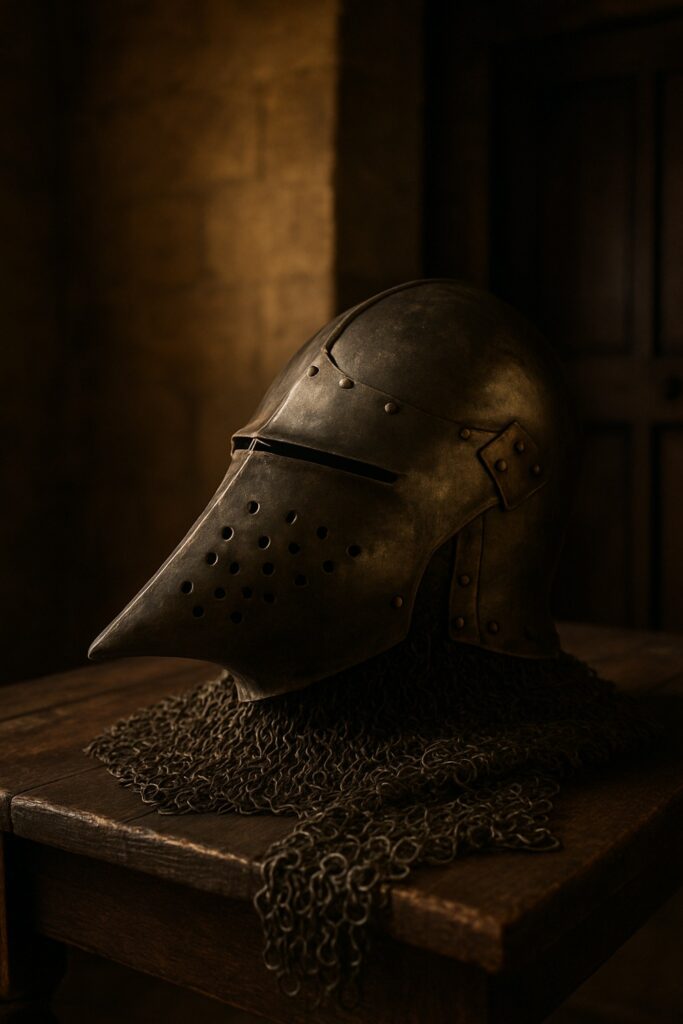
It is 1346. You are standing inside a steel shell in the August heat outside Calais, and the only air you have access to is trickling in through a dozen holes punched by a craftsman you’ve never met, in a workshop you’ve never seen, months before this moment. The visor in front of your face has saved your life at least twice today. It has also reduced your entire visible world to a strip of chaos roughly the width of your thumb.
That’s the hounskull bascinet. And once you actually understand what it was doing — what it was asking of the person wearing it — medieval warfare stops being a backdrop and starts being something almost unbearable to think about.
What the Hounskull Bascinet Helmet Actually Did
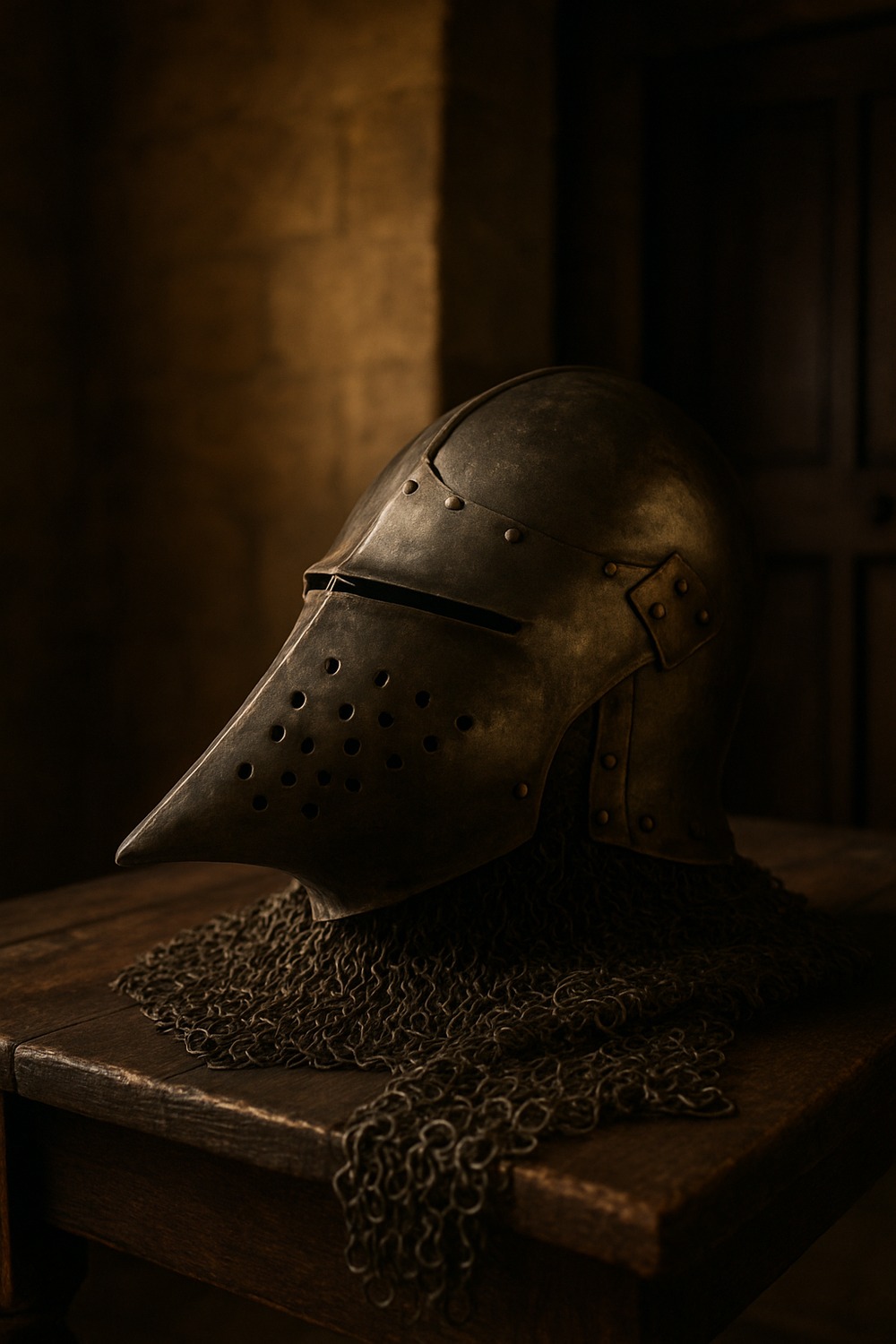
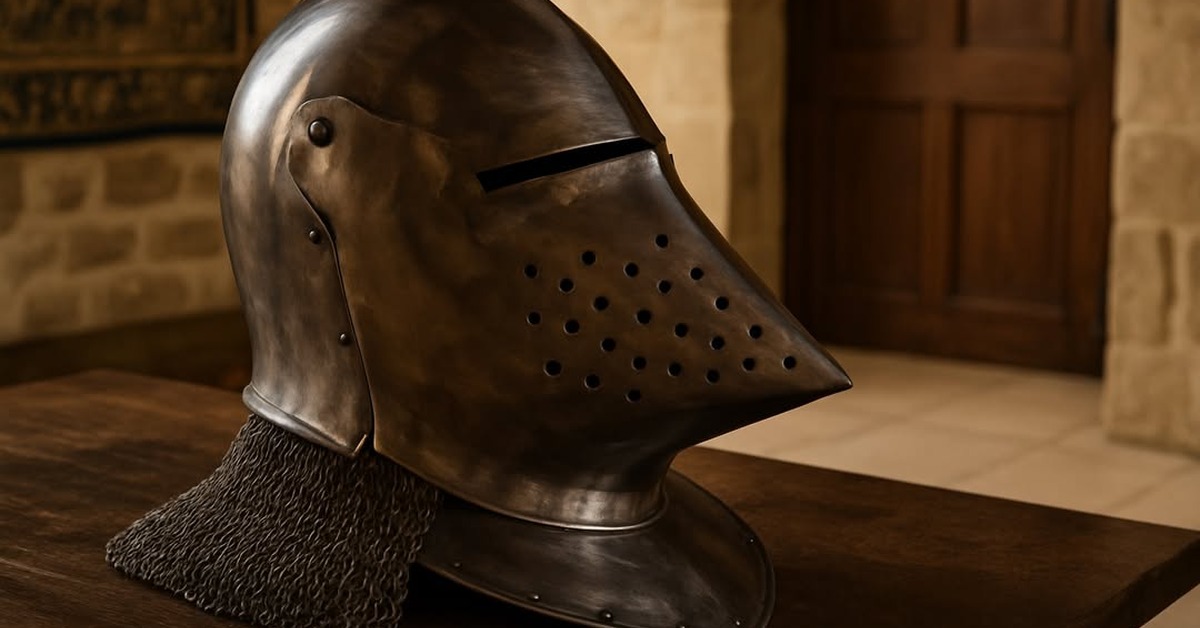
The hounskull bascinet emerged in 14th-century Europe, named for that unmistakable elongated snout — though the knights themselves just called it a bascinet. The animal comparisons came later, from people who’d never worn one into anything. According to historical records documented in Wikipedia’s bascinet entry, that angled snout-shaped visor wasn’t ornamental. It was geometry working in your favor. A lance tip or blade striking the sloped face deflects outward — away from your skull — rather than punching straight through. The angle does the work. But only if you hold your chin correctly. Only if you tilt at precisely the right moment. In real time. While someone is actively trying to kill you.
The technology and the person inside it had to function as one thing, or neither survived.
The Tiny Holes That Kept Knights Breathing
Look at any surviving hounskull bascinet and the ventilation holes almost read as decorative. Little rows of perforations along the snout. Tidy, even pretty. They were not decorative. The Siege of Calais ran from August 1346 through August 1347 — eleven months — and English knights held the siege line through a full continental summer sealed inside forged steel. Those holes were punched by an armorer in a workshop, possibly in a different country, months before any of that happened. Someone’s ability to keep breathing, to keep lifting a weapon, to stay conscious under a July sun — it all came down to that craftsman’s decision. The size of the holes. The placement. Whether he punched them at all.
Ventilation in armor sounds almost mundane. It isn’t.
Vision Through a Slit: The Price of Survival
Here’s what the hounskull bascinet actually costs the man wearing it. Vision collapses to a narrow horizontal strip — sometimes less than an inch of usable sightline, covering roughly 10 to 15 degrees of vertical field of view. The human eye, unobstructed, ranges across approximately 135 degrees vertically. That’s an 85% reduction. Gone. Hearing arrives muffled, distorted, late — which in a battlefield full of screaming men and clanging weapons gives you almost nothing useful to work with. And the air inside the helmet is your own exhaled air, cycling back through your lungs, thinning, warming, thickening with every breath.
The helmet keeps you alive. It also makes the world disappear.
Medieval combat wasn’t choreographed. It was disorienting in a way that’s hard to reconstruct from a museum case or a textbook. Knights trained for years — not just to fight, but to fight while half-blind. To read movement they couldn’t directly see. To act on information arriving a half-second late and still make the right call. The visor was a design achievement. The human being inside the visor was the other half of the engineering problem.
A Replica That Changes Everything You Think You Know
A replica hounskull bascinet sits at Tryon Palace in North Carolina, and visitor accounts describe something consistent happening the moment they actually lift it. It’s the weight. 2.2 kilograms resting directly on your skull, compressing your neck, narrowing your world to a strip of filtered light. The abstract understanding of “medieval knights wore heavy armor” becomes something physical and immediate. The training required to fight in this thing — for hours, in summer heat, while being repeatedly struck — stops being impressive and starts being almost incomprehensible.
That last detail kept me reading for another hour.
Museum experiences like this are doing something that matters. Collapsing the distance between knowing something and feeling it.

The Engineering Was Only Half the Battle
The hounskull bascinet didn’t function alone. It was one component in a full harness — plate armor, chainmail underlayers, a padded gambeson beneath all of it, articulated joints that had to flex and hold without catastrophic failure under load. Medieval armorers understood stress distribution, articulation points, and material fatigue without having formal vocabulary for any of those concepts. They were solving the problem of keeping a human body intact under extreme mechanical stress roughly three centuries before anyone codified the physics involved.
A single bespoke suit of plate armor could take up to six months to complete. Six months of individual decisions — each one made by a craftsman who would never personally test the result under combat conditions. The knight who wore it was betting his life on someone else’s judgment, accumulated across thousands of small choices, made in a workshop he’d probably never visit.
And the knight himself trained in this armor from adolescence. Not just fighting technique — stamina, movement, spatial awareness rebuilt entirely around the helmet’s limitations. The knight didn’t wait for the technology to adapt to him. He spent years adapting himself to the technology. That inversion is worth sitting with for a moment.
By the Numbers
- The Siege of Calais lasted eleven months — August 1346 to August 1347 — one of the longest sustained engagements of the Hundred Years’ War. Knights maintained armor discipline through a full summer. Then another.
- 10–15 degrees of vertical field of view through the visor slit, versus the human eye’s natural 135 degrees. An 85% reduction in visible world, while navigating chaos.
- A full 14th–15th century plate harness weighed 15 to 25 kilograms, distributed across the body — but the helmet alone, sitting on the skull and neck, accounted for roughly 10% of that total.
- Six months. That’s how long a bespoke suit could take to produce. The helmet a knight staked his life on was the result of thousands of decisions made by a craftsman who would never see combat.

Field Notes
- “Hounskull” — also called “pig-faced bascinet” — was never what the knights called it. Medieval soldiers just said bascinet. The animal comparisons came from later observers, people reconstructing history at a comfortable distance from the thing itself.
- The visor attached via a pivot pin system and could be flipped entirely up between engagements. Which means the sealed, blinding, suffocating experience was temporary by design — the default position was visor raised, snapped down only when combat was actually imminent. Most of the day, a knight could breathe normally. Then couldn’t.
- Some surviving examples show deliberate repair work: dents hammered back out, ventilation holes re-punched after damage. These helmets weren’t discarded when they took hits. They were maintained, reworked, and reused — sometimes across multiple campaigns. Possibly across generations.
What This Helmet Tells Us About Human Survival
It is 1347. The siege has broken. A knight outside Calais lifts the visor on his hounskull bascinet and breathes full air for the first time in hours. The helmet did what it was supposed to do. So did he.
The hounskull bascinet is a specific object with a specific history, but it keeps pointing at something larger. Humans have always walked directly into conditions that should kill them — siege lines, burning summers, plague cities, open water — and built something to survive inside those conditions. Not retreating. Not waiting. Engineering a solution from available materials and available knowledge, trusting it completely, and walking forward anyway. The holes punched in a visor to let a man breathe became the ventilation geometry in modern combat helmets. The angled deflection surface became the angular design logic of modern ballistic armor. The craftsman in a 14th-century workshop and the materials engineer designing body armor today are solving the same problem.
Keep a person alive in a situation that should kill them.
Medieval knights weren’t superhuman. They were men working with incomplete information, limited materials, and a very strong interest in not dying. They took what existed, shaped it into something that might work, and wore it into chaos. The hounskull bascinet is what that looks like, forged in iron. Brutal, elegant, and considerably smarter than it appears. There’s more of this kind of history at this-amazing-world.com — and the next one gets stranger.


