How Human Ashes Are Growing Memorial Forests in Europe
Here’s the thing about grief: we’ve always tried to make it permanent. Stone monuments. Engraved dates. Plots that outlast the people who tend them. The memorial forest biodegradable urn inverts all of that — not by erasing permanence, but by trading it for something that grows.
In Italy and Spain, families are walking away from stone and silence toward something older and stranger: the idea that death can be metabolically useful. The Bios Urn — a biodegradable capsule made from coconut shell and cellulose — places cremated remains directly into the root zone of a living tree. No chemicals. No concrete vault. Just the slow, cellular negotiation between ash and earth. What researchers are now documenting in memorial forests across Catalonia and Tuscany suggests this isn’t just a personal ritual. It might be genuine ecological restoration.
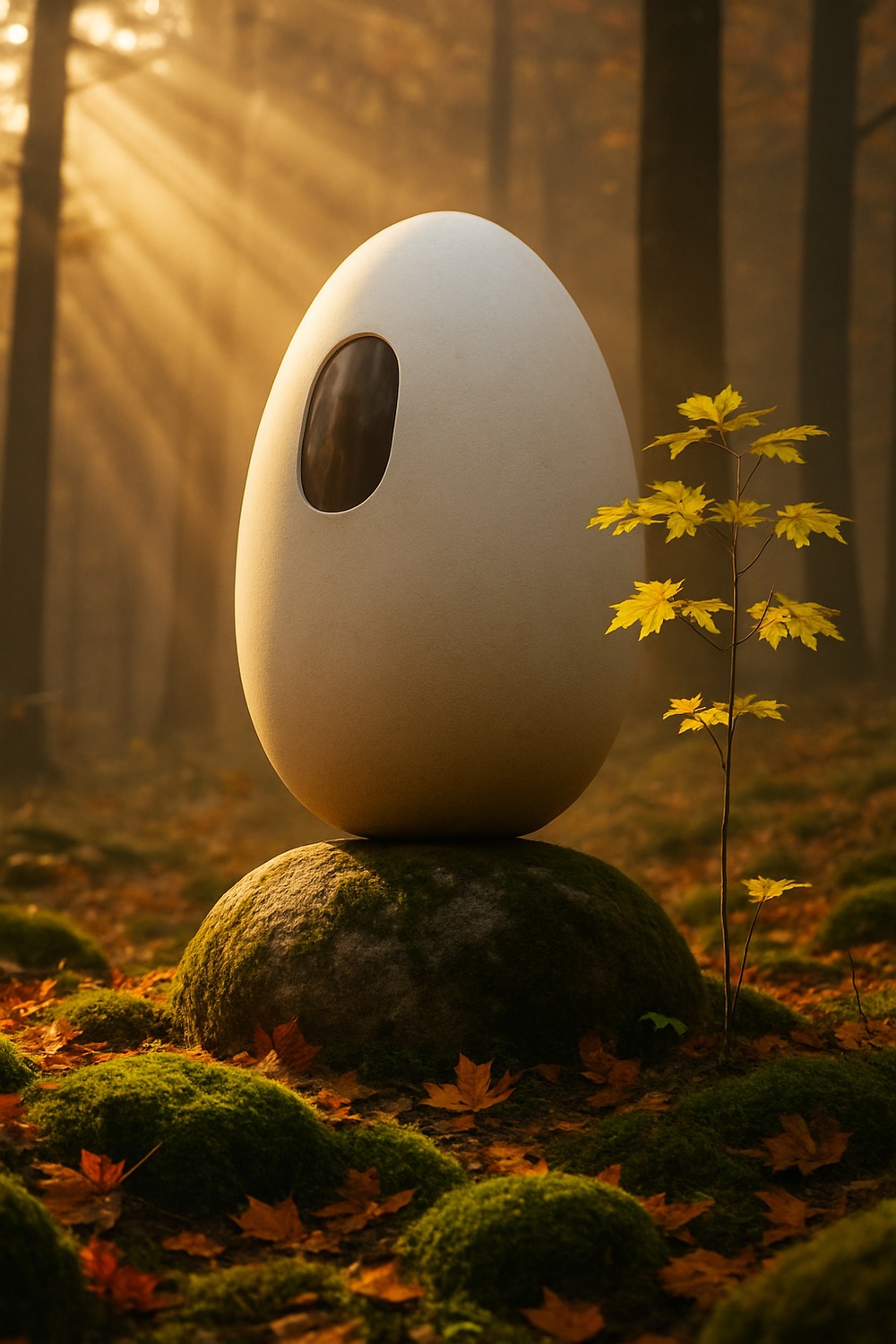
What the Biodegradable Urn Actually Does to Soil
Gerard Moline and Roger Moliné — a pair of Spanish designers working out of Barcelona — launched the Bios Urn commercially in 2013 through their company, Bios Inc. The capsule itself is a two-chamber system: the lower compartment holds compacted cremated remains mixed with a substrate of peat, cellulose, and coconut fiber; the upper compartment holds the seed or young sapling. Cremation reduces a human body to calcium phosphate crystals — dense, mineral-rich, and initially hostile to most plant roots because of high pH and salt content. The Bios substrate is formulated specifically to buffer that chemistry, moderating alkalinity while the capsule’s outer casing breaks down.
Soil scientists at the University of Barcelona’s Faculty of Biology measured decomposition timelines in 2018 and found that the outer shell becomes structurally indistinguishable from surrounding organic matter within four to six months under standard Mediterranean soil conditions. What happens next is more nuanced than the marketing suggests. Cremated remains don’t “feed” a tree the way compost does — there’s no nitrogen spike, no sudden burst of microbial activity. What the ash delivers is a slow mineral supplement — calcium, phosphate, potassium — released over years as water moves through the soil column. The tree doesn’t grow because of the ash. It grows alongside it, rooting through a medium that has been subtly altered. The difference is almost philosophical: not transformation so much as coexistence.
Dig near a three-year-old Bios planting and you won’t find the capsule anymore. You’ll find root hair, fungal mycelium, and earthworm castings where the casing once was. The boundary between the urn and the forest floor has simply dissolved.
How Memorial Forests Are Reshaping European Landscapes
Why does this matter beyond individual families making end-of-life choices? Because Europe’s relationship with burial land is under structural pressure, and the numbers are no longer comfortable to ignore.
In Germany, traditional grave leases last only 20 to 30 years before plots are reassigned. In the UK, many urban cemeteries are at or near capacity. Demand for alternative burial practices has accelerated sharply since 2015. Memorial forests — designated woodlands where natural or biodegradable burials take place — now operate in 14 European countries, with Germany’s Friedwald network alone managing more than 60 forest burial sites across the country as of 2023. Much the way a crow’s behavior reveals the surprising intelligence encoded in seemingly simple acts — the kind of thing you notice when you read about crow anting behavior and its function in feather maintenance — memorial forests reveal how ecosystems encode memory in ways we’ve barely begun to map.
Collserola Natural Park in Catalonia — roughly 8,000 hectares on the edge of Barcelona — began permitting licensed biodegradable urn plantings within designated zones in 2019. By 2022, environmental monitors from the Institut de Ciència i Tecnologia Ambientals at the Universitat Autònoma de Barcelona had documented measurable canopy increases in the planting zones compared to control areas of similar terrain. The effect was modest — a 6 to 9 percent increase in juvenile tree density over three years — but statistically significant. Memorial planting wasn’t the only variable, but it wasn’t negligible either.
Stand in Collserola on a November morning and the light comes through the holm oaks at a low, amber angle. The plaques here are small, embedded in wood rather than carved in stone. Some have photographs. Most have just a name and two dates. The forest doesn’t care about either. It keeps growing.
The Environmental Math That Traditional Burial Can’t Win
Conventional burial’s numbers are genuinely difficult to sit with. In the United States alone, traditional interment consumes more than 30 million board feet of hardwood annually, along with an estimated 800,000 gallons of embalming fluid — a formaldehyde-based mixture that persists in surrounding soil for decades after burial. Concrete burial vaults, used in the vast majority of American interments, require enormous energy to produce and never biodegrade. A 2021 analysis published by Smithsonian Magazine calculated that the annual carbon footprint of the US funeral industry — including cremation, embalming, and manufacturing — exceeds 8.5 billion pounds of CO₂ equivalent. European figures are proportionally lower but follow the same structural logic.
The memorial forest biodegradable urn system, by contrast, produces near-zero direct emissions. The capsule is manufactured without synthetic polymers, the burial requires no excavation equipment, and nothing enters the soil that wasn’t already cycling through the biosphere. Cremation itself isn’t carbon-neutral — a standard cremation releases approximately 400 kilograms of CO₂. But when those remains are directed into a living tree through a biodegradable urn, the calculus shifts. A mature oak sequesters roughly 22 kilograms of carbon per year and can live for 500 years. A grove of 50 memorial oaks, planted over a decade, begins to offset the emissions of the cremations that created them within 20 to 30 years.
An industry that profits from permanence has never had strong incentives to ask what permanence actually costs the ground beneath it — and this evidence makes that evasion look less like oversight and more like a choice.
That’s not a small distinction. That’s a different philosophy of what a death means to the living world around it.
Memorial Forest Biodegradable Urn Options Spreading Across Europe
Bios Inc. isn’t alone in this space anymore. Since 2015, at least a dozen companies across Europe have developed competing biodegradable urn systems, each with slightly different substrate formulations and capsule architectures. Italy’s ForeverForest, launched in 2017 in partnership with the Legambiente environmental organization, offers a capsule made from pressed rice paper and volcanic mineral aggregate — designed specifically for the high-clay soils of the Po Valley and central Apennines, where the Bios coconut-fiber formula had shown slower decomposition rates. Switzerland’s Algordanza takes a different approach entirely: they compress remains into a synthetic diamond under high pressure, but their sister company, Algordanza Green, began trialing a companion biodegradable urn in 2021 aimed at pairing memorial gems with forest plantings.
Soil composition studies run by the University of Florence’s Department of Agriculture in 2022 compared four different biodegradable urn systems under controlled conditions. Their findings, presented at the European Society for Agronomy conference that year, confirmed that pH buffering capacity was the single strongest predictor of early sapling survival — more important than capsule material or substrate composition alone. What this means in practice: not every biodegradable urn performs equally in every soil type. A capsule optimized for sandy Andalusian soils may actively harm a sapling planted in the waterlogged clay margins of the Dutch polders. This matters enormously for families making irreversible decisions (and this matters more than it sounds — a tree planted with an ill-matched capsule in inhospitable soil will fail, and there’s no second ceremony). The science of matching urn chemistry to local geology is only beginning to be systematized, and most commercial providers are still well ahead of the peer-reviewed evidence base.
Landscape ecologists at Wageningen University in the Netherlands are currently building a publicly accessible soil-matching database for biodegradable burial products — expected to launch in 2026. It’s a small, quiet project. But if it works, it could become infrastructure.
What Happens When a Forest Is Made of People
Turns out the environmental data doesn’t fully answer the most interesting question: what happens to a landscape — socially, culturally, ecologically — when its woodland is understood as populated? In Japan, the concept of satoyama describes a managed transition zone between human settlement and wild forest, maintained through generations of mutual obligation. In pre-Christian northern Europe, sacred groves served similar functions — spaces where the boundary between community and ecosystem was deliberately blurred. The memorial forest biodegradable urn movement, whether its practitioners realize it or not, is reaching toward something ancient.
A 2023 study by researchers at the University of Exeter’s European Centre for Environment and Human Health surveyed 1,200 people who had planted memorial trees in UK woodlands. 74 percent reported visiting the site more than twice per year — far more frequently than they visited traditional graves. More striking: 61 percent described the visits as “restorative” rather than “mournful.” That shift in emotional register has ecological consequences. People who visit memorial forests walk trails, notice seasonal changes, report invasive species, and — in documented cases across Friedwald sites in Germany — have begun participating in volunteer forest maintenance.
And the forest creates attachment in ways no cemetery planner anticipated. Attachment creates stewardship. Stewardship, compounded over decades across hundreds of sites, begins to look like a conservation movement that nobody formally organized.
In a small Friedwald site outside Freiburg, a woman named Ingrid has visited her husband’s oak every March for seven years. She knows which woodpeckers nest nearby. She knows when the wild garlic blooms beneath his canopy. She’s reported two instances of illegal dumping to the forest management authority. The oak is 4.3 meters tall now. She measured it herself.
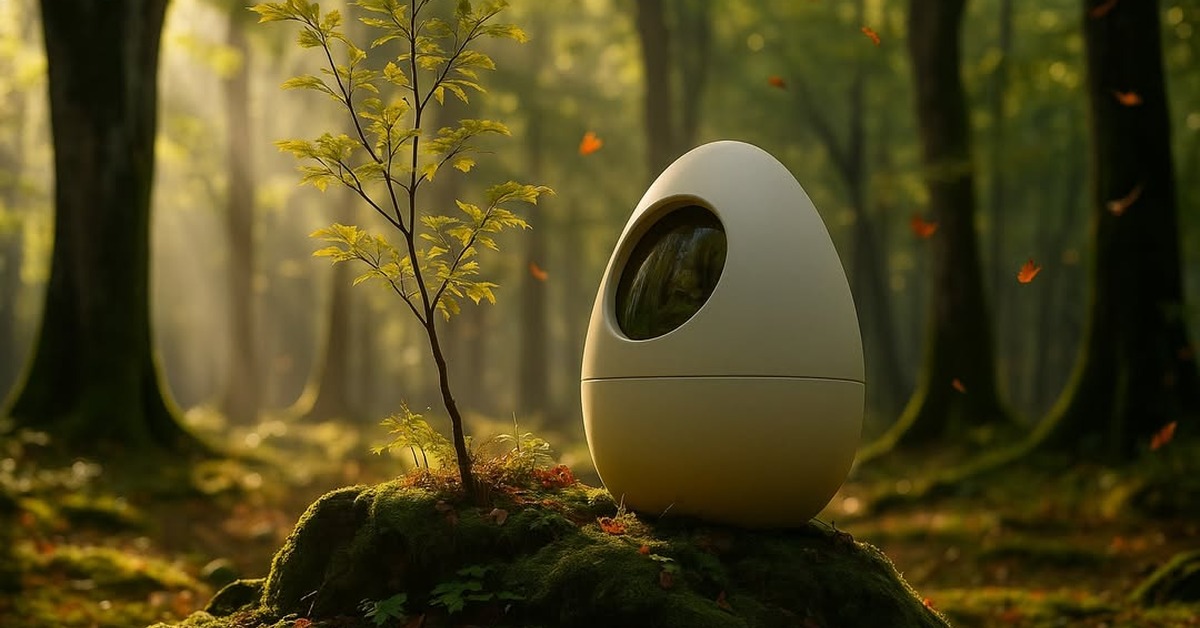
How It Unfolded
- 2013 — Gerard Moline and Roger Moliné launch the Bios Urn commercially from Barcelona, becoming the first company to market a biodegradable cremation urn designed specifically for tree planting at scale.
- 2015 — Germany’s Friedwald network expands to 60 forest burial sites, bringing licensed woodland interment into the mainstream of European funeral practice and triggering regulatory interest across the EU.
- 2019 — Collserola Natural Park in Catalonia becomes one of the first protected natural areas in southern Europe to permit licensed biodegradable urn plantings within its boundaries, under strict zoning rules.
- 2023 — University of Exeter research documents the behavioral and emotional patterns of memorial forest visitors, establishing the first systematic link between tree burial sites and long-term conservation stewardship by bereaved families.
By the Numbers
- 800,000 gallons of embalming fluid used annually in US traditional burials, containing formaldehyde compounds that persist in soil for decades (Green Burial Council, 2022)
- 400 kg of CO₂ released by a standard cremation — roughly equivalent to a 1,600-kilometer car journey
- 74% of UK memorial forest planters visited their tree site more than twice per year, versus an average of 1.2 visits per year to traditional graves (University of Exeter, 2023)
- 4–6 months for a Bios Urn outer casing to fully decompose under standard Mediterranean soil conditions (University of Barcelona, 2018)
- 60+ Friedwald forest burial sites operating across Germany as of 2023, covering an estimated 1,200 hectares of managed woodland
Field Notes
- In 2022, soil analysts studying a Bios planting site in Tuscany discovered that ectomycorrhizal fungi — the underground networks that connect tree root systems — had colonized the decomposed capsule substrate at rates 30 percent higher than surrounding unplanted soil, suggesting the organic capsule material may temporarily enrich fungal habitat independent of the ash content.
- Cremated human remains have a calcium-to-phosphorus ratio almost identical to commercial hydroxyapatite fertilizer — the same compound used in slow-release agricultural supplements — which partly explains why soil scientists consider them a genuine, if minor, mineral resource rather than an inert substance.
- Europe’s oldest confirmed “living memorial tree” — a sessile oak planted over a biodegradable urn in a private estate in County Clare, Ireland — is now 11 years old and shows no measurable difference in growth rate from naturally seeded oaks of equivalent age in the same woodland.
- Researchers still can’t fully predict which tree species perform best over cremated remains in alkaline-heavy soils: trials in Spain using Mediterranean pine, cork oak, and wild olive produced contradictory survival data across identical capsule formulations, and no consensus model yet exists for species-soil-ash matching.
Frequently Asked Questions
Q: How does a memorial forest biodegradable urn actually work in practice?
Bios Urn and similar products are two-chamber biodegradable capsules — typically made from coconut shell, rice paper, or compressed cellulose — that hold cremated remains in the lower chamber and a sapling or seed in the upper one. The capsule is planted at standard root depth, and the outer casing breaks down within four to six months, releasing the ash into the surrounding soil column. Over the following years, the tree’s roots grow through and around the remains. No special equipment is needed, and the planting can be done by family members.
Q: Is it legal to plant a memorial forest biodegradable urn on private land?
Legality varies significantly by country and even by regional jurisdiction. Germany and the UK restrict burial — even biodegradable — to licensed sites, which is why the Friedwald network operates under formal permits. Italy and Spain allow more flexibility for private land in rural zones, provided the landowner holds clear title and local municipal ordinances don’t prohibit it. In the United States, natural burial law is governed state by state, and several states — including California, Washington, and Vermont — now explicitly permit biodegradable urn burial on private land under specific conditions. Always verify with local authorities before proceeding.
Q: Will the tree actually benefit from the cremated remains, or is that a myth?
Cremated remains don’t function like fertilizer — they don’t accelerate growth or dramatically change a tree’s nutrient intake. What they do is contribute a slow-release mineral profile, primarily calcium and phosphate, to the local soil chemistry over years. The real benefit is substrate and ecosystem: the biodegradable capsule itself enriches microbial and fungal activity as it decomposes, which can marginally improve root zone conditions for the sapling. The tree grows because of good soil, adequate light, and water — not because of the ash. The ash simply coexists, which is perhaps the more honest and more beautiful truth.
Editor’s Take — Alex Morgan
What stays with me isn’t the carbon math, as compelling as it is. It’s that 74 percent visitation figure from Exeter. People are going back to forests more than twice a year — not because they have to, but because something pulls them there. Traditional grave maintenance is obligation. Forest visits become something closer to relationship. If the memorial forest biodegradable urn movement ends up doing one thing that matters ecologically, it might be this: it turns bereaved people into habitual forest-goers. And habitual forest-goers, over time, become the people who fight to protect them.
Europe’s memorial forest trees are barely a decade old — adolescents, really. They haven’t yet weathered a major drought, a beetle outbreak, a storm that takes half the canopy down. But they’re growing in soil that holds names, and they’re being watched by people who have a personal reason to care whether they survive. That’s not nothing. That might, in the long arc of conservation history, turn out to be exactly the kind of motive that actually moves people — not data, not policy, but the fact that somewhere in a particular stand of oaks, someone they loved is slowly, quietly, becoming the forest floor.