


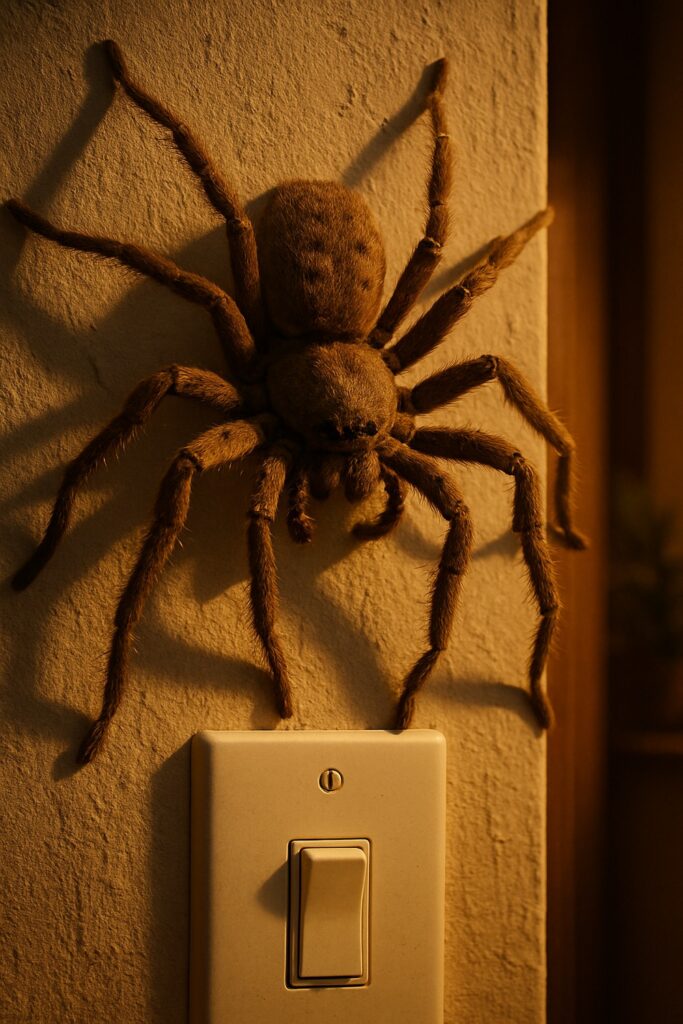
Nobody panic — but the huntsman spider on your bathroom wall is probably doing you a favor. These animals, built flat as a hand and fast enough to cross a wall in under a second, have been running informal pest control operations inside human homes for millennia. The huntsman spider didn’t choose your house at random. It followed the insects in.

Built for the Shadows: Anatomy of a Natural Infiltrator
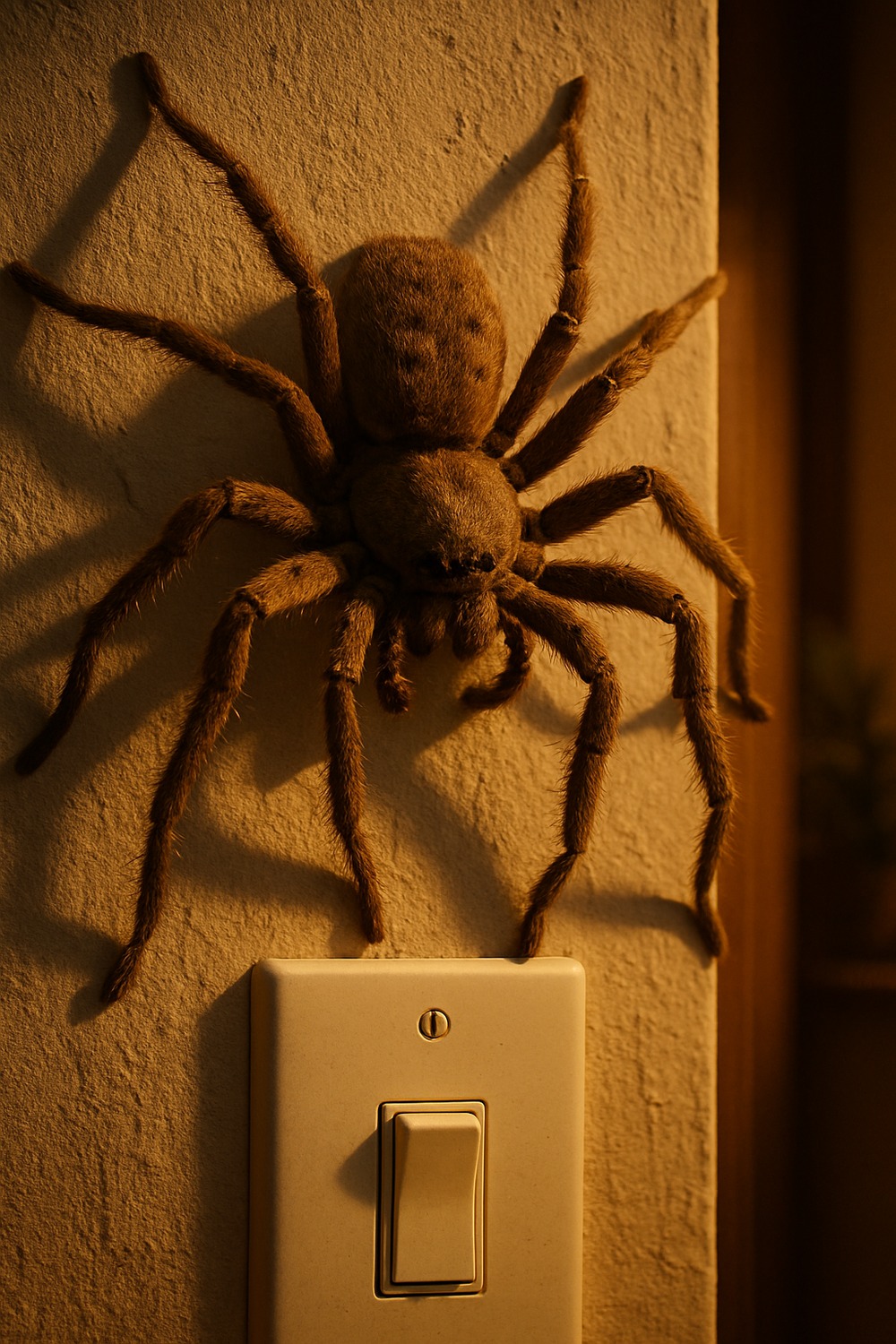
Huntsman spiders belong to the family Sparassidae — a globally distributed group with over 1,300 described species, and a body plan that looks almost purpose-built for domestic infiltration. That’s because it is. Their bodies are dramatically flattened, an adaptation for hunting beneath loose tree bark and inside rock crevices across tropical and subtropical environments.
When human architecture came along, those crevices became wall cavities, window frames, and the backs of kitchen cupboards. Easy trade. Their legs — spanning up to 30 centimeters in the largest species — extend laterally rather than downward, which lets them navigate flat surfaces and tight gaps at speeds reaching one meter per second. Eight eyes, arranged in two rows of four, give them a wide field for detecting movement across walls and ceilings. They don’t spin webs. They hunt — roaming freely through rooms at night, picking off moths, mosquitoes, flies, and cockroaches with a patience that no plug-in repellent can match. Females guard their egg sacs with a fierce maternal intensity that still catches researchers off guard, given how reflexively we dismiss these animals as unthinking.
Venom, Risk, and the Reality Behind the Fear
Right. The bite question. Decades of toxicological research have delivered a fairly clear verdict: huntsman venom is calibrated to overwhelm insect nervous systems, not ours. In a healthy adult human, a bite produces localized pain, some swelling, occasional mild nausea — comparable, at worst, to a moderate bee sting, and typically resolved within a day or two. Serious medical complications are vanishingly rare.
Bites themselves are uncommon, and almost always defensive — a spider trapped in a shoe, caught inside a shirt sleeve, pressed against skin with nowhere to go. Given an exit route, a huntsman’s overwhelming preference is to run. That’s worth sitting with, because everything about their size and speed reads as aggression to our startled primate brains. Behavioral studies say otherwise. Among large-bodied indoor spiders, huntsmen are consistently among the least confrontational. They just don’t photograph that way. Anyone who’s ever had one sprint across their face in the dark would probably dispute that characterization — but the data holds.
The Living Pest Trap: What Huntsmen Actually Do for You
Why does this matter? Because one unchecked cockroach population can balloon into the thousands within months — and the huntsman charges nothing to stop that.
Here’s the thing: a resident huntsman, working nights while you sleep, delivers a steady, ongoing culling of mosquitoes, moths, silverfish, cockroaches, and the miscellaneous other insects that most homeowners spend real money trying to eliminate. No maintenance, no batteries, no annual service contract. Just darkness behind the bookshelf and the occasional unlucky fly.
Treating a wild predator as free infrastructure sounds radical until you look at the numbers. A widely cited 2017 study estimated that the world’s spiders collectively consume between 400 and 800 million metric tons of prey annually (researchers actually call this “ecosystem service valuation”) — a figure that dwarfs the combined meat consumption of the entire human population. Redirecting even a fraction of that toward the insects in your walls costs nothing and leaves no residue in your soil or water. In Australia, Southeast Asia, and sub-Saharan Africa — where huntsmen are most abundant and most commonly found indoors — many households have quietly operated under an informal arrangement with their resident spiders for generations. Not out of ecological philosophy. Out of practical observation: the bugs are fewer. Entomologists focused on integrated pest management have grown increasingly interested in generalist predators like huntsmen as a meaningful, chemical-free suppression force for indoor insect populations, and preliminary research is starting to catch up with that intuition.
Turns out the spider on your wall has been ahead of the science for quite a while.
{{IMAGE_1}}

Coexistence as a Choice: Rethinking Who Belongs in Your Home
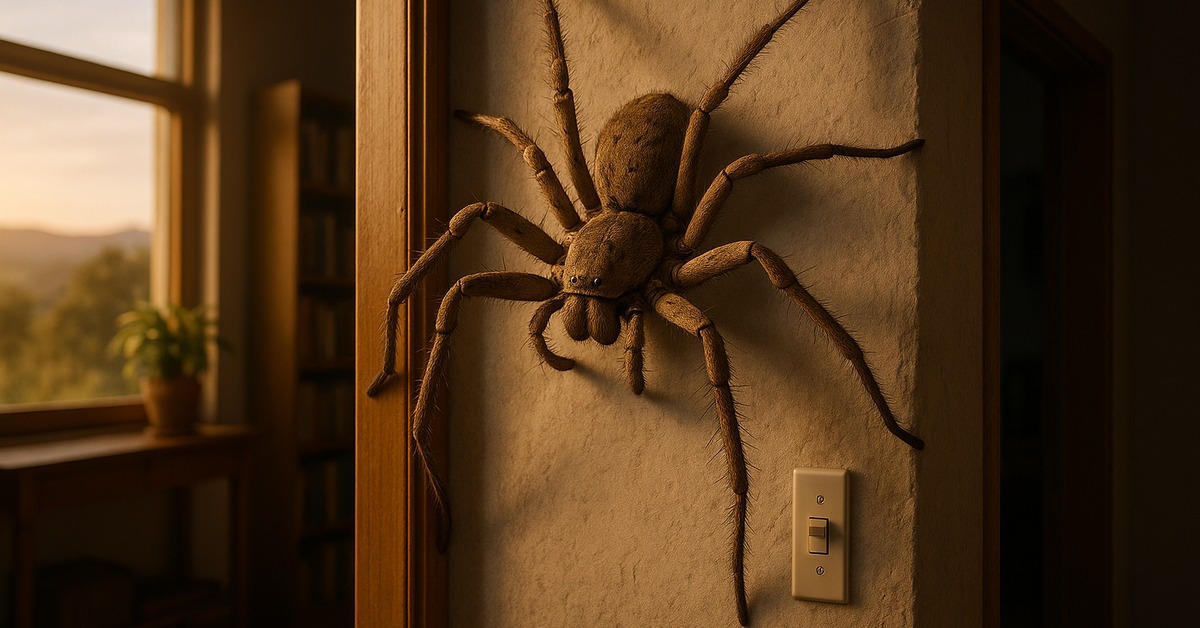
Somewhere along the way, the modern home became a sealed fortress — climate-controlled, nature-expelling, with anything wild treated as a breach of contract. That impulse isn’t irrational. It comes from legitimate health concerns and a completely understandable discomfort with the unpredictable. But it has costs that keep compounding: financial, environmental, and increasingly biochemical. Pesticide resistance is climbing among the very insect species we most want gone, while the cumulative toll of domestic chemical use accumulates quietly in soil and groundwater.
Any homeowner who’s replaced a professional pest treatment twice in three years, watched the cockroaches come back anyway, and still found themselves buying another canister of spray — that’s not pest control. That’s subscription servitude to a problem that isn’t getting solved.
How It Unfolded
- 1900s: Early taxonomic work begins formally classifying Sparassidae species found in homes across Australia and Southeast Asia, confirming what locals had long observed about their hunting habits.
- 1970s: Integrated pest management research begins exploring non-chemical predator roles indoors; generalist spiders draw early academic attention.
- 2001: Peer-reviewed behavioral studies establish that huntsman spiders rank among the least confrontational large-bodied indoor spiders when given an escape route.
- 2017: A landmark study published in The Science of Nature estimates global spider prey consumption at 400–800 million metric tons annually, forcing a reappraisal of spiders as active ecosystem service providers inside human structures.
By the Numbers
- 1,300+ described species in the family Sparassidae, distributed across every continent except Antarctica
- 30 cm maximum leg span in the largest huntsman species
- 1 m/s top sprint speed across flat surfaces
- 400–800 million metric tons of prey consumed annually by the world’s spiders collectively (2017 estimate)
- 8 eyes arranged in two rows of four, optimized for wide-field movement detection
- 24–48 hours typical recovery time from a huntsman bite in a healthy adult
Field Notes
- Huntsmen are classified under Sparassidae, a family defined by their laterally-oriented legs and bark-adapted flat bodies
- Their flattened profile, originally evolved for life under bark and inside rock crevices, translates directly into an ability to navigate wall cavities, window frames, and cabinet backs inside human homes
- Females carry and actively guard their egg sacs — a level of maternal investment unusual enough among spiders that it continues to attract dedicated research attention
- Unlike web-building species, huntsmen are active pursuit predators, which means their presence translates directly into insect removal rather than passive trapping
- Learn more about spider behavior and ecology across different environments
{{IMAGE_2}}
Frequently Asked Questions
Are huntsman spiders dangerous to humans?
Bites are rare and almost always defensive. In healthy adults, symptoms typically run to localized pain, mild swelling, and occasional nausea — resolving within a day or two. No fatalities appear in modern medical literature.
What do huntsman spiders eat indoors?
Mosquitoes, moths, flies, cockroaches, silverfish — most of the insects homeowners actively want gone. They’re generalist predators, which means they work the full menu.
Should I remove a huntsman spider from my home?
That’s genuinely your call. Many people in Australia, Southeast Asia, and sub-Saharan Africa choose to leave them. If you’d rather relocate one, sliding a container over it and slipping card underneath works without harming the spider.
Do huntsman spiders come back if relocated?
Not the same individual — they don’t home-navigate like some species. A new one may eventually appear if conditions inside attract insects, which is rather the point.
How do I tell a huntsman from a more dangerous spider?
Huntsmen are large, dramatically flat, and fast. They lack the rounded, high-set abdomens of redbacks or black widows. Their legs spread wide rather than curling beneath them. If you’re in genuine doubt about a species, a local pest management professional or entomology extension service can make a quick identification.
Editor’s Take — Alex Morgan
What strikes me, standing back from all of this, is how much effort we’ve put into engineering the spider out of the home while simultaneously spending billions on the insects it would have eaten. The fear is visceral and I’m not dismissing it — I’ve startled badly myself, lights off, something moving fast across a wall. But there’s a specific kind of irony in reaching for a chemical spray while a free, targeted, zero-residue alternative sits frozen three feet away, waiting for you to leave the room so it can get back to work.
Against that backdrop, the huntsman spider looks less like an intruder and more like an offer. Imperfect coexistence — it’ll startle you at 11pm, it’ll pick the worst possible wall to sit on when guests arrive. But these hunters have been navigating human structures since our ancestors first built them. They don’t ask for an invitation. They don’t cause harm. Night after night, they eat the things you don’t want in your home, for free, without side effects. The most radical pest management move available to any homeowner might also be the simplest: put the spray can down, take a step back from the wall, and let the spider work.


