


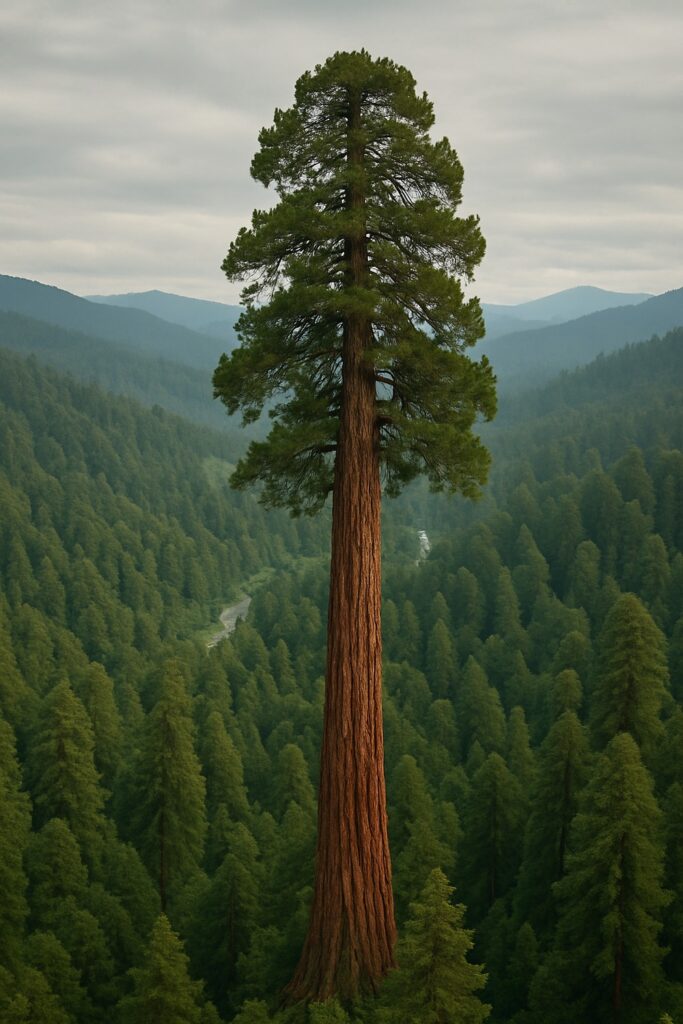
Nobody was supposed to find it. That’s the thing about Hyperion — it only exists because a stretch of Northern California hillside was too steep and too tangled for the logging crews to bother with.
It’s called Hyperion. A coast redwood growing somewhere in the fog-choked valleys of Redwood National Park, and the National Park Service has quietly made it unfindable. Not metaphorically. They’ve actually scrubbed the GPS coordinates from public records. Too many people came. Too many hiking boots pressed into a root system that spent six centuries threading through the soil — and the foot traffic was beginning to compact and suffocate it. So the solution was almost elegantly simple: stop telling people where it is. Today, anyone caught deliberately trying to locate it can face fines up to $5,000. The tallest tree on Earth is protected by secrecy.
Why the Tallest Tree on Earth Stays Hidden
Hyperion was found in 2006, by naturalists Chris Atkins and Michael Taylor, who’d been methodically measuring old-growth redwoods the way some people work through a checklist. At 380.3 feet — about 115.9 meters — it beat the previous record-holder, a redwood called Stratosphere Giant, by over eight feet. Researchers documented the discovery and the internet did what the internet does. Pilgrimages started. Thousands of them. The shallow, sensitive root zone — the thing Hyperion depends on entirely for water and nutrients — began taking damage from the sheer volume of people coming to stand next to a famous tree.
So the Park Service stopped publishing the coordinates. Trail access got quietly discouraged. The tree is still out there, still growing. It just doesn’t want visitors.
Stack Two Statues of Liberty — Still Looking Up
Here’s a way to actually feel the number: the Statue of Liberty, pedestal included, stands about 305 feet. Stack two of them. You’re still 55 feet short of Hyperion’s crown. The Empire State Building’s roof clears 1,250 feet, so we’re not talking skyscraper territory — but this is a single living organism that grew itself, cell by cell, with no blueprint and no construction crew. Just fog rolling off the Pacific, fungi in the soil, and about six hundred years of uninterrupted time.
Hyperion started growing somewhere around the 1400s.
That’s before Columbus crossed the Atlantic. Before the printing press had spread across Europe. Whatever was happening in the world — empires rising, wars, plagues, entire civilizations reshaping themselves — this tree was just quietly adding rings in a California valley. If you find yourself drawn to things that quietly outlast human ambition (and honestly, who doesn’t), this-amazing-world.com has plenty more to knock you sideways.
The Secret Network Beneath the Forest Floor
This is where it gets strange. Really strange.
Beneath these ancient groves runs a mycorrhizal fungal network — microscopic threads, thinner than a human hair, lacing through the soil and physically connecting tree roots across whole acres. Not a metaphor. Not a poetic way of saying the trees are near each other. A measurable, documented biological system that ecologist Suzanne Simard first mapped in British Columbia in the 1990s, and that the scientific community initially pushed back against with some force. Trees talking to each other through fungal threads sounded, frankly, like something you’d read on a wellness blog.
Turns out the skeptics had to walk it back.
Trees exchange nutrients through this network. Water moves along it. And when a tree comes under insect attack, it can send chemical signals through the fungal threads to neighboring trees — which then start producing their own defensive compounds before the insects have even reached them. The forest doesn’t just share resources. That last part kept me reading for another hour, just trying to understand the mechanism. It communicates. Slowly, chemically, in a language we’ve only just started decoding.
A Forest Isn’t Trees. It’s One Organism.
The old model of a forest was competitive. Individual trees racing for light, hoarding water, crowding out rivals with their roots. That picture isn’t completely wrong — competition absolutely exists — but it turns out it’s only half the story, maybe less.
The mycorrhizal network means a large, established tree like Hyperion is actively linked to younger seedlings in the understory, sometimes transferring carbon to help them survive in low light. Simard called the oldest, most-connected trees “mother trees” — hubs that support younger growth across species lines, not just within their own kind. A mature Douglas fir feeding a baby birch through fungal threads. That’s not competition. That’s something else entirely.
Here’s what really got me: the network retains chemical information. Stress responses triggered in one section of a grove can influence the biochemistry in another section, even after the original stressor is long gone. It’s distributed information storage. A forest with a kind of memory. That sounds like poetry until you look at the data, and then it just sounds like biology we weren’t ready for.
And we nearly logged all of it.

The Logging History That Almost Erased Everything
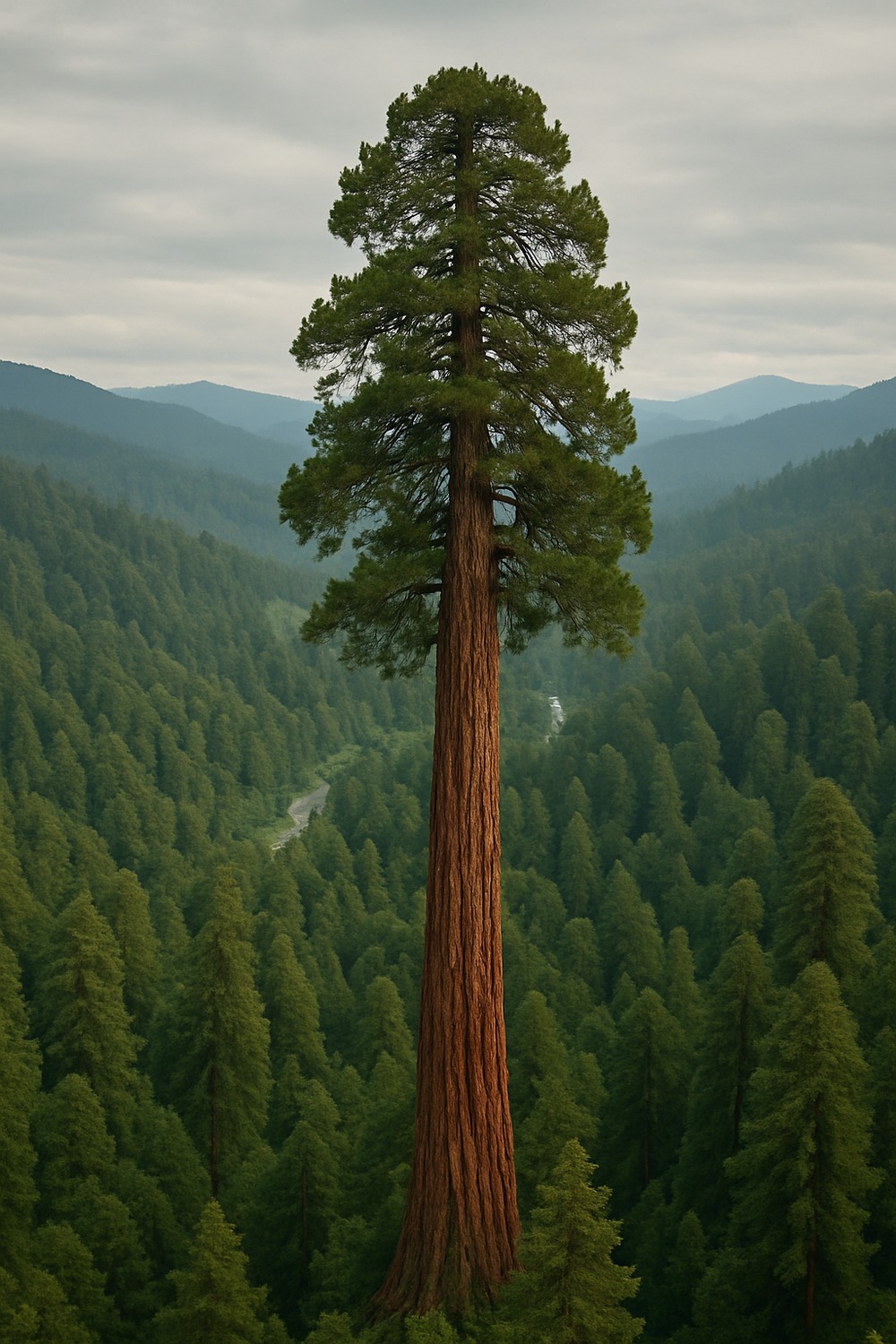
96% of old-growth redwood forest is gone. Before European settlement, coast redwoods covered roughly 2.2 million acres along California’s coast. Today, less than 110,000 acres of original old-growth remains. The logging era moved fast and left almost nothing — redwood timber was too valuable, resistant to rot and easy to work, and entire ancient groves disappeared in decades. Redwood National and State Parks protect what’s left.
Hyperion survived because it was hard to reach. Difficult terrain. That’s it. Not policy. Not foresight. Not some early conservationist who recognized its value. Just a hillside that was inconvenient enough that the crews moved on.
The world’s tallest known living thing exists by accident.
Everything around it — the mycorrhizal network, the centuries of accumulated soil biology, the fog-capture system that took longer to evolve than most countries have existed — nearly vanished before anyone fully understood what any of it was. We got lucky. Narrowly, accidentally lucky.
By the Numbers
- 380.3 feet (115.92 meters) tall — confirmed in 2006, beating the previous record by over 8 feet.
- Old-growth coast redwood forest once covered 2.2 million acres; today less than 110,000 acres remain, a reduction of roughly 96% since the mid-1800s.
- Suzanne Simard’s research showed that mycorrhizal networks can link hundreds of trees across several acres in a single system — and a single mother tree can be networked to dozens of neighboring species at once, simultaneously feeding and receiving signals from trees it has no genetic relationship to.
- Over 2,000 years, some documented.
- The oldest confirmed coast redwood was estimated at 2,520 years — meaning some trees alive right now in Redwood National Park germinated before the fall of the Roman Republic.

Field Notes
- Woodpecker damage at Hyperion’s crown may have actually capped its height — the tree could theoretically be taller without it.
- Coast redwoods don’t rely primarily on rainfall. They absorb fog directly through their leaves, pulling moisture from the marine air that rolls in off the Pacific — a system so efficient that fog drip from a single large tree can contribute hundreds of gallons of water to the surrounding soil annually, feeding the understory even in dry summers.
- Thousands of trees in Redwood National Park have never been precisely measured.
- Hyperion was only found because Chris Atkins and Michael Taylor were running a systematic survey. Given how much terrain remains unmeasured, there’s a real possibility something taller is still out there, unrecorded, in a valley nobody’s worked through yet.
What Hyperion Actually Teaches Us About Nature
The record is almost beside the point.
What Hyperion actually represents is a system — six hundred years of fog and fungi and interconnected roots and chemical signaling passing warnings through the soil — that we came within logging roads of destroying before we understood what it was. The science of mycorrhizal networks is barely thirty years old. The idea that trees actively support each other across a distributed biological network is still filtering its way into mainstream ecology textbooks. We protected these forests late. Partially. And mostly by accident. The understanding of why they matter came even later than the protection.
The forests still standing aren’t just scenic. They regulate coastal moisture. They store carbon at rates that managed timber plantations can’t match. They maintain soil biology that took centuries to develop and genuinely cannot be replanted in a season or a decade. Losing them isn’t like losing a building. It’s closer to losing a language that has no dictionary — once it’s gone, there’s no reconstructing what was in it.
Somewhere in a valley that most people will never visit, a tree that started growing before the Renaissance is still doing what it’s always done. Pulling fog out of Pacific air. Feeding its neighbors through threads in the soil. Adding another ring. It doesn’t need to be found. It doesn’t need a plaque. It just needs to be left alone — which, given everything, is the one thing we’ve managed to do right. If this kind of thing keeps you up at night, there’s more waiting at this-amazing-world.com. The next one is stranger.


