


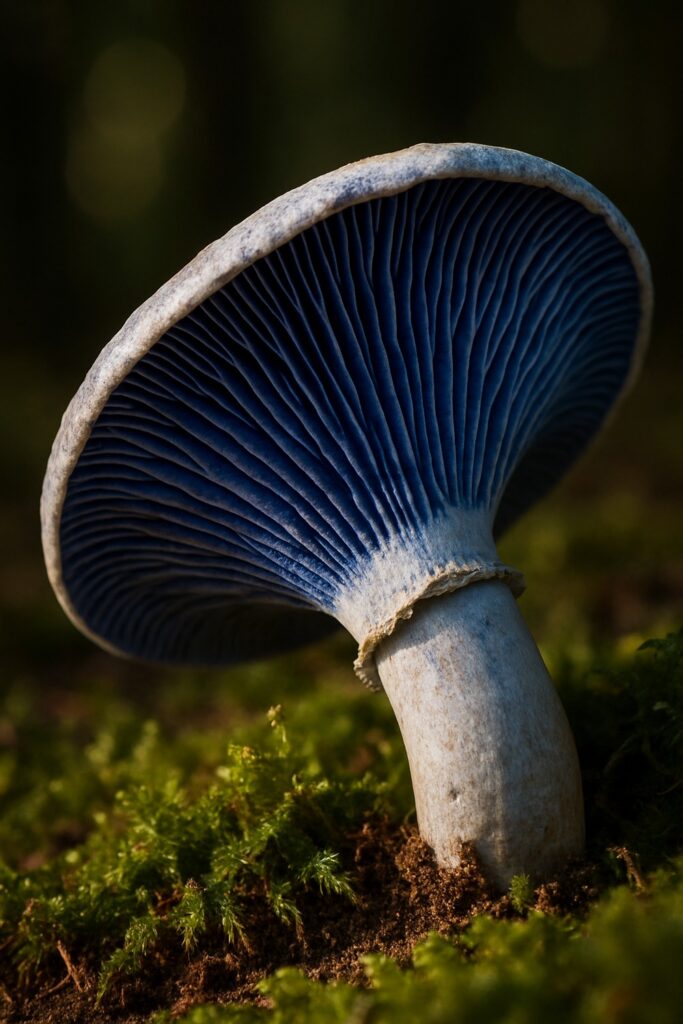
Most forests don’t do blue. Not real blue — not the kind that lives in the tissue, that bleeds when you cut it, that sits there on your palm looking like it arrived from somewhere the periodic table forgot to mention. The indigo milk cap blue mushroom does all of that. Fewer than one in ten temperate fungal species ever studied carry true blue pigmentation, and Lactarius indigo doesn’t just qualify — it makes the color look inevitable.
This is a mushroom with a distribution spanning three continents, a chemistry closer to chamomile extract than forest floor, and a reputation for being dangerous that it has never once earned. Almost everyone who finds it assumes it’s poisonous. The real question — the one mycologists keep circling back to — is why nature bothered producing something this blue at all.
Why the Indigo Milk Cap Blue Mushroom Is So Unusual
Mycologist and color researcher David Lee noted in his 2007 book Nature’s Palette that true blue pigmentation occurs in fewer than one in ten plant and fungal species studied across temperate ecosystems — a figure that excludes structural color produced by light refraction entirely. Researchers at the Royal Botanic Gardens, Kew, have catalogued the biochemical pathways involved: metabolically expensive, evolutionarily uncommon, and mostly absent from the fungal kingdom. Most organisms never developed them.
Lactarius indigo, however, didn’t get that memo. What makes this mushroom stranger still is the source of its color. Not a fluke of light, not an optical trick — the blue is a genuine pigment, a guaiazulene derivative baked into the tissue itself. That’s a crystalline hydrocarbon more commonly associated with chamomile extract and high-end skincare serums than with something growing out of damp leaf litter.
The Pigment Chemistry Behind This Electric Blue
Guaiazulene belongs to the azulene family of hydrocarbons — bicyclic compounds with a deep blue-violet hue that fascinated chemists from the moment of their isolation in the 19th century. In Lactarius indigo, the pigment occurs as a derivative integrated directly into the mushroom’s latex, the milk-like fluid that oozes from any cut or broken surface. Dr. Mariana Simões-Araújo of Brazil’s Embrapa research institute has described the compound as sitting at a peculiar chemical crossroads: it behaves more like a secondary metabolite from a plant than a typical fungal compound (and this matters more than it sounds, because it raises serious questions about convergent biochemical evolution).
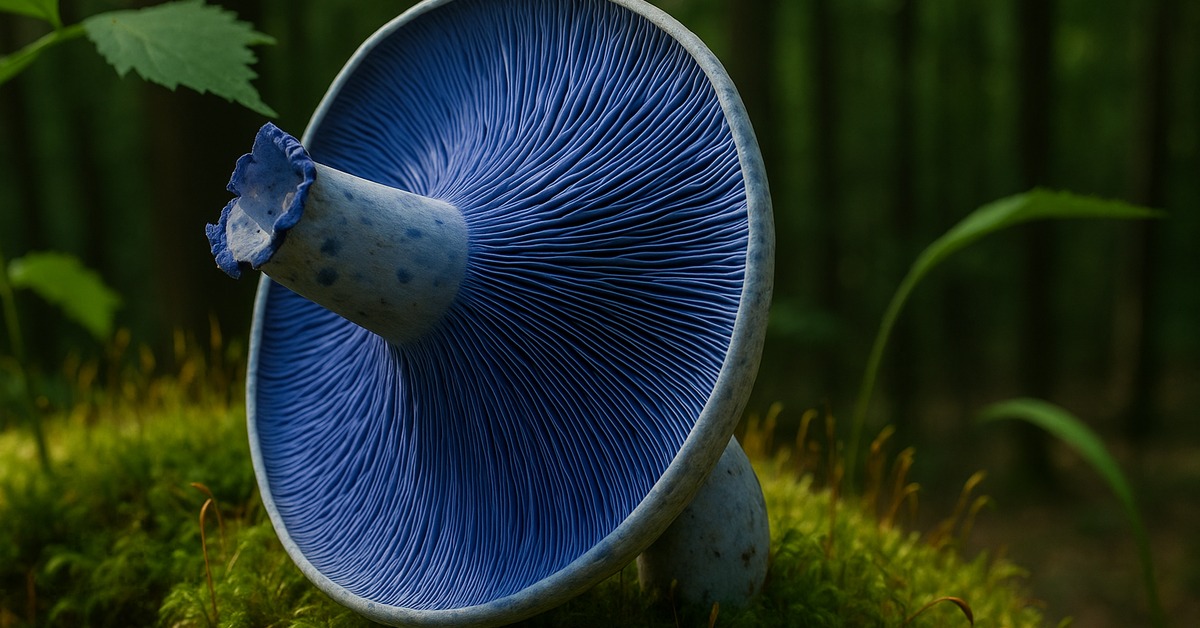
Here’s the thing about the chemistry. Bruise the flesh, expose the latex to air, and oxidation intensifies the color — it deepens, almost like a bruise blooming in slow motion. Rapid, visible to the naked eye, happening right there in your palm. It’s one of the only fungi in the world where you can watch pigment chemistry work in real time. If you’re curious about other organisms that evolved surprising chemical defenses in unexpected places, this piece on animals with bizarre natural defenses at This Amazing World covers some equally counterintuitive cases.
Blue in Nature: A Color That Almost Doesn’t Exist
Why does this matter? Because almost every blue thing you’ve ever seen in nature is an illusion. A 2012 analysis in Current Biology found that fewer than 10 percent of flowering plant species produce blue flowers — and of those, many achieve the effect through pH manipulation of red anthocyanin pigments, not true blue compounds. The morpho butterfly’s wings are blue because of nanostructural light interference, not pigment. Even the vivid blue of a poison dart frog contains no single blue molecule. True blue pigmentation, the kind the indigo milk cap blue mushroom carries, is a biochemical rarity approaching the level of a statistical anomaly.
That context hits differently when you’re standing in an oak forest in Tennessee or Oaxaca, looking down at something that looks like it was painted by hand.
The forest doesn’t do blue like this. Nothing nearby does.

The Indigo Milk Cap Blue Mushroom You Can Actually Eat
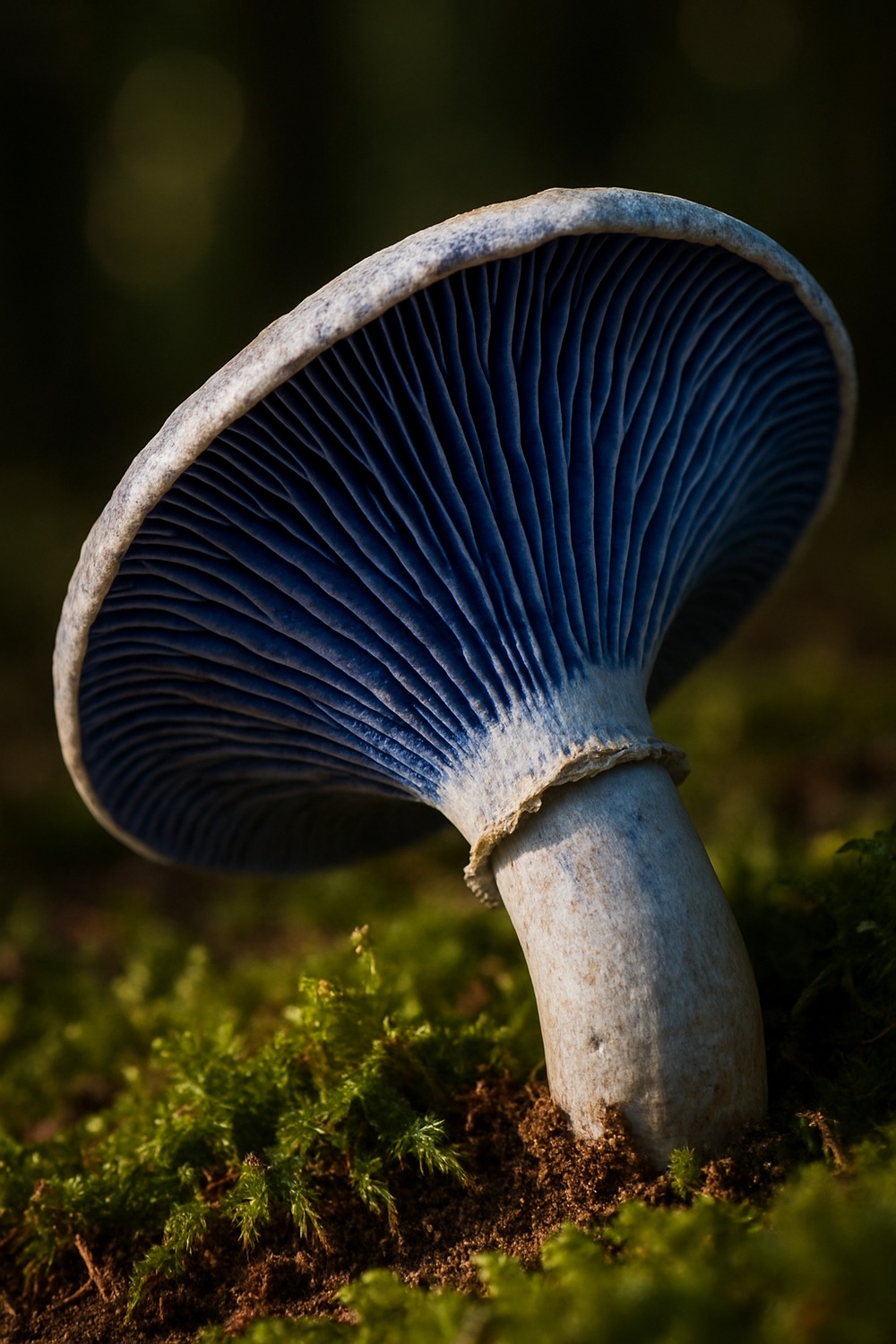
Here’s the paradox that trips everyone up: the indigo milk cap blue mushroom is edible. Not just technically edible in a survival-situation way — genuinely consumed, intentionally, across multiple cultures and centuries. In Mexico’s Oaxacan markets, Lactarius indigo appears seasonally alongside other foraged fungi, known as hongo azul or simply “the blue one.” Markets in Yunnan Province, China, have sold it for generations. Deep blue coloring, in nearly every other context in nature, signals toxicity — poison dart frogs, certain amanitas, blue-ringed octopuses. Turns out that signal is entirely misleading here. The indigo milk cap carries no known toxins dangerous to humans at normal consumption levels.
A species that looks this dangerous should be left alone — that’s what every ecological instinct says, and the indigo milk cap has spent centuries quietly proving those instincts wrong.
Heat is another matter. Cook the mushroom and the vivid guaiazulene-derived blue fades to a dull, unglamorous gray — as if the chemistry that makes it extraordinary is precisely the chemistry that makes it disappear under heat. That color loss almost certainly explains why it’s underutilized as a food source in North America. Few people trust a mushroom that looks like old dishwater on the plate, even if it tasted magnificent before the pan.
A Fungal Mystery Spanning Three Continents
Genetic distance is where the story gets genuinely strange. DNA analyses of North American and Asian populations have revealed enough divergence to suggest millions of years of isolation — yet the pigment chemistry remains almost identical across both. That’s not supposed to happen easily.
This disjunct distribution — the same species on opposite sides of the planet with a gap in between — suggests either a very ancient origin predating continental drift, or multiple independent evolutionary events producing a functionally identical organism. Lactarius indigo appears in deciduous and mixed forests across the eastern United States, throughout Mexico and Central America, and in separate populations across East and Southeast Asia, yet it’s largely absent from Europe. The latter possibility, that two separate fungal lineages evolved the same rare blue chemistry independently, would rank among the more striking examples of convergent evolution in all of mycology. If guaiazulene derivatives are metabolically costly and evolutionarily rare, why did nature land on this exact solution twice, or perhaps more?
And scientists haven’t resolved it cleanly.

How It Unfolded
- 1863 — Guaiazulene first isolated from chamomile essential oil, introducing chemists to the azulene hydrocarbon family and its deep blue-violet properties
- 2007 — David Lee’s Nature’s Palette formally catalogues true blue pigmentation as occurring in fewer than one in ten temperate plant and fungal species studied
- 2012 — Current Biology analysis confirms fewer than 10% of flowering plant species produce genuine blue pigmentation, cementing blue as one of nature’s rarest biochemical achievements
- 2024 — Ecological function of Lactarius indigo‘s guaiazulene derivative remains unresolved; ITS ribosomal DNA sequencing places East Asian and North American population divergence at roughly 3–4 million years
By the Numbers
- Fewer than 10% of flowering plant species produce true blue flowers through direct blue pigmentation, rather than pH-shifted anthocyanins (Current Biology, 2012)
- Lactarius indigo fruitbodies typically measure 5–15 cm in cap diameter, with latex that stains tissue within approximately 30 seconds of air exposure
- Guaiazulene was first isolated from chamomile essential oil in 1863 — over 150 years before its derivatives in fungi were examined with modern spectroscopic methods
- East Asian Lactarius indigo populations show genetic divergence equivalent to roughly 3–4 million years of reproductive isolation from North American populations, based on ITS ribosomal DNA sequencing
Field Notes
- Slice Lactarius indigo and leave it exposed to air, and the blue latex doesn’t just discolor — it intensifies first, darkening visibly over several minutes through active oxidation, a reaction that amateur foragers have compared to watching ink develop on old photographic paper.
- Mycorrhizal relationships with oaks, pines, and certain hickories mean this mushroom cannot be cultivated in isolation — it needs its tree partner to survive, which is part of why you won’t find it at a farmers’ market despite being edible.
- The ecological function of the guaiazulene derivative remains genuinely unresolved; leading hypotheses include deterrence of fungal competitors and insect grazers, but no controlled field study has conclusively demonstrated either mechanism as of 2024.
Frequently Asked Questions
Q: Is the indigo milk cap blue mushroom safe to eat?
Lactarius indigo is considered edible and has been consumed in Mexico and parts of East Asia for generations. No known dangerous toxins appear at normal consumption levels, though correct identification — as with any wild mushroom — is essential before eating. The striking blue color is not an indicator of toxicity.
Q: Why does the blue color disappear when you cook it?
High temperatures break down the guaiazulene derivative’s chromophore — the part of the molecule responsible for absorbing light in the blue spectrum — causing the vivid indigo to degrade into dull gray-brown tones. Chemically stable at room temperature, the pigment simply can’t survive the sustained heat of a frying pan or oven.
Q: Why does this mushroom produce blue pigment at all?
Researchers don’t yet fully understand it. Leading hypotheses suggest the guaiazulene derivative may deter competing fungi, insect grazers, or microbial pathogens — a chemical defense system expressed as color. But no definitive study has confirmed any single ecological function, and the fact that the pigment intensifies on exposure to air only adds another layer of mystery to what the mushroom might be biochemically “doing” with it.
Editor’s Take — Sarah Blake
What stays with me isn’t the blue itself — it’s the gap between what we assume and what’s true. A pigment borrowed from chamomile chemistry, a distribution that spans oceans and millions of years, a color that screams danger and means nothing of the sort. Science has been staring at Lactarius indigo for over a century and still can’t explain why it chose this particular solution. Sometimes a mushroom on a forest floor holds more open questions than an entire laboratory — and the ones we keep failing to answer are the ones most worth carrying.
A mushroom that bleeds blue, persists on two continents separated by millions of years of evolution, tastes fine on a plate, and carries a pigment borrowed from the chemistry of skincare — it’s a reminder that nature’s most interesting puzzles aren’t always hiding in deep oceans or rainforest canopies. Sometimes they’re underfoot, in a temperate forest in October, asking to be noticed. What else are we walking past without looking down?


