The Keel-Billed Toucan’s Beak: Nature’s Masterpiece
Here’s the thing about the keel-billed toucan beak: it shouldn’t work. One-third of the bird’s entire body length, yet it weighs almost nothing — a structural paradox that stumped engineers until they actually cut one open. Stand in a Costa Rican rainforest at dawn and that kaleidoscope bill catches light before anything else does. Electric green, sky blue, burnt orange. Evolution didn’t lose a bet. It ran the numbers differently than we did.
The Keel-billed Toucan, Ramphastos sulfuratus, ranges from southern Mexico through Colombia and Venezuela, threading through lowland tropical forests that are increasingly fragmented by agriculture. Despite being one of the most visually recognizable birds on Earth — the one on the Froot Loops box, the one on a hundred Costa Rican tourism posters — science is still arguing about what that extraordinary beak is fundamentally for. The answers keep multiplying. And they keep getting stranger.
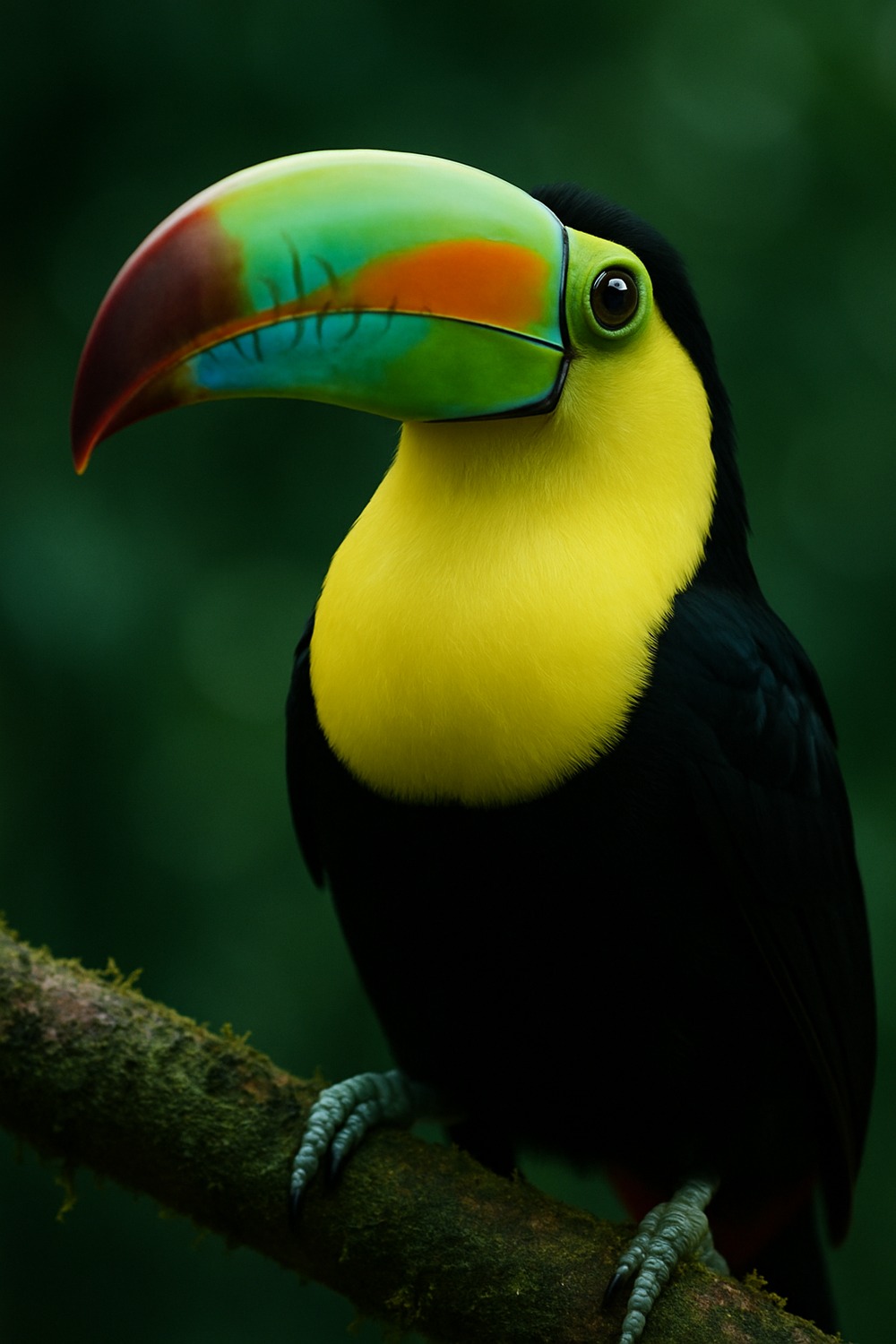
Inside the Keel-Billed Toucan’s Beak: Aerospace Engineering
In 2011, researchers at the University of California San Diego published a structural analysis of the Toco Toucan’s bill — the largest of all toucan beaks — in the journal Acta Biomaterialia. What they found stopped engineers cold. The beak’s outer shell is made of keratin tiles, the same protein that builds your fingernails, arranged in overlapping hexagonal layers like a biological composite material. Beneath that shell sits a three-dimensional foam of bone struts — calcium-rich rods crisscrossing an interior that is, structurally, almost entirely air. The result is a bill that achieves extraordinary rigidity for a fraction of the mass you’d expect.
Keratin is not, by most standards, exotic engineering material. What makes the keel-billed toucan beak remarkable is how precisely it’s been deployed: layered, tensioned, and foamed into something that rivals modern sandwich-panel composites used in aircraft fuselages. Evolution arrived at this solution millions of years before we did.
The numbers are genuinely startling. The beak can represent between 30 and 50 percent of the bird’s total body surface area, yet accounts for only around five percent of its total body mass. For a bird weighing roughly 380 grams, that’s an extraordinary weight-to-volume ratio. Mechanical engineers who’ve modeled the internal structure found that the bone foam absorbs energy and resists bending forces without adding significant weight — the same principle behind aerospace honeycomb panels.
Watch a Keel-billed Toucan navigate a dense rainforest canopy and the bill’s lightness becomes obvious. It doesn’t drag the bird forward or destabilize its posture. It swings cleanly, responds fast. The bird moves like the beak isn’t there at all. That’s the point.
What the Beak Actually Does All Day
Why does this matter? Because foraging alone doesn’t come close to explaining what the keel-billed toucan beak is doing. The leading functional explanation for its reach is foraging efficiency — specifically, fruit-snatching from branch tips too slender to support the bird’s full body weight. Toucans can extend that serrated bill to pluck a berry from a twig that would snap under their feet, then flip the fruit backward into their throat with a practiced toss of the head. It’s like eating with an arm instead of a mouth. But the beak is also deeply social. Keel-billeds engage in a behavior researchers call “bill fencing” — two birds clashing bills in what appears to be play or competitive display — the kind of exuberant, contact behavior you see in animals where physical signals carry real information about strength and condition, much like the extraordinary ear-temperature regulation seen in the antelope jackrabbit, where a body part that seems excessive is actually doing precise physiological work. You can read about how desert animals use oversized anatomy for thermoregulation — and the toucan fits neatly into that same conversation.
Thermoregulation is, in fact, emerging as one of the beak’s most important and underappreciated functions. In 2009, a team led by Glenn Tattersall at Brock University in Ontario used infrared thermal imaging to monitor heat flow through Toco Toucan bills during periods of rest and stress. They found that the birds actively shunt warm blood into the bill’s surface network of vessels to dump heat — essentially using it as a radiator — and then restrict that blood flow to conserve warmth at night. The beak functions like a tunable thermal window, adjusting heat loss by up to 400 percent between open and restricted states. That’s a physiological control system of genuine sophistication (researchers actually call this “regional heterothermy,” and it’s rarer than it sounds).
At night, groups of Keel-billeds squeeze into shared tree cavities to roost communally. They rotate their beaks back over their bodies just to fit. A structure that screams excess by day becomes a quietly folded tool by dark. Economy disguised as extravagance. It keeps happening with this bird.
Forty-Five Species, Forty-Five Different Problems
Ramphastidae — the family the keel-billed toucan belongs to — contains 45 recognized species distributed across tropical Central and South America, each with a beak shaped by a slightly different set of ecological pressures. Toco Toucans have the largest bills, extending nearly 20 centimeters. The Lettered Aracari’s beak is narrow and serrated like a bread knife. The Curl-crested Aracari has feathers that look like vinyl records. The variation within this single family is a textbook case of adaptive radiation — one ancestral body plan splintering into dozens of ecological specialists over millions of years.
A 2019 study traced how sexual selection and ecological competition have driven beak shape divergence across the family, with different species occupying different fruit-size niches within overlapping forest ranges. The keel-billed toucan beak sits in the mid-range — big enough to reach large fruit, maneuverable enough to handle small ones. A generalist in a family of specialists. When you line up the 45 species side by side, the variation is almost comic — and yet each bill is a precise answer to a precise question the forest keeps asking.
What’s counterintuitive is how much of the beak’s function may relate to things we still can’t directly measure — mate assessment, species recognition, and the signaling of immune fitness. Bright bill coloration in toucans is produced by carotenoid pigments acquired through diet, which means the intensity and pattern of those colors is a direct proxy for foraging quality, gut health, and metabolic efficiency. A dull bill isn’t just aesthetically inferior. It’s a health report. Potential mates read it accordingly.
A beak doing this many jobs simultaneously, and we spent decades calling it ornamental. The data left no room for that interpretation — the field just took a long time to look.
That changes how you look at the colors. It’s not decoration layered on top of function. The decoration is the function. The billboard and the tool are the same object, inseparable, built from the same piece of keratin and bone foam.
How the Keel-Billed Toucan Beak Survives Real Threats
Habitat loss is the primary driver of pressure on this species. The lowland tropical forests of Central America and northern South America — the keel-billed toucan’s core range — have been cleared at an accelerating rate for cattle pasture, palm oil, and banana plantations. Understanding the beak’s biology matters more now than it once did, because the species faces a converging set of pressures that put the whole system at risk. Cornell Lab of Ornithology, which has tracked Neotropical bird populations through its eBird database since 2002, has documented range contractions for Keel-billed Toucans across the Pacific slope of Costa Rica and in fragmented forest patches in Colombia’s Magdalena Valley. Two critical needs explain why the birds struggle in degraded landscapes: sufficient fruit tree diversity to sustain a year-round diet, and large-diameter old-growth trees with natural cavities for roosting and nesting. Remove the old growth, and the roosting sites disappear before the food does.
And there’s a second threat that operates more quietly: the cage-bird trade. The keel-billed toucan beak makes the species immediately recognizable and, to some collectors, immediately desirable. Despite CITES Appendix II protections that regulate international trade, illegal capture persists in parts of Honduras, Nicaragua, and Guatemala. Captured juveniles — taken before they’ve fully developed that iconic beak — are often kept in conditions that result in permanent bill deformities from nutritional deficiencies. A bird with a deformed bill can’t forage efficiently, can’t thermoregulate properly, and can’t signal fitness to mates. The beak that defines the species becomes the mechanism of its suffering.
Conservation organizations like the Ara Project in Costa Rica and Toucan Rescue Ranch in La Fortuna have taken in injured and confiscated Keel-billeds, rehabilitating birds with bill damage and reintroducing them where forest cover remains. The work is painstaking. But it’s happening.
Where to See This
- Tortuguero National Park and Braulio Carrillo National Park in Costa Rica offer reliable Keel-billed Toucan sightings year-round, with the dry season (December–April) providing clearer canopy visibility and peak bird activity.
- Toucan Rescue Ranch in La Fortuna, Costa Rica (toucanrescueranch.org) runs educational tours and houses rehabilitated toucans; it’s among the few places you can observe the birds at close range while supporting genuine conservation work.
- Cornell Lab of Ornithology’s free eBird platform (ebird.org) lets you track real-time sighting hotspots across the species’ range — filter by “Ramphastos sulfuratus” to find exactly where birders are seeing them right now.
By the Numbers
- The keel-billed toucan beak represents 30–50% of the bird’s total body surface area but only ~5% of its body mass (University of California San Diego, 2011).
- Toucan bills can adjust heat dissipation by up to 400% between maximum and minimum blood flow states (Brock University, 2009).
- Ramphastidae contains 45 recognized species, distributed across tropical regions from Mexico to northern Argentina.
- Keel-billed Toucans typically weigh 380–500 grams, with the bill alone accounting for approximately 19–23 grams of that total.
- CITES Appendix II listing regulates international trade in the species; illegal domestic trade remains active in at least four Central American countries as of 2023.
Field Notes
- In 2009, Glenn Tattersall’s infrared imaging study at Brock University revealed that toucans can shift from maximum heat-dumping mode to near-full heat-retention in under three minutes — a circulatory response faster than most mammals can manage in equivalent thermal challenges.
- Keel-billed Toucans don’t excavate their own nest cavities. They rely entirely on natural hollows or holes made by woodpeckers — which means their nesting success is directly tied to woodpecker populations in the same forest.
- Serrated edges on the keel-billed toucan beak aren’t for cutting — they’re for grip. The serrations help the bird hold slippery fruit during the backward toss maneuver that’s the species’ primary swallowing technique.
- Researchers still can’t fully explain how Keel-billed Toucans maintain structural integrity in the beak as the bird ages. Bill tip wear patterns suggest active repair processes, but the cellular mechanism for keratin renewal in the bill hasn’t been characterized with the same precision as in mammalian nails.
Frequently Asked Questions
Q: Why is the keel-billed toucan beak so large compared to its body?
At least three simultaneous selection forces shaped it: foraging reach, thermoregulation, and mate signaling. Longer bills allow fruit to be plucked from branch tips too thin to support the bird’s weight. The bill surface acts as a heat radiator. And the coloration signals genetic fitness. No single explanation covers it — the keel-billed toucan beak is doing multiple jobs at once, which is why it grew this large and stayed this large.
Q: How does something that big not weigh the bird down?
The internal structure of the keel-billed toucan beak is largely empty space — a lattice of thin bone struts surrounding air pockets, analogous to aerospace sandwich-panel composites. The outer keratin shell is layered in overlapping tiles that distribute mechanical stress without requiring dense, heavy material. The result is a beak that achieves structural rigidity at roughly one-twentieth of the weight you’d expect for its size. Engineers at UC San Diego’s materials science department analyzed this in 2011 and described it as a genuinely novel biological composite architecture.
Q: Do toucans actually use their beaks as weapons?
Not in the way most people assume. The keel-billed toucan beak looks formidable, but it’s not a predator’s tool — the bone foam interior would compromise its structural integrity under serious impact loading. What toucans do use it for is ritualized “bill fencing,” a contact behavior between individuals that functions more like a test of condition than a genuine fight. Real aggression in toucans tends to involve wing-spreading and vocalizations rather than bill-to-bill combat. The beak intimidates. It doesn’t brawl.
Editor’s Take — Alex Morgan
What strikes me most about the keel-billed toucan beak isn’t the engineering — it’s the misreading. For decades, the working assumption was that the bill was primarily a sexual ornament, full stop. Thermoregulation was a footnote. Then infrared imaging arrives in 2009, and suddenly the radiator function is arguably as important as the signal function. That’s not a small correction. It’s a reminder that when something looks like pure display, you haven’t finished asking questions. You’ve barely started.
The keel-billed toucan beak has been staring at us from rainforest canopies for as long as humans have walked beneath them. We named it, painted it, put it on cereal boxes, and still spent a century underestimating what it does. That gap — between how well we think we know something and how well we actually do — exists everywhere in the natural world. The forest canopy is full of structures we’ve catalogued and not yet understood, functions we’ve observed and not yet explained. The next time something in nature looks excessive, looks like a joke, looks like too much — it probably isn’t. It’s probably doing four things at once, and we’ve only noticed two.