


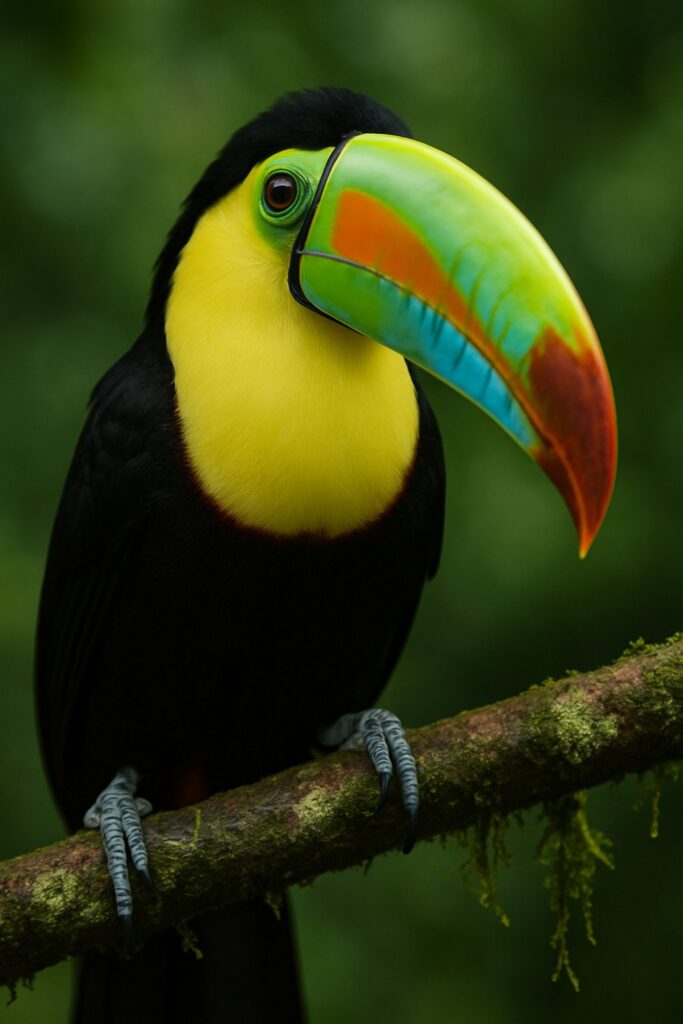
Here’s the thing about the keel-billed toucan beak: it shouldn’t work. One-third of the bird’s entire body length, jutting forward like a structural dare — and yet it accounts for barely a twentieth of the animal’s total weight. That’s not a coincidence. That’s the whole story, compressed into a single improbable instrument that evolution spent millions of years quietly perfecting while everyone assumed it was just for show.
Stand in the lowland rainforests of Costa Rica, Panama, or Colombia and you’ll eventually spot one — a Keel-billed Toucan perched in the canopy, that impossible bill catching the light like broken stained glass. Electric green bleeding into sky blue, tipped with burnt orange. It looks structurally absurd. So why has this bird carried that beak for millions of years, and what exactly is it telling us?

The Beak’s Impossible Architecture Explained
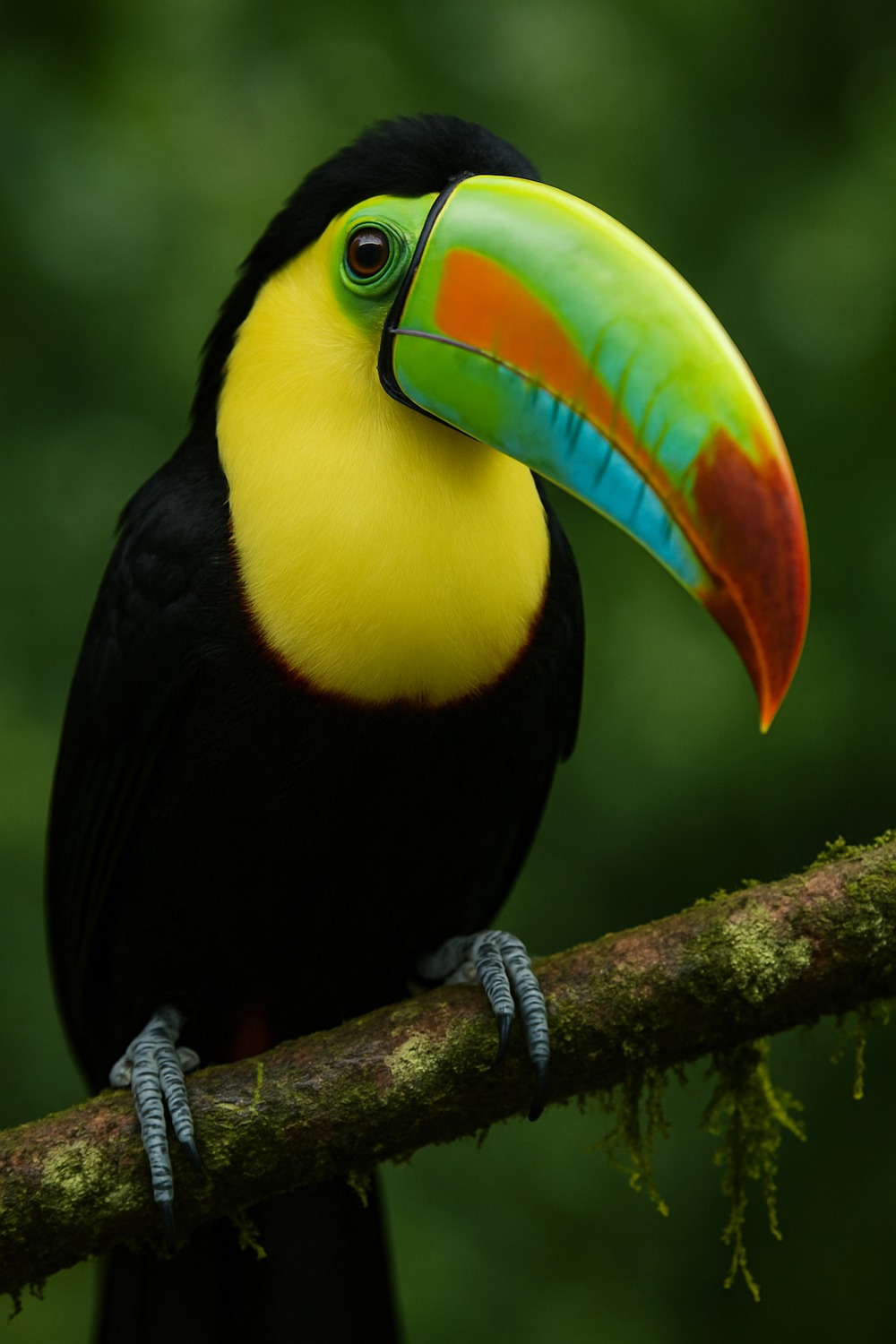
The keel-billed toucan beak can reach up to 20 centimeters in length — roughly half the bird’s body length when measured beak-tip to tail, and one-third of its total body mass distribution. Despite its visual dominance, the beak accounts for just one-twentieth of the bird’s total body weight. That feat of structural engineering comes down to what’s inside: not solid bone, but a three-dimensional lattice of thin bony struts, surrounded by a shell of keratin — the same protein that makes up your fingernails and a rhinoceros’s horn. Researchers at the Universidad Nacional Autónoma de México published detailed micro-CT analysis of toucan bill architecture in 2005, describing it as a natural sandwich composite: stiff outer shell, lightweight foam-like interior. Their findings revealed the internal trabecular bone creates extraordinary rigidity without the weight penalty a solid structure would demand.
Aerospace engineers took notice. That same paper drew direct comparisons between toucan bill architecture and man-made composite panels used in aircraft fuselage construction — materials designed specifically to maximize strength-to-weight ratio. It’s not a loose metaphor. Evolution, working blind across millions of years, arrived at nearly the same answer humans took decades to engineer deliberately. The outer keratin layer handles compression and tensile stress; the inner lattice distributes load across the structure; the result is a tool that can grip, pry, and peel fruit without flexing or fracturing under normal use.
Watch a Keel-billed Toucan feeding and the engineering becomes visible. The bird doesn’t crush fruit. It grips the item at the tip, tilts its head back, and tosses the food toward the throat in a smooth, practiced motion. The beak isn’t brute force. It’s precision.
Two Jobs, One Extraordinary Tool
A structure this elaborate rarely evolves for a single purpose, and the keel-billed toucan beak is no exception. The two leading explanations — foraging efficiency and sexual selection — aren’t competing theories. They’re probably both true, running simultaneously. Consider the foraging argument first. Keel-billed Toucans are fruit specialists, and tropical rainforest canopies present a logistical problem: the best fruit often dangles from branches far too slender to support a bird’s full body weight. The long bill solves this elegantly — the toucan perches on a stable branch and reaches, extending its center of gravity forward, plucking food from twigs it could never safely land on. This kind of feeding strategy isn’t unique to toucans; other birds have evolved analogous solutions. But the degree to which the bill dominates the toucan’s body plan suggests the selective pressure here was intense.
What’s striking is how this mirrors a pattern you see across wildly different species — animals that use body structures as remote-access tools to exploit resources competitors can’t reach. If you’ve ever read about how crows deploy their bodies in surprisingly sophisticated ways, you’ll recognize the same underlying logic: anatomy shaped by behavioral pressure, over time, until the behavior and the body become inseparable.
The sexual selection argument is harder to quantify but no less compelling. Female Keel-billed Toucans select mates partly based on bill quality. A larger, more vividly colored bill signals genetic fitness — specifically, resistance to parasites and disease, adequate nutrition, and overall developmental stability. Research from the Smithsonian Tropical Research Institute in Panama, ongoing since the 1990s, has tracked how bill coloration in toucans correlates with carotenoid pigment levels, which in turn reflect diet quality and health. A washed-out bill isn’t just less attractive. It tells a potential mate something real about the bird’s condition — and unlike human advertising, it can’t lie.
What makes this dual-purpose story remarkable is scale. The bill isn’t slightly elongated for foraging and slightly colorful for display. It’s dramatically both. The selective pressures didn’t compromise each other — they stacked. Each amplified the value of the other. A bird with a longer, more striking bill reaches more fruit and attracts better mates, and both outcomes improve reproductive success, pushing the bill further toward excess with every generation.
The Thermoregulation Discovery Nobody Expected
Why does this matter? Because for most of the twentieth century, scientists had already decided they understood what the toucan bill was for — and they were only partly right.
Foraging and mate selection dominated the conversation about toucan bill evolution until 2009, when a study published in Science upended the conversation entirely. A team led by Glenn Tattersall at Brock University in Ontario used infrared thermal imaging to measure heat dissipation across the surfaces of Toco Toucans — the largest species in the family. By dilating or constricting blood vessels inside the bill, the bird can regulate how much heat it loses to the surrounding air. When too warm, blood flow to the bill increases dramatically and the surface temperature rises by several degrees, dumping excess heat. When the bird needs to conserve warmth overnight, blood flow drops and the bill surface cools. The keel-billed toucan beak shares this vascular architecture, and while Tattersall’s direct measurements focused on Toco Toucans, the thermoregulatory mechanism is considered consistent across large-billed toucans based on comparative anatomy studies conducted since 2009.
A structure we thought we understood had an entirely new layer of purpose — and it had been there the whole time.
What looked like sexual excess might also be physiological necessity. What looked ornamental might be functional in a way nobody thought to measure until thermal imaging technology made it visible. Larger bills, in hot, humid lowland rainforests, may provide a competitive advantage simply by keeping the bird cooler with less metabolic cost. The keel-billed toucan beak, it turns out, is also an air conditioner. That changes how you read the whole evolutionary story. The beak didn’t change between 2008 and 2010. Our instruments did.
What the Keel-Billed Toucan Beak Reveals About Toucan Evolution
Forty-five recognized toucan species, distributed across Central and South America, each carrying a bill that answers the same evolutionary questions differently — this is what makes toucans so useful to researchers. Studying this diversity lets scientists treat toucan evolution like a natural experiment, each species a data point in a long-running test of what bill architecture is actually good for. Work published by the Field Museum of Natural History in Chicago in 2014, using phylogenetic analysis of museum specimens collected across 150 years, found that bill morphology in toucans has diversified far faster than would be expected under neutral evolution alone. The study’s authors argued that a combination of ecological niche differentiation and sexual selection operating independently in isolated populations produced the extraordinary variety we see today. The Keel-billed Toucan, Ramphastos sulfuratus, sits near the larger end of the size spectrum for its genus, with bill coloration researchers consider among the most complex in the family.
When two selective forces push in the same direction, the result isn’t incremental — it’s exponential. And frankly, the pace of divergence documented in that 2014 study makes a strong case that sexual selection in toucans is more powerful than most models had previously assumed. Each generation that preferred slightly longer, brighter bills produced offspring with slightly longer, brighter bills. Multiply that across hundreds of thousands of generations, add geographic isolation, add varying thermal environments, and you get a family of birds whose defining feature has become almost absurdly diverse.
But researchers at the Cornell Lab of Ornithology are now using bioacoustic data alongside morphological measurements to understand how bill size affects the calls Keel-billed Toucans make — adding yet another potential function to an already overcrowded job description. The beak, it turns out, may also shape the voice.

Where to See This
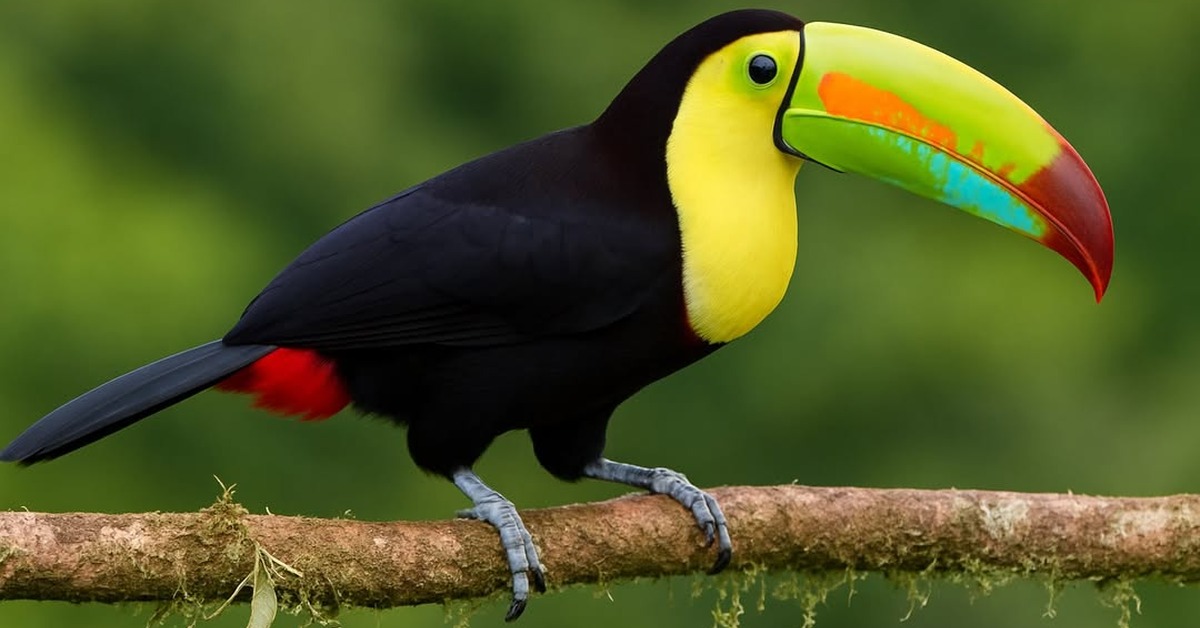
- Tortuguero National Park and La Selva Biological Station in Costa Rica offer consistent Keel-billed Toucan sightings year-round, with highest activity from March through September; La Selva, run by the Organization for Tropical Studies, is one of the best-studied tropical field stations in the Americas and frequently hosts visiting researchers and naturalist-guided tours.
- The Smithsonian Tropical Research Institute (STRI) in Panama operates field sites across the Panamanian lowlands — including Barro Colorado Island — where toucans have been observed and studied for decades; their public education resources at stri.si.edu include species profiles and ongoing research summaries.
- For readers who can’t travel, the Cornell Lab of Ornithology’s eBird platform (ebird.org) maps every reported Keel-billed Toucan sighting in real time across its entire range — a genuinely useful tool for understanding where and when this species appears, and how its range is shifting under climate pressure.
By the Numbers
- Up to 20 cm — maximum recorded length of a Keel-billed Toucan bill, roughly half the bird’s total body length (Smithsonian Institution species accounts)
- ~1/20th — the fraction of the bird’s total body weight represented by the bill, despite its visual dominance
- 45 — number of recognized toucan species in the family Ramphastidae, distributed across Central and South America
- ~10°C — the range of surface temperature variation recorded on a Toco Toucan’s bill during active thermoregulation, across a single 24-hour period (Tattersall et al., Science, 2009)
- 500–1,000 meters — typical elevation range for Keel-billed Toucan habitat; the species is predominantly a lowland bird, with documented populations from sea level to approximately 1,900 meters in Colombia
Field Notes
- At night, groups of up to six Keel-billed Toucans have been observed sharing a single tree cavity, each bird rotating its bill back over its body to reduce the space it occupies — a behavior documented by researchers at La Selva Biological Station in Costa Rica that reveals the beak’s flexibility in social contexts beyond display or foraging.
- Despite its size, the keel-billed toucan beak is capable of extraordinary delicacy — the birds have been observed removing external parasites from each other’s feathers using only the tip of the bill, a form of allopreaching that requires precise control of a structure nearly half their body length.
- Bill coloration comes from carotenoid pigments (researchers actually call this an “honest signal” in the strict biological sense) — which must be obtained through diet rather than synthesized internally, meaning a poorly fed toucan literally can’t fake a healthy-looking bill.
- Researchers still can’t fully explain why the bill’s coloration pattern — that specific sequence of green, blue, and orange — is so consistent within the species yet so different from closely related species. Whether the exact color sequence carries additional information beyond “this individual is healthy” remains an open question in toucan behavioral ecology.
Frequently Asked Questions
Q: Why is the keel-billed toucan beak so large compared to the bird’s body?
At least three documented functions are running simultaneously: the bill extends the bird’s reach to fruit on thin branches, functions as a thermal radiator for temperature regulation, and signals genetic fitness to potential mates. Each of these pressures independently favors a larger bill, and when multiple selective forces point in the same direction, the result tends toward the extreme. The beak’s internal lattice structure keeps it lightweight despite its size.
Q: How does the toucan manage to hold its head up with that enormous bill?
The bill weighs far less than it looks. The external keratin shell wraps around an internal network of thin bony struts — a natural composite structure that provides rigidity without mass. The whole bill accounts for roughly one-twentieth of the bird’s total body weight. Neck musculature in Keel-billed Toucans is proportionally well-developed for handling the bill’s moment arm, but because the bill is so light, the mechanical challenge is much smaller than the visual drama suggests. Engineers have described the internal architecture as comparable to aerospace composite panels.
Q: Is the keel-billed toucan beak used as a weapon?
Not primarily, and this is a common misconception. Keel-billed Toucans do use the bill in ritualized bill-fencing behaviors during territorial disputes or mate competition, but these interactions rarely cause injury. The bill’s composite structure, which prioritizes light weight over impact resistance, would actually make it a poor weapon for sustained physical conflict. Escape, not confrontation, is the bird’s real defensive strategy.
Editor’s Take — Alex Morgan
What stays with me about the keel-billed toucan beak isn’t the aerospace engineering comparison — though that’s genuinely startling. It’s the 2009 thermal imaging result. We’d been looking at this bird for centuries, painting it, cataloguing it, writing field guides about it. And the entire time, the beak was quietly running a temperature-management system nobody thought to check for. It makes you wonder how many other “ornamental” structures in nature are doing invisible functional work we haven’t thought to measure yet. The instruments we lack are always the ones that matter most.
And so the keel-billed toucan beak keeps accumulating functions — thermoregulator, foraging arm, fitness signal, voice shaper — each one discovered only after someone thought to look with the right instrument. Every time researchers add a new question, the beak turns out to have been doing something else they hadn’t noticed. That’s not unusual for complex biological structures. But it is a specific kind of humility lesson. The next time something in nature looks like excess, like a joke, like pure extravagance without purpose — look harder. The explanation is probably already there, waiting for a better question.


