A Chicken Head Survived KFC’s Entire Process — Eyes Shut
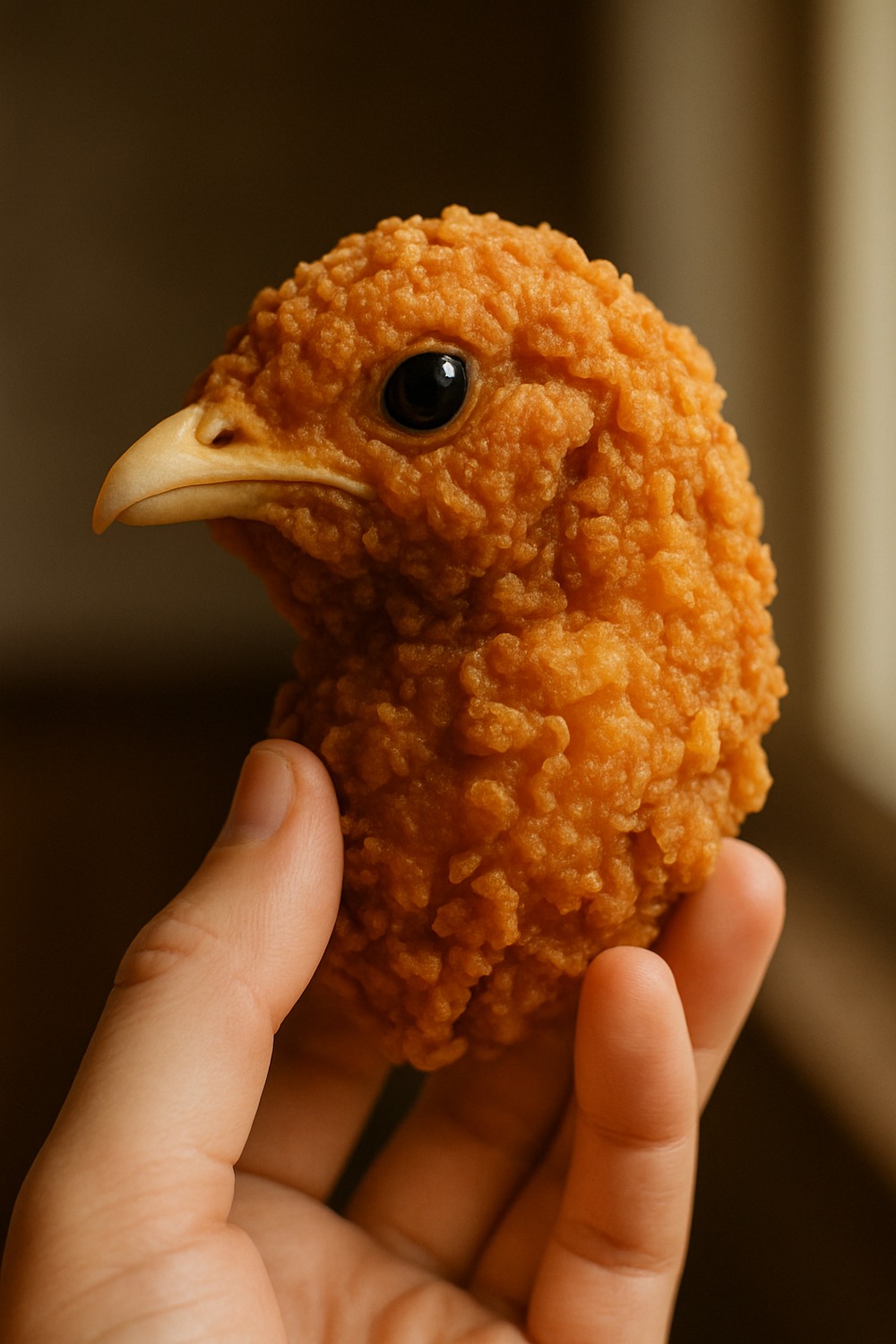
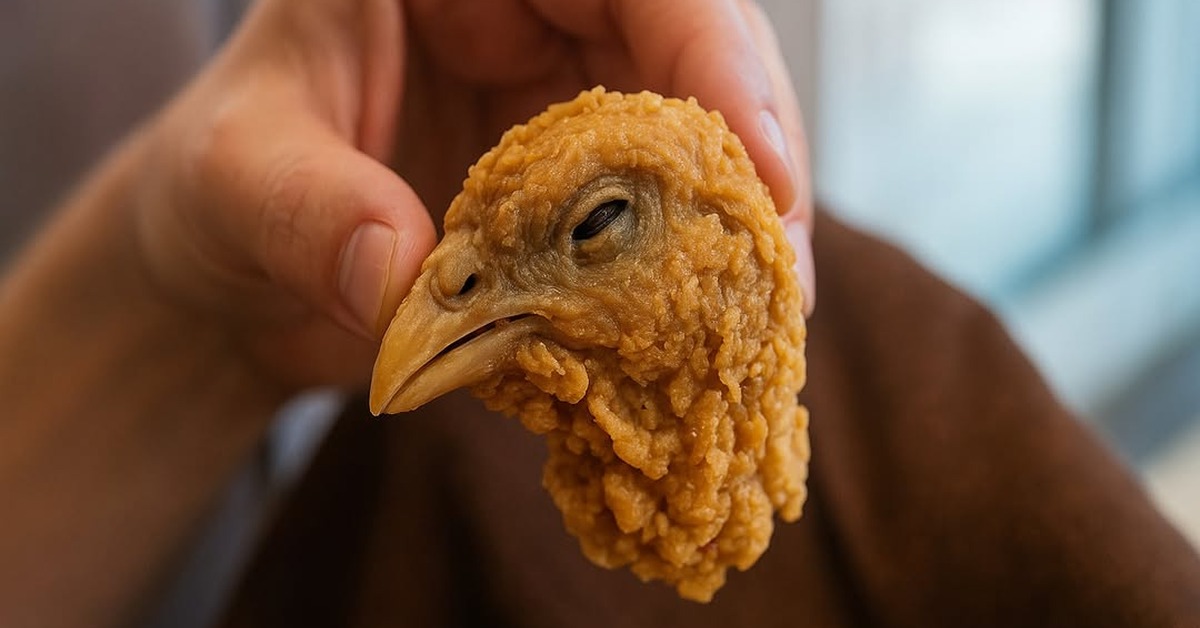
Nobody was looking for it. The head was just there — bronzed, fully intact, eyes sealed shut — sitting in a takeout box next to what was supposed to be a wing order.
It was late 2021. A woman named Gabrielle had ordered KFC for dinner. She opened the box and found a whole chicken head staring back at her. The photo she took went viral within hours, and then something interesting happened: people kept sharing it days later, weeks later. Not because it was dangerous. Because it was weird in a way that wouldn’t quite leave you alone.
How the KFC Chicken Head Slipped Through Everything
KFC processes roughly 1 billion chickens every year. More than 27,000 locations across 150 countries. A single large processing facility can move upwards of 200,000 birds in a day — which works out to about two or three birds per second, continuously, without stopping. Food scientist Dr. Marion Nestle has written extensively about how industrial poultry processing depends on layered automated and manual checkpoints to catch exactly this kind of thing.
So how does a whole head make it through every single one of them?
Scale creates noise. When you’re moving that fast, the math allows for outliers — the industry knows this, even if it rarely advertises it. KFC called it a “rare mistake,” and statistically, they weren’t wrong. But statistics don’t do much for you when you’re the one holding the box.
The Industrial Machine That Missed One Thing
Modern poultry processing lines are genuinely impressive pieces of engineering. Laser sensors. Automated cutters calibrated to millimeter precision. Cold chain systems maintaining exact temperatures from slaughter to shelf. The entire point is uniformity — a piece of KFC chicken is supposed to taste identical whether you’re eating it in Mumbai, Memphis, or Manchester. For a deeper look at how food systems hide their complexity, this-amazing-world.com has been pulling at exactly that thread.
And yet. A chicken head got battered. Got fried. Got boxed. Traveled across London in a paper bag. And then looked Gabrielle dead in the eye.
That’s not a failure of one checkpoint. That’s every checkpoint failing, in sequence, on the same afternoon.
What Had to Go Wrong for This to Happen
Think through the actual journey that KFC chicken head took. First, it had to survive the initial mechanical evisceration stage — where heads are supposed to be removed automatically, classified as offal under UK food processing regulations, and separated before anything else happens. That step is supposed to be mechanical, not manual. It didn’t work.
Then the head had to pass manual inspection. Then enter the battering stage, where someone or something should have clocked that it didn’t look like a wing. Then frying — at temperature, for the full cycle. Then sorting. Then boxing. That last fact kept me reading about this for another hour, because it’s not five unlucky moments. It’s five separate systems, each designed independently, each failing to flag the same object.
Research published in the journal Food Control found that manual inspection lines in high-speed poultry processing miss detectable defects at rates of up to 15% during peak throughput. Fifteen percent. At 200,000 birds a day, that’s not a rounding error.
Something had to give. On this particular day in London, it was Gabrielle’s dinner.
The Part Nobody Talks About After the Apology
KFC’s response was textbook. They apologized, issued a refund, handed over vouchers. Clean, efficient, PR-approved. And the British media treated the whole thing as a gross-out story for a 48-hour news cycle before moving on.
But here’s the thing — what the response never addressed, and what nobody really pressed them on, is what the incident reveals about the system underneath. Turns out, when a company processes a billion animals a year, the occasional anomaly isn’t a glitch you can fix with better training. It’s almost mathematically guaranteed to happen somewhere, at some point, to someone who just wanted dinner.
We’ve built food systems of extraordinary complexity specifically so we never have to think about where food comes from. The chicken head made that invisible process visible again — just for a moment, in a paper bag, in someone’s kitchen in London.
By the Numbers
- KFC operates in over 150 countries with more than 27,000 locations as of 2023 (Yum! Brands annual report), processing an estimated 1 billion chickens annually.
- Two to three birds per second. Continuously. That’s the pace of a large US processing facility running between 175,000 and 250,000 birds per day.
- The UK alone slaughters approximately 1.1 billion birds per year (Food Standards Agency, 2022) — one of the highest per-capita consumption rates in Europe.
- Manual inspection lines miss detectable defects at rates of up to 15% during peak throughput, according to research published in the journal Food Control. The industry doesn’t put that number on the packaging.
Field Notes
- Chicken heads are classified as offal under UK food processing regulations and are supposed to be removed at the very first mechanical stage — before any human inspector even sees the bird. Which means what failed here wasn’t human attention. Something upstream of that went wrong.
- The Maillard reaction — the chemistry behind golden-brown fried food — works identically on muscle tissue, skin, bone, and whatever else you put in the fryer. The head looked “bronzed.” It looked, at a glance, like food.
- KFC’s Original Recipe batter formula is a closely guarded trade secret. But the battering machine itself is fully automated — no mechanism to identify what it’s coating, no sensor that cares. It battered the head the same way it batters everything else.
Why This Story Is About More Than Fried Chicken
The KFC chicken head story circulated longer than most food contamination incidents because nobody got hurt. It wasn’t a pathogen. It wasn’t a hygiene crisis in any traditional sense. What it was — and why it kept spreading — is that it briefly cracked open the carefully maintained illusion that industrial food production is clean, abstract, and invisible.
The packaging exists to make the product feel like it materialized from nowhere. The branding, the uniformity, the identical golden pieces arranged in a box — it all works toward the same goal: distance. Distance between the consumer and the animal. Distance between the meal and the process that produced it.
The chicken head didn’t maintain that distance.
It had a face. It arrived at dinner. And for a moment, the process revealed exactly what it usually manages to hide.
There’s something almost philosophical buried in the absurdity of this — we’ve engineered systems of extraordinary precision to deliver uniform food at global scale, and every so often, one small thing slips through that makes the whole machinery visible again. The KFC chicken head wasn’t a scandal. It wasn’t a warning. It was just a reminder that the thing on your plate was once an animal, and no amount of automation fully closes that gap. If that kind of hidden-machinery story interests you, there’s more waiting at this-amazing-world.com. The next one is stranger still.