KFC Served a Whole Fried Chicken Head and the Internet Lost It
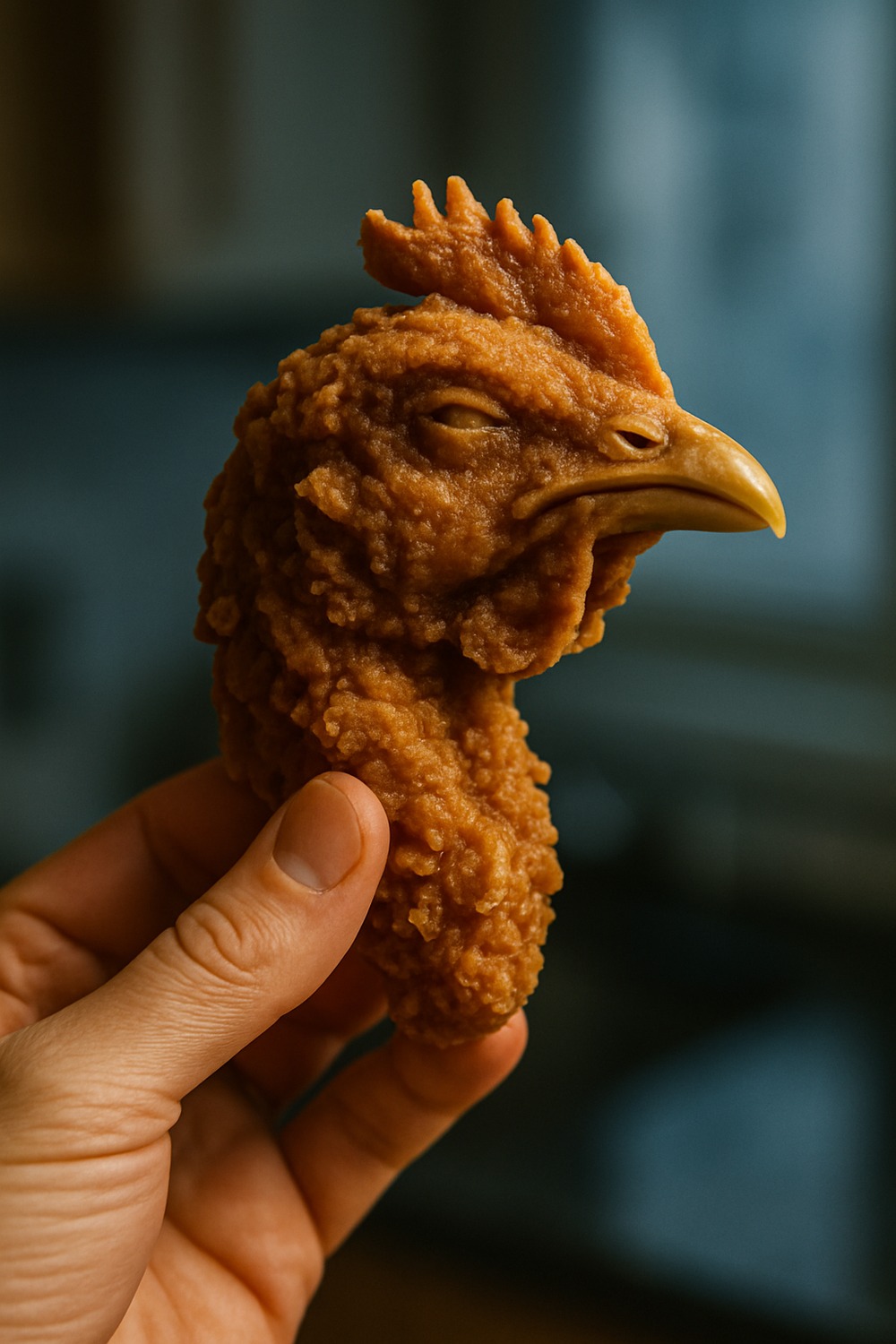
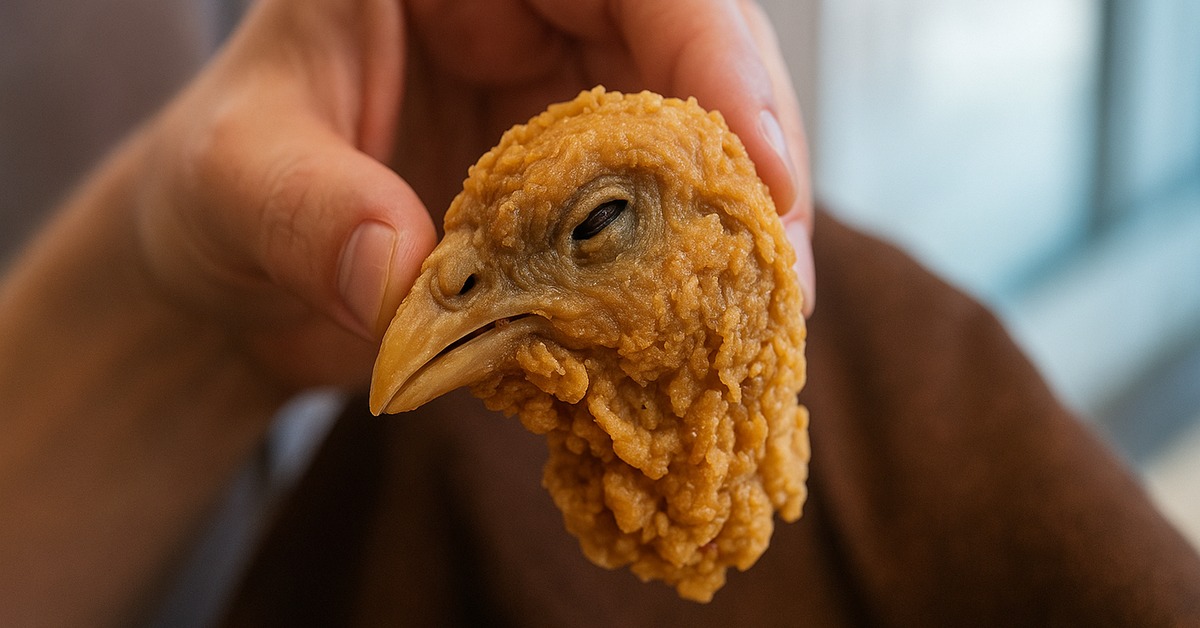
It had a beak. Closed eyes. And it had been deep-fried golden alongside the rest of her order like that was perfectly normal.
Gabrielle had just unpacked her KFC delivery somewhere in London, 2021, fully expecting wings. What she got instead was a whole chicken head — intact, battered, bronzed — staring up at her from inside the box. She took a photo. Then the internet took over.
The Fried Chicken Head That Stopped London Cold
The image moves fast. A small battered skull, beak resting calmly, eyes shut, surrounded by ordinary pieces of chicken like it belongs there. Gabrielle posts it. British media picks it up within hours. Twitter, Facebook, news sites — the photo is everywhere before most people have finished dinner. Food safety researchers note that contamination events in industrial poultry processing are statistically rare — the UK Food Standards Agency tracks these things closely — but rare doesn’t mean nothing, and statistics don’t prepare you for the specific experience of opening a box and finding a face.
Because that’s the thing. It’s a face.
You can eat chicken your whole life without really thinking about it. The system is specifically designed to help you not think about it. And then something slips through with eyes — even closed ones, even crumbed and fried — and the whole comfortable abstraction collapses in about half a second.
KFC Responded, But the Damage Was Already Done
The corporate response was fast and entirely predictable: apology issued, refund processed, vouchers sent — enough for a full replacement meal, presumably head-free. KFC called it a “rare mistake,” and honestly, given the scale of their operation, that’s probably accurate. For other examples of how fast food giants navigate PR disasters in the social media era, this-amazing-world.com has catalogued some that make this one look almost quaint.
The vouchers were generous. The internet was not.
No apology travels as fast as the original image. KFC’s statement reached people already following the story. The photo reached everyone else — including people who hadn’t thought about where their chicken came from in years, maybe ever. That gap between “we’re sorry” and “the thing that made everyone sorry” is where reputations quietly dissolve.
How Does a Chicken Head Even Get There?
This is the part that kept me reading for another hour — because the answer isn’t sabotage, isn’t negligence in any dramatic sense, and isn’t really even a story about KFC specifically. It’s a story about math.
KFC processes an estimated 1 billion chickens per year across more than 27,000 restaurants globally. That number is so large it stops meaning anything after you stare at it for a moment. Billions of birds moving through slaughterhouses, processing plants, packaging facilities, cold chains, delivery networks. The fried chicken head almost certainly slipped through at the processing stage — one bird that wasn’t fully dressed before entering the supply chain.
Even 99.999% accuracy, at that volume, still produces thousands of errors annually.
The system didn’t catastrophically fail. It blinked, once, for a fraction of a second. Someone happened to be watching.
The Assembly Line Behind Your Chicken Bucket
A live chicken becomes a KFC piece through somewhere between 10 and 16 separate processing steps depending on the facility — slaughter, scalding, defeathering, evisceration, inspection, portioning, marination, breading, frying, packaging. Each step has its own quality checkpoint. Each checkpoint is run by humans, or machines calibrated by humans, or software written by humans. A typical large processing plant moves thousands of birds per hour. USDA inspectors at peak production are sometimes responsible for visually checking one carcass per second.
Per second.
A head, in that context, is not as outlandish a miss as it sounds. It’s almost more surprising that it doesn’t happen more often — which is either reassuring or unsettling depending on your particular mood right now.
By the Numbers
- KFC serves roughly 12 million customers daily across 27,000+ locations worldwide (Yum! Brands, 2022) — even a vanishingly small error rate becomes a meaningful number when you multiply it out.
- 70 billion chickens processed globally each year. That’s approximately 9 birds for every human on Earth, running through high-speed lines built for volume, not for manual inspection of every piece.
- A single large processing facility can handle up to 250,000 birds in a day.
- In the UK alone, over 1 billion chickens are slaughtered annually — with the overwhelming majority passing through just a handful of major facilities, which concentrates both the efficiency and every single point of possible failure into very few places.
Field Notes
- Chicken heads are considered a delicacy in China, the Philippines, and across much of Southeast Asia — grilled, fried, skewered as street food. Gabrielle’s find would have been completely unremarkable on a different continent.
- The UK’s Food Standards Agency mandates that all poultry processing plants maintain a Hazard Analysis and Critical Control Points (HACCP) plan — a systematic framework for identifying where errors can enter the supply chain. It’s rigorous. It’s also designed by humans, run by humans, and occasionally missed by humans, because that’s what humans do at 250,000 birds per day.
- This wasn’t KFC’s first strange viral moment. Feathers, unidentified objects, and other unexpected contents have surfaced in fast food chicken across decades of news stories. But the 2021 London head was different. It wasn’t an ambiguous lump or a processing artifact. It had a face. Intact. Recognizable. Looking — if you want to be dramatic about it — almost peaceful.
What One Chicken Head Actually Tells Us About Everything
The story went viral not because it was dangerous, not because it was the result of anything sinister, and honestly not even because it was that shocking by the standards of what industrial food processing occasionally produces. It went viral because it punctured something carefully maintained.
Modern food systems are engineered for invisibility. The whole project is to make sure you think about the bucket, the seasoning, the crunch — not the bird. For the most part, the system is extraordinarily good at this. It succeeds billions of times a day, all over the world, with barely a crack showing. But one small head, battered and bronzed, broke through in a way no food safety audit ever could. It didn’t file a report. It just sat there, in the box, with its eyes closed.
Gabrielle’s photo became a kind of Rorschach. Some people laughed. Some people were genuinely disturbed. Some people quietly set their chicken aside. And many, many people — probably most — ordered again the following week, because the habit runs deep and the capacity for selective forgetting runs deeper.
It didn’t spark a boycott. It didn’t change regulations. It didn’t even dent KFC’s quarterly figures in any measurable way. But for one brief, strange news cycle, it made millions of people look at their dinner and actually see it. A whole bird, once. With a face. With eyes. Deep-fried and inexplicably present, like nature politely clearing its throat in the middle of dinner.
One chicken head, one photo, one very corporate apology — and suddenly the machinery behind every fast food order became briefly, uncomfortably visible. It’s funny. It’s unsettling. It’s a glitch in a system built to never glitch where anyone can see it. And if that kind of story is your thing, there’s more at this-amazing-world.com. The next one is stranger.