The Killdozer of Granby: One Man’s Rampage That Shook Colorado
Here’s the thing about the Granby Killdozer: the machine was never the most frightening part. Forty-seven tons of armored steel moving through a small Colorado town at five miles per hour — slow enough to outrun, impossible to stop. What Marvin Heemeyer built wasn’t just a weapon. It was a decade of unresolved grievance given treads and a concrete shell, and on June 4, 2004, it moved.
Granby, Colorado sits at 8,000 feet in the Rocky Mountains, population 2,000. On that Friday afternoon, one man and one machine dismantled thirteen buildings across two hours and six minutes. It ended only because physics intervened where law enforcement couldn’t. What drove Heemeyer to this point, and what does it say about the quiet, grinding weight of unresolved grievance?
The Man Behind the Machine: Heemeyer’s Long Slow Burn
Marvin Heemeyer moved to Granby in the early 1990s, drawn by the mountains and the possibility of a simple life. He built a muffler repair shop — Heemeyer’s Muffler — and by most accounts he was competent, hardworking, and ordinary. The trouble began incrementally, as it almost always does. A concrete plant was permitted to operate on land adjacent to his property, cutting off his access road and, according to Heemeyer, directing sewage runoff toward his business. The town fined him $2,500 for the resulting violations. He appealed. He lost.
Then came a series of disputes with local officials and neighbors — zoning conflicts, property line arguments, a deep conviction that the authorities of Grand County were systematically conspiring against him. According to the Wikipedia documentation of Heemeyer’s life and the 2004 events, he exhausted every legal avenue available to him over roughly a decade before concluding that the system was irredeemably rigged.
What’s striking, in retrospect, is how unremarkable each individual grievance was. A road. A fine. A neighbor’s decision that felt, to Heemeyer, like a personal insult compounded over years. Psychologists studying what the Federal Bureau of Investigation has categorized as “grievance-driven” violence note that escalation rarely announces itself — it accumulates (researchers actually call this “grievance stacking”). Each small injustice, real or perceived, added to a mental ledger that eventually tips past any rational accounting. Heemeyer kept a journal. He recorded grievances. He taped audio messages explaining his reasoning, and left them behind when he was done.
He wasn’t a man without friends or history. Former associates described him as capable of warmth, of humor. The radicalization — if that word even fits — was quiet, interior, and nearly invisible until the morning he welded himself inside a bulldozer.
Eighteen Months in Secret: Building the Killdozer
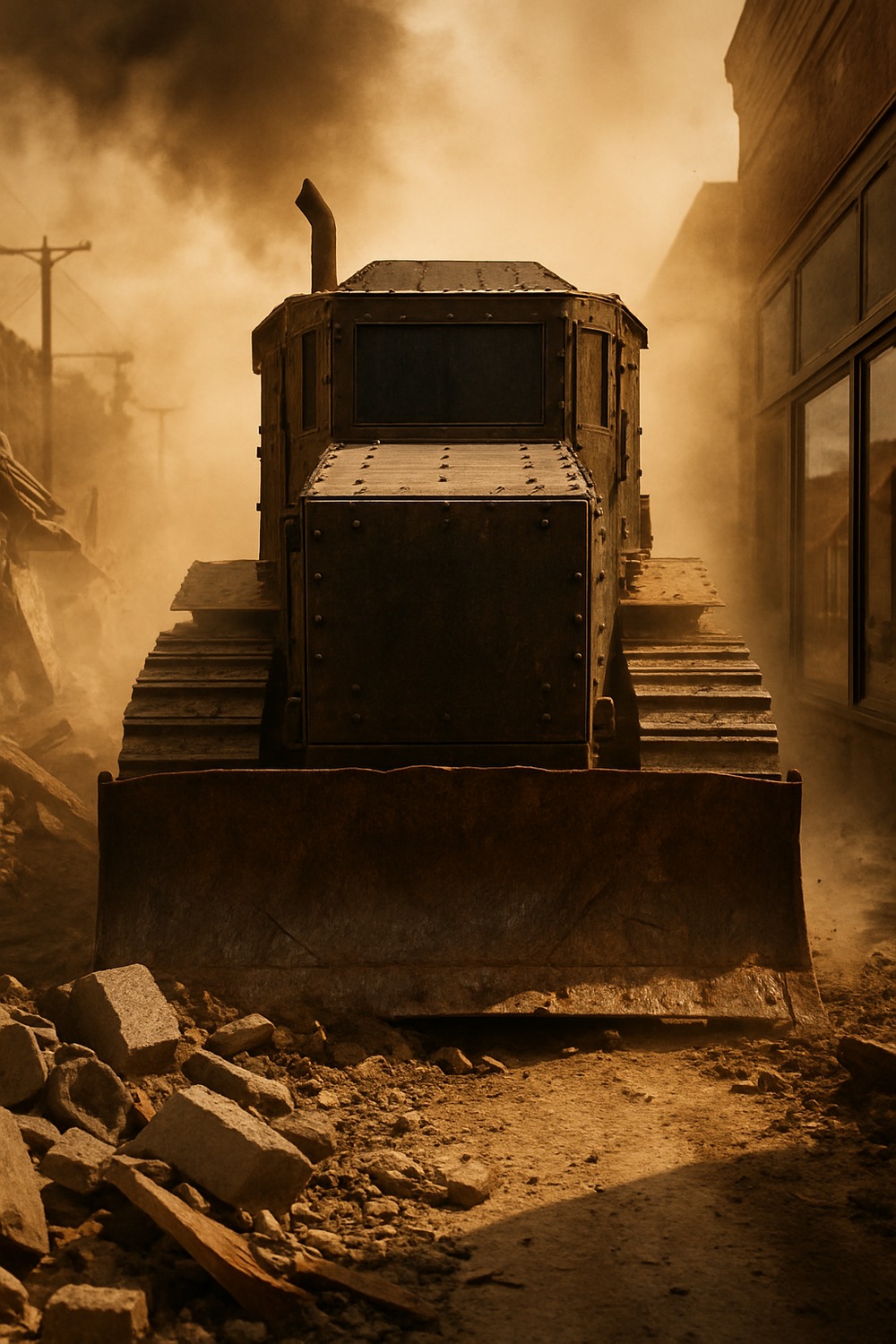
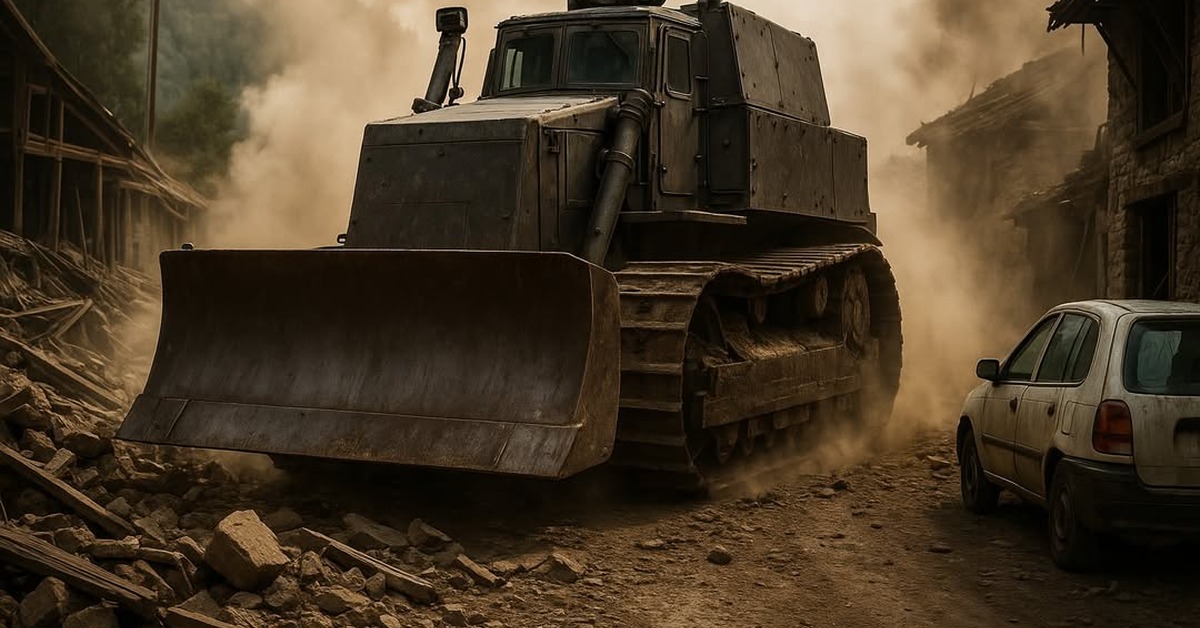
Heemeyer’s chosen machine was a Komatsu D355A bulldozer — heavy construction equipment already sitting in his shop. Over approximately eighteen months, working alone and in secret, he transformed it into something that had no real precedent. He layered inch-thick steel plate across every external surface. He poured concrete reinforcement into the gaps between steel layers, creating composite armor that police rounds simply could not penetrate. He fabricated a series of cameras and monitors — roughly a dozen — and routed their feeds inside the cab so he could navigate despite being sealed inside a steel shell with no direct sightlines.
Ventilation systems kept him supplied with air. He prepared containers of water and an improvised toilet. This wasn’t impulsive. This was engineered, methodically and over months, by a man with real mechanical aptitude. Stories like this remind us how ordinary people, pushed past a threshold, can channel extraordinary focus into catastrophic ends — not unlike the desperate ingenuity visible in survival narratives documented across human history, from the determined heists of remarkably persistent and determined thieves to far darker chapters.
Why does this matter? Because the preparation was almost surgical in its completeness — and it happened entirely in plain sight, inside a locked shop, for a year and a half.
When Heemeyer finally broke through the wall of his own shop on June 4, 2004 at approximately 2:00 p.m. local time, the machine weighed 47 tons. Granby police chief Bob Murray and his small department — a force of just a handful of officers — responded immediately. They fired. The rounds ricocheted. They attempted to access the cab from above and failed. The Colorado State Patrol arrived. A SWAT team was dispatched from Grand County. None of it mattered. The machine moved at roughly five miles per hour — slow enough that bystanders could walk alongside it, fast enough that it outpaced every countermeasure available. At one point, officers attempted to dump gravel into the exhaust stack. The engine didn’t stall. Heemeyer had anticipated this too. Almost.
Thirteen Buildings, Two Hours, and One Town Changed Forever
Heemeyer’s target list was personal, precise, and in some cases deeply petty — which made it all the more unnerving. He drove into Granby Town Hall. He demolished the offices of the Granby Sky-Hi News, the local paper that had run stories critical of him. He destroyed the home of a former mayor. He targeted the concrete plant whose construction he blamed for starting everything. He hit a former selectman’s home. He drove through a building owned by a man he felt had testified against him.
Thirteen structures in total sustained significant damage. Damages were ultimately estimated at over $7 million.
Remarkably — and this is the detail that resists every easy narrative — nobody else died. No bystanders were killed. Heemeyer had the opportunity, with 47 tons of armor-clad machinery, to cause mass casualties. He did not. Whether this reflects a residual moral line or simply logistical limitation remains genuinely unclear. A Smithsonian examination of American folk violence and grievance mythology helps illuminate why events like this embed themselves so deeply in collective memory — they sit at the uncomfortable intersection of sympathy and horror.
The machine stopped not because of police intervention but because it drove into the basement of a partially constructed building — Gambles Hardware, under renovation — and became trapped. The basement couldn’t support the vehicle’s weight. The treads couldn’t find purchase. For a man who had calculated everything for eighteen months, the concrete floor of an unfinished basement was the one variable he hadn’t fully accounted for. Investigators later found that Heemeyer died of a single self-inflicted gunshot wound inside the sealed cab. It took authorities hours to cut through the armor to reach him.
Inside the cab: the water containers, the cameras, audio recordings. And a Bible. He had been planning to die in there from the beginning.
The Granby Killdozer’s Strange Afterlife in American Mythology
In the weeks and months that followed, something unexpected happened. A segment of internet culture — particularly on early forums and, later, platforms like Reddit and 4chan — began celebrating Heemeyer as a folk hero. The “Killdozer,” a term borrowed from a 1974 Stephen King novella about a possessed construction machine, became the dominant cultural shorthand for the event. Memes circulated. Tributes were posted. A specific reading of Heemeyer’s actions emerged: one man, wronged by bureaucratic corruption, fighting back with everything he had. Researchers at the University of California, Berkeley’s School of Information, studying anti-government sentiment in online communities as recently as 2021, identified the Killdozer narrative as a recurring reference point in communities that valorize individual defiance against institutional power.
Turns out, the people of Granby experienced something entirely different. Business owners whose livelihoods were destroyed. Families who lost homes they’d spent decades building. A town government forced to spend years in financial and psychological recovery. The gap between the meme and the reality is enormous — it tells us something important about how distance transforms catastrophe into symbol. For those who weren’t there, the Granby Killdozer was a story about defiance. For those who were, it was a story about a man who decided that his grievances entitled him to erase other people’s lives.
Watching a community spend twenty years reassembling what one afternoon destroyed, you stop calling the romanticization of this event a difference of opinion.
And Grand County’s emergency responders have since reported that the event permanently changed how they approach threat assessment for construction equipment — a category of potential weapon that most law enforcement agencies had never considered before June 4, 2004.
How It Unfolded
- Early 1990s — Marvin Heemeyer establishes Heemeyer’s Muffler Shop in Granby, Colorado, beginning what will be a decade of escalating disputes with local authorities and neighbors.
- 2002–2003 — Heemeyer begins secretly armoring the Komatsu D355A bulldozer in his shop, a process that will take roughly eighteen months and remain undetected by anyone in the town.
- June 4, 2004 — Heemeyer breaks through his shop wall at approximately 2:00 p.m. and over the next two hours and six minutes demolishes thirteen buildings before becoming trapped in a basement; he dies by suicide inside the sealed cab.
- 2004–present — The “Killdozer” enters American internet mythology, becoming a persistent reference point in anti-government communities and a subject of ongoing debate about grievance, justice, and the mythology of individual rebellion.
By the Numbers
- 47 tons — weight of the armored Komatsu D355A at the time of the rampage
- 13 — buildings significantly damaged or destroyed during the two-hour rampage through Granby
- $7 million+ — total estimated property damage from the Granby Killdozer incident
- 18 months — time Heemeyer spent secretly constructing the armor, working entirely alone inside his locked shop
- ~1 inch — thickness of the steel plate layered across the bulldozer’s exterior, combined with concrete reinforcement that made it impervious to standard police rounds
Field Notes
- Heemeyer left behind over three hours of audio recordings explaining his grievances and motivations in detail. Reviewed by investigators in 2004, they reveal a man who was lucid, coherent, and entirely convinced of the righteousness of his actions — one who believed, explicitly, that God had guided him to build the machine.
- Every camera, monitor, and internal system inside the cab was fabricated by Heemeyer himself. No outside fabrication shop was involved. The improvised surveillance system let him navigate the town despite being completely sealed inside steel and concrete.
- Despite the machine’s enormous weight and armoring, Heemeyer apparently took deliberate steps to avoid hitting people directly. Whether this was a moral choice or a practical one — to avoid intervention that might have halted the rampage sooner — remains a matter of genuine interpretive debate among criminologists.
- Researchers studying lone-actor violence still cannot fully explain why individuals with similar grievance profiles — long-running legal disputes, perceived institutional betrayal, social isolation — diverge so dramatically in outcome. Most don’t build a bulldozer. The psychological threshold between chronic resentment and catastrophic action remains poorly understood.
Frequently Asked Questions
Q: What exactly was the Granby Killdozer, and why couldn’t police stop it?
The Granby Killdozer was a Komatsu D355A bulldozer that Marvin Heemeyer spent eighteen months secretly armoring with inch-thick steel plate and concrete reinforcement. Police couldn’t stop it because standard firearms couldn’t penetrate the composite armor, and there was no accessible entry point — Heemeyer had welded himself inside. SWAT teams attempted multiple interventions. All failed. The machine stopped only when it became physically trapped in a basement on June 4, 2004.
Q: Did Marvin Heemeyer kill anyone besides himself during the rampage?
No. Despite operating a 47-ton armored machine through a populated town for over two hours, Heemeyer did not kill anyone other than himself. Several people had narrow escapes — a woman inside one of the targeted buildings evacuated moments before impact — but there were no civilian fatalities. This fact is central to the ongoing debate about his legacy: was the absence of casualties intentional, or simply fortunate circumstance?
Q: Is it accurate to call Heemeyer a folk hero, as some online communities do?
It’s a label that deserves serious scrutiny. The folk hero narrative focuses on Heemeyer’s defiance of local government — a story of one man against a corrupt system — and strips out the human cost entirely. Real people lost businesses, homes, and years of their lives to this event. Grand County residents who actually lived through it have repeatedly pushed back against the romanticization. Calling him a hero requires ignoring the specific, named individuals whose lives he chose to target.
Editor’s Take — Sarah Blake
What troubles me most about the Killdozer story isn’t the machine or the rampage — it’s the eighteen months of silence before it. A man worked alone in a locked shop, building something that would reshape an entire town’s future, and nobody noticed. That’s not just a security failure. It’s a portrait of how completely a person can disappear inside their own grievance, and how invisible that disappearance looks from the outside. We keep expecting radicalization to announce itself. It almost never does.
Granby has rebuilt, mostly. The lots where buildings once stood have been filled, the financial damage absorbed slowly and painfully across two decades. But the story of the Granby Killdozer hasn’t faded — if anything it’s grown larger in the cultural imagination than it ever was in reality, retold and reshaped by people who weren’t there and don’t know the names of the families who lost everything. That gap — between the symbol and the flesh-and-blood people inside the story — is worth sitting with. What do we choose to remember when we turn catastrophe into myth, and what do we quietly decide to forget?