


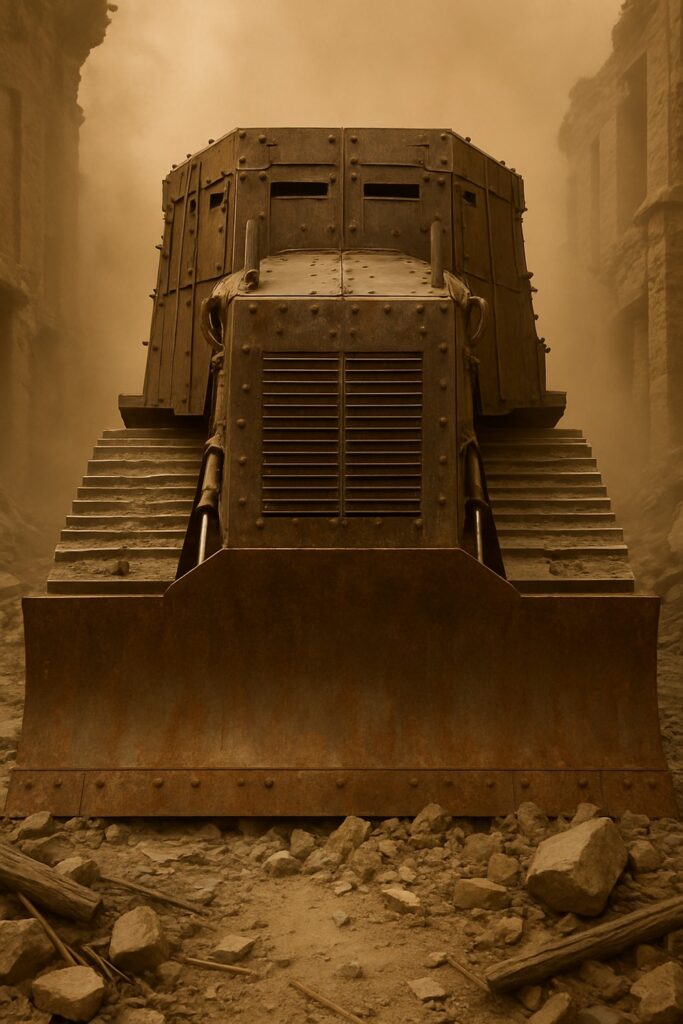
Here’s the thing about the Killdozer: nobody in Granby, Colorado saw it coming — not because the signs weren’t there, but because the signs looked like paperwork. Zoning disputes. Sewer fines. A blocked access road. Marvin Heemeyer spent a decade losing small bureaucratic battles before he stopped filing complaints and started welding steel.
On June 4, 2004, Granby, Colorado — population roughly 2,000 — became the epicenter of a story that stunned the nation. A local welder named Marvin Heemeyer had spent 18 months secretly converting a Komatsu D355A bulldozer into a rolling fortress. His target: the town itself. What drove a quiet man to such an extreme? And what does it say about the pressure that accumulates, silently, in small places?

The Man Behind the Killdozer Rampage in Granby
Marvin Heemeyer was born in 1951 in Castlewood, South Dakota, and moved to Granby in the early 1990s. He ran a muffler shop — Mountain Park Muffler — and by most accounts, he was competent, self-reliant, and largely left alone. Then the disputes began. A concrete plant, owned by the Docheff family, was built adjacent to his property in the late 1990s, cutting off his access road and, he claimed, flooding his lot with concrete slurry. Heemeyer filed complaints. He sued. He lost. According to Colorado court records reviewed extensively in the years after the rampage, Heemeyer was also fined multiple times by the town of Granby for building code violations — a functioning toilet in his shop, a connection to the municipal sewer system. Each fine stoked his sense of persecution.
Marvin Heemeyer’s documented conflicts with Granby’s municipal authorities stretched across nearly a decade before they converged into something far darker. What’s striking, looking back, is how ordinary it all sounds on paper — zoning disputes, sewer hookups, property access, the everyday bureaucratic frictions that thousands of small-business owners navigate every year without incident. But for Heemeyer, each setback became a brick in a wall he felt was being built specifically to destroy him. He kept journals. He recorded audio logs. In them, he described himself as a man chosen by God to carry out a righteous act.
That shift — from aggrieved neighbor to self-appointed instrument of justice — is what makes the story so unsettling. The grievances were real. The response was not proportionate to anything recognizable as reality.
Neighbors later said he’d grown quiet in his final years. The laughter stopped. He sold his shop in 2001 and rented the building back, apparently to maintain access to the machine he was already secretly building. Nobody noticed. Or if they did, nobody asked.
Building a Fortress: Eighteen Months of Secret Armor
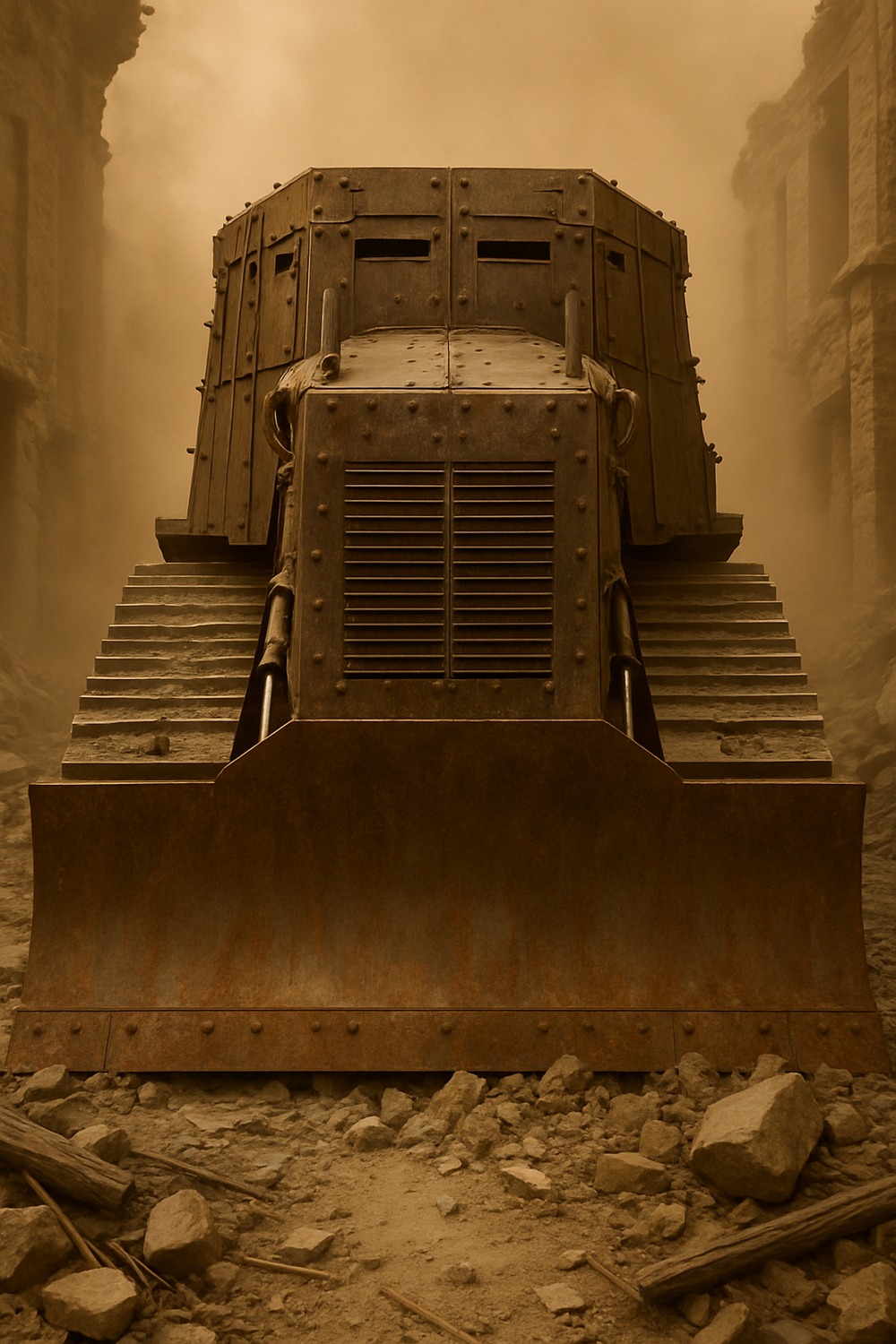
Working alone inside his rented shop, Heemeyer welded steel plate — in some sections over three inches thick — directly onto the bulldozer’s frame, sealing himself into a concrete-reinforced cab. He mounted three cameras connected to monitors inside so he could see forward, left, and right, since the armor completely blocked direct vision. He ran the cables himself. He fitted the machine with improvised gun ports — though he never used them offensively — and rigged an air conditioning system to keep himself cool during what he expected to be a long operation. The total weight of the modified machine approached 90,000 pounds. Stories like this one remind us that obsession, when it finds a focus, can produce outcomes of extraordinary precision — not unlike the single-minded determination seen in a very determined thief who planned far beyond what anyone expected.
He did it all by himself. No accomplices. No outside help. Investigators from the Colorado Bureau of Investigation, who examined the machine after the rampage, were genuinely astonished at its construction quality. In 2004, law enforcement officials told reporters that the armor was so well-designed that even .50-caliber rifle rounds fired by police during the rampage failed to penetrate the cab. Tear gas canisters bounced off it. The machine was, effectively, impervious to anything short of military-grade hardware — Heemeyer had essentially built a slow-moving tank capable of sustaining direct fire for hours without meaningful damage.
When he finished, there was no way to get out of the cab without dismantling the armor from the outside. Heemeyer knew this. He welded himself in. The machine was never meant to be a vehicle of escape. It was built to be a one-way door.
The Hour the Town of Granby Couldn’t Stop
Why does this matter beyond the spectacle of it? Because at approximately 3:00 p.m. on June 4, 2004, Heemeyer fired up the Komatsu D355A and drove it straight through the wall of his former shop — and for the next two hours, every institution meant to stop something like this proved completely inadequate.
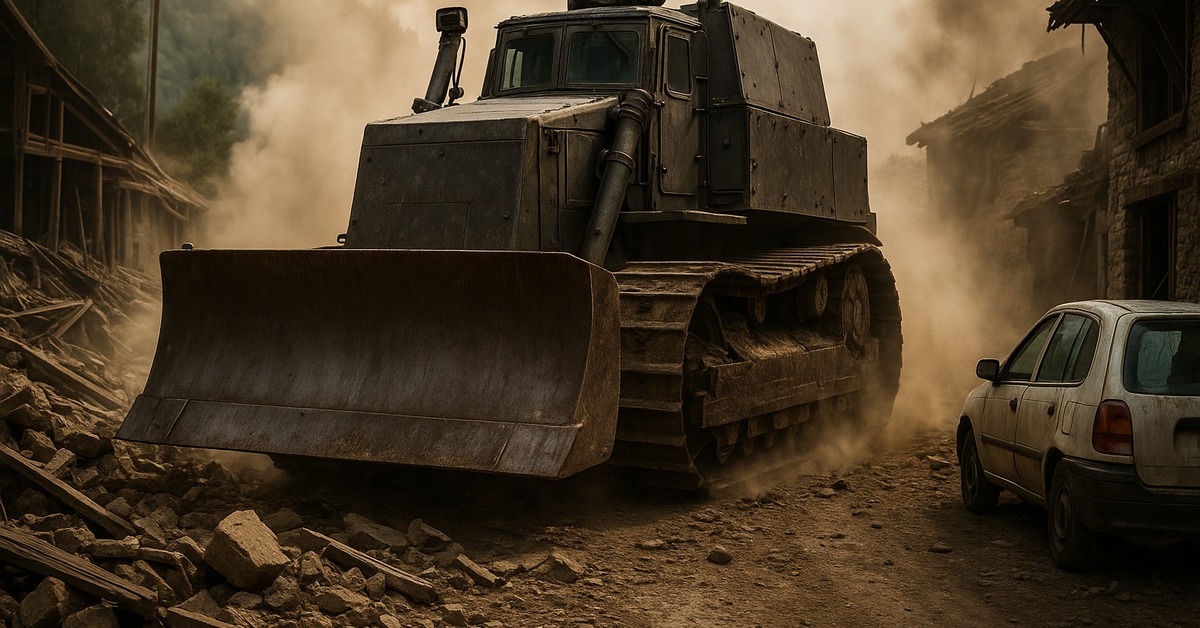
Thirteen buildings targeted with surgical precision: Granby’s town hall, the local newspaper office (which had covered his disputes critically), the concrete plant that started the feud, the home of a former mayor, and several other properties tied to the list of grievances he’d documented over a decade. The Smithsonian Magazine has written about how events like this expose the fault lines that exist inside communities too small to absorb prolonged, unresolved conflict — the kind of pressure that builds without institutional release valves. Colorado State Police, Grand County Sheriff’s deputies, and local officers fired hundreds of rounds at the machine. None penetrated. For the residents and business owners of Granby watching from behind police tape, the scene was genuinely incomprehensible: a homemade armored vehicle grinding through concrete-block walls while law enforcement stood by, functionally helpless.
A plan this methodical, executed against neighbors who had no means of defense, deserves to be called what it was — not folk heroism, not righteous defiance, but premeditated destruction of a community by one of its own members.
No civilians died. That outcome — catastrophic property destruction with zero civilian casualties — was not accidental. His own journals confirmed he had deliberately planned routes to avoid harming people. They attempted to flood the basement of a building he had partially driven into, hoping to disable the engine. It didn’t work fast enough.
The machine finally stalled when it drove into the basement of a partially constructed building and became lodged. Heemeyer couldn’t reverse out. After a pause, a single gunshot was heard from inside the cab. He had taken his own life. When investigators cut through the armor to reach him, they found a man who had arrived exactly where he intended.

What the Killdozer Left Behind in Granby and Beyond
Approximately $7 million in physical damage — staggering for a mountain town of 2,000 people. Thirteen buildings damaged, several beyond repair. The town hall required extensive reconstruction. A local bank, the office of the Granby Pumping Plant, and private homes were all hit. But the more durable damage was psychological and civic. In the months following June 4, 2004, Granby struggled with a question that had no comfortable answer: had they seen this coming? The Colorado Bureau of Investigation’s post-incident analysis, released in late 2004, noted that Heemeyer had engaged in years of documented, escalating conflict with multiple municipal entities — conflict that had never been mediated, never been seriously addressed, and never triggered any formal intervention.
And then the internet got hold of it. Within months, corners of the web had begun to mythologize Heemeyer as a folk hero — a lone man standing against an indifferent bureaucracy. Message boards in 2004 and 2005 filled with comments lionizing the Killdozer as a symbol of righteous defiance. That mythology has never fully dissipated. It resurfaces every few years, particularly during moments of heightened public frustration with government institutions. Researchers at the University of Colorado’s Institute of Behavioral Science, who have studied domestic radicalization (researchers actually call this the “grievance-to-violence pipeline”), have noted that the Heemeyer case sits in an uncomfortable overlap between genuine grievance and violent extremism — a space that resists easy categorization precisely because both things are simultaneously true.
Granby rebuilt. The town hall was reconstructed, the concrete plant repaired, life resumed as it does. But ask anyone who was there on June 4th, and the two hours when the Killdozer moved through their streets don’t feel like history yet. They feel like something that is always just slightly present, parked at the edge of the possible.
How It Unfolded
- 1992 — Marvin Heemeyer establishes Mountain Park Muffler in Granby, Colorado, beginning his decade-long entanglement with the town’s business and civic community.
- Late 1990s — The Docheff concrete plant is constructed on land adjacent to Heemeyer’s property, blocking his access road and triggering the series of legal disputes and municipal fines that would define his final years.
- 2001–2003 — Heemeyer sells his shop, rents it back, and begins the secret 18-month construction of his armored bulldozer, working alone and telling no one.
- June 4, 2004 — The Killdozer rampage unfolds over approximately two hours in Granby, destroying 13 buildings before Heemeyer’s machine stalls and he takes his own life inside the sealed cab.
By the Numbers
- $7 million — estimated total property damage caused by the Killdozer rampage in Granby on June 4, 2004 (Colorado Bureau of Investigation, 2004).
- 13 — number of buildings damaged or destroyed during the two-hour event, including the Granby town hall, a local newspaper, and a concrete plant.
- ~90,000 pounds — approximate weight of the armored Komatsu D355A after Heemeyer’s modifications, making it effectively impervious to standard law enforcement weaponry.
- 18 months — the duration of Heemeyer’s secret solo construction project, completed without a single outside collaborator or visible outside purchase flagging concern.
- 0 — civilian fatalities during the entire two-hour rampage, a figure investigators attributed directly to deliberate route planning by Heemeyer himself.
Field Notes
- When Colorado Bureau of Investigation specialists cut open the armored cab in June 2004, they found Heemeyer had installed not just cameras but a complete ventilation system and a small seat cushion — suggesting he’d planned for an operation potentially much longer than two hours.
- Heemeyer left behind audio recordings totaling several hours in length, in which he described each target by name and explained, in calm detail, why each deserved destruction. Those recordings were never publicly released in full.
- Turns out the Komatsu D355A was designed for heavy construction and mining — not military use — yet Heemeyer’s modifications produced a vehicle that outperformed the armor protection standards of many contemporary light military vehicles.
- Investigators still can’t fully explain how Heemeyer navigated precisely to 13 separate targets using only three small monitor screens inside a sealed, half-blind cab moving through unfamiliar street configurations — the spatial precision of the route remains unexplained.
Frequently Asked Questions
Q: What exactly was the Killdozer, and why did Marvin Heemeyer build it in Granby?
A Komatsu D355A bulldozer that Marvin Heemeyer secretly armored over 18 months in his rented shop in Granby, Colorado — that’s what the Killdozer was. He added steel plating up to three inches thick, concrete reinforcement, camera systems, and an air supply. Heemeyer built it as an act of retaliation against the town of Granby and specific individuals he blamed for a decade of property disputes, zoning fines, and what he perceived as coordinated persecution.
Q: Was anyone killed during the Killdozer rampage on June 4, 2004?
No civilians were killed during the two-hour rampage. Thirteen buildings were damaged or destroyed, and property damage reached approximately $7 million, but Heemeyer deliberately planned his routes to avoid injuring people — a fact confirmed by his own audio journals recovered after the event. The only fatality was Heemeyer himself, who died by suicide inside the sealed cab after the machine became lodged in a basement and could no longer move.
Q: Why is Marvin Heemeyer sometimes called a folk hero, and is that view accurate?
Portions of the internet began framing Heemeyer as a symbol of individual defiance against an overbearing government — someone who fought back when the system failed him. That framing isn’t entirely false: his grievances were real, documented, and largely unaddressed. But it omits the fact that his response was a premeditated act of mass property destruction that traumatized a town of 2,000 people and could easily have killed someone. Calling him a hero requires ignoring the people whose livelihoods and homes he destroyed.
Editor’s Take — Sarah Blake
What keeps pulling me back to this story isn’t the machine — it’s the journals. Heemeyer recorded hours of audio explaining exactly what he was doing and why, in a voice described by those who’ve heard it as eerily calm. He wasn’t raging. He was narrating. That detail changes the whole shape of the story. This wasn’t an explosion of impulse. It was the product of years of quiet, deliberate construction — of grievance and of steel. The town of Granby didn’t just survive a rampage. It survived a plan.
Small towns carry pressure in ways that cities can diffuse through size and noise. In Granby, that pressure found a man with welding skills, a rented workshop, and enough time. The Killdozer story is extreme by any measure — but it raises a question that doesn’t go away: how many other places are quietly accumulating the same kind of weight, one unresolved grievance at a time, waiting for a form of release that nobody sees coming until the wall is already coming down?


