



Declared dead while still alive in India, Lal Bihari didn’t rage at the sky or collapse into despair. He held his own funeral. The paradox at the center of his story is almost too neat: a living man who had to perform death more convincingly than his enemies had faked it, just to prove he was still there.
Mid-1970s, rural Uttar Pradesh. A corrupt uncle bribes a local official to enter Lal Bihari’s death into the village land register. The paperwork agrees. The state agrees. And for 18 years, he fights a government that refuses to acknowledge a living, breathing, protesting man standing right in front of it. How does that happen? And how many times has it happened since?

How a Living Man Gets Declared Dead in India
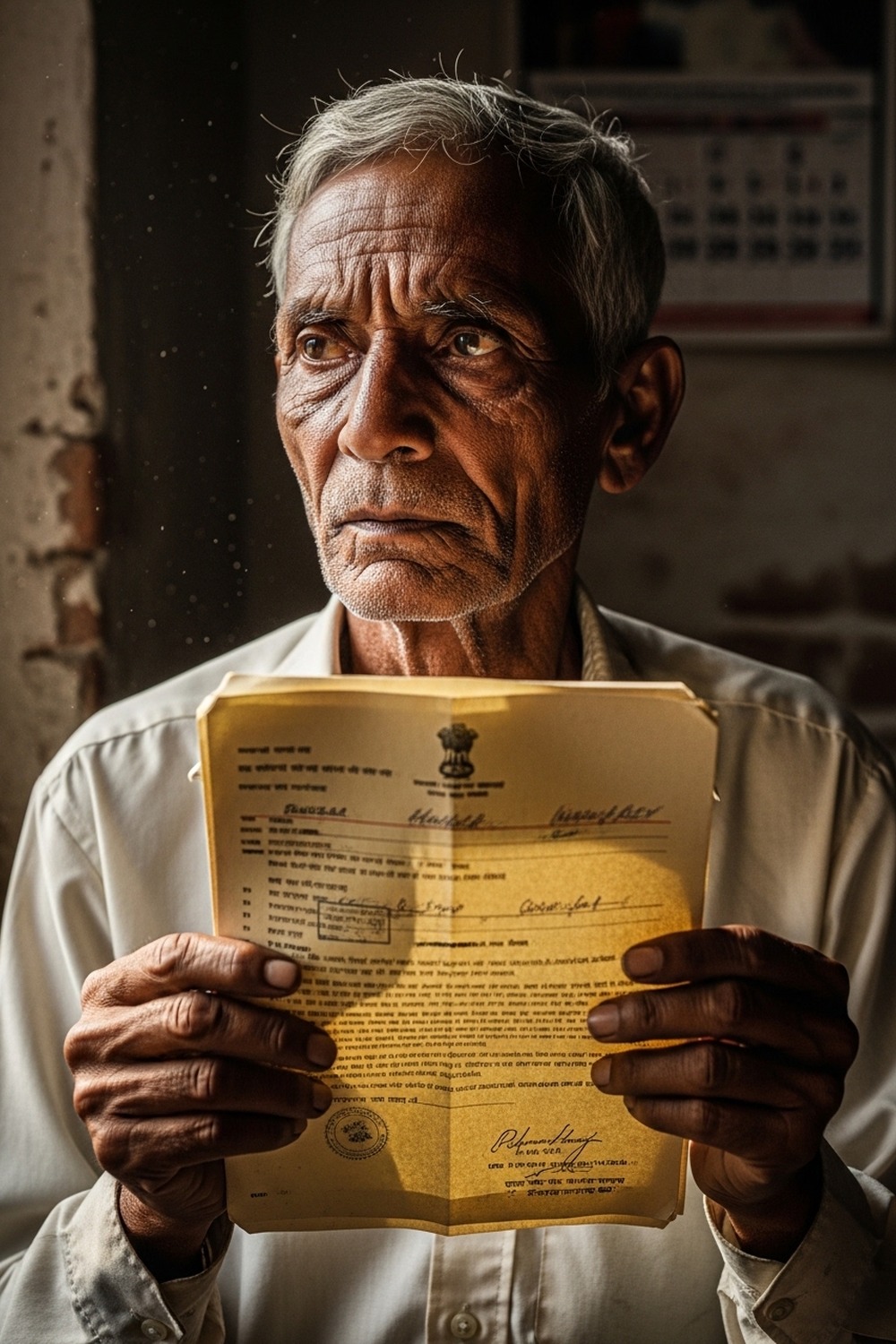
The mechanism is grimly simple. In India’s rural revenue administration system, local officials called lekhpals — village-level record keepers — maintain land and population registers that carry enormous legal weight. According to research documented by the Mritak Sangh (Association of Dead People), which Lal Bihari would eventually found in 1988, the process of fraudulent death declaration typically begins with a bribe. A relative — usually one with a claim on inherited property — pays a local official to update the register. Death certificates are forged or simply entered into ledgers. The target, often a poor farmer with limited literacy and no legal resources, discovers the fraud only when they try to access a service the state no longer believes they’re entitled to.
By then, the paperwork has calcified. Challenging it requires navigating a court system that can take years — or decades — to respond to a man whose very legal identity has been voided.
Lal Bihari’s case wasn’t unique even in the 1970s. What made it extraordinary was what he did next. He didn’t simply petition. He performed. He held his own funeral. He organized “ghost marches.” He applied for a widow’s allowance — for himself. He ran for political office against the Prime Minister, Rajiv Gandhi, in 1988, partly to force officials to process paperwork in his name. Every act was designed to create friction, to force a system in denial to confront a man it had erased. The courts still moved slowly. The bureaucracy still stalled.
The child kidnapping incident — the child was returned unharmed within hours — was his most drastic gambit. A police report would name him as the perpetrator. It would, theoretically, prove his existence. It barely worked. The case was quietly buried. But the stunt attracted press attention, and press attention, it turned out, was the one thing bureaucratic inertia couldn’t fully absorb.
The Association of Dead People Refuses to Disappear
Why does this matter beyond one man’s extraordinary story? Because what poured into the Mritak Sangh after 1988 wasn’t a trickle — it was a flood of cases following the same template almost exactly.
In 1988, Lal Bihari transformed a personal injustice into a political movement by founding the Mritak Sangh — literally, the Association of Dead People — to advocate for the thousands of Indians declared dead while still alive across the country. Headquartered in Uttar Pradesh, where the problem was most concentrated, its membership quickly spread across India’s northern plains. The stories followed a pattern nearly identical to Bihari’s own: a vulnerable person, a greedy relative, a corrupt local official, and a paper death that cost almost nothing to manufacture and almost everything to undo. If you think of bureaucracy as a kind of infrastructure — an architecture for recognizing human existence — then this is what happens when that infrastructure is weaponized. The parallels to other invisible injustices aren’t hard to find; stories of people erased by systems built to protect them appear across the full, strange spectrum of human experience, in every corner of the world.
By the early 2000s, the Mritak Sangh had registered tens of thousands of members — all of them people officially listed as dead in government records. Estimates from Indian civil society organizations in the 2010s placed the number of fraudulent death declarations in Uttar Pradesh alone in the hundreds of thousands, though precise figures are difficult to verify for an obvious reason: the people affected don’t officially exist. They can’t vote. They can’t easily file lawsuits. They can’t open bank accounts. The very fact of their erasure makes them harder to count.
Lal Bihari himself was finally restored to the official record in 1994, after revenue records in his district were corrected following sustained public pressure and media coverage. Eighteen years. That’s the length of a childhood — spent fighting to be seen by a government that had sold his existence for the price of a bribe.
Land, Inheritance, and the Bureaucracy of Erasure
Fraudulent death declarations to seize land aren’t unique to India, but the specific conditions of India’s land registration system have made the practice particularly endemic in certain states. A 2016 investigation by the BBC found that Uttar Pradesh, Bihar, and Jharkhand had the highest concentrations of fraudulent death declarations, almost all tied to inheritance disputes in agricultural communities. BBC reporting documented cases where entire families had been erased — parents and children all declared dead so that distant relatives could absorb their land holdings without legal challenge. The common thread across every case was the same: vulnerability compounded by poverty, illiteracy, and geographic isolation from legal recourse.
And here’s the thing — India’s land registration reforms, accelerating after 2004 under the National Land Records Modernization Programme, were designed in part to close exactly these gaps. Digitizing records, in theory, makes them harder to falsify at the local level.
In theory. People who are declared dead while still alive in India today face a slightly different landscape than Lal Bihari did in the 1970s — digital records have replaced some paper ledgers, and awareness of the issue is higher. But a 2019 report by the Comptroller and Auditor General of India found significant data integrity issues in digitized land records across multiple states, suggesting that modernization hasn’t eliminated the vulnerability — it’s simply moved it to a different layer of the system. The mechanism changes. The incentive doesn’t.
A system whose officials have low salaries, sweeping discretionary power, and minimal oversight will produce corruption at scale — and no digitization programme fixes that without addressing all three variables at once. History has a way of treating the people who ignored that kind of structural evidence unkindly.
Declared Dead While Still Alive: The Thousands Still Fighting
By 2010, the Mritak Sangh had registered approximately 40,000 members across India — all living people officially listed as dead. By some estimates cited by Indian civil rights researchers at Jawaharlal Nehru University, the actual number of fraudulently declared deaths in Uttar Pradesh alone could be three to four times higher, with many victims unaware that an organization exists to advocate for them, or simply too poor and isolated to make contact. In 2012, the Allahabad High Court issued directives to state authorities to expedite the correction of fraudulent death registrations, acknowledging formally that the problem had reached systemic scale. Individual district courts had been handling these cases for decades, but courts move on individual petitions, and the Mritak Sangh had long argued that the scale of the problem required administrative — not just judicial — remedy.
Being officially resurrected in India is, if anything, more absurd than being fraudulently killed. A victim must typically obtain a court order — which requires legal representation, filing fees, and time — then present that order to multiple government agencies, each of which may require its own documentation chain. Revenue records, voter rolls, ration card databases, and identity systems like Aadhaar (researchers actually call this “database fragmentation”) all maintain separate records that don’t automatically sync. A successful court order in one system doesn’t cascade through the others.
A man can be alive in court, dead in the revenue ledger, and simply absent in the voter rolls — all simultaneously.
Lal Bihari understood this. That’s why the Mritak Sangh didn’t just help individuals file petitions — it organized mass demonstrations outside government offices, demanded administrative rather than case-by-case remedies, and kept the issue in front of journalists. Noise, it turns out, is a form of legal strategy when the formal channels are designed — however unintentionally — to exhaust the very people who need them most.

How It Unfolded
- Mid-1970s — Lal Bihari’s uncle bribes local officials in Uttar Pradesh to have him officially declared dead in revenue records, triggering the loss of his land and legal identity.
- 1988 — Bihari founds the Mritak Sangh (Association of Dead People) in Uttar Pradesh, creating the first formal organization for Indians declared dead while still alive.
- 1994 — After 18 years of protests, ghost marches, and relentless public pressure, Lal Bihari’s revenue records are officially corrected and he is legally restored to life.
- 2012 — The Allahabad High Court issues formal directives to Uttar Pradesh authorities to expedite the resolution of fraudulent death registration cases, recognizing the issue as systemic.
By the Numbers
- ~40,000 — registered members of the Mritak Sangh by 2010, all living people officially listed as dead in Indian government records.
- 18 years — the length of time Lal Bihari spent fighting to correct his fraudulent death declaration, from the mid-1970s until 1994.
- Uttar Pradesh, Bihar, and Jharkhand account for the highest concentration of fraudulent death declarations in India, according to BBC reporting from 2016.
- Hundreds of thousands — estimated total of fraudulently declared deaths in Uttar Pradesh alone, per civil society researchers at Jawaharlal Nehru University.
- 2004 — year India’s National Land Records Modernization Programme began accelerating digital record reforms, in part to reduce the manipulation of paper-based systems.
Field Notes
- Lal Bihari legally added the word “Mritak” (meaning “deceased”) to his own name as a protest act, formally calling himself Lal Bihari Mritak — the Dead Lal Bihari — to highlight the absurdity of his legal status. He maintained this name for years after his records were corrected.
- India’s Aadhaar biometric identity system, launched in 2009, was partly intended to create a fraud-resistant identity layer. But Aadhaar and revenue land records remain in separate databases, meaning a successful Aadhaar enrollment doesn’t automatically correct a fraudulent death entry in the revenue ledger.
- The Mritak Sangh is almost certainly the only political organization in the world whose entire membership consists of people the state officially believes to be dead — which creates genuinely strange legal questions about whether the organization itself can formally exist.
- Researchers still can’t produce a reliable national count of fraudulent death declarations in India, because the people affected don’t appear in systems that would normally track them — the very erasure that creates the problem also makes it impossible to measure at scale.
Frequently Asked Questions
Q: How does someone get declared dead while still alive in India?
In most documented cases, a relative — typically one who stands to inherit land — bribes a local revenue official to update village-level land and population registers. These records carry significant legal weight. Once the change is entered, the target loses access to government services, property rights, and legal identity. The fraud can be executed quickly and cheaply, while correcting it can take years or decades through the court system.
Q: What happens to someone after they’ve been declared dead while still alive in India?
The consequences are comprehensive and compounding. The person can’t own property, vote, access government benefits, or open a bank account — because all of these services verify identity against official records that now list them as deceased. Their spouse is technically a widow or widower. Any children may face inheritance complications. Every petition they file to correct the record is processed, with bitter irony, by the same administrative system that accepted the fraudulent death declaration in the first place.
Q: Has India fixed the problem that allowed this to happen?
Partially, but not fully. Digital land records have made some forms of fraudulent entry harder, and the Aadhaar biometric identity system creates a parallel identity layer that’s more difficult to falsify. But India’s various government databases — revenue records, voter rolls, ration systems, Aadhaar — don’t automatically synchronize. A correction in one system doesn’t cascade through the others. The 2019 Comptroller and Auditor General report found ongoing data integrity problems in digitized land records, suggesting the vulnerability has shifted rather than disappeared.
Editor’s Take — Sarah Blake
What stays with me isn’t the 18 years — it’s the child kidnapping. That a man calculated that committing a crime was his fastest path to generating proof of his own existence tells you everything about how thoroughly the system had closed around him. We talk about bureaucratic failure as a kind of abstract inconvenience. Lal Bihari’s story is a reminder that at the sharp end, it’s something closer to a slow erasure of personhood — and that tens of thousands of people in India are still living inside that erasure right now.
There’s a particular cruelty in being made invisible by the very systems built to recognize you. Land registers. Revenue records. Voter rolls. These are the architecture of belonging — the paper bones of a legal self. Lal Bihari spent 18 years battering against that architecture, staging his own funeral, kidnapping a child for a police report, running for office against a sitting Prime Minister. He got through. Most people don’t have 18 years of fight in them. How many still don’t?


